As Hurricane Erick heads toward Hawaii, another Pacific hurricane expected to form

Hurricane Erick - NOAA track photograph

(Reuters) – As Hurricane Erick gained strength in the eastern Pacific as it churned toward Hawaii, another weather system, tropical storm Flossie brewing farther east is likely to become a hurricane later on Tuesday, forecasters said.

Tropical Storm Erick grew into a hurricane late on Monday in the eastern Pacific, packing maximum sustained winds of 1115 mph as it churned more than 1,000 miles (1,610 km) from Hawaii’s Big Island.

Erick, the Pacific season’s third hurricane, is rated a Category 3 on the Saffir-Simpson hurricane wind scale and could gain strength in the next two days, the National Hurricane Center in Miami said.

“A weakening trend is expected to begin later in the week,” it said in an advisory.

The weather system is expected to weaken back into a tropical storm by the time it makes its closest approach to Hawaii and is forecast to skirt south of the Big Island on Friday morning. Forecasts call for a higher chance of gale-force winds from the storm on the Big Island later this week.

Another tropical storm, Flossie, was trailing Erick farther out in the eastern Pacific, packing winds of 65 mph (100 kph) early on Tuesday.

Flossie is expected to become the fourth hurricane of the Pacific this season later in the day, forecasters said. It was about 965 miles (1550 km) southwest of Baja, California, an advisory said, and was slowly headed west.

(Reporting by Rich McKay in Atlanta and Steve Gorman in Los Angeles; Editing by Bernadette Baum)

Americans accused of Rome murder reacted with tears, disbelief: prosecutor

Regent Prosecutor Michele Prestipino attends a news conference after the killing of Carabinieri military police officer Mario Cerciello Rega in Rome, Italy July 30, 2019. REUTERS/Ciro De Luca

By Angelo Amante

ROME (Reuters) – An American teenager accused of stabbing an Italian policeman to death last week began to weep, and his alleged accomplice voiced disbelief, when told after their arrest that the officer had died of his wounds, a prosecutor said on Tuesday.

Finnegan Lee Elder, 19, is accused of killing the policeman in central Rome with an 18-cm (7-inch) blade in an incident that shocked Italians and raised questions over both the motive for the attack and police interrogation methods.

Elder and fellow student Gabriel Christian Natale-Hjorth, 18, were arrested on Saturday on suspicion of murdering Mario Cerciello Rega, 35, after the policeman intervened in a dispute that began over a drug deal involving the pair, police say.

The court-appointed lawyers for the American pair could not be reached for comment. The Elder family said in a statement on Tuesday it had not spoken to him since his arrest on Saturday.

“The situation is fluid. Finn’s parents are coping,” the statement said.

Police say Cerciello Rega, unarmed and in plain clothes, was attacked by Elder in the early morning of Friday in an affluent Rome neighborhood as he was trying to arrest him and Natale-Hjorth on suspicion of stealing a backpack.

The policeman and another officer, who was allegedly injured in the incident by Natale-Hjorth, had been called to the scene after the pair allegedly stole the backpack from a drug-dealer who they believed had cheated them, said Francesco Gargaro, head of the capital’s Carabinieri police force.

Prosecutor Nunzia D’Elia told a news conference on Tuesday that Natale-Hjorth, had reacted with disbelief when told of the policeman’s death, saying “Really dead? Dead dead?”

In an order for the pair to be held in jail pending investigation, a judge said the Americans had told investigators they had not been aware that Cerciello Rega was a policeman.

However, police chief Gargaro said on Tuesday that Cerciello Rega and his colleague had clearly identified themselves as police to the pair before the attack.

Police have also begun an investigation into the pair’s interrogation after a photo emerged of Natale-Hjorth in police custody, sitting blindfolded, hands cuffed behind his back.

Natale-Hjorth and Elder, both from San Francisco, were likely to have been under the influence of drugs or alcohol when they were arrested on Saturday but were judged fit to be questioned, prosecutor D’Elia said.

She and Gargaro declined to comment on the inquiry into the interrogation.

Rome’s public attorney office said the investigation into the stabbing was still ongoing.

An Italian lawyer for Elder, Francesco Codini, told the New York Times that the two men had asserted their right to remain silent during a court hearing in Rome on Saturday afternoon.

(Additional reporting by Domenico Lusi, Writing by Juliette Jabkhiro, Editing by Mark Bendeich)

U.S., China move trade talks to Shanghai amid deal pessimism

Chinese and U.S. flags flutter near The Bund, before U.S. trade delegation meet their Chinese counterparts for talks in Shanghai, China July 30, 2019. REUTERS/Aly Song

By Michael Martina and David Lawder

BEIJING/WASHINGTON (Reuters) – U.S. and Chinese trade negotiators shift to Shanghai this week for their first in-person talks since a G20 truce last month, a change of scenery for two sides struggling to resolve deep differences on how to end a year-long trade war.

Expectations for progress during the two-day Shanghai meeting are low, so officials and businesses are hoping Washington and Beijing can at least detail commitments for “goodwill” gestures and clear the path for future negotiations.

These include Chinese purchases of U.S. farm commodities and the United States allowing firms to resume some sales to China’s tech giant Huawei Technologies.

President Donald Trump said on Friday that he thinks China may not want to sign a trade deal until after the 2020 election in the hope that they could then negotiate more favorable terms with a different U.S. president.

“I think probably China will say “Let’s wait,” Trump told reporters at the White House. “Let’s wait and see if one of these people who gives the United States away, let’s see if one of them could get elected.”

For more than a year, the world’s two largest economies have slapped billions of dollars of tariffs on each other’s imports, disrupting global supply chains and shaking financial markets in their dispute over China’s “state capitalism” mode of doing business with the world.

Trump and Chinese President Xi Jinping agreed at last month’s G20 summit in Osaka, Japan, to restart trade talks that stalled in May, after Washington accused Beijing of reneging on major portions of a draft agreement — a collapse in the talks that prompted a steep U.S. tariff hike on $200 billion of Chinese goods.

Trump said after the Osaka meeting that he would not impose new tariffs on a final $300 billion of Chinese imports and would ease some U.S. restrictions on Huawei if China agreed to make purchases of U.S. agricultural products.

CHIPS AND COMMODITIES

Since then, China has signaled that it would allow Chinese firms to make some tariff-free purchases of U.S. farm goods. Washington has encouraged companies to apply for waivers to a national security ban on sales to Huawei, and said it would respond to them in the next few weeks.

But going into the talks, neither side has implemented the measures that were intended to show their goodwill. That bodes ill for their chances of resolving core issues in the trade dispute, such as U.S. complaints about Chinese state subsidies, forced technology transfers and intellectual property violations.

U.S. officials have stressed that relief on U.S. sales to Huawei would apply only to products with no implications for national security, and industry watchers expect those waivers will only allow the Chinese technology giant to buy the most commoditized U.S. components.

Reuters reported last week that despite the carrot of a potential exemption from import tariffs, Chinese soybean crushers are unlikely to buy in bulk from the United States any time soon as they grapple with poor margins and longer-term doubts about Sino-U.S. trade relations. Soybeans are the largest U.S. agricultural export to China.

“They are doing this little dance with Huawei and ag purchases,” said one source recently briefed by senior Chinese negotiators.

White House economic adviser Larry Kudlow on Friday said he “wouldn’t expect any grand deal,” at the meeting and negotiators would try to “reset the stage” to bring the talks back to where they were before the May blow-up.

“We anticipate, we strongly expect the Chinese to follow through (on) goodwill and just helping the trade balance with large-scale purchases of U.S. agriculture products and services.” Kudlow said on CNBC television.

U.S. Treasury Secretary Steven Mnuchin and Trade Representative Robert Lighthizer will meet with Chinese Vice Premier Liu He for two days of talks in Shanghai starting on Tuesday, both sides said.

“Less politics, more business,” Tu Xinquan, a trade expert at Beijing’s University of International Business and Economics, who closely follows the trade talks, said of the possible reason Shanghai was chosen as the site for talks.

“Each side can take a small step first to build some trust, followed by more actions,” Tu said of the potential goodwill gestures.

‘DO THE DEAL’

A delegation of U.S. company executives traveled to Beijing last week to stress to Chinese officials the urgency of a trade deal, according to three sources who asked to not be named. They cautioned Chinese negotiators in meetings that if a deal is not reached in the coming months the political calendar in China and the impending U.S. presidential election will make reaching an agreement extremely difficult.

“Do the deal. It’s going to be a slog, but if this goes past Dec. 31, it’s not going to happen,” one American executive told Reuters, citing the U.S. 2020 election campaign. Others said the timeline was even shorter.

Two sources briefed by senior-level Chinese negotiators ahead of the talks said China was still demanding that all U.S. tariffs be removed as one of the conditions for a deal. Beijing is opposed to a phased withdrawal of duties, while U.S. trade officials see tariff removal — and the threat of reinstating them — as leverage for enforcing any agreement.

China also is adamant that any purchase agreement for U.S. goods be at a reasonable level, and that the deal is balanced and respects Chinese legal sovereignty.

U.S. negotiators have demanded that China make changes to its laws as assurances for safeguarding U.S. companies’ know-how, an insistence that Beijing has vehemently rejected. If U.S. negotiators want progress in this area, they might be satisfied with directives issued by China’s State Council instead, one of the sources said. One U.S.-based industry source said expectations for any kind of breakthrough during the Shanghai talks were low, and that the main objective was for each side to get clarity on the “goodwill” measures associated with the Osaka summit.

There is little clarity on which negotiating text the two sides will rely on, with Washington wanting to adhere to the pre-May draft, and China wanting to start anew with the copy it sent back to U.S. officials with numerous edits and redactions, precipitating the collapse in talks in May.

Zhang Huanbo, senior researcher at the China Centre for International Economic Exchanges (CCIEE), said he could not verify U.S. officials’ complaints that 90 percent of the deal had been agreed before the May breakdown.

“We can only say there may be an initial draft. There is only zero and 100% – deal or no deal,” Zhang said.


(Reporting by Michael Martina and Kevin Yao in BEIJING, and David Lawder, Steve Holland and Makini Brice in Washington; Editing by Simon Webb and Daniel Wallis)

Police seek motive for shooting at California garlic festival

Justin Bates, a survivor of the Gilroy Garlic Festival mass shooting, and his mother, Lisa Barth, attend a vigil outside of Gilroy City Hall, in Gilroy, California, U.S. July 29, 2019. REUTERS/Kate Munsch

GILROY, Calif. (Reuters) – Police continued on Tuesday to look into what motivated a teenager to shoot visitors attending a popular California food festival over the weekend, killing three people, including a 6-year-old boy and 13-year-old girl.

Santino William Legan, 19, cut through a fence at the Gilroy Garlic Festival on Sunday and shot people, seemingly at random, with an assault-style rifle, according to the Gilroy police department. Police officers on the scene fatally shot the gunman within about a minute of him opening fire.

Police had obtained search warrants for a home in Gilroy associated with the suspect and a car they believe he drove to the festival, a decades-old annual event celebrating the produce farmed in the countryside south of San Jose.

Police and FBI agents were also looking into unconfirmed reports by witnesses that Legan may have had an accomplice.

Shortly before the attack, a couple of posts were published on what appeared to be Legan’s Instagram account, including one featuring a photograph of Sunday’s festival. One urged people to read “Might is Right,” an obscure racist and sexist tract written in the 19th century.

The post also railed against overdevelopment in nearby Silicon Valley to build housing for what he called “hordes” of white people and Latinos with European ancestry. Legan described himself on his account as having Italian and Iranian ancestry.

Cellphone videos of the attack showed people fleeing past tents in panic, as loud rapid-fire popping sounds are heard.

The three people who were killed were Stephen Romero, 6; Keyla Salazar, 13, of San Jose, and Trevor Deon Irby, 25, of Romulus, New York, according to the Santa Clara County Medical Examiner-Coroner.

Romero’s mother and grandmother were also wounded by bullets in the attack, according to media interviews given by Romero’s family.

At least five of the wounded were still recovering in hospital on Monday night. A 12-year-old child and a 69-year-old were among those injured, officials said.

Police believe Legan, who was originally from Gilroy, purchased the rifle legally on July 9 in Nevada, where he had recently been living.

Police planned to hold a news conference on Tuesday.

(Reporting by Alexandria Sage, writing by Jonathan Allen; Editing by Scott Malone and Bernadette Baum)

Canadian police descend on tiny Manitoba hamlet as teen murder suspects spotted

Canadian Mounted Police (RCMP) continue their search for Kam McLeod and Bryer Schmegelsky, two teenage fugitives wanted in the murders of three people, near Gillam, Manitoba, Canada July 28, 2019. Manitoba RCMP/Handout via REUTERS

TORONTO (Reuters) – Canadian police descended on a tiny hamlet in northern Manitoba on Sunday after a reported sighting of two teenage fugitives wanted in the murders of three people, including American and Australian tourists.

The days-long manhunt for Kam McLeod, 19, and Bryer Schmegelsky, 18, which has crossed half the country, shifted to the area of York Landing, Manitoba, about 3,000 km (1,865 miles) from the crime scenes in British Columbia.

“Multiple resources are being sent to York Landing, Manitoba, to investigate a tip that the two suspects are possibly in, or near, the community,” the Royal Canadian Mounted Police said on Twitter. ” … despite reports, there’s no-one in custody at this time.”

The pair were originally reported as missing on July 19 but were later described as suspects in the killing of American Chynna Deese, 24, and her boyfriend, Australian Lucas Fowler, 23. Police charged the fugitives last week with the second-degree murder of Leonard Dyck, 64, a Vancouver botany professor. ]

Police had concentrated their search in recent days in the harsh terrain in the Gillam, Manitoba, area, more than 1,000 km (620 miles) north of Winnipeg, deploying drones, dogs and military help before shifting focus to York Landing on Sunday.

An official there said there had been sightings of the pair around the community’s landfill.

Chief Leroy Constant of York Factory Cree Nation said heavy winds were limiting police helicopters and drones.

“We are urging everyone to remain indoors with windows and doors locked. Patrols of the community will be done on a 24-hour basis,” he said in a statement.

(Writing by Amran Abocar; Editing by Paul Tait)

Venezuela is terrorist sanctuary: Colombian president

FILE PHOTO: Colombia's President Ivan Duque gives a speech during the swearing-in ceremony of a new Congress in Bogota, Colombia, July 20, 2019. Courtesy of Colombian Presidency/Handout via REUTERS

BOGOTA (Reuters) – Venezuelan President Nicolas Maduro has turned his country into a terrorist sanctuary and committed the grave error of protecting guerrilla groups and drug traffickers, Colombian President Ivan Duque said on Monday, as tensions between the neighboring countries escalated once again.

The comments came after Maduro said on Sunday that two missing former Revolutionary Armed Forces of Colombia (FARC) commanders sought by Colombian judicial authorities were “welcome in Venezuela.”

Tensions have worsened since Duque joined the United States and most Latin American countries in recognizing Juan Guaido, president of Venezuela’s opposition-controlled National Assembly, as the country’s rightful leader, arguing that Maduro’s 2018 re-election was illegitimate.

“What we are seeing is that not only has (Maduro) harbored Colombian terrorists for many years, but he ratifies more and more that Venezuela is a sanctuary for terrorists and drug traffickers,” Duque said in Shanghai, China, where he is on an official visit.

Maduro said over the weekend that Seuxis Paucias Hernandez and Luciano Marin, known respectively by their nom de guerres Jesus Santrich and Ivan Marquez, were “leaders of peace.”

Santrich and Marquez both joined the FARC’s political party after the leftist rebel group demobilized under a 2016 peace deal that ended decades of civil war. They were set to serve in congressional seats reserved for the group.

But Marquez went missing last year after his nephew was arrested and taken to the United States to cooperate with drug-trafficking investigators.

Earlier this month Colombia’s Supreme Court ordered Santrich’s arrest after he failed to appear for questioning about U.S. drug-trafficking charges.

“There is not one doubt that Santrich is protected by that dictatorial regime,” Duque said of Venezuela. “This is one more motivation to keep strengthening the diplomatic blockade.”

Duque has repeatedly said Santrich might have fled to Venezuela. Maduro said on Sunday he had learned of Santrich’s possible presence in Venezuela from Duque’s statement.

Colombian authorities believe dissident FARC rebels, who did not demobilize under the peace accord, and fighters for the leftist National Liberation Army (ELN) rebel group hide in Venezuela and receive protection from Maduro. Maduro’s government has denied protecting rebels.

Maduro, who calls Guaido a U.S. puppet seeking to oust him in a coup, broke off diplomatic relations with Bogota in February after Guaido’s failed attempt to bring humanitarian aid into Venezuela via the Colombian border.

(Reporting by Luis Jaime Acosta; Writing by Julia Symmes Cobb; Editing by Dan Grebler)

U.S. records 16 new measles cases as outbreak shows signs of slowing

FILE PHOTO: Materials are seen left at demonstration by people opposed to childhood vaccination after officials in Rockland County, a New York City suburb, banned children not vaccinated against measles from public spaces, in West Nyack, New York, U.S. March 28, 2019. REUTERS/Mike Segar/File Photo

(Reuters) – The United States recorded 16 new measles cases between July 18 and July 25, federal health officials said on Monday, as the spread of the disease, which has infected 1,164 people this year in the worst U.S. outbreak since 1992, shows signs of slowing.

The U.S. Centers for Disease Control and Prevention said the new cases represented a 1.4% increase in the number of cases of the highly contagious and sometimes deadly disease since the previous week.

In recent weeks, the CDC has reported smaller increases in the number of measles cases, compared with a surge of more than a hundred cases reported in a single week earlier this year.

The running tally of cases this year, which have popped up in 30 states, includes active cases and those that have since resolved. No fatalities have been reported.

Health experts say the virus has spread mostly among school-age children whose parents declined to give them the measles-mumps-rubella, or MMR, vaccine, which confers immunity to the disease. A vocal fringe of U.S. parents cites concerns that the vaccine may cause autism despite scientific studies that have debunked such claims.

Measles was declared eliminated in the United States in 2000, meaning there was no continuous transmission of the disease for a year. Still, cases of the virus occur and spread via travelers coming from countries where measles is common.

CDC officials have warned that the country risks losing its measles elimination status if the ongoing outbreak, which began in October 2018 in New York, continues until October 2019.

(Reporting by Gabriella Borter in New York and Ankur Banerjee in Bengaluru; editing by Maju Samuel and Jonathan Oatis)

Iran intends to restart activities at Arak heavy water nuclear reactor: ISNA news agency

The Iranian flag flutters in front the International Atomic Energy Agency (IAEA) headquarters in Vienna, Austria July 10, 2019. REUTERS/Lisi Niesner

GENEVA (Reuters) – The head of Iran’s Atomic Energy Organization, Ali Akbar Salehi, told lawmakers on Sunday that Iran will restart activities at the Arak heavy water nuclear reactor, the ISNA news agency reported.

ISNA cited a member of parliament who attended the meeting. Heavy water can be employed in reactors to produce plutonium, a fuel used in nuclear warheads.

Iran stopped complying in May with some commitments in the 2015 nuclear deal that was agreed with global powers after the United States unilaterally withdrew from the accord in 2018 and re-introduced sanctions on Tehran.

The remaining signatories have tried to hold the nuclear deal together, an increasingly difficult task as tensions between Washington and Tehran have soared in recent weeks.

On July 3, President Hassan Rouhani said Tehran would increase its uranium enrichment levels and start to revive its Arak heavy-water reactor after July 7 if the nations in the nuclear pact did not protect trade with Iran promised under the deal but blocked by the U.S. sanctions.

The reduction of commitments can be reversed, Iranian officials have said, if the remaining signatories to the deal uphold their promises.

Western powers have said Iran’s nuclear ambitions must be curbed due to their concerns that Tehran intends to build nuclear weapons. Tehran denies this.

The meeting on Sunday of the Joint Commission of the Joint Comprehensive Plan of Action (JCPOA), the deal’s formal name, will be chaired by the EU foreign policy service’s Secretary General Helga Schmid.

(Reporting By Babak Dehghanpisheh; Editing by Raissa Kasolowsky)

Israel says Arrow-3 missile shield passes U.S. trials, warns Iran

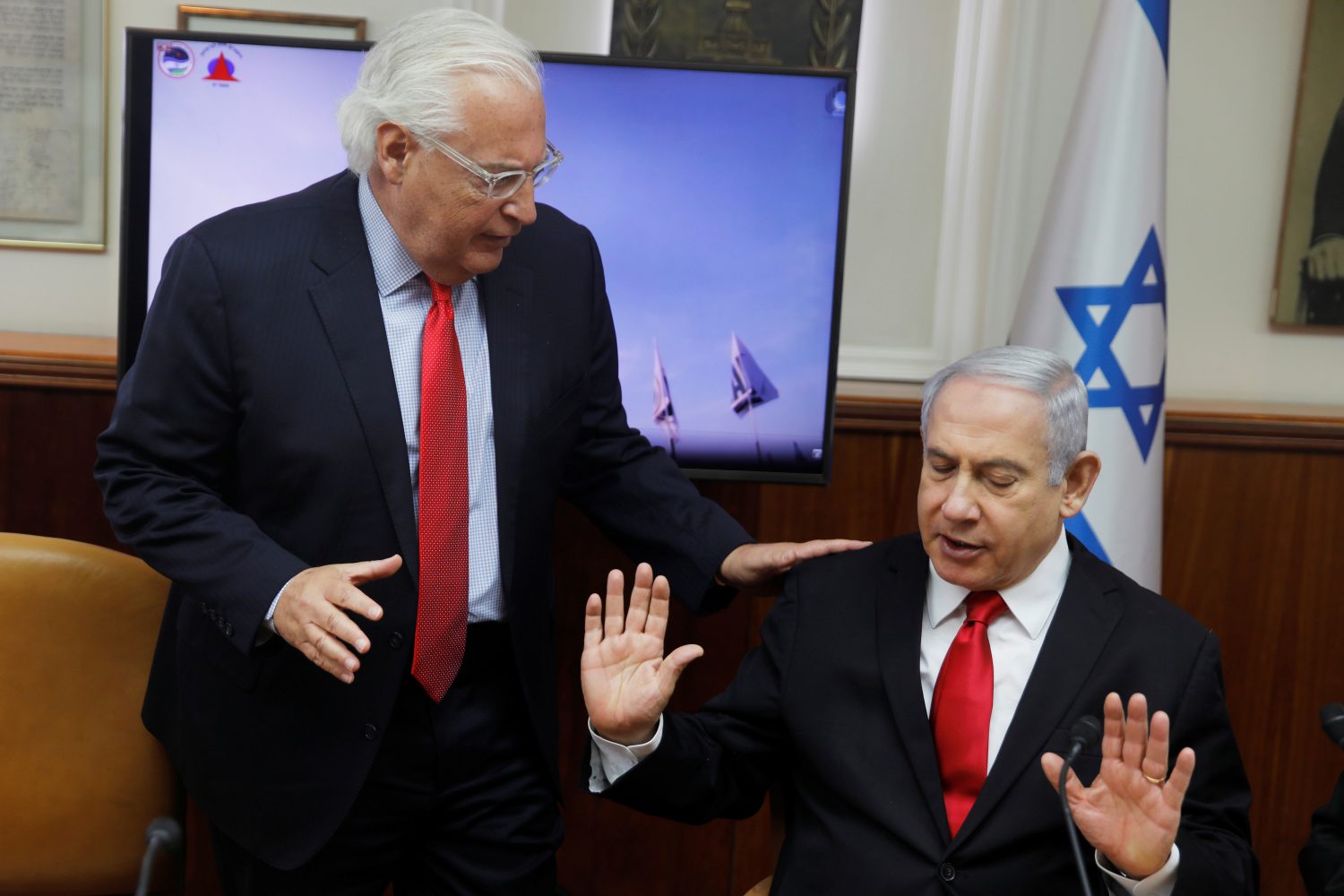
Israeli Prime Minister Benjamin Netanyahu and U.S. Ambassador to Israel David Friedman talk after watching a video of Israel's U.S.-backed Arrow-3 ballistic missile shield performing a series of live interception tests over Alaska, U.S., during a cabinet meeting in Jerusalem July 28 2019. Menahem Kahana/Pool via REUTERS

By Dan Williams

JERUSALEM (Reuters) – Israel’s U.S.-backed Arrow-3 ballistic missile shield has passed a series of live interception tests over Alaska, Prime Minister Benjamin Netanyahu said on Sunday, casting the achievement as a warning to Iran.

Jointly manufactured by U.S. firm Boeing Co, Arrow-3 is billed as capable of shooting down incoming missiles in space, an altitude that would destroy any non-conventional warheads safely. It passed its first full interception test over the Mediterranean Sea in 2015 and was deployed in Israel in 2017.

Israeli Prime Minister Benjamin Netanyahu and U.S. Ambassador to Israel David Friedman talk after watching a video of Israel's U.S.-backed Arrow-3 ballistic missile shield performing a series of live interception tests over Alaska, U.S., during a cabinet meeting in Jerusalem July 28 2019. Menahem Kahana/Pool via REUTERS

Israeli Prime Minister Benjamin Netanyahu and U.S. Ambassador to Israel David Friedman talk after watching a video of Israel’s U.S.-backed Arrow-3 ballistic missile shield performing a series of live interception tests over Alaska, U.S., during a cabinet meeting in Jerusalem July 28 2019. Menahem Kahana/Pool via REUTERS

“The performance was perfect – every hit a bull’s eye,” Netanyahu, who doubles as defense minister, said in a statement announcing the three secret tests.

Israel views the Arrow-3 as a bulwark against the ballistic missiles fielded by Iran and Syria.

Iran has been locked in a spiraling confrontation with the United States over its nuclear program and missile projects.

Washington said last week that Iran appeared to have tested a medium-range ballistic missile that flew about 1,000 km (620 miles). Tehran said such tests were for defensive needs.

“Today Israel has the capabilities to act against ballistic missiles launched at us from Iran and from anywhere else,” Netanyahu said on Sunday. “All our foes should know that we can best them, both defensively and offensively.”

Arrow-3’s Alaska trials had been expected last year but were postponed, following earlier difficulties in testing the system.

Its first full trial, scheduled in 2014, was aborted due to what designers said was a faulty flight by the target missile. Follow-up Israeli tests in late 2017 and early 2018 were also called off at short notice due to technical problems.

The system’s success in Alaska was held up by both Israel and the United States as a sign of the strength of their alliance.

The U.S. ambassador to Israel, David Friedman, attended Sunday’s meeting of Netanyahu’s cabinet, where he and the ministers watched a video of an Alaska missile interception.

Israel’s Ministry of Defense said that, as part of the Alaska tests, Arrow-3 was successfully synched up with the AN-TPY2 radar – also known as X-band – which provides the United States with extensive global coverage. Israel hosts an X-band battery.

“We are committed to assisting the government of Israel in upgrading its national missile defence capability to defend the state of Israel and deployed U.S. forces from emerging threats,” Vice Admiral John Hill, director of the Pentagon’s Missile Defence Agency, said in a statement.

Arrow-3 and an earlier generation system, Arrow-2, serve as the top tier of an integrated Israeli shield built up with U.S. backing to withstand various potential missile or rocket salvoes. The bottom tier is the short-range Iron Dome interceptor while David’s Sling shoots down mid-range missiles.

Also involved in Arrow’s manufacturing are Israel Aerospace Industries, Rafael Advanced Defense Systems and the Elisra Company, a subsidiary of Elbit Systems Ltd.

(Writing by Dan Williams; Editing by Susan Fenton)

Mass shooting at California food festival, gunman killed, police hunt for associate

People look on from near the scene of a mass shooting during the Gilroy Garlic Festival in Gilroy, California, U.S. July 28, 2019. REUTERS/Chris Smead.

By Chris Smead

GILROY, Calif. (Reuters) – California police were searching on Monday for a suspected accomplice of the gunman who killed three people, including a 6-year-old boy, in a mass shooting at a food festival south of San Francisco.

The gunman was shot dead by police officers within minutes of opening fire early on Sunday evening at the three-day Gilroy Garlic Festival, about 30 miles (48 km) southeast of the city of San Jose.

He was identified as Santino William Legan, 19, according to CBS News and NBC News, both citing unnamed law enforcement officials. The Gilroy police department declined to confirm the reports but planned to hold a news briefing later on Monday morning.

Among those killed was a 6-year-old boy, according to news reports. Fifteen people were injured, but it was unclear how many were shot or otherwise hurt in the crush of bystanders trying to flee, according to police. One person was in critical condition, a hospital spokeswoman said.

President Donald Trump described the gunman as a “wicked murderer” and asked people to pray for the victims during an event at the White House.

“We grieve for their families, and we ask that God will comfort them with his overflowing mercy and grace,” he said.

A second suspect “was involved in some way, we just don’t know in what way,” Gilroy Police Chief Scot Smithee said late on Sunday, without giving further details.

“We have no idea of a motive,” he said.

Police recovered a rifle at the scene, Smithee said.

The gunman cut through a fence to evade metal detectors and other security at the festival entrance, police said.

Legan, the teenager identified in news reports as the gunman, appeared to post a photograph from the festival on his Instagram account shortly before the shooting accompanied by disgruntled captions. The account only appeared to be a few days old, and was deactivated at some point on Monday morning.

“Ayyy garlic festival time,” he wrote in the caption to the picture of people walking through the festival grounds. “Come get wasted on overpriced shit.”

Another photograph posted on Sunday showed a sign warning of a high danger of forest fires. Its caption urged people to read “Might is Right,” a racist and sexist treatise written by the pseudonymous author Ragnar Redbeard in the late 19th century. “Why overcrowd towns and pave more open space to make room for hordes of mestizos and Silicon Valley white twats?” the caption continued.

Footage uploaded to social media showed festival attendees scattering in fear and confusion as loud popping sounds could be heard in the background.

“What’s going on?” a woman can be heard asking on one video. “Who’d shoot up a garlic festival?”

‘THROWING TABLES’ TO GET OUT

One of the victims was identified by his grandmother as Stephen Romero in an interview with ABC7 News. Maribel Romero described her 6-year-old grandson as “a really loving boy.”

Her daughter-in-law and the boy’s other grandmother were also being treated in a hospital for gunshot wounds, she said. “I want justice for my grandson,” she said.

Evenny Reyes, 13, told the San Jose Mercury News that at first, she thought the gunfire was fireworks but then saw someone with a wounded leg.

“We were just leaving and we saw a guy with a bandana wrapped around his leg because he got shot,” Reyes told the newspaper. “There was a little kid hurt on the ground. People were throwing tables and cutting fences to get out.”

Maximo Rocha, a volunteer with the Gilroy Browns youth football team, said he saw many people on the ground, but could not be sure how many were shot.

He told NBC Bay Area that “quite a few” were injured, “because I helped a few.”

One video posted on Twitter showed a blood-spattered woman sitting in the back of a semi-trailer and telling a man she had been shot in the hand.

Founded in 1979, the Gilroy Garlic Festival is an annual event run by volunteers and held outdoors at Christmas Hill Park.

Weapons of any kind are prohibited, according to the event’s website, which also said anyone wearing clothing or paraphernalia indicating membership in a gang, including a motorcycle club, would be refused entry.

“I want to express my extreme shock and sadness about what’s happened today,” Gilroy Mayor Roland Velasco said at a late-night news conference. “I would ask for the thoughts and prayers of the community as our Gilroy police officers continue to investigate this tragic and senseless crime.”

(Additional reporting by Sharon Bernstein in Sacramento, California, Rich McKay in Atlanta, and Jonathan Allen in New York; Editing by Raissa Kasolowsky, Nick Zieminski and Jonathan Oatis)