Fired Ohio policeman pleads not guilty in Black man’s killing, granted bail

By Rich McKay

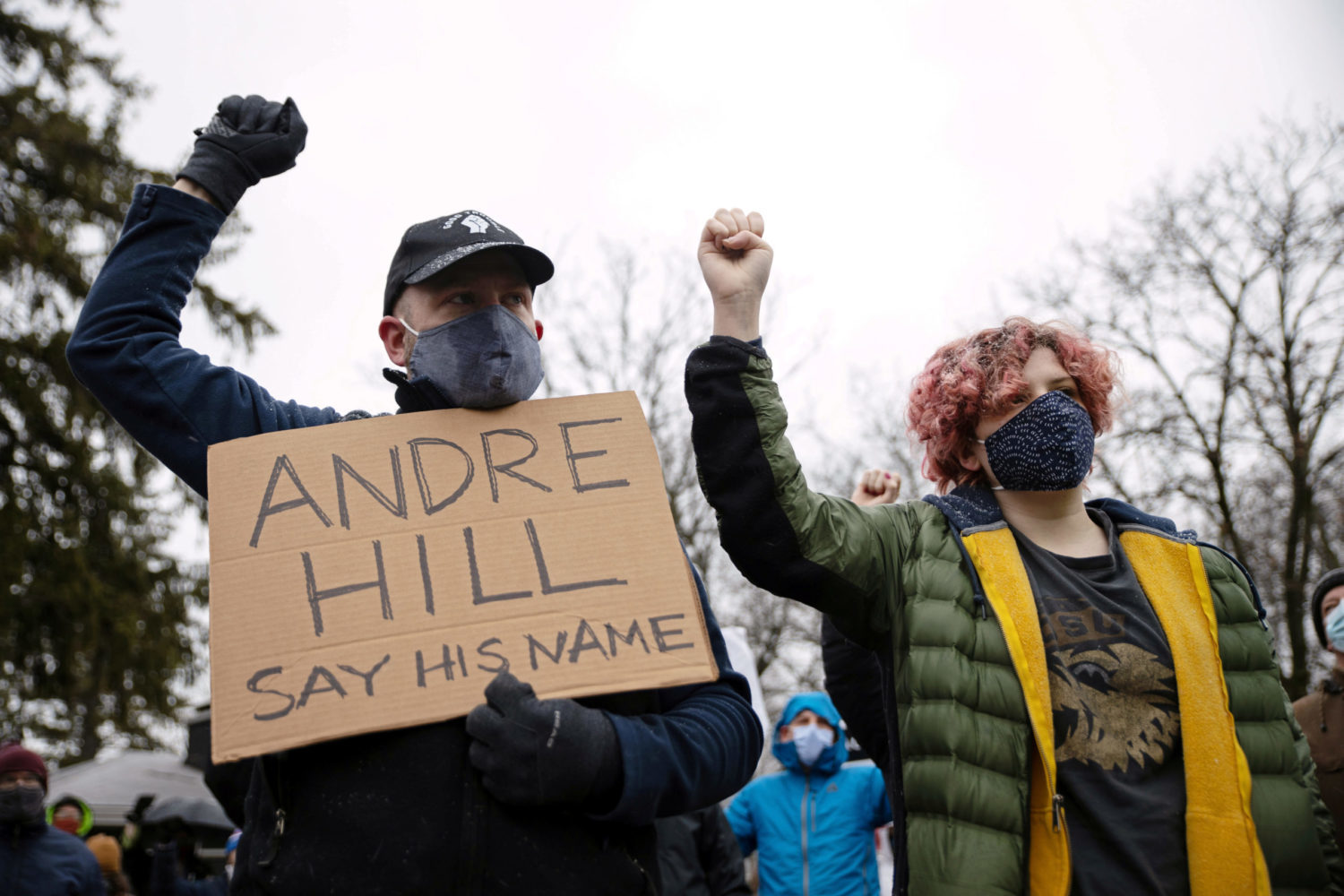
(Reuters) – A former Ohio police officer pleaded not guilty on Friday to murder and other charges in the shooting death of an unarmed Black man, the latest in a series of killings that have raised questions of racial injustice in U.S. law enforcement.

At the hearing in Franklin County court, Judge Elizabeta Saken agreed to release the former officer, Adam Coy, a 19-year-veteran of the Columbus police force, on $3 million bail.

Coy, a 44-year-old white man, was indicted by a grand jury on Wednesday in the Dec. 22 killing of Andre Maurice Hill, 47. Coy was responding to a nuisance call about car noise.

The former officer, shackled and dressed in an orange prison jumpsuit, appeared at the hearing through a video monitor from a jail where he has been held since his arrest on Wednesday.

Coy’s attorney, Mark Collins, told the court Friday that his client is not a danger to the public and is not a flight risk, emphasizing his connections to the community and family ties.

“This case is unique,” Collins said. “It is not a who-done-it, but whether or not his use of force was justified. He is not a threat, your honor.”

Coy was indicted on one charge of murder, one charge of felonious assault and two counts of dereliction of duty.

The case is the latest in a series of police killings of Black people that have highlighted longstanding accusations of racial injustice in U.S. law enforcement. Last summer, a handful of high-profile deaths in Minneapolis, Atlanta and Louisville and elsewhere triggered nationwide protests that pushed police reform to the top of the U.S. political agenda.

(Reporting by Rich McKay; Editing by Chizu Nomiyama)

White House says it is working to speed early production of J&J COVID-19 vaccine

By Dania Nadeem, Rebecca Spalding and Julie Steenhuysen

(Reuters) – The Biden administration is exploring every option for increasing manufacturing of Johnson & Johnson’s COVID-19 vaccine, which is under regulatory review, and said on Friday that currently expected levels of early doses were less than hoped.

The White House has invoked the Defense Production Act to help Pfizer Inc ramp up COVID-19 vaccine production and that “every option” was on the table to produce more Johnson & Johnson vaccine should it be authorized.

It will also use the wartime powers to increase at-home COVID-19 tests, and make more surgical gloves in the United States, officials said at a Friday media briefing.

“As is the case with other vaccines, we have not found that the level of manufacturing allows us to have as much vaccine as we think we need coming out of the gate,” said Andy Slavitt, senior adviser to the White House’s COVID-19 response team, referring to the J&J vaccine.

J&J applied on Thursday for U.S. emergency use authorization. It expects to have some vaccine ready for distribution as soon as authorized but has not said how much.

Emergent Biosolutions’ Chief Executive Robert Kramer said in an interview on Friday that the company currently is making bulk drug substance for J&J “at large scale.” Emergent is only producing bulk vaccine, which is then filled into syringes or vials and packaged for shipment by another contractor.

Kramer said they were on track to make enough product for hundreds of millions of doses a year. It remains unclear what other supply bottlenecks may be. Kramer said his company had already benefited from the Defense Production Act under the Trump Administration, which helped the company get to the point where it’s ready to go.

Under the authority of the Defense Production Act, the government will give priority ratings to two components important to Pfizer’s vaccine production – filling pumps and tangential flow filtration units, the officials said.

“We told you that when we heard of a bottleneck on needed equipment, supplies, or technology related to vaccine supply that we would step in and help, and we were doing just that,” said Tim Manning, the supply chain coordinator for the national COVID-19 response.

The government will also invoke its powers under the Defense Production Act to increase at-home COVID-19 tests with six, unnamed manufacturers, aiming to produce 61 million tests by the summer, Manning said.

It will also invoke its powers to increase the nation’s supply of surgical gloves, which are made almost exclusively overseas.

Manning said the government will build factories that make the raw materials for surgical gloves and help build plants in the United States to make the gloves.

By the end of the year, he said, the United States would be able to produce a billion gloves a month.

Officials have said that once J&J’s vaccine is authorized, it would mean that millions more doses would be available to states. The vaccine is one-shot, as opposed to Pfizer’s and Moderna Inc’s two-dose vaccines, and can be stored in a refrigerator.

Officials have hoped that the ease of giving the J&J vaccine will mean that states will be able to more quickly immunize residents.

(Reporting by Dania Nadeem, Rebecca Spalding and Julie Steenhuysen, Editing by Peter Henderson, Steve Orlofsky and David Gregorio)

Trump impeachment defense to attack the process, lawyer says

By Karen Freifeld

(Reuters) – Donald Trump’s lawyers will make “procedural objections” a focus during his U.S. Senate impeachment case next week, including challenging the notion the former president can face trial after leaving office, one of his attorneys said.

Attorney Bruce Castor Jr. decried the U.S. Senate proceeding due to begin on Tuesday as “unconstitutional,” telling Reuters by phone late on Thursday: “We’re trying to win a case on a bunch of procedural objections.”

“This is ‘Law School 101’ stuff. This isn’t advanced legal treatises in bound volumes that are used in the Supreme Court as references,” Castor said.

It may well be enough to win the case in the 100-member Senate where Trump’s fellow Republicans appear likely to deny rival Democrats the total 67 votes they need to convict Trump. The Republicans assert they do not have the authority to hold a trial for Trump since he left office on Jan. 20.

On Jan. 6, Trump exhorted a crowd of supporters to go to the Capitol, told them to “fight like hell,” and repeated his claims the November election was stolen from him. The ensuing rampage interrupted the congressional certification of President Joe Biden’s election victory and sent lawmakers into hiding.

A majority of constitutional law experts assert that it is lawful to hold an impeachment trial after a president leaves office. They assert that presidents who commit misconduct late in their terms should not be immune from the very process the U.S. Constitution created to hold them accountable.

Because the Constitution makes clear that impeachment proceedings can result in disqualification from holding future office, there is a live issue for the Senate to resolve, they say.

Castor and his co-counsel David Schoen were hired on Sunday after Trump parted ways with his prior defense team due to disagreements over strategy.

Trump is only the third U.S. president to be impeached and the first to be impeached twice and to face trial after leaving office.

Trump on Thursday rejected a request to testify at his impeachment proceeding. The House members trying the case have yet to say whether they will call witnesses or how long the trial might run.

(Reporting by Karen Freifeld in New York; Editing by Scott Malone and Howard Goller)

Pentagon to deploy 1,100 troops to help COVID-19 vaccination efforts

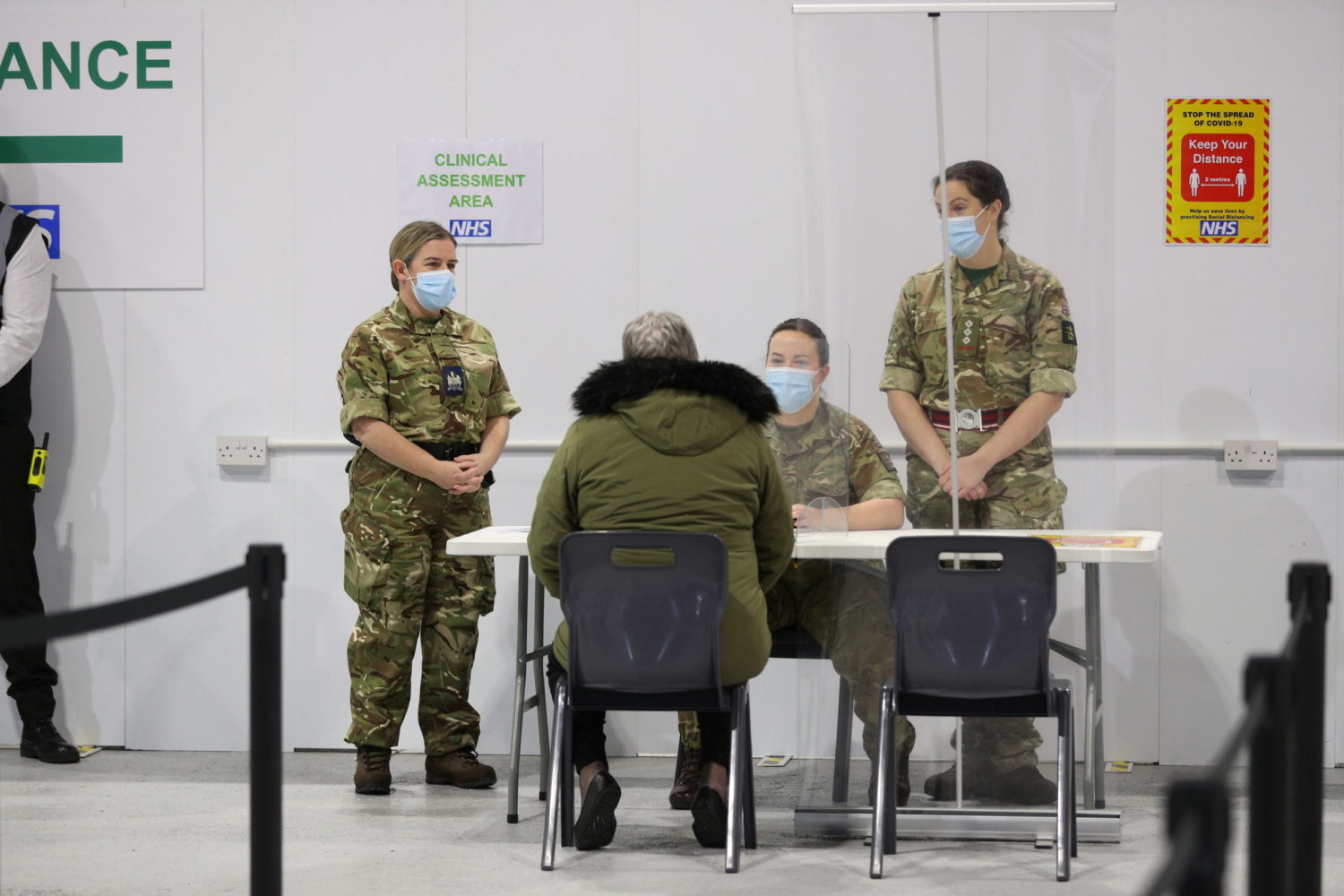
WASHINGTON (Reuters) – President Joe Biden’s administration on Friday announced that the Pentagon had approved the deployment of 1,100 active-duty troops to assist with COVID-19 vaccination efforts in the United States, a number likely to rise in the coming weeks and months.

The pandemic has killed more than 447,000 Americans and thrown millions out of work.

Andy Slavitt, senior adviser to the White House’s COVID-19 response team, said in a briefing that part of the group would start to arrive in California within the next 10 days.

The Pentagon said the 1,110 troops would be broken down into five teams, each with vaccinators, nurses and clinical staff.

The deployment is likely just the first tranche of U.S. military personnel assisting in administering vaccinations around the country.

White House Chief of Staff Ron Klain last week said the Federal Emergency Management Agency was working with the Pentagon to use 10,000 troops and open 100 centers across the country to increase the availability of vaccines.

Using the military to fight the coronavirus is not new. At its peak under former President Donald Trump, more than 47,000 National Guard troops were supporting COVID-19 operations and about 20,000 continue to help.

The Army Corps of Engineers has also built thousands of rooms across the country to assist hospitals with the strain caused by the spread of the coronavirus.

(Reporting by Idrees Ali; Editing by Dan Grebler)

Biden’s immense economic challenge: Putting 10 million people back to work

By Jonnelle Marte

(Reuters) – President Joe Biden is presenting his plan on Friday for addressing one of the greatest challenges created by the COVID-19 pandemic – how to get millions of out-of-work Americans back on the job.

The labor market regained some minor ground in January when the economy added 49,000 jobs, according to a report released Friday by the Labor Department. But the report showed labor market growth is stalling, doing little to close the huge gap created by the pandemic

“At that rate it’s going to take 10 years before we get to full employment,” Biden said Friday morning from the White House.

Roughly half of the 22 million jobs lost at the height of the pandemic have been recouped. But that still leaves a hole of about 10 million jobs, disproportionately ones held by women and minorities in low-wage roles.

Here is a look at the people who may need the most help as the economy heals:

MINORITIES HIT HARDEST

As the economy reopened last year from widespread shutdowns, many office workers adjusted to working remotely and other industries called people back to their jobs.

But many Black, Hispanic and Asian workers who were overrepresented in the low-wage occupations most affected by the pandemic, including servers, bartenders, cooks and housekeepers, are still unemployed.

The overall unemployment rate dropped to 6.3% in January. But within that rate are huge racial disparities – over 9% of Black workers are unemployed, versus less than 6% of white workers:

WOMEN PUSHED OUT

Before the pandemic, the share of women either working or looking for work was rising, thanks to a record-long economic expansion.

The crisis reversed those gains, in part because the closures of schools and child care centers left working mothers with a weaker support system.

Some 2.5 million woman dropped out of the labor force during the pandemic, compared to 1.8 million men, according to data from the Labor Department.

Biden says he wants to help more women get back to work through policies that reopen schools safely and make childcare more affordable.

SECTOR BY SECTOR

Businesses that rely on travel or on people spending time close to each other indoors have rebounded the slowest, and many people who made their living by staffing kitchens, mixing drinks or cleaning hotel rooms are still out of work.

Employment in leisure and hospitality was down 23% in January from pre-pandemic levels in February 2020, more than any other industry.

Economists expect many of those jobs to return after coronavirus vaccines are distributed widely and consumers feel more comfortable spending money in restaurants, bars and other entertainment venues. But it’s not clear whether employment will return completely to previous levels.

LONG-TERM UNEMPLOYED

Job searches have stretched on for some people, including many in the leisure and hospitality industry.

The “long-term unemployed,” or those who have been out of work for at least six months, now make up about 40% of the total unemployed, or about 4 million people, up from about 20% before the pandemic.

Research shows people who are long-term unemployed can have a harder time finding new jobs, putting them at greater risk of facing pay cuts or of dropping out of the labor market.

Biden wants to create federally subsidized jobs in healthcare, clean energy and other fields that could help the long-term unemployed move into new roles.

ACROSS THE MAP

Designing federal policies to help the out of work may be especially challenging because job losses vary widely from one state to the next.

Employment in Idaho, Utah and Kansas had fully recovered to pre-pandemic levels by December. But the situation was more dire in New York and tourism-dependent Nevada and Hawaii.

This could lead to wide disagreements among lawmakers about how much more aid is needed to nurse the economy, and the labor market, back to health.

(Reporting by Jonnelle Marte; Additional reporting by Howard Schneider. Editing by Heather Timmons and Andrea Ricci)

Mars ready for its close-up: China releases space probe’s first image

BEIJING (Reuters) – China’s maiden space exploration mission to Mars has captured its first image of the red planet, the space agency said on Friday, some six months after the probe left Earth.

The uncrewed Tianwen-1 took the picture at a distance of around 2.2 million km (1.4 million miles) from Mars, according to the China National Space Administration (CNSA), which supplied a black-and-white image.

The probe is now only half that distance away from Mars and around 184 million km from Earth after 197 days of the mission, the CNSA said in a statement, adding that its systems were in good condition.

The Tianwen-1 was launched in July from China’s southern Hainan island and expected to reach the orbit of Mars this month. In May, it will try to land in Utopia Planitia, a plain in the northern hemisphere, and deploy a rover to explore for 90 days.

If successful, the Tianwen-1 will make China the first country to orbit, land and deploy a rover in its inaugural mission to Mars, further boosting China’s space credentials after it last year became the first nation to bring back samples from the moon since the 1970s.

China previously made a Mars bid in 2011 with Russia, but the Russian spacecraft carrying the probe failed to exit Earth’s orbit and disintegrated over the Pacific Ocean.

(Reporting by Ryan Woo; writing by Tom Daly; editing by Nick Macfie)

Hong Kong to teach children as young as six about subversion, foreign interference

By Pak Yiu and Sarah Wu

HONG KONG (Reuters) – Hong Kong has unveiled controversial guidelines for schools in the Chinese-ruled city that include teaching students as young as six about colluding with foreign forces and subversion as part of a new national security curriculum.

Beijing imposed a security law on Hong Kong in June 2020 in response to months of often violent anti-government and anti-China protests in 2019 that put the global financial hub more firmly on an authoritarian path.

The Education Bureau’s guidelines, released late on Thursday, show that Beijing’s plans for the semi-autonomous Hong Kong go beyond quashing dissent, and aim for a societal overhaul to bring its most restive city more in line with the Communist Party-ruled mainland.

“National security is of great importance. Teachers should not treat it as if it is a controversial issue for discussion as usual,” the guidelines said.

Teachers should “clearly point out that safeguarding national security is the responsibility of all nationals and that as far as national security is concerned, there is no room for debate or compromise”.

After the 2019 protests in which many of the demonstrators were teenagers, Chinese leaders turned to re-education in a bid to tame the city’s youth and make them loyal citizens.

Head of the Professional Teachers’ Union, Ip Kin-yuen, said the guidelines would cause “uncertainty, ambiguity and anxiety” for teachers and enforce a “restrictive and suppressive” education style that does not foster student development and independent thinking.

Raymond Yeung, a former teacher partially blinded by a projectile during 2019 protests, described the guidelines as “one dimensional, if not brainwashing”.

Wong, mother of primary school children, said the law was “clamping down on people’s individual thoughts” and adding national security to the curricula created a climate of fear.

“I am angry. They shouldn’t be bringing this into classrooms,” said Wong, who declined to give her first name due to the sensitivity of the issue.

However, not all parents were opposed to the changes.

“It’s a good start, no matter who you are and where are you from, you have to love your country,” said Feng, mother of a six-year-old.

‘WISE OWL’

Children in primary schools will learn how to sing and respect China’s national anthem, and gain an understanding of the four main offences in the new security law, including terrorism and secessionism.

In secondary schools, pupils will learn what constitutes such offences, which can carry sentences of up to life in prison.

Some legal scholars have said the law’s language is broad and vague, and the range of activities authorities might see as potential threats to national security was unclear and fluid.

An educational cartoon video released by the government shows an owl wearing glasses and a graduation hat explaining Hong Kong’s institutional architecture, its duties to the central government in Beijing and the national security law.

At one point the video says “national security affairs are of utmost importance to the whole country,” while showing smiling faces of a student, a chef and an engineer.

Schools are encouraged to “organize various game activities, such as puppet theatre, board games … to establish a good atmosphere and improve students’ understanding of national security”, according to the guidelines.

The guidelines said kindergartens can help students learn about traditional festivals, music and arts and develop fondness for Chinese customs to “lay the foundation for national security education.” Kindergarten children were not expected to learn about national security crimes.

The Education Bureau said it accepted international and private schools had different curricula, but said they had a “responsibility to help their students (regardless of their ethnicity and nationality) acquire a correct and objective understanding … of national security”.

Schools should also stop students and teachers from participating in activities deemed as political, such as singing certain songs, wearing various items, forming human chains or shouting slogans.

Teachers and principals are required to inspect notice-boards, remove books that endanger national security from libraries and call police if they suspected any breaches.

The bureau said national security education will become part of subjects such as geography and biology to enhance students’ sense of national identity.

(Reporting by Hong Kong newsroom and Sarah Wu in Toronto; Writing by Marius Zaharia; Editing by Richard Pullin, Raju Gopalakrishnan and Michael Perry)

Virginia lawmakers vote to abolish death penalty

By Brendan O’Brien and Jonathan Allen

(Reuters) – Lawmakers in Virginia voted on Friday to make it the first Southern U.S. state to abolish the death penalty, a significant sign of waning support for capital punishment across the country as the practice is weighed at the federal level.

The state’s Democratic-led House of Delegates voted 57-41 on a measure to end the practice. The Senate passed the measure earlier this week, and Governor Ralph Northam, a Democrat, said he will sign the repeal into law.

Virginia has conducted 1,390 executions since 1608, the most in the United States and 68 more than Texas, the state with the second most executions. Virginia last carried out an execution in 2017.

Two men remain on Virginia’s death row, including Thomas Porter, who was convicted of killing a police officer in 2005.

Public support for capital punishment has declined in the United States. According to Gallup, support has dropped from 80% in the 1990 to 55% in 2020.

It is also being weighed at the national level.

Former President Donald Trump, a Republican, resumed the execution of prisoners on federal death row last summer after a 17-year hiatus, killing 13 people convicted of murder. That followed six decades which saw a total of three federal executions. Last year was the first time the U.S. government executed more people than all 50 state governments combined.

Democrat Joe Biden took office last month as the first U.S. president to commit to seeking to abolish the federal death penalty. Lawmakers in Congress are asking him to support bills that would repeal the death penalty.

Most countries have abolished capital punishment, and the United Nations has long called for a moratorium on executions and urged its abolition worldwide.

(Reporting by Brendan O’Brien in Chicago and Jonathan Allen in New York; Editing by Leslie Adler and David Gregorio)

China’s latest weapon against Taiwan: the sand dredger

By Yimou Lee

ON BOARD THE TAIWAN COAST GUARD SHIP PP-10062, East China Sea (Reuters) – Taiwanese coast guard commander Lin Chie-ming is on the frontline of a new type of warfare that China is waging against Taiwan. China’s weapon? Sand.

On a chilly morning in late January, Lin, clad in an orange uniform, stood on the rolling deck of his boat as it patrolled in choppy waters off the Taiwan-run Matsu Islands. A few kilometers away, the Chinese coast was faintly visible from Lin’s boat. He was on the lookout for Chinese sand-dredging ships encroaching on waters controlled by Taiwan.

The Chinese goal, Taiwanese officials say: pressure Taiwan by tying down the island democracy’s naval defenses and undermining the livelihoods of Matsu residents.

Half an hour into the patrol, Lin’s nine-man crew spotted two 3,000-ton dredgers, dwarfing their 100-ton vessel. Parked just outside Taiwan’s waters, neither of the dredgers clearly displayed their names, making it difficult for a crew member to identify them as he peered through binoculars.

Upon spotting Lin’s boat, armed with two water cannons and a machine gun, the dredgers quickly pulled up anchor and headed back toward the Chinese coast.

“They think this area is part of China’s territory,” said Lin, referring to Chinese dredgers that have been intruding into Matsu’s waters. “They usually leave after we drive them away, but they come back again after we go away.”

The sand-dredging is one weapon China is using against Taiwan in a campaign of so-called gray-zone warfare, which entails using irregular tactics to exhaust a foe without actually resorting to open combat. Since June last year, Chinese dredgers have been swarming around the Matsu Islands, dropping anchor and scooping up vast amounts of sand from the ocean bed for construction projects in China.

The ploy is taxing for Taiwan’s civilian-run Coast Guard Administration, which is now conducting round-the-clock patrols in an effort to repel the Chinese vessels. Taiwanese officials and Matsu residents say the dredging forays have had other corrosive impacts – disrupting the local economy, damaging undersea communication cables and intimidating residents and tourists to the islands. Local officials also fear that the dredging is destroying marine life nearby.

Besides Matsu, where 13,300 people live, the coast guard says China has also been dredging in the shallow waters near the median line of the Taiwan Strait, which has long served as an unofficial buffer separating China and Taiwan.

Last year, Taiwan expelled nearly 4,000 Chinese sand-dredgers and sand-transporting vessels from waters under its control, most of them in the area close to the median line, according to Taiwan’s coast guard. That’s a 560% jump over the 600 Chinese vessels that were repelled in all of 2019.

In Matsu, there were also many Chinese vessels that sailed close to Taiwanese waters without actually entering, forcing the coast guard to be on constant alert.

The dredging is a “gray-zone strategy with Chinese characteristics,” said Su Tzu-yun, an associate research fellow at Taiwan’s top military think tank, the Institute for National Defense and Security Research. “You dredge for sand on the one hand, but if you can also put pressure on Taiwan, then that’s great, too.”

‘PSYCHOLOGICAL WARFARE’

Sand is just part of the gray-zone campaign. China, which claims democratically-governed Taiwan as its own territory, has been using other irregular tactics to wear down the island of 23 million. The most dramatic: In recent months, the People’s Liberation Army, China’s military, has been dispatching warplanes in menacing forays toward the island. Taiwan has been scrambling military aircraft on an almost daily basis to head off the threat, placing an onerous burden on its air force.

Taiwanese military officials and Western analysts say China’s gray-zone tactics are meant to drain the resources and erode the will of the island’s armed forces – and make such harassment so routine that the world grows inured to it. China’s sand dredging, said one Taiwanese security official investigating the matter, is “part of their psychological warfare against Taiwan, similar to what they are doing in Taiwan’s southwestern airspace,” where the Chinese jets are intruding.

China’s Taiwan Affairs Office said in a statement to Reuters that Taiwan’s claims that Beijing is allowing sand-dredging boats to engage in “illegal operations” near Matsu and the median line are baseless. The office did say it has taken steps to stop illegal sand-dredging, without elaborating.

The office also said Taiwan is “an inseparable part of China.” Taiwanese authorities, it alleged, are using their claims of control over the waters near the islands to “detain mainland boats and even resorting to dangerous and violent means in their treatment of mainland crews.”

Asked about China’s gray-zone actions, Taiwan’s Mainland Affairs Council, which oversees policy toward China, said the Chinese Communist Party was engaging in “harassment” with the aim of putting pressure on Taiwan. The council said the government had recently increased penalties for illegal dredging in its waters.

Taiwan’s Ministry of National Defense did not respond to questions.

Chinese President Xi Jinping has not ruled out the use of force to subdue Taiwan. If he succeeds – by gray-zone tactics or outright war – it would dramatically undermine America’s decades of strategic dominance in the Asia-Pacific region and propel China toward preeminence in the area.

The Matsu Islands are almost an hour by plane from Taipei. They are one of a handful of island groups close to China’s coast that Taiwan has governed since 1949, when the defeated Republic of China government, under Chiang Kai-shek, fled to Taiwan after losing the Chinese civil war. The Matsu, Kinmen and Pratas island groups lie several hundred kilometers from mainland Taiwan. Their isolation, and their much-reduced Taiwanese military presence since the end of the Cold War, would make them highly vulnerable to a Chinese attack.

Matsu is just nine kilometers from the Chinese coastline at the closest point. The island has a total of just nine coast guard ships, ranging from 10 to 100 tons. On some days, government officials said, the coast guard has faced hundreds of Chinese vessels, ranging in size from 1,000 to 3,000 tons, in and around the island’s waters. Taiwan says those waters extend six kilometers out from the coastline here. China doesn’t officially recognize any claims of sovereignty by Taiwan.

At one point last year, more than 200 Chinese sand-dredging and transport boats were spotted operating south of Nangan, the main Matsu islet, three Taiwanese officials told Reuters. Lin, the coast guard commander, recalls a similar scene playing out on the morning of Oct. 25, when he and his colleagues encountered an armada of roughly 100 Chinese boats. That day, he said, his team expelled seven Chinese vessels that breached Matsu waters.

“People were frightened by the scene,” he said, referring to local residents. “They were speculating about the purpose of the mainland boats and whether they would pose a security threat to the Matsu region.”

NEW BOATS

In some stand-offs, Taiwan’s coast guard has sprayed high-power water cannons at the Chinese ships in an attempt to drive them away. Last year, Taiwan impounded four Chinese vessels and detained 37 crew members, according to the coast guard. Ten of those arrested were given sentences of six to seven months in prison. The others are still on trial, the coast guard said.

Taiwan is in the process of beefing up its coast guard, partly in response to the dredging threat. Last year, President Tsai Ing-wen commissioned into service the first of a new class of coast guard vessel, based on the design of an “aircraft-carrier killer,” a missile boat for the navy.

More than 100 new coast guard boats will be built in the next decade, Tsai said in December, vowing to enforce a crackdown with “no mercy” on Chinese dredging in Taiwan waters. In the meantime, larger patrol boats were sent to temporarily reinforce the coast guard in Matsu, whose 117 members are now conducting 24-hour patrols.

The number of sand dredgers off the coast of Matsu dropped significantly at the end of last year, as winter weather brought rougher seas that make dredging difficult. When the seasons change and the seas are calmer, local residents fear that dredgers will be back.

From the late 1950s through to the late 1970s, Chinese forces occasionally bombarded the Matsu Islands with artillery shells. Remnants of that era are still visible across the island group, from old air-raid tunnels to anti-Communist slogans displayed on the rugged cliffs of Nangan island.

Today, Matsu is a popular tourist destination. Its picturesque old-stone homes have been turned into fashionable guest houses.

But locals say China’s dredging tactics are hurting their livelihoods. Chen Kuo-chiang, who runs a seafood restaurant on Nangan, says the dredging has led to a drastic decline in the number of fish he catches off the island. Three years ago, he was hooking a dozen a day with his rod, said Chen, 39, as he stood fishing on some rocks in a Nangan port. Now, he said, he struggles to catch one or two.

The fears of a Chinese invasion are palpable on Nangan. Chen thinks the sand dredging might be a precursor to an attack by Chinese forces. “We don’t want to be ruled by mainland China,” he said. “We have freedom, which is limited over there.”

Tsai Chia-chen, who works at an ocean-front bed and breakfast, said concern was particularly high ahead of the U.S. presidential election in early November. At the time, said Tsai, rumors circulated that China might seize the window of opportunity with the United States distracted by the election to launch an attack on Taiwan. The large number of Chinese dredgers around the islands in late October added to the anxiety, she recalled.

“Our guests were obviously worried,” she said. “There was only one small Taiwan coast guard boat, surrounded by many huge dredgers.”

DAMAGED CABLES

On five occasions last year, the dredgers damaged undersea communication cables between Nangan and Juguang, another isle in the Matsu group, the three Taiwanese officials told Reuters. Mobile phone and internet services for the islanders were disrupted, they said. There were no such incidents in 2019.

State-backed Chunghwa Telecom said it spent T$60 million (about $2 million) to fix the cables last year. It also hired a local fishing boat to conduct daily patrols to ensure the safety of the cables.

The coast guard said most of the fully loaded Chinese vessels around Matsu have been seen heading with their sand in a northerly direction, towards the city of Wenzhou, where the local Chinese government has been touting a massive land reclamation project.

Known as the Ou Fei project, the area has been reclaimed for a new economic zone. It encompasses about 66 square kilometers – more than double the area of all the Matsu Islands. On its website, the Wenzhou local government describes the project as a “major strategic development for the future” of the city.

The Wenzhou city government didn’t respond to a request for comment.

Following contact on the local level between the two sides, China detained several dredging boats last month, according to Taiwan’s coast guard. But a Taiwan-initiated meeting with authorities in the port city of Fuzhou to discuss the dredging was “postponed indefinitely” and without explanation in late December, said Wang Chien-hua, who oversees economic development in the local government that administers Matsu.

Taiwan had been planning to use the online meeting to urge Chinese authorities to enforce mandatory registration for dredgers and punish those who go out to sea without reporting to the authorities, according to an internal government note reviewed by Reuters.

The Taiwan Affairs Office in Beijing said the local authorities on both sides maintained “necessary communication and collaboration” to ensure order on the seas.

Aboard his patrol vessel, Taiwanese commander Lin sounded defiant. The coast guard, he said, “will use force to drive away” Chinese ships that enter Taiwan’s waters.

“That way we can reassure the people in Matsu. At the moment, we are capable of doing this job.”

(Reporting by Yimou Lee. Additional reporting by Ben Blanchard in Taipei. Edited by Peter Hirschberg.)
Protests against Myanmar junta spread despite arrests

(Reuters) – Teachers and students in Myanmar rallied on Friday to a growing civil disobedience campaign as the anti-coup protest movement won the support of ousted leader Aung San Suu Kyi’s party.

Stepping up measures to quell discontent, police arrested one of Suu Kyi’s veteran aides and dozens of people who had joined noisy demonstrations against Monday’s coup.

International pressure on the junta increased with the U.N. Security Council urging the release of detainees and Washington considering sanctions on the ruling generals.

Teachers became the latest group to join a civil disobedience campaign with some lecturers refusing to work or cooperate with authorities over the coup that halted a long and unsteady transition to democracy.

“We want the military coup to fail,” said lecturer Nwe Thazin Hlaing at the Yangon University of Education.

Reuters was unable to reach the government for comment.

The disobedience campaign, which began with doctors, has also spread to some government offices and on Friday won the formal backing of Suu Kyi’s National League for Democracy party.

In a statement, the party denounced the coup and Suu Kyi’s detention as “unacceptable” and said it would help people who are arrested or sacked for opposing the takeover.

Army chief Min Aung Hlaing took power citing alleged irregularities in a November election that the party won in a landslide. The electoral commission has said the vote was fair.

There has been no outpouring of people onto the streets in a country with a bloody history of crackdowns on protests, but there were signs of coup opponents growing bolder – with dozens of youths parading in the southeastern city of Dawei.

COLOR RED

In the biggest city, Yangon, supporters hung red clothing, ribbons and balloons outside their homes to show support.

“We put red balloons down the whole street,” said Myint Myint Aye, 49. “This is a non-violent campaign. We want to show the dictators that all of us are with Mother Suu.”

But authorities also began to step up action against coup opponents.

In Myanmar’s second city of Mandalay, 30 people were arrested over pot-banging protests which have taken place for the last three nights.

Eleven Media quoted Maung Maung Aye, deputy head of the regional police force, as saying they were accused of breaking a law against “causing noise in public streets”.

The latest high-profile detainee was 79-year-old Win Htein, a stalwart of Suu Kyi who was repeatedly imprisoned during their decades of struggling against previous juntas.

“I have never been scared of them because I have done nothing wrong my entire life,” he told Reuters by phone as he was taken away.

Reuters was unable to reach police for comment on his arrest or what charges could be brought against him.

The 15-member U.N. Security Council released a statement on Thursday calling for the release of all detainees and for respect for human rights, fundamental freedoms and the rule of law.

But before it won consensus among members that include China and Russia, which have close ties to Myanmar’s army, the language of the draft was changed to remove any mention of a coup.

Nobel Peace laureate Suu Kyi, 75, has not been seen since her arrest in morning raids on Monday. Police have filed charges against her for illegally importing and using six walkie-talkie radios found at her home.

‘CREDIBLE ELECTION’

President Joe Biden said the United States was working with allies and partners to address the generals’ takeover.

“There can be no doubt in a democracy force should never seek to overrule the will of the people or attempt to erase the outcome of a credible election,” he said.

National security adviser Jake Sullivan said targeted sanctions on individuals and on entities controlled by the military were under consideration.

He spoke by phone with ambassadors from the Association of South East Asian Nations (ASEAN) regional bloc. Indonesia and Malaysia later said regional foreign ministers would be asked to hold a special meeting on the situation.

Myanmar’s generals have few overseas interests that could be targeted by sanctions, but the military has extensive business interests that could suffer if foreign partners leave.

Japanese drinks giant Kirin Holdings said on Friday it was terminating its alliance with a top Myanmar conglomerate whose owners, according to the United Nations, include members of the military. Kirin said the coup had “shaken the very foundation of the partnership”.

(Reporting by Reuters staff; Writing by Matthew Tostevin, Rosalba O’Brien and Stephen Coates; editing by Lincoln Feast, Robert Birsel, Nick Tattersall)