Mexico’s new National Guard was created to fight crime, but now it’s in a face-off with migrants

An agent of the National Migration Institute (INM) talks to Honduran migrants after being stopped from crossing the border into the United States by members of the Mexican National Guard, in Ciudad Juarez, Mexico June 28, 2019. REUTERS/Jose Luis Gonzalez

By Anthony Esposito

CIUDAD JUAREZ, Mexico (Reuters) – A convoy of Mexican state and municipal police trucks roared along the U.S.-Mexico border in Ciudad Juarez to confront cartel gunmen, past National Guardsmen patrolling the banks of the Rio Grande River for migrants trying to cross into the United States.

“We should be with them, not here. We’re soldiers,” one of three guardsmen in a green camouflage uniform grumbled to himself within earshot of a Reuters reporter. He was frustrated that orders kept him from going to back up police in the shootout with gangsters.

The National Guard is a new security force that was created by Mexican President Andres Manuel Lopez Obrador to bring down record homicide rates. But now it has been tasked with patrolling the border to placate President Donald Trump, who has demanded Mexico stem the flow of U.S.-bound Central Americans that pass through the country or risk tariffs on Mexican goods.

If the deployment of some 21,000 National Guard troops at Mexico’s northern and southern borders can reduce the flow of migrants, Lopez Obrador will have successfully kept Trump’s tariffs at bay and averted opening up another front in the global trade war.

But using almost a third of the National Guard’s total ranks for migration duties means fewer security forces to tackle one of Mexico’s most pressing issues, spiraling violence, which last year cost a record 33,000 lives. Those numbers continued surging in the first six months of Lopez Obrador’s term in office, which began in December.

In Juarez, where drug cartel murders are especially acute, many people wish the troops were helping fight crime instead.

The city across the border from El Paso, Texas has long been synonymous with cartel warfare, which pushed the murder rate to 244 per 100,000 residents by March 2011, according to data compiled by Juarez-based advocacy group Mesa de Seguridad y Justicia.

With help from civil society groups and businesses, the city made hard-won gains to restore security, and by late 2015 the murder rate had been cut to 21 per 100,000, the group says, citing numbers from the attorney general’s office it corroborates independently.

Now, crime is climbing back towards levels last seen in the darkest days of the drug war, with homicides growing fivefold in the last three years to 107 per 100,000.

“Murders, kidnappings, extortion have taken a back seat so the Mexican army can patrol the border,’ said Juan Hernan Ortiz, director of Citizens for Better Government, a watchdog organization in Juarez that keeps tabs on the local government.

The Mexican government did not respond to requests for comment on the criticism.

The National Guard in Juarez, mostly made up of active-duty soldiers equipped with ballistic helmets, body armor and assault rifles, is identifiable by small armbands emblazoned with the letters GN, for the Spanish words for National Guard.

“We have the army dressed up as the National Guard making sure migrants don’t reach the United States while the city is headed towards a much larger crisis of violence,” said Ortiz.


SHOOTOUT BY THE BRIDGE

The police convoy that raced by the National Guardsmen was heading to free a 53-year-old American man kidnapped by members of the Assassin Artists cartel. A car chase through the streets of Juarez led to a shootout near the Zaragoza border bridge, said the attorney general’s office of Chihuahua state. The American was freed, four kidnappers were arrested, another was killed and two policemen were wounded.

Visibly vexed at not being able to take part in the rescue, the three guardsmen remained at their post on the lookout for migrants as one cop car after another, sirens blaring, zipped past them toward the scene of the gunfight.

Along this stretch of frontier, the Rio Grande River is parched dry. Reuters reporters saw a steady trickle of women, children and men walking along the U.S. side of the riverbed, out of the guardsmen’s jurisdiction and into the United States, where waiting U.S. Customs and Border Protection agents took them into custody.

Facing accusations the troops had been heavy-handed in their efforts to deter migrants from crossing the northern border, Lopez Obrador said on June 25 the National Guard does not have orders to detain migrants.

The guardsmen themselves, who are posted in groups at specific points along the border or patrol the frontier in military vehicles mounted with heavy weapons, say they do not detain migrants but are there to advise them not to cross into the United States.

Still, Reuters witnessed at least three adults and four children being detained as they tried to cross into the United States after Obrador made his statement.

Among them was 23-year-old Honduran Lixa Garcia, who was traveling with her two daughters aged 4 years and 10 months, when she was detained mere feet from crossing into El Paso and handed over to Mexican immigration authorities, who will decide if they are deported to Honduras.

And last week, Brigadier-General Vicente Antonio Hernandez, who heads the National Guard’s operations in Mexico’s southern states, said 20,000 migrants had been “rescued” since May 17, a euphemism for detained.

KEEPING TARIFFS AT BAY

Some business and industry leaders in Juarez said that with nearly 80% of Mexican exports destined for the United States they support the deployment of National Guard troops to the northern border if that keeps Trump’s tariff threats on ice.

“What I care about is that the agreement is met so we’re not subject to tariffs. Regardless of whether the (National Guard) is effective or not, if it is part of the agreement, they have to be there,” said Pedro Chavira, head of manufacturing industry chamber INDEX in Juarez.

Mexico struck a deal on June 7 with the United States to avert the tariffs, setting the clock ticking on a 45-day period for the Mexican government to make palpable progress in reducing the numbers of people trying to cross the U.S. border illegally. Under that deal Mexico agreed to send National Guard troops to the border.

Trump seems happy, at least for now, praising Mexico for its efforts and saying tariffs are off the table.

But, in Juarez doubts remain that containing migration is the right priority for Mexico’s newest fighting force in a city sinking deeper into lawlessness.

“That’s a political play to appease the United States and it’s not a job the National Guard should be doing,” said Isabel Sanchez Quirarte, who heads the Mesa de Seguridad y Justicia advocacy group.

“They should be doing crime prevention work,” she said.

(Reporting by Anthony Esposito in Ciudad Juarez; Additional reporting by Rebekah F Ward and Lizbeth Diaz in Mexico City;editing by Ross Colvin)

Fed faces tougher task in deciding whether to cut U.S. rates

The Federal Reserve building is pictured in Washington, DC, U.S., August 22, 2018. REUTERS/Chris Wattie/

By Trevor Hunnicutt

NEW YORK (Reuters) – U.S. employers are hiring workers at a brisk pace, but that is only making the Federal Reserve’s job harder.

On Friday, the Labor Department said nonfarm employers added 224,000 jobs last month – the most in five months, and not the kind of labor market that would normally cause policymakers at the U.S. central bank to cut interest rates.

But the Fed opened up the possibility of cuts last month, citing muted inflation pressures and an economic outlook clouded by a U.S. trade war and slower global growth.

This complicates a debate Fed policymakers are having over whether the economy needs stimulus, setting up a possible standoff with markets at their July 30-31 meeting.

“They are in a bit of a bind,” said Karim Basta, chief economist at III Capital Management. “On the surface, the data, in my opinion, doesn’t really support an imminent cut, but markets are expecting it, and I do think there’s a risk at this stage that they disappoint.”

Markets are overwhelmingly betting the Fed’s next move will be its first rate cut since the financial crisis a decade ago, and President Donald Trump on Friday renewed demands for lower rates to strengthen the economy.

Fed Chairman Jerome Powell has repeatedly said the central bank makes decisions independently from both markets and the White House, but failing to deliver a cut could cause a stock and short-term bond selloff and reduce economic activity.

U.S. interest rates futures fell after the jobs report on Friday. Markets still see a rate cut this month as a near-certainty, though they largely priced out changes for an aggressive half-percentage-point cut.

“These are good numbers, but a rate cut in July is still all but inevitable,” said Luke Bartholomew, investment strategist for Aberdeen Standard Investments. “Employment growth remains a bright spot amid a fairly mixed bag of U.S. data and yet markets have come to expect a cut now so (they) will fall out of bed if they don’t get one.”

The U.S. has not resolved its trade dispute with China, but the two countries agreed last weekend to resume trade talks, putting off new tariffs.

There are still signs of a pullback in economic activity. Businesses’ spending on machines and other equipment is tepid, but employers keep hiring hotel maids, electricians, daycare providers and other workers. They are also paying them more. Average hourly earnings rose at a 3.1%-a-year pace. A May payroll gain of 72,000 now seems like a fluke rather than a sign of deterioration.

Those are not the prototypical conditions for a rate cut. Unemployment at 3.7% is near its lowest levels since 1969 and policymakers have traditionally seen job gains with low unemployment posing risks of inflation.

But economists have grown less confident in academic models that forecast an inverse relationship between unemployment and inflation. The core personal consumption expenditures index is running at 1.6% a year, short of the Fed’s 2% goal.

In its semi-annual report to Congress, the Fed on Friday repeated its pledge to “act as appropriate” to sustain the economic expansion, with possible interest rate cuts in the coming months, but notably said the jobs market had “continued to strengthen” so far this year, and described recent weak inflation as due to “transitory influences.”

Some policymakers think a rate cut could lift inflation expectations, reducing chances of more drastic rate cuts being needed later. With rates at 2.25%-2.50%, policymakers have less room to cut before they resort to unconventional measures.

A cut could also reduce the Fed’s firepower in the case of a more severe downturn and signal greater concern about the future and even that more stimulus is on the way.

(Reporting by Trevor Hunnicutt in New York; Additional reporting by April Joyner in New York and Howard Schneider in Washington; Editing by Jennifer Ablan and James Dalgleish)

Trump officials say U.S.-China trade talks to resume next week

Workers load goods for export onto a crane at a port in Lianyungang, Jiangsu province, China June 7, 2019. Picture taken June 7, 2019. REUTERS/Stringer

By Jeff Mason

WASHINGTON (Reuters) – Top representatives of the United States and China are organizing a resumption of talks for next week to try to resolve a year-long trade war between the world’s two largest economies, Trump administration officials said on Wednesday.

“Those talks will continue in earnest this coming week,” White House Economic Adviser Larry Kudlow told reporters in a briefing.

An official from the Office of the U.S. Trade Representative said later that the two sides were in the process of scheduling a principal-level phone call with Chinese officials for next week.

The principal negotiators on the U.S. side are U.S. Trade Representative Robert Lighthizer and Treasury Secretary Steven Mnuchin, while China’s top negotiator is Vice Premier Liu He.

The two sides have been in communication by telephone since last weekend, when U.S. President Donald Trump and Chinese President Xi Jinping agreed to relaunch talks that had stalled in May.

Kudlow was unclear about the timeline for relaunching face-to-face talks, saying that these would begin “soon” and that an announcement would be forthcoming.

“I don’t know precisely when. They’re on the phone. They’re going to be on the phone this coming week and they’ll be scheduling face-to-face meetings,” he said.

Talks between the two sides broke down in May after U.S. officials accused China of pulling back from commitments it had made previously in the text of an agreement that negotiators said was nearly finished.

The United States accuses China of allowing intellectual property theft and forcing U.S. companies to share their technology with Chinese counterparts in order to do business in China. It wants China to change its laws on those and other issues.

China denies such practices and is reluctant to make sweeping legal changes.

Both countries have levied tariffs on the other, but Trump made two major concessions at the meeting with Xi to get talks started again: he agreed not to put tariffs on some $300 billion in additional Chinese imports and to loosen restrictions on Chinese technology company Huawei.

China welcomed the U.S. decision not to put new tariffs on Chinese goods, commerce ministry spokesman Gao Feng told a regular media briefing on Thursday, but added the removal of existing U.S. tariffs was essential for a trade deal.

“The U.S. move to unilaterally increase tariffs on Chinese imports started the Sino-U.S. economic and trade frictions. If both sides could reach a deal, those tariffs must be completely removed,” said Gao.

The United States has 25% tariffs on $250 billion of Chinese goods now ranging from semi-conductors to furniture.

“We’ve been accommodative. We will not lift tariffs during the talks,” Kudlow said. “We are hoping that China will toe its end of it by purchasing a good many of American imports.”

Gao said China hoped the United States would follow through on Trump’s promise to ease restrictions on telecommunications giant Huawei.

Trump surprised markets on Saturday with an announcement that U.S. companies would be allowed to sell products to Huawei, which was placed on a so-called Entity List in May over national security concerns.

But industry and government officials are uncertain what the new policy will be.

The U.S. Commerce Department is reviewing license requests from U.S. companies seeking to export products to Huawei “under the highest national security scrutiny”.

(Reporting by Jeff Mason and David Lawder in Washington; Additional reporting by Stella Qiu; Editing by James Dalgleish and Lisa Shumaker)

Iran to boost uranium enrichment level above nuclear pact’s limit

Iranian President Hassan Rouhani is seen during meeting with health ministry top officials in Tehran, Iran, June 25, 2019. Official President website/Handout via REUTERS

By Babak Dehghanpisheh

GENEVA (Reuters) – Iran will boost its uranium enrichment after July 7 to whatever levels it needs beyond the cap set in the landmark 2015 nuclear deal, President Hassan Rouhani said on Wednesday, while calling on Washington to rejoin the pact.

Iran announced this week it has stockpiled more low-enriched uranium than is permitted under the accord, a move that prompted U.S. President Donald Trump – who withdrew the United States from the deal last year – to warn Iran was “playing with fire”.

European co-signatories said on Tuesday they were “extremely concerned” by Tehran’s apparent breach of the deal while Israel said it was preparing for possible involvement in any military confrontation between Iran and the United States.

Weeks of tensions crested last month when Tehran shot down a U.S. military surveillance drone and Trump responded with a decision to launch air strikes only to call them off at the last minute. Washington also accused Iran of being behind attacks on several oil tankers in the Gulf, which Tehran denies.

“Our level of enrichment will no longer be 3.67. We will put this commitment aside by whatever amount we feel like, by whatever amount is our necessity, our need. We will take this above 3.67,” said Rouhani, according to IRIB news agency.

Uranium refined to a fissile purity of 3.67% is deemed suitable for electricity generation and is the maximum allowed by the deal. Enrichment to 90% yields bomb-grade material.

Rouhani added that the Islamic Republic’s actions were reversible. “All of our actions can be returned to the previous condition within one hour, why are you worried?” he said.

His tone was unusually tough. Rouhani was the architect of the nuclear pact and is seen as a pragmatist, unlike senior clerics in Iran’s ruling elite who opposed his opening to the West and have kept up their denunciations of the United States.

Rouhani further urged the Trump administration to “adopt a rational approach again” and return to the negotiating table.

Trump’s “maximum pressure” policy aims to push Iran into negotiate a wider-ranging deal also reining in its ballistic missile program and its backing of proxies around the Middle East in a struggle with Saudi Arabia for regional dominance.

HEAVY-WATER REACTOR

Rouhani said that if the other signatories did not protect trade with Iran promised under the deal but blocked by Trump’s reimposition of tough sanctions, Tehran would also start to revive its Arak heavy-water reactor after July 7.

As required by the accord, Iran said in January 2016 that it had removed the core of the reactor and filled it with cement.

“From (July 7) onward with the Arak reactor, if you don’t operate (according to) the program and time frame of all the commitments you’ve given us, we will return the Arak reactor to its previous condition,” said Rouhani.

“Meaning, the condition that you say is dangerous and can produce plutonium,” he said, referring to a key potential component of a nuclear bomb. “We will return to that unless you take action regarding all your commitments regarding Arak.”

He kept the door open to negotiations, saying Iran would again reduce its stockpile of enriched uranium below the 300-kilogram limit set by the nuclear pact if signatories Britain, France, Germany, Russia and China honored their deal pledges.

Iran will gain nothing by departing from the terms of the deal, the French foreign ministry cautioned on Wednesday.

“Putting (the deal) into question will only increase the already heightened tensions in the region,” ministry spokesman Agnes von der Muhll told reporters in a daily briefing.

U.S. SANCTIONS NOOSE

Tensions between Washington and Tehran have escalated since Trump pulled Washington out of the pact in May 2018 and acted to bar all international sales of Iranian oil, the Islamic Republic’s economic lifeblood.

The European signatories to the accord have sought to pull the two longstanding adversaries back from the verge of military conflict, fearing a mistake could spiral into a wider Middle East war endangering global security and energy supplies.

Iranian Foreign Minister Mohammad Javad Zarif denies that Iran is in violation of the nuclear accord by exceeding the cap on low-enriched uranium, saying Iran is exercising its right to respond after the U.S. withdrawal.

The nuclear accord lifted most global sanctions against Iran in return for curbs on its uranium enrichment capacity.

It aimed to extend the time Tehran would need to produce a nuclear bomb, if it chose to, from roughly 2-3 months to a year.

Tehran has denied any intent to develop nuclear weapons.

Iran’s main demand – in talks with the European parties to the deal and as a precondition to any talks with the United States – is to be allowed to sell its oil at the levels that prevailed before Trump left the deal and restored sanctions.

Iranian crude exports were around 300,000 barrels per day or less in late June, industry sources said, a small fraction of the more than 2.5 million bpd Iran shipped in April 2018, the month before Trump abandoned the nuclear deal.

(Additional reporting by Parisa Hafezi in Dubai, John Irish and Sudip Kar-Gupta in Paris; Writing by Michael Georgy; Editing by Mark Heinrich)

Europeans urge Iran to abide by nuclear pact; Israel says preparing military

FILE PHOTO - French President Emmanuel Macron speaks to the media ahead of a European Union leaders summit that aims to select candidates for top EU institution jobs, in Brussels, Belgium June 30, 2019. REUTERS/Johanna Geron

By John Irish and Parisa Hafezi

PARIS/DUBAI (Reuters) – European signatories to a nuclear pact with Iran said on Tuesday they were “extremely concerned” by Tehran’s apparent breach of the 2015 deal, as Israel said it was preparing for possible involvement in any confrontation between Iran and the United States.

Iran announced this week it has amassed more low-enriched uranium than is permitted under the nuclear pact, a move that prompted U.S. President Donald Trump to say Iran was “playing with fire”.

“We regret this decision by Iran, which calls into question an essential instrument of nuclear non-proliferation,” the foreign ministers of Germany, France and Britain said in a joint statement with the EU’s High Representative on Iran. “We urge Iran to reverse this step and to refrain from further measures that undermine the nuclear deal,” they said.

Tensions between Washington and Tehran have increased since Trump pulled Washington out of the pact last year and moved to bar all international sales of Iranian oil. Washington also blames Iran for attacks on oil tankers in the Gulf, something Tehran denies.

The European signatories to the accord have sought to pull back the two longstanding foes from direct confrontation, fearing a mistake could lead to war accidentally.

Israel has encouraged the Trump administration to press ahead with sanctions against its arch-foe Iran, predicting that Tehran will eventually renegotiate a more limiting nuclear deal.

But Foreign Minister Israel Katz told an international security forum that Iran might accidentally stumble out of what he termed the “gray zone” of contained confrontation.

“It should be taken into account that mistaken calculations by the (Iranian) regime … are liable to bring about a shift from the ‘gray zone’ to the ‘red zone’ – that is, a military conflagration,” he said in a speech to the Herzliya Conference.

“We must be prepared for this, and thus the State of Israel continues to devote itself to building up its military might for the event that it will have to respond to escalation scenarios.”

Israel has long threatened to take preemptive military action to deny Iran the means of making nuclear weapons. Tehran says it has no such designs. One of its senior lawmakers warned on Monday that Israel would be destroyed within “only half an hour” should the United States attack Iran.

Iranian Foreign Minister Mohammad Javad Zarif denies that Iran is in violation of the nuclear accord by amassing more low-enriched uranium, saying Iran is exercising its right to respond following the U.S. pullout.

By exceeding the limit, Tehran could prompt the return of all international sanctions on Iran but one European diplomat, asked if Europe would trigger a dispute resolution mechanism that is part of the accord, said:

“Not for now. We want to defuse the crisis.”

A second diplomat said Britain, France and Germany would focus on bringing Iran back into compliance and that they wanted to gain more time for dialogue.

“In the immediate term, Iran must return to its obligations. There is room for dialogue,” a French diplomatic source added.

China, like France a signatory to the deal, said it regretted Iran’s move but urged all parties to exercise restraint and said the U.S. policy of increasing pressure on Iran was the “root cause of the current tensions”.

IRANIAN DEMANDS

The nuclear deal lifted most international sanctions against Iran in return for curbs on its nuclear work. It aimed to extend the time Tehran would need to produce a nuclear bomb, if it chose to, from roughly 2-3 months to a year.

Iran’s main demand – in talks with the European parties to the deal and as a precondition to any talks with the United States – is to be allowed to sell its oil at the levels before Washington pulled out of the deal and restored sanctions.

Iranian crude exports were around 300,000 barrels per day or less in late June, industry sources said, a fraction of the more than 2.5 million bpd Iran shipped in April 2018, the month before Trump withdrew from the nuclear deal.

Iran says it will breach the deal’s nuclear curbs one by one until it is able to sell that amount of oil, saying this is the least it should be able to expect from an accord that offered economic gains in exchange for nuclear restrictions.

Iran’s semi-official Fars news agency reported on Monday that the Islamic Republic’s enriched uranium stockpile had passed the 300kg (661 lb) limit allowed under the deal.

“We have NOT violated the #JCPOA,” Zarif wrote on Twitter, referring to the deal by the abbreviation of its formal title, the Joint Comprehensive Plan of Action.

Iran’s parliament speaker Ali Larijani accused Trump of trying to bully Tehran with his remark about playing with fire, and said such language would only made Iran stronger.

Zarif reacted with exasperation to a White House accusation that Tehran had long violated the terms of the deal.

“Seriously?” he said in a one-word message on Twitter, after White House press secretary Stephanie Grisham said in a statement that “there is little doubt that even before the deal’s existence, Iran was violating its terms.”

Her comment contrasted with CIA Director Gina Haspel&rsquo’s testimony in January to the Senate Intelligence Committee that “at the moment, technically, they are in compliance.”

(Additional reporting by Francois Murphy in Vienna, Writing by William Maclean and Alistair Bell; Editing by Jon Boyle and Grant McCool)

Israeli spymaster sees ‘one-time’ chance for peace with Arabs sharing Iran worries

FILE PHOTO: Mossad director Joseph (Yossi) Cohen gestures as he addresses a budgeting conference hosted by Israel's Finance Ministry in Jerusalem October 22, 2018. REUTERS/Ronen Zvulun/File Photo

By Dan Williams

HERZLIYA, Israel (Reuters) – Israel and U.S.-aligned Arab countries have a unique chance to forge a regional peace deal given their shared worries about Iran, the chief of Israel’s Mossad spy service said on Monday.

In a rare public appearance, Joseph (Yossi) Cohen said his agency had formed a task force designed to spot peacemaking opportunities in a region where only two Arab states, Egypt and Jordan, have full diplomatic relations with Israel.

“The Mossad today espies a rare opportunity, perhaps for the first time in Middle East history, to arrive at a regional understanding that would lead to a comprehensive peace accord,” he told the Herzliya Conference, an annual international security forum near Tel Aviv.

“Common interests, the fight against rivals such as Iran and jihadist terrorism, the close relations with the White House, and channels of communication with the Kremlin all combine to create what might be a one-time window of opportunity,” he said.

The United States convened Arab and other dignitaries in Bahrain last week to encourage investment in the Palestinian economy that might help renew peace talks with Israel. 

The Palestinians, seeing a pro-Israel bias in the Trump administration and a ruse to deny them their goal of full statehood, boycotted the Manama meeting. Israel, which sent only a non-official delegation, saw in the event a chance to bolster its wider ties to the Arab world.

Cohen, whose speech alluded to the Palestinians only in the context of threats against Israel from the armed factions, said many Arab countries “cannot stand Iran’s thuggish behavior”.

He cited Iran’s nuclear program, assistance for guerrillas in Lebanon, Syria, Yemen and elsewhere, and alleged responsibility for a recent spate of sabotage strikes on oil tankers in the Gulf. Iran denies any role in those incidents.

RAPPROCHEMENT PUSH

Cohen said Israel’s warming of relations with Oman, which Prime Minister Benjamin Netanyahu visited last October, followed “a lengthy covert effort by the Mossad” to seek out closer ties.

He pointed to what he termed “an expanding group of responsible, serious countries” – which he did not name – in the region that have channels of communication with Israel despite no formal relations, and cooperate with it in various ways.

Israeli Foreign Minister Israel Katz made a rare visit to Abu Dhabi, which does not have officials ties with Israel, for a two-day U.N. climate meeting on Sunday and Monday. While there, he met with an unnamed Emirati official to discuss bilateral ties as well as the Iranian threat, his office said.

Iran announced on Monday it had amassed more low-enriched uranium than permitted under its 2015 deal with major powers, its first major step in violation of the deal since the United States pulled out of it more than a year ago.

Cohen reaffirmed Israel’s policy that it would not allow its arch-foe to get a bomb. ”The Mossad or the State of Israel did not sign the nuclear deal (and) will do everything to ensure that Iran will never have nuclear weaponry,” he said.

Iran denies ever seeking to acquire a nuclear bomb.

“Currently, it’s about uranium enrichment at a relatively low percentage, and in amounts that are not large. The threat is to step up enrichment and increase the amounts,” Cohen said, speaking before news of the enrichment breach.

“Just imagine what will happen if the material stockpiled by the Iranians becomes fissionable, at military-enrichment grade, and then an actual bomb. The Middle East, and then the entire world, will be a different place. Therefore, the world must not allow this to happen.”

(Editing by Jeffrey Heller, William Maclean and Andrew Cawthorne)

American caravan arrives in Canadian ‘birthplace of insulin’ for cheaper medicine

Type 1 diabetes advocates from the United States depart a Canadian pharmacy after purchasing lower cost insulin in London, Ontario, Canada June 29, 2019. REUTERS/Carlos Osor

By Tyler Choi

TORONTO (Reuters) – A self-declared “caravan” of Americans bused across the Canada-U.S. border on Saturday, seeking affordable prices for insulin and raising awareness of “the insulin price crisis” in the United States.

The group called Caravan to Canada started the journey from Minneapolis, Minnesota on Friday, and stopped at London, Ontario on Saturday, to purchase life-saving type 1 diabetes medication at a pharmacy.

The caravan numbers at approximately 20 people, according to Nicole Smith-Holt, a member of the group. Smith-Holt said her 26-year-old son died in June 2017 because he was forced to ration insulin due to the high cost. This is Smith-Holt’s second time on the caravan.

Caravan to Canada trekked the border in May for the same reasons, which Holt-Smith said was smaller than the group this week. She said Americans have gone to countries like Mexico and Canada for more affordable medications in the past and continue to do so.

The Canadian Broadcasting Corporation reported in May that Canadian pharmacists have seen a “quiet resurgence” in Americans coming to Canada looking for cheaper pharmaceuticals.

Insulin prices in the United States nearly doubled to an average annual cost of $5,705 in 2016 from $2,864 in 2012, according to a study in January.

Allison Nimlos, a Type 1 diabetes advocate from the United States, shows the less expensive Canadian insulin she purchased (right) after leaving a Canadian pharmacy in London, Ontario, Canada June 29, 2019. REUTERS/Carlos Osorio

Allison Nimlos, a Type 1 diabetes advocate from the United States, shows the less expensive Canadian insulin she purchased (right) after leaving a Canadian pharmacy in London, Ontario, Canada June 29, 2019. REUTERS/Carlos Osorio

While not everyone purchased the same amount of insulin, Smith-Holt said most people are saving around $3,000 for three months of insulin, and as a whole, the group is saving around $15,000 to $20,000.

Prescriptions for insulin are not required in Canadian pharmacies Smith-Holt said, but the caravan has them so they can prove to the border patrol they are not intending to resell them when returning to the United States.

Quinn Nystrom, a leader of T1International’s Minnesota chapter, said on May via Twitter that the price of insulin in the United States per vial was $320, while in Canada the same medication under a different name was $30.

T1International, a non-profit that advocates for increased access to type 1 diabetes medication, has described the situation in U.S. as an insulin crisis.

“We know that many people couldn’t make this trip because they cannot afford the costs associated with traveling to another country to buy insulin there,” said Elizabeth Pfiester, the executive director of T1International in a press release.

An itinerary states the caravan will stop at the Banting House in London, Ontario later in the day. The Banting House is where Canadian physician and scientist Frederick Banting, who discovered insulin, lived from 1920 to 1921, and is called the “birthplace of insulin”, according to the Banting House website.

Smith-Holt said the group is not currently planning any future trips, but they could be organized in the near future depending on need. She hopes for long-term solutions in the United States like price caps, anti-gouging laws, patent reform and transparency from pharmaceutical companies.

(Reporting by Tyler Choi, Editing by Franklin Paul)

Trump says China trade talks ‘back on track,’ new tariffs on hold

U.S. President Donald Trump and China's President Xi Jinping shake hands before their bilateral meeting during the G20 leaders summit in Osaka, Japan, June 29, 2019. REUTERS/Kevin Lamarque

By Roberta Rampton and Michael Martina

OSAKA (Reuters) – The United States and China agreed on Saturday to restart trade talks after President Donald Trump offered concessions including no new tariffs and an easing of restrictions on tech company Huawei in order to reduce tensions with Beijing.

China agreed to make unspecified new purchases of U.S. farm products and return to the negotiating table, Trump said. No deadline was set for progress on a deal, and the world’s two largest economies remain at odds over significant parts of an agreement.

The last major round of talks collapsed in May.

Financial markets, which have been rattled by the nearly year-long trade war, are likely to cheer the truce. Washington and Beijing have slapped tariffs on billions of dollars of each other’s imports, stoking fears of a wider global trade war. Those tariffs remain in place while negotiations resume.

“We’re right back on track,” Trump told reporters after an 80-minute meeting with Chinese President Xi Jinping at a summit of leaders of the Group of 20 (G20) major economies in Osaka, Japan.

“We’re holding back on tariffs and they’re going to buy farm products,” Trump said, without giving details about the purchases.

Trump tweeted hours later that the meeting with Xi went “far better than expected.”

“The quality of the transaction is far more important to me than speed,” he tweeted. “I am in no hurry, but things look very good!”

The U.S. president had threatened to slap new levies on roughly $300 billion of additional Chinese goods, including popular consumer products if the meeting in Japan proved unsuccessful. Such a move would have extended existing tariffs to almost all Chinese imports into the United States.

In a lengthy statement on the two-way talks, China’s foreign ministry quoted Xi as telling Trump he hoped the United States could treat Chinese companies fairly.

“China is sincere about continuing negotiations with the United States … but negotiations should be equal and show mutual respect,” the foreign ministry quoted Xi as saying.

Trump offered an olive branch to Xi on Huawei Technologies Co [HWT.UL], the world’s biggest telecom network gear maker. The Trump administration has said the Chinese firm is too close to China’s government and poses a national security risk, and has lobbied U.S. allies to keep Huawei out of next-generation 5G telecommunications infrastructure.

Trump’s Commerce Department has put Huawei on its “entity list,” effectively banning the company from buying parts and components from U.S. companies without U.S. government approval.

But Trump said on Saturday he did not think that was fair to U.S. suppliers, who were upset by the move. “We’re allowing that, because that wasn’t national security,” he said.

CHEERS FROM CHIP MAKERS

Trump said the U.S. Commerce Department would study in the next few days whether to take Huawei off the list of firms banned from buying components and technology from U.S. companies without government approval.

China welcomed the step.

“If the U.S. does what it says, then of course, we welcome it,” said Wang Xiaolong, the Chinese foreign ministry’s envoy for G20 affairs.

U.S. microchip makers also applauded the move.

“We are encouraged the talks are restarting and additional tariffs are on hold and we look forward to getting more detail on the president’s remarks on Huawei,” John Neuffer, president of the U.S. Semiconductor Association, said in a statement.

Republican U.S. Senator Marco Rubio, however, tweeted that any agreement to reverse the recent U.S. action against Huawei would be a “catastrophic mistake” and that legislation would be needed to put the restrictions back in place if that turned out to be the case.

Last month, Rubio and Democratic U.S. Senator Mark Warner urged Trump to not use Huawei as a bargaining chip for trade negotiations.

Huawei has come under mounting scrutiny for over a year, led by U.S. allegations that “back doors” in its routers, switches and other gear could allow China to spy on U.S. communications.

The company has denied its products pose a security threat. It declined to comment on the developments on Saturday.

The problems at Huawei have filtered across to the broader chip industry, with Broadcom Inc warning of a broad slowdown in demand and cutting its revenue forecast.

Trump said he and Xi did not discuss the extradition proceedings against Meng Wanzhou, Huawei’s chief financial officer, who was arrested in Canada in December on charges alleging she misled global banks about Huawei’s relationship with a company in Iran.

RELIEF AND SCEPTICISM

Scores of Asia specialists, including former U.S. diplomats and military officers, urged Trump to rethink policies that “treat China as an enemy,” warning that approach could hurt U.S. interests and the global economy, according to a draft open letter reviewed by Reuters on Saturday.

Investors, businesses and financial leaders have for months been warning that an intractable tit-for-tat tariff war between the United States and China could damage global supply chains and push the world economy over a cliff.

International Monetary Fund Managing Director Christine Lagarde on Saturday urged G20 policymakers to reduce tariffs and other obstacles to trade, warning that the global economy had hit a “rough patch” due to the trade conflict.

Although analysts cheered a resumption of talks between Washington and Beijing, some questioned whether the two sides would be able to build enough momentum to breach the divide and forge a lasting deal.

“Translating this truce into a durable easing of trade tensions is far from automatic … especially as what’s in play now extends well beyond economics to include delicate national security issues of both immediate- and longer-term nature,” said Mohamed El-Erian, chief economic adviser at Allianz.

The United States says China has been stealing American intellectual property for years, forces U.S. firms to share trade secrets as a condition for doing business in China, and subsidizes state-owned firms to dominate industries.

China has said the United States is making unreasonable demands and must also make concessions.

The negotiations hit an impasse in May after Washington accused Beijing of reneging on reform pledges made during months of talks. Trump raised tariffs to 25% from 10% on $200 billion of Chinese goods, and China retaliated by raising levies on a list of U.S. imports.

(Reporting by Roberta Rampton, Michael Martina and Chris Gallagher in Osaka; Additional reporting by Koh Gui Qing in New York, Ben Blanchard in Beijing and Leika Kihara in Osaka and Jennifer Ablan in New York; Writing by Linda Sieg, Malcolm Foster, Jeff Mason and Paul Simao; Editing by Clarence Fernandez, Himani Sarkar)

U.S. recorded 18 new cases of measles last week

FILE PHOTO: Materials are seen left at demonstration by people opposed to childhood vaccination after officials in Rockland County, a New York City suburb, banned children not vaccinated against measles from public spaces, in West Nyack, New York, U.S. March 28, 2019. REUTERS/Mike Segar/File Photo

(Reuters) – The United States recorded 18 new measles cases last week, taking the total for the year to 1,095 in the worst outbreak since 1992, federal health officials said on Monday.

The U.S. Centers for Disease Control and Prevention said it has recorded cases of the highly contagious and sometimes deadly disease in 28 states as of June 27, the majority of them in New York City and nearby Rockland County.

The running tally includes both active cases and those that have since resolved. No fatalities have been reported.

Health experts say the virus has spread among school-age children whose parents declined to give them the measles-mumps-rubella vaccine, which confers immunity to the disease. A vocal fringe of U.S. parents cite concerns that the vaccine may cause autism, despite scientific studies that have debunked such claims.

Measles was declared eliminated in the United States in 2000, meaning there was no continuous transmission of the disease for a year. Still, cases of the virus occur and spread via travelers coming from countries where measles is common.

CDC officials have warned that the country risks losing its measles elimination status if the ongoing outbreak, which began in October 2018 in New York, continues until October 2019.

(Reporting by Manas Mishra in Bengaluru; Editing by Arun Koyyur and Bill Berkrot)

North Korea upbeat on Trump-Kim surprise meeting as a chance to push nuclear talks

U.S. President Donald Trump and North Korean leader Kim Jong Un cross over a military demarcation line at the demilitarized zone (DMZ) separating the two Koreas, in Panmunjom, South Korea, June 30, 2019. KCNA via REUTERS

By Joyce Lee

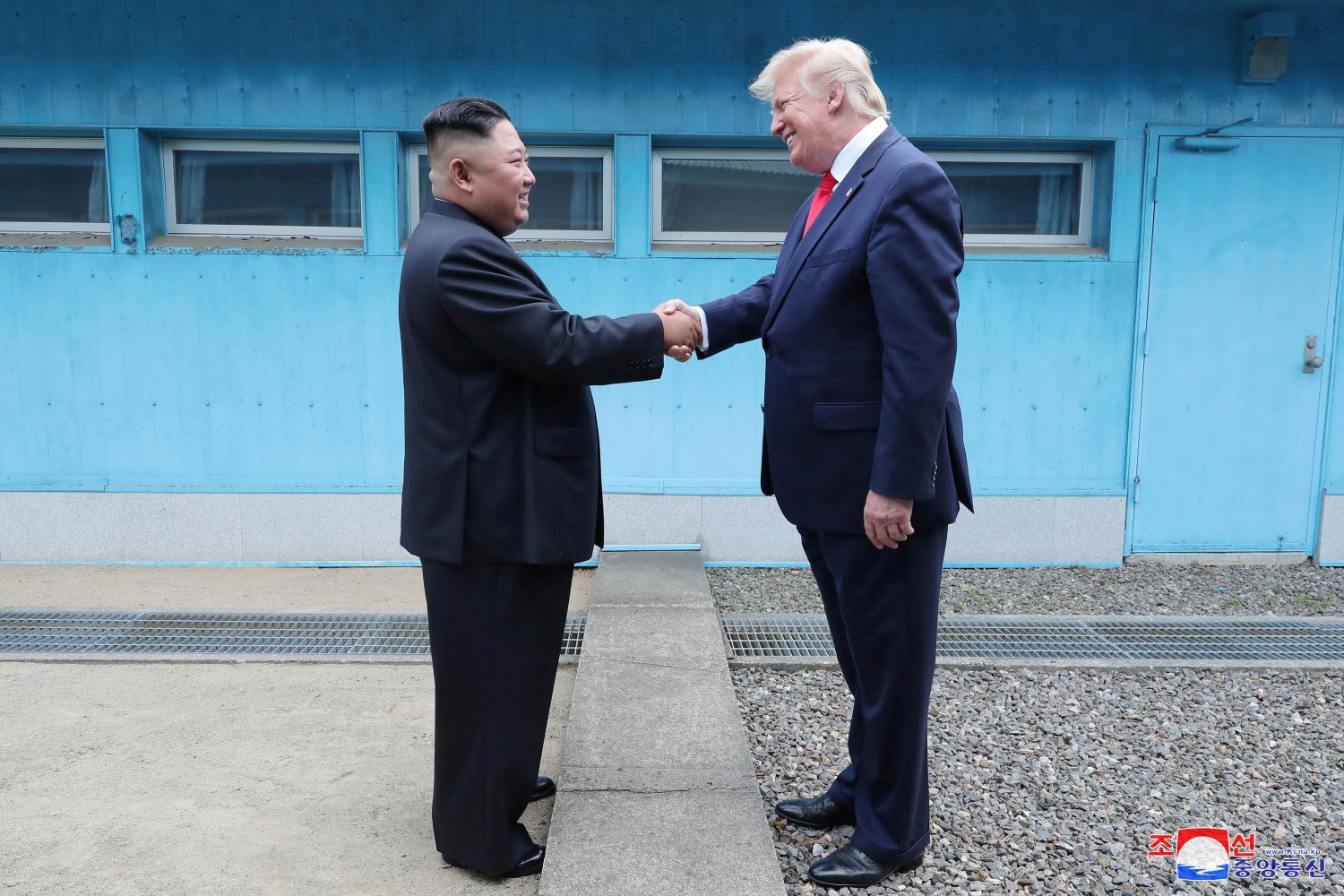
SEOUL (Reuters) – North Korean leader Kim Jong Un and U.S. President Donald Trump agreed at their meeting on Sunday to push forward dialogue for making a new breakthrough in the denuclearization of the Korean peninsula, North Korean state media said on Monday.

Trump became the first sitting U.S. president to set foot in North Korea on Sunday when he met Kim in the Demilitarized Zone (DMZ) between the two Koreas and agreed to resume stalled nuclear talks.

U.S. President Donald Trump shakes hands with North Korean leader Kim Jong Un as they meet at the demilitarized zone separating the two Koreas, in Panmunjom, South Korea, June 30, 2019. KCNA via REUTERS

U.S. President Donald Trump shakes hands with North Korean leader Kim Jong Un as they meet at the demilitarized zone separating the two Koreas, in Panmunjom, South Korea, June 30, 2019. KCNA via REUTERS

“The top leaders of the two countries agreed to keep in close touch in the future, too, and resume and push forward productive dialogues for making a new breakthrough in the denuclearization of the Korean peninsula and in the bilateral relations,” KCNA news agency said.

The meeting, initiated by a tweet by Trump that Kim said took him by surprise, displayed the rapport between the two, but analysts said they were no closer to narrowing the gap between their positions since they walked away from their summit in February in Vietnam.

U.S. Secretary of State Mike Pompeo told reporters shortly before departing South Korea that a new round of talks would likely happen “sometime in July” and the North’s negotiators would be foreign ministry diplomats.

In a photo released by KCNA on Monday, North Korean Foreign Minister Ri Yong Ho and Pompeo are shown sitting next to Kim and Trump respectively in Freedom House, the building in which the two leaders had their one-on-one talks.

KCNA said that during the chat between Trump and Kim, the two leaders explained “issues of easing tensions on the Korean peninsula,” “issues of mutual concern and interest which become a stumbling block in solving those issues,” and “voiced full understanding and sympathy.”

Kim said it was the good personal relationship he had with Trump that made such a dramatic meeting possible at just one day’s notice and that the relationship with Trump would continue to produce good results, according to KCNA.

The two leaders’ “bold, brave decision” that led to the historic meeting “created unprecedented trust between the two countries” that had been tangled in deeply rooted animosity, KCNA said.

U.N. Secretary-General Antonio Guterres welcomed the meeting between Trump and Kim and “fully supports the continued efforts of the parties to establish new relations toward sustainable peace, security and complete and verifiable denuclearization of the Korean Peninsula”, U.N. spokesman Stephane Dujarric said in a statement.

China also welcomed the meeting, with a foreign ministry spokesman describing it as “constructive and achieving positive results”.

U.S. President Donald Trump shakes hands with North Korean leader Kim Jong Un as they meet at the demilitarized zone separating the two Koreas, in Panmunjom, South Korea, June 30, 2019. KCNA via REUTERS

U.S. President Donald Trump shakes hands with North Korean leader Kim Jong Un as they meet at the demilitarized zone separating the two Koreas, in Panmunjom, South Korea, June 30, 2019. KCNA via REUTERS

But problems could lie ahead.

“The fact that the nuclear talks have jump-started is very encouraging, but that doesn’t mean that the two sides have already adjusted their positions and set the conditions for successful working-level negotiations,” said Kim Hyun-wook, a professor at the Korea National Diplomatic Academy.

Trump’s national security adviser, John Bolton, dismissed a report in The New York Times on Monday that Washington is seeking to soften its approach, floating an idea of accepting a nuclear freeze – instead of complete dismantlement – and giving tacit recognition that North Korea is a nuclear state.

“I read this NYT story with curiosity,” Bolton said in a tweet. “Neither the [National Security Council] staff nor I have discussed or heard of any desire to ‘settle for a nuclear freeze by NK.’ This was a reprehensible attempt by someone to box in the President. There should be consequences.”

(Reporting by Jack Kim and Joyce Lee; Additional reporting by Michelle Nichols at United Nations, Josh Smith in Seoul, and Ben Blanchard in Beijing; Editing by Peter Cooney and Sandra Maler)