Many U.S. farmers fume at Washington, not Trump, over biofuel, trade policies

FILE PHOTO: A crop scout walks through a soybean field to check on crops during the Pro Farmer 2019 Midwest Crop Tour, in Allen County, Indiana, U.S., August 19, 2019. REUTERS/P.J. Huffstutter

By P.J. Huffstutter and Tom Polansek

ROCHESTER, Minn./CHICAGO (Reuters) – American farmers helped elect President Donald Trump in 2016 on hopes he would shake up Washington and turn around a struggling agricultural economy, but many of his policies have actually stung farmers, notably his trade war with China and biofuel waivers for oil refiners.

Many farmers are angry, and some are directing their anger not at the Republican president, but at Washington’s bureaucracy.

Trump has faced backlash from agricultural groups, ethanol producers and Midwestern politicians upset that his trade war with China has slashed export sales of U.S. soybeans and other crops. Also, Corn futures tumbled after the government forecast a big crop when a flood-ridden spring stalled plantings. Corn-based ethanol plants shuttered after the administration granted waivers to dozens of exempting oil refineries.

Yet polls show that while Trump’s support in farm country has slipped, it remains substantial.

Instead of directing their anger at Trump, dozens of farmers interviewed by Reuters blasted the U.S. Department of Agriculture (USDA) and other Washington institutions they believe are thwarting his true agenda. Unsubstantiated conspiracy theories involving USDA staff are circulating in farm country and gaining traction online.

USDA did not respond to Reuters’ questions on Monday.

Farmers are struggling with how to emotionally process their pain from the Trump administration’s policies, and anger at the USDA may be a coping mechanism, said Ted Matthews, a Minnesota psychologist who has spent 30 years counseling farmers and rural residents across the Midwest.

“The question I hear from farmers who voted for (Trump) is, ‘We believed him when he said he would help make the farm economy better, that we could save our farms. Now, who do we blame?'” Matthews said.

Many farmers told Reuters they intend to support Trump again in his re-election bid in 2020.

“It’s much easier to be angry at a faceless Washington bureaucracy than at the man you voted for,” said Jere Solvie, 69, grain and hog farmer from west-central Minnesota who voted for Trump and still supports him.

Ahead of Democratic nominating contests, that party’s presidential candidates have been campaigning hard in Iowa and other Midwestern states where farms have lost billions of dollars in crop sales to China.

Still, the latest Reuters/Ipsos poll conducted last month shows five in 10 U.S. adults in rural areas approved of Trump’s performance in office, higher than his 41% approval nationwide.

Trump’s approval rating was 71% as of Aug. 23, down from 79% in July, according to trade publication Farm Journal Pulse’s poll of 1,153 farmers.

Of the farmers who supported the president, 43% said they “strongly approve” – down 10% from July and the first time the number fell below 50%. The farm journal’s poll came as ethanol groups complained that demand was decimated when Trump’s Environmental Protection Agency granted biofuel waivers to dozens of refineries, saving the oil industry hundreds of millions of dollars.

ALREADY FURIOUS

The USDA is a natural scapegoat and a topic of conspiracy theories among farmers suspicious of its sprawling bureaucracy, career employees and its research who sometimes conflicts with what they see on their own farms.

One farmer, enraged by the USDA’s corn crop estimate, threatened an agency employee last month. The threat of violence prompted USDA to pull all staff from a privately run crop tour that surveys Midwest crops.

This is a sharp contrast to the early days in the administration when Agriculture Secretary Sonny Perdue was a reliable point person. His folksy southern charm and his appeals to patriotism helped sell Trump’s policies to farmers, even the trade war.

But Perdue’s honeymoon in farm country has ended. Farmers booed the agriculture secretary in Minnesota last month after he joked: “What do you call two farmers in a basement? A whine cellar.”

“He’s supposed to support us, especially during times of distress,” said Gary Wertish, a fourth-generation Minnesotan who farms 500 acres of corn, soybeans and navy beans, and heard the remarks in person.

Grain farmers were already furious that corn futures prices <Cv1> posted their biggest drop in three years after USDA estimated a bigger-than-expected crop on Aug. 12, despite floods that slowed planting.

Market analysts said farmers have more of a localized view on crop health and are often skeptical of the national focus of USDA forecasts.

Trump voter Byron Heppler, a soybean and corn farmer from Calhoun, Kentucky, said he is open to considering other Republican candidates if any emerge. He said he believes USDA’s research methods are flawed and he feels its employees want to unseat Trump, although he offered no evidence to back up those views.

Other disgruntled farmers have also alleged, without offering evidence, that federal agriculture employees are overestimating corn plantings as part of a plot to hurt Trump in the 2020 election. These farmers said they believe USDA employees are upset the administration is relocating hundreds of economists and other researchers to Kansas City from Washington.

The agency has stood by its forecasts, saying they are in part based on surveys of thousands of farmers. On Trump’s order, the agency has rolled out $28 billion in trade aid support for farmers over the past two years.

Wes Hitchcock, a corn farmer and Trump supporter in Sparks, Nebraska, wrote a 1,700-word paper titled “USDA vs. Trump” and has repeatedly posted it on Facebook in a grain market discussion group with 13,000 members.

Hitchcock said he was unable to plant about 30% of the 2,200 corn acres he had planned to grow because of heavy rains this spring. The corn he did manage to plant is not looking great, either, he said.

“I’m going bankrupt and everybody else will this year too,” he said in a phone interview with Reuters.

His Facebook posts received some skeptical responses.

“To think the USDA deliberately is skewing numbers to make their boss look bad and that people appointed by the president allowed this to happen is delusional,” wrote a user named Zach Alger from Palmyra, Pennsylvania.

(Additional reporting by Rajesh Kumar Singh in Decatur, Illinois; Editing by Caroline Stauffer and David Gregorio)

Killings, torture still going on in Venezuela: U.N. rights chief

FILE PHOTO - U.N. High Commissioner for Human Rights Michelle Bachelet attends a session of the Human Rights Council at the United Nations in Geneva, Switzerland, September 9, 2019. REUTERS/Denis Balibouse

By Stephanie Nebehay

GENEVA (Reuters) – The United Nations human rights chief said on Monday that extrajudicial killings appeared to be continuing in Venezuela and the Special Action Forces (FAES) presumed to be responsible had received support from the highest levels of government.

Michelle Bachelet told the U.N. Human Rights Council that alongside possible executions, her office had documented cases of torture of soldiers and others arbitrarily held and urged the government of President Nicolas Maduro to punish perpetrators.

Bachelet who issued a report in early July detailing witness accounts of death squads run by the FAES, said non-governmental organization Monitor de Victimas (Victims’ Monitor) had found 57 new presumed executions by FAES members in Caracas that month.

The government called her earlier report a “selective and openly partial vision” that ignored official information and relied on biased witnesses.

She has also expressed concern about U.S. sanctions aimed at pressuring Maduro to step down; on Monday she said they were among factors fuelling a mass exodus from the country, which is reeling from hyperinflation and a collapsing economy.

Bachelet said even though the sanctions envisaged exceptions for humanitarian assistance, over-caution by the financial sector, lower public revenues and a decrease in oil production were having a serious impact.

“All of this is contributing to the worsening of the humanitarian situation and the exodus of Venezuelans from the country,” noting that 4.3 million refugees and migrants had already fled the turmoil, most since the end of 2015.

Washington has urged the European Union to join the sanctions, arguing that they would help advance negotiations on a handover of power to opposition leader Juan Guaido, who assumed a rival interim presidency in January.

Guaido, who said Maduro’s 2018 re-election was illegitimate, has the support of most Western nations as well as Washington. Maduro calls him a U.S. puppet.

Bachelet called for more details from Venezuela’s Public Ministry on what she said it had told her were the convictions of 104 members of the security forces for human rights violations between August 2017 and May 2019.

Despite her recommendations to dissolve the FAES and prevent extrajudicial executions, this was not being done, she said: “On the contrary, the FAES have received support from the highest level of Government.”.

Some Latin American countries and activists are urging the Geneva forum, whose 47 members include Venezuela, to establish a U.N. Commission of Inquiry on Venezuela at the three-week session.

Bachelet, who visited Venezuela in June, said 83 opposition members were freed around that time, but the cases of 27 other detainees were still pending and Judge Lourdes Afiuni and journalist Braulio Jatar, conditionally released in early July, had not yet received unconditional freedom.

(Reporting by Stephanie Nebehay; editing by Philippa Fletcher)

North Korea says it is willing to resume nuclear talks with U.S. in late September

FILE PHOTO: U.S. President Donald Trump and North Korea's leader Kim Jong Un meet at the start of their summit at the Capella Hotel on the resort island of Sentosa, Singapore June 12, 2018. REUTERS/Jonathan Ernst/File Photo

By Hyonhee Shin

SEOUL (Reuters) – North Korea said on Monday it was willing to restart nuclear talks with the United States in late September, but warned that chances of a deal could end unless Washington takes a fresh approach.

North Korean leader Kim Jong Un agreed in a June 30 meeting with U.S. President Donald Trump to reopen working-level talks stalled since their failed February summit in Hanoi, but this has yet to happen in spite of repeated appeals from Washington.

In a statement carried by North Korea’s official KCNA news agency, Vice North Korean Foreign Minister Choe Son Hui said Pyongyang was willing to have “comprehensive discussions” with the United States in late September at a time and place agreed between both sides.

Asked for comment, a U.S. State Department spokeswoman said: “We don’t have any meetings to announce at this time.”

On Sunday, U.S. Secretary of State Mike Pompeo said he hoped to return to denuclearization talks with North Korea in the coming days or weeks.

Choe stressed that Washington needed to present a new approach or the talks could fall apart again.

“I want to believe that the U.S. side would come out with an alternative based on a calculation method that serves both sides’ interests and is acceptable to us,” Choe said.

“If the U.S. side toys with an old scenario that has nothing to do with the new method at working-level talks which would be held after difficulties, a deal between the two sides may come to an end.”

In April, Kim set a year-end deadline for the United States to show more flexibility in talks, which broke down in February over U.S. demands for North Korea to give up all of its nuclear weapons and Pyongyang’s demands for relief from punishing U.S.-led international sanctions.

The end-of-September time frame would coincide with the annual United Nations General Assembly in New York, which Pompeo is due to attend. North Korea’s mission to the United Nations said last week that Foreign Minister Ri Yong Ho would not attend “due to his schedule.”

North Korea has demanded that Pompeo be replaced with a “more mature” person in the U.S. negotiating team, while lauding the rapport built between Kim and Trump in three meetings since June 2018.

The U.S. special representative for North Korea, Stephen Biegun, led working-level talks with North Korea in the run-up to the failed Hanoi meeting.

(Reporting by Hyonhee Shin in Seoul and David Brunnstrom in Washington; Editing by Grant McCool)

Afghan president renews calls for peace, demands ceasefire

Afghanistan's President Ashraf Ghani speaks during an event with Afghan security forces in Kabul, Afghanistan September 9, 2019. REUTERS/Omar Sobhani

By Hamid Shalizi and Hameed Farzad

KABUL (Reuters) – Afghan President Ashraf Ghani made a renewed call for peace on Monday but insisted the Taliban must observe a ceasefire, as he sought to regain a hold on the peace process following the surprise collapse of talks between the United States and the militants.

Ghani’s comments, to a meeting of military leaders in Kabul, came amid uncertainty over the future of efforts to end 18 years of war in Afghanistan after U.S. President Donald Trump’s abrupt cancellation of talks with the Taliban at the weekend.

“We are ready for peace talks but if the Taliban think they can scare us, look at these warriors,” Ghani said, declaring that peace could not be unconditional as he repeated demands for a ceasefire that the Taliban have so far refused.

“Peace without a ceasefire is impossible.”

Trump’s refusal to meet the Taliban has left it unclear whether talks can be revived or whether the two sides, locked in a broad stalemate, will continue fighting.

The insurgents’ determination to step up both attacks on provincial centers and suicide bombings even as peace talks were taking place was a key factor in pushing Trump to cancel talks days after a U.S. soldier was killed in the capital Kabul.

The end of the talks has fueled fears of a further increase in violence across Afghanistan, with heightened security warnings in the Kabul and other centers ahead of a presidential election scheduled for Sept. 28.

The talks, which had been secret until Trump unexpectedly announced their cancellation on Saturday, would have brought the U.S. president face-to-face with senior Taliban leaders at the presidential compound in Camp David, Maryland.

WITHDRAWAL TIMETABLE

Ghani, who was sidelined from months of negotiations between U.S. officials and Taliban representatives, had been deeply suspicious of the talks, which sought to agree a timetable for a withdrawal of thousands of U.S. troops.

A draft accord agreed last week would have seen some 5,000 U.S. troops withdrawn over coming months in exchange for guarantees that Afghanistan would not be used as a base for militant attacks on the United States or its allies.

Afghan officials had argued for months that it was a mistake for the United States to agree a deal on troop withdrawals separately from a broader peace accord.

The collapse of the talks appears to have strengthened Ghani’s position, in part by removing lingering doubts over whether the twice-delayed election – in which he is favorite to win a second five-year term – would go ahead.

Until Saturday’s surprise announcement by Trump, many politicians and Western diplomats had argued that peace talks should take priority over an election seen as a potential obstacle to a deal with the Taliban.

Now officials say there is no excuse for the vote not to be held, with election authorities promising that the problems that dogged parliamentary elections last year will not be repeated.

Ghani, a former World Bank official who came to power after a bitterly disputed election in 2014, has kept up campaigning even as the talks went on, adapting to the worsening security situation by holding “virtual rallies” that address supporters in various provinces through a video link-up.

“Afghanistan is now at a critical juncture because of the election and the peace process,” he said.

(Reporting by James Mackenzie; Editing by Alex Richardson)

Trump says he canceled peace talks with Taliban over Kabul attack

U.S. President Donald Trump departs after presenting NBA Hall of Fame player Jerry West with the Presidential Medal of Freedom in the Oval office of the White House in Washington, U.S., September 5, 2019. REUTERS/Joshua Roberts

By Phil Stewart and Jason Lange

WASHINGTON/ISLAMABAD (Reuters) – U.S. President Donald Trump on Saturday said he canceled peace talks with Afghanistan’s Taliban leaders after the insurgent group claimed responsibility last week for an attack in Kabul that killed an American soldier and 11 other people.

Trump said he had planned a secret meeting with the Taliban’s “major leaders” on Sunday at a presidential compound in Camp David, Maryland. Trump said he also planned to meet with Afghanistan’s president.

But Trump said he immediately called the talks off when the insurgents said they were behind the attack.

“If they cannot agree to a ceasefire during these very important peace talks, and would even kill 12 innocent people, then they probably don’t have the power to negotiate a meaningful agreement anyway,” Trump said on Twitter.

The surprise announcement left in doubt the future of the draft accord worked out last week by Zalmay Khalilzad, the special U.S. envoy for peace in Afghanistan, for a drawdown of thousands of U.S. troops over the coming months.

There was no immediate reaction from the Taliban but the decision appeared to catch them by surprise.

Just hours before Trump’s tweet, a senior Taliban leader privy to talks in Doha with U.S. officials including Khalilzad and Taliban chief negotiator Mullah Abdul Ghani Baradar, said an agreement to sign the deal appeared close.

Taliban fighters, who now control more territory than at any time since 2001, launched fresh assaults on the northern cities of Kunduz and Pul-e Khumri over the past week and carried out two major suicide bombings in the capital Kabul.

One of the blasts, a suicide attack in Kabul on Thursday, took the life of U.S. Army Sergeant 1st Class Elis A. Barreto Ortiz, 34, from Puerto Rico, bringing the number of American troops killed in Afghanistan this year to 16.

A spike in attacks by Taliban insurgents in Afghanistan has been “particularly unhelpful” to peace efforts there, a senior U.S. military commander said on Saturday as he visited neighboring Pakistan, where many Taliban militants are based.

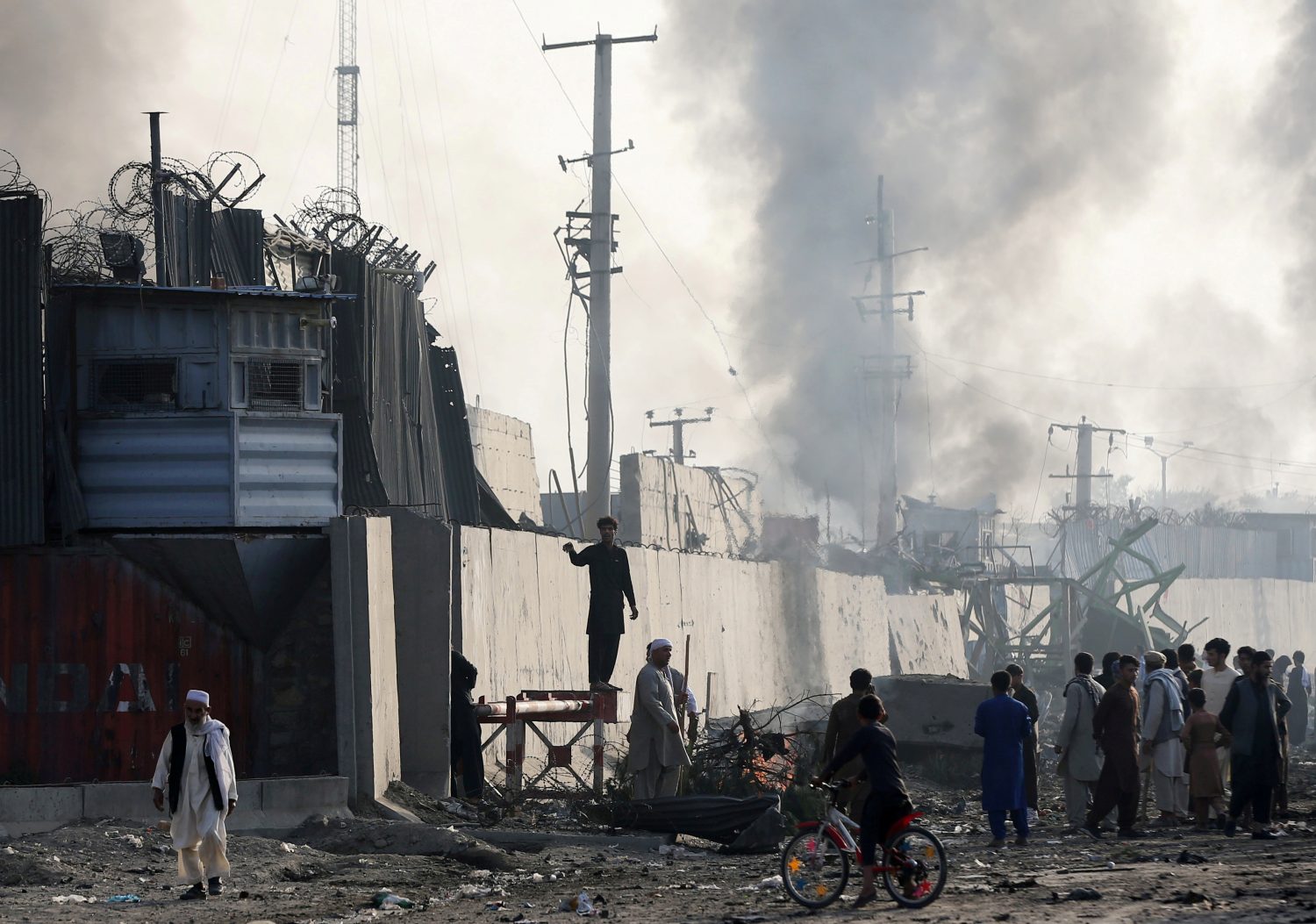
FILE PHOTO: Angry Afghan protesters burn tires and shout slogans at the site of a blast in Kabul, Afghanistan September 3, 2019. REUTERS/Omar Sobhani/File Photo

FILE PHOTO: Angry Afghan protesters burn tires and shout slogans at the site of a blast in Kabul, Afghanistan September 3, 2019. REUTERS/Omar Sobhani/File Photo

U.S. Marine General Kenneth McKenzie, who oversees American troops in the region, declined to comment on the diplomatic negotiations themselves but criticized a wave of Taliban violence that has cast a long shadow over the deal.

“It is particularly unhelpful at this moment in Afghanistan’s history for the Taliban to ramp up violence,” McKenzie, head of U.S. Central Command, told reporters traveling with him.

McKenzie said for the peace process to move forward, “all parties should be committed to an eventual political settlement” which, in turn, should result in reduced violence.

“If we can’t get that going in, then it is difficult to see the parties are going to be able to carry out the terms of the agreement, whatever they might or might not be,” McKenzie said.

Under the draft accord, some 5,000 U.S. troops would be withdrawn over the coming months in exchange for guarantees Afghanistan would not be used as a base for militant attacks on the United States and its allies.

However, a full peace agreement to end more than 18 years of war would depend on subsequent “intra Afghan” talks involving officials and civil society leaders as well as further agreement on issues including the remainder of the roughly 14,000-strong U.S. forces as well as thousands of other NATO troops.

The Taliban have rejected calls for a ceasefire and instead stepped up operations across the country and it remains unclear whether they will accept direct negotiations with the Afghan government, which they consider an illegitimate “puppet” regime.

NEW CIVIL WAR?

For Afghans, the Taliban’s recent escalation of attacks has underscored fears it may be impossible to reach a stable settlement following any complete U.S. withdrawal.

Ghani dismissed the talks as “meaningless” following Thursday’s suicide bombing and his spokesman said an official reaction to Trump’s announcement would come soon.

The Taliban’s strategy appears to be based on the assumption that battlefield success would strengthen their hand in future negotiations with Afghan officials. Some of their field commanders have also said they are determined not to surrender gains when they are close to victory, suggesting the leadership is under internal pressure not to concede a ceasefire.

But that has risked undermining acceptance of the deal by Washington and its NATO allies as well as by Kabul.

“The Taliban’s leaders will have to show they can stop the attacks, if not, then what is the point of holding long negotiations with Baradar?” said one Western diplomat in Kabul.

Even within the Taliban ranks, there appears to be doubt about how any agreement would take effect, given growing opposition to the deal from the government side.

“Don’t ask me how to implement the peace accord,” the Taliban official said.

Memories of the bloody 1990s conflict between the Taliban and rival militia groups are vivid. Former U.S. envoys who worked on Afghanistan warned last week that “total civil war” with “catastrophic” consequences for U.S. national security was possible.

Many have worried about a fracture along ethnic and regional lines, with Persian-speaking Tajiks and Hazaras from the north and west against southern and eastern Pashtuns, the group that have supplied most of Afghanistan’s rulers and where the Taliban draw most support.

Some Taliban are based in neighboring Pakistan, where McKenzie held talks on Saturday with a top Pakistani general. More talks are scheduled for Sunday.

McKenzie said he did not know whether any of the planning for the recent wave of attacks in Afghanistan came from Pakistan-based militants.

But McKenzie commended Pakistan for supporting the peace efforts in Afghanistan, in the latest sign of an improvement in long-fraught relations between Washington and Islamabad.

“A lot of Pakistanis have been killed by militant attacks inside Pakistan. I think Pakistan sees the benefits of a stable Afghanistan,” McKenzie said.

(Additional by Jibran Ahmad in Peshawar, Rupam Jain and James Mackenzie in Kabul; Editing by Marguerita Choy, Chris Reese and Michael Perry)

U.S.-Japan trade deal may be finished, announced at U.N. General Assembly: Kudlow

FILE PHOTO: White House chief economic advisor Larry Kudlow speaks with reporters on the driveway outside the West Wing of the White House in Washington, U.S. July 26, 2019. REUTERS/Yuri Gripas

WASHINGTON (Reuters) – A final trade deal between the United States and Japan may be finished and announced at the U.N. General Assembly meetings later this month, White House economic adviser Larry Kudlow said on Friday.

“We announced at the G7 in France – I was over there – the outline of a deal with Japan, that deal may be finished and announced in its entirety at the U.N. meetings coming up in a couple of weeks,” Kudlow said in an interview with Fox Business Network.

(Reporting by Tim Ahmann; Writing by Makini Brice; Editing by Chizu Nomiyama)

U.S. wants ‘near term’ results from new China trade talks: Kudlow

FILE PHOTO: White House chief economic adviser Larry Kudlow talks with reporters on the driveway outside the West Wing of the White House in Washington, U.S. August 2, 2019. REUTERS/Carlos Barria

By David Lawder and Makini Brice

WASHINGTON (Reuters) – The Trump administration wants to see “near term results” from U.S.-China trade talks in September and October, White House economic adviser Larry Kudlow said on Friday, but he declined to predict any outcomes or say if U.S. tariff delays were possible.

Speaking on CNBC and Bloomberg TV, Kudlow confirmed that the top U.S. and Chinese trade negotiators would meet in early October but added that a date had not been set.

The plans for the first in-person U.S.-China trade meetings since late July were set during a phone call on Thursday between Chinese Vice Premier Liu He, U.S. Trade Representative Robert Lighthizer and Treasury Secretary Steven Mnuchin. Trade deputies are due to meet in mid-September.

The 14-month U.S.-China trade war has escalated sharply since May when talks broke down after Beijing backtracked on earlier commitments to make changes in law to improve intellectual property protections, curb the forced transfer of U.S. technology to Chinese firms and improve U.S. access to Chinese markets.

Since then, U.S. President Donald Trump has sharply increased existing tariffs on $200 billion worth of Chinese goods and imposed or scheduled new tariffs on virtually all remaining imports from China to increase his negotiating leverage.

Kudlow told Bloomberg TV that he could not speculate on whether the September or October talks could delay a planned tariff increase on Oct. 1 to 30% from 25% on $250 billion worth of Chinese goods.

“Our team would like to go back and pick up where we left off in the May talks. Whether that will be possible remains to be seen,” Kudlow said.

He said Trump has shown willingness to use tariffs as part of the negotiating process.

“We want to see results. We would like to see results in the near term. When we don’t see results, we take additional actions,” Kudlow said. “On the other hand, if we do see results from these upcoming meetings, then progress will be made.”

Kudlow also said there were no preconditions for the October talks.

Trump later said on Twitter that China was hurting economically from the U.S. tariffs but that the new round of talks were positive.

“‘China is eating the Tariffs,'” Trump tweeted. “Billions pouring into USA. Targeted Patriot Farmers getting massive Dollars from the incoming Tariffs! Good Jobs Numbers, No Inflation(Fed). China having worst year in decades. Talks happening, good for all!”

(Reporting by Susan Heavey, Tim Ahmann and David Lawder; Writing by David Lawder and Makini Brice; Editing by Jonathan Oatis and Steve Orlofsky)

Son of Afghan resistance hero criticizes ‘secretive’ U.S. Taliban deal

Ahmad Massoud, son of the slain hero of the anti-Soviet resistance, Ahmad Shah Massoud, shakes hands with his supporters at his house in Bazarak, Panjshir province Afghanistan September 5, 2019. Picture taken September 5, 2019.REUTERS/Mohammad Ismail

By James Mackenzie

JANGALAK, Afghanistan (Reuters) – A “secretive” peace deal between United States and the Taliban could face wide resistance in Afghanistan if it opens the door to the insurgents’ hardline regime, said the son of Ahmad Shah Massoud, the slain hero of the anti-Soviet resistance.

Ahmad Massoud, who was 12 years old when his father was assassinated days before the Sept 11, 2001, attacks on the United States, is among several Afghan politicians critical of the accord reached with the Taliban this week.

While he is still relatively new to Afghan politics, the aura of his father’s name adds weight to his words in a country where the habits of dynastic politics remain deeply ingrained.

“It’s very secretive. It has happened behind closed doors,” Massoud told Reuters in an interview.

“We see the peace deal as a great opportunity but how it has been managed is unfortunately disappointing,” Massoud said. “We want to see clarity, we want to see people from all over the country involved in it.”

Speaking after some 10,000 supporters rallied at his father’s mausoleum in the Panjshir Valley on Thursday, Massoud’s comments reflect the deep suspicion many Afghans have of a deal reached without their involvement.

The accord would see thousands of U.S. troops withdrawn in exchange for Taliban promises not to let Afghanistan be used as a base for future attacks on the United States and its allies.

It is intended as a first step to a peace deal between the Taliban and wider Afghan society but it remains unclear what will happen next. The insurgents have refused to negotiate directly with the Afghan government, which they consider an illegitimate “puppet” regime and mistrust abounds.

President Ashraf Ghani’s spokesman said this week the government had serious concerns and wanted further clarification from Washington.

Although details have not been made public, the fact that the accord appears to acknowledge the Taliban’s self-described status as the Islamic Emirate of Afghanistan has aroused particular anger.

‘RED LINE’

Many Taliban officials have said the country’s constitutional status should revert to the Islamic Emirate, but opponents see the term as a direct challenge to the internationally recognized Islamic Republic of Afghanistan, the state formed after the fall of the Taliban in 2001.

“For us, the Islamic Republic of Afghanistan is our red line,” Massoud said, adding that any change to the country’s status could only come through a referendum.

Opposition to the deal has been deepened by the Taliban’s recent escalation of attacks, heightening fears that it may be impossible to reach a stable settlement once U.S. forces leave.

Many have worried about a fracture along ethnic and regional lines, with Persian-speaking Tajiks and Hazaras from the north and west against southern and eastern Pashtuns, the group that have supplied most of Afghanistan’s rulers and where the Taliban draw most support. Memories of the 1990s civil war are vivid.

“We do not want to see another war break out,” Massoud said. “This peace must end war all at once.”

The aggressive displays by supporters on the Sept. 9 anniversary of the death of Massoud’s father, when armed bands drive through the streets of Kabul firing into the air, have led many to suspect that the old Mujahideen Northern Alliance could reform to oppose the Taliban.

However, Massoud insists that only a political settlement will be effective and that only government forces should be armed.

“After the peace process, no political group … but the government should have guns,” he said.

(Reporting by James Mackenzie; editing by Darren Schuettler)

Britain will support U.S. in Iran talks if deal can be made: UK defense minister

FILE PHOTO: Britain's Defence Secretary Ben Wallace walks outside Downing Street in London, Britain, September 2, 2019. REUTERS/Simon Dawson

LONDON (Reuters) – Britain will always help the United States along a path to talks with Iran if a deal can be made, British defense minister Ben Wallace said on Friday, although he cautioned that Iran should be judged by its actions rather than words.

“Actions speak louder than words, so I think we’ll take them (Iran) at their actions rather than their words,” Wallace said at a news conference in London with his U.S. counterpart Mark Esper, who earlier said Iran was “inching” towards a place where talks could be held.

“But if there is a deal to be made, we will of course always help the United States along that path, because I think peace and stability in that region is the most important thing,” Wallace added.

(Reporting by Idrees Ali, writing by Alistair Smout; editing by Stephen Addison)

Hurricane Dorian hits North Carolina’s Outer Banks

A fallen tree and flood waters sit in a hotel parking lot after Hurricane Dorian swept through, in Wilmington, North Carolina, U.S., September 6, 2019. REUTERS/Jonathan Drake

By Amanda Becker

ELIZABETH CITY, N.C. (Reuters) – Hurricane Dorian made landfall on the Outer Banks of North Carolina on Friday, hitting the beach resort area with powerful winds and battering waves days after reducing parts of the Bahamas to rubble.

The storm, packing 90-mile-per-hour winds (150 km-per-hour) made landfall at Cape Hatteras at about 9 a.m. EDT (1300 GMT), according to the National Hurricane Center.

It lashed the Outer Banks with hurricane-force winds as far as 45 miles (72 km) from the center of the hurricane and sent tropical storm winds farther than 200 miles (320 km) from its center, the NHC said.

It has already dumped up to 10 inches (25 cm) of rain along the coast between Charleston, South Carolina, to Wilmington, North Carolina, about 170 miles (275 km) away, forecasters said.

“The rain is moving up north,” said National Weather Service forecaster Alex Lamers early on Friday. “Even the Raleigh-Durham area inland will get 3 inches today.”

Dorian is expected to push out to sea later on Friday and bring tropical storm winds to Nantucket Island and Martha’s Vineyard, Massachusetts, early on Saturday.

But it will likely spare much of the rest of the East Coast the worst of its rain and wind, before likely making landfall in Canada’s Nova Scotia that night, the NHC said.

“It’s in the process of moving out, going north,” Lamers said.

The howling west flank of Dorian has soaked the Carolinas since early Thursday, flooding coastal towns, whipping up more than a dozen tornadoes and cutting power to hundreds of thousands of people.

Floodwaters rose to a foot (30 cm) or more in parts of the historic South Carolina port city of Charleston, where more than 7 inches (18 cm) of rain fell in some areas, officials said. Another half-inch or more was expected overnight Friday.

More than 330,000 homes and businesses were without power in North Carolina and South Carolina on Friday morning. Power had mostly been restored to thousands of people in Georgia, tracking site poweroutage.us showed.

But as Dorian is expected to pick up speed from its 14 mph (22 kph) crawl on Friday, life-threatening storm surges and dangerous winds remain a threat for much of the area and Virginia, the National Hurricane Center said.

Governors in the region declared states of emergency, shut schools, opened shelters, readied National Guard troops and urged residents to heed warnings, as news media circulated fresh images of the storm’s devastation in the Bahamas.

At least 70,000 Bahamians needed immediate humanitarian relief after Dorian became the most damaging storm ever to hit the island nation.

A city park and playground are inundated with flood waters from Hurricane Dorian in Wilmington, North Carolina, U.S., September 6, 2019. REUTERS/Jonathan Drake

A city park and playground are inundated with flood waters from Hurricane Dorian in Wilmington, North Carolina, U.S., September 6, 2019. REUTERS/Jonathan Drake

In the Carolinas alone, more than 900,000 people had been ordered to evacuate their homes. It was unclear how many did so.

In Kill Devil Hills in the Outer Banks, Mark Jennings decided to ignore the order, lining his garage door with sandbags and boarding up his home with plywood.

The retired firefighter planned to stay put with his wife and two dogs, saying: “We are ready to go. If something happens, we can still get out of here.”

Dorian whipped up at least three tornadoes in the region, officials said. One in North Carolina damaged scores of trailers at a campground in Emerald Isle, but no one was injured, the News & Observer said.

Of at least four storm-related deaths reported in the United States, three were in Orange County, Florida, during storm preparations or evacuation, the mayor’s office said.

In North Carolina, an 85-year-old man fell off a ladder while barricading his home for Dorian, the governor said.

(Reporting by Nick Carey in Charleston, South Carolina, and Amanda Becker in Kill Devil Hills, North Carolina; Additional reporting by Jonathan Allen, Peter Szekely, Matt Lavietes and Scott DiSavino in New York and Rich McKay in Atlanta; Editing by Alison Williams, Chizu Nomiyama and Jonathan Oatis)