U.S., China resume high-level talks to end grueling trade war

By David Lawder

WASHINGTON (Reuters) – Top U.S. and Chinese negotiators met on Thursday for the first time since late July to try to find a way out of a 15-month trade war as new irritants between the world’s two largest economies threatened hopes for progress.

U.S. Treasury Secretary Steven Mnuchin and U.S. Trade Representative Robert Lighthizer greeted Chinese Vice Premier Liu He on the steps of the USTR office before a meeting in which they will seek to narrow differences enough to avoid an escalation of tit-for-tat tariffs that have roiled financial markets and stoked fears of a global recession.

The mood surrounding the talks soured this week when the U.S. government blacklisted 28 Chinese public security bureaus, technology and surveillance firms and imposed visa restrictions on Chinese officials over allegations of abuses of Muslim minorities in China.

Beijing is planning to tighten visa restrictions for U.S. nationals with ties to anti-China groups, sources said.

U.S. President Donald Trump has threatened to raise tariffs on $250 billion worth of Chinese goods on Oct. 15 if no progress is made in the on-again, off-again negotiations.

That would make nearly all Chinese goods imports into the United States – more than $500 billion – subject to tariffs.

“Big day of negotiations with China,” Trump said on Twitter. “They want to make a deal, but do I?” He added that he would be meeting with Liu at the White House on Friday.

Chinese officials indicated more willingness to negotiate. “The Chinese side came with great sincerity, willing to cooperate with the U.S. on the trade balance, market access and investor protection,” Xinhua quoted Liu as saying on Thursday.

A U.S. Chamber of Commerce official said there was a possibility U.S. and Chinese negotiators would reach a currency agreement in exchange for a delay of the tariff hikes.

Major U.S. stock exchanges were trading higher on hopes of progress in the talks.

Although some media reports suggested both sides are considering an “interim” deal that would suspend the planned further U.S. tariffs in exchange for additional purchases of American farm products, Trump has repeatedly dismissed this idea, insisting he wants a “big deal” with Beijing that addresses core intellectual property issues.

The U.S. Agriculture Department said on Thursday that private exporters reported a snap sale of 398,000 tonnes of soybeans to China, part of a flurry of purchases the top buyer of the oilseed has made since granting waivers to some importers to buy U.S. soy exempt from tariffs as a goodwill gesture.

Chinese firms have bought more than 3.5 million tonnes of U.S. soybeans since the beginning of September. Soybeans, the most valuable U.S. agricultural export, have been among the products hardest hit by China’s retaliatory tariffs.

LOWERED EXPECTATIONS

The two sides have been at loggerheads over U.S. demands that China improve protections of American intellectual property, end cyber theft and the forced transfer of technology to Chinese firms, curb industrial subsidies and increase U.S. companies’ access to largely closed Chinese markets.

But Chinese officials, surprised by the U.S. blacklisting of Chinese companies, including video surveillance gear maker Hikvision, along with the suspension of U.S. visas for some Chinese officials, told Reuters that Beijing had lowered expectations for significant progress from the talks.

“I’ve never seen China respond with concessions to someone throwing down the gauntlet in this manner,” said Scott Kennedy, a China trade expert at the Center for Strategic and International Studies in Washington. “It suggests to me that the U.S. may have determined that progress was impossible, so everyone is just going through the motions.”

Other flashpoints that have cropped up in recent days include China’s swift action to cut corporate ties to the National Basketball Association over a team official’s tweet in support of Hong Kong pro-democracy protesters.

U.S. Commerce Secretary Wilbur Ross said in Sydney on Thursday that the tariffs were working, forcing Beijing to pay attention to American concerns about its trade practices.

“We do not love tariffs – in fact we would prefer not to use them – but after years of discussions and no action, tariffs are finally forcing China to pay attention to our concerns,” Ross said in remarks prepared for delivery on an official visit to Australia.

(Reporting by David Lawder; Editing by Simon Cameron-Moore and Paul Simao)

North Korea says may reconsider steps to build trust with U.S.: KCNA

SEOUL (Reuters) – North Korea said on Thursday its patience has limits and it could reverse steps to build trust with the United States, as it criticized a U.N. Security Council call for it to cease its weapons programs and denounced a U.S. missile test.

The five European members of the U.N. Security Council met on Tuesday to urge North Korea “to take concrete steps” towards giving up its nuclear weapon and ballistic missile programs in a complete, verifiable and irreversible manner.

That call came days after North Korea said it test-fired a new submarine-launched ballistic missile, in what was the most provocative action by North Korea since it resumed dialogue with the United States in 2018.

North Korea, as part of its efforts to sustain that dialogue, which has included three meetings between its leader, Kim Jong Un, and U.S. President Donald Trump, has stopped testing nuclear weapons and intercontinental ballistic missiles.

But North Korea’s foreign ministry spokesman, in a statement reported by its state KCNA news agency, raised questions about that restraint.

“There is a limit to our patience and there is no law that anything we have refrained from so far will continue indefinitely,” the spokesman said.

The spokesman also denounced what he said was the U.N. Security Council’s unfair taking up of the issue of North Korea’s self-defense.

“The fact … is prompting us to reconsider the crucial pre-emptive steps we have taken to build trust with the U.S.”

The spokesman did not elaborate on what pre-emptive steps he was referring to, but North Korean state media and officials have referred to the halting of nuclear and intercontinental ballistic missile tests, and the return of remains of U.S. soldiers killed in the 1950-1953 Korean War, as good-faith gestures to the United States, which it says have not been reciprocated.

The North Korean spokesman also referred to a U.S. Air Force test of a Minuteman III intercontinental ballistic missile this month.

The U.S. test was “clearly carried out in order to pressure us”, the North Korean spokesman said.

(Reporting by Joyce Lee; Editing by Raissa Kasolowsky, Robert Birsel)

Power cut to millions as California faces heightened wildfire risks

Power cut to millions as California faces heightened wildfire risks
By Steve Gorman

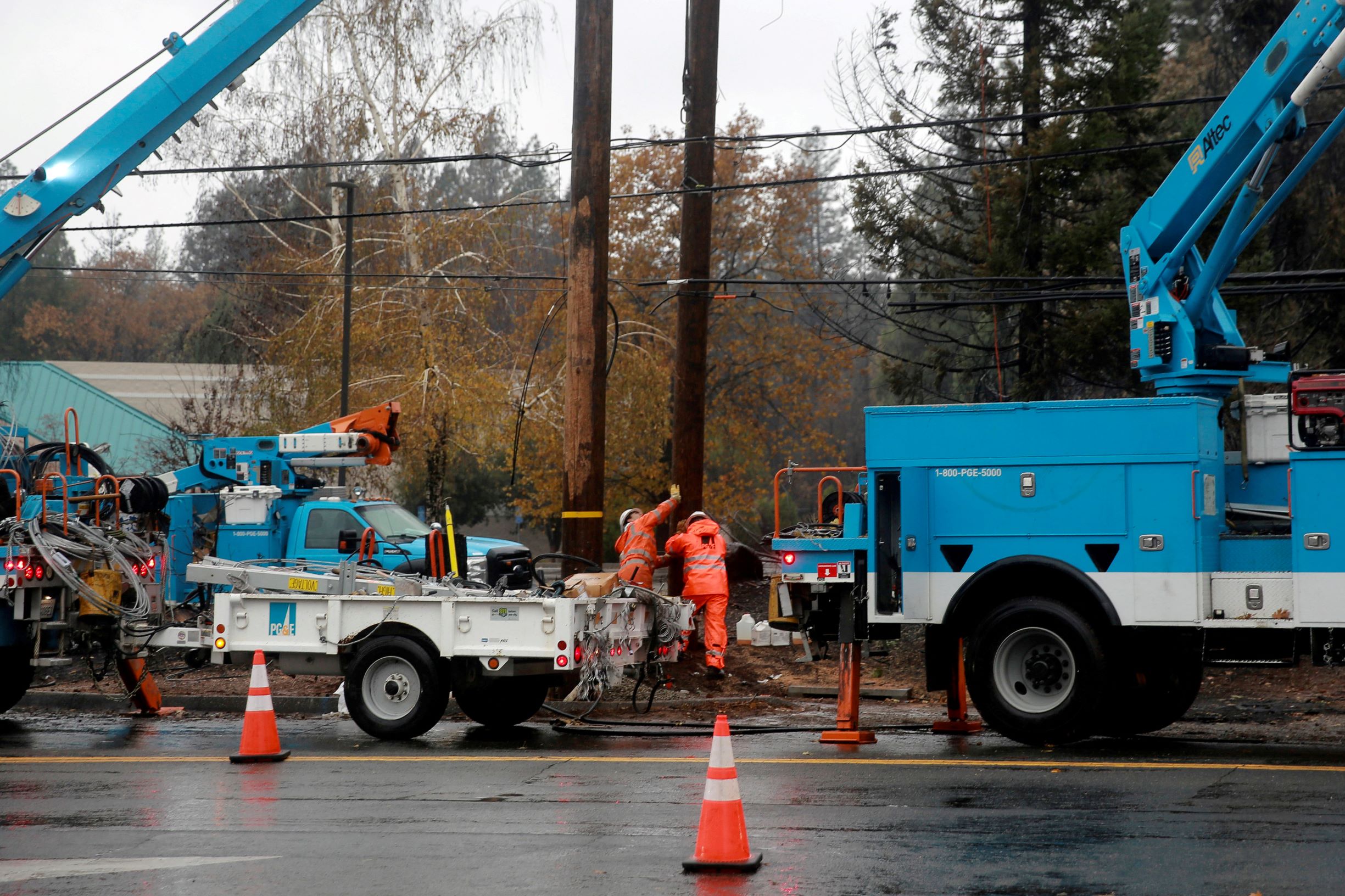
LOS ANGELES (Reuters) – Electricity was shut off to nearly 750,000 California homes and workplaces on Wednesday as Pacific Gas and Electric Co (PG&E) imposed a string of planned power outages of unprecedented scale to reduce wildfire risks posed by extremely windy, dry weather.

The power cut knocked out traffic signals, forced school closures and shut businesses and government offices across northern and central California, said Brian Ferguson, a spokesman for the state Office of Emergency Services.

One key disruption was at the University of California at Berkeley, which canceled classes on Wednesday during the first phase of the “public safety power shutoff”, targeting more than 500,000 homes and businesses.

A second phase began at 3 p.m. Pacific time and extended the blackout to 234,000 more customers, said the utility, which was considering a third phase for 4,600 more dwellings and businesses.

Although PG&E said changing weather conditions and work-arounds had restored power to about 44,000 customers, its action was the largest precautionary electricity shutoff undertaken by California’s biggest investor-owned utility.

“It’s too bad that it is such a large area to be turned off,” said Matthew Gallagher, a resident of Vacaville, a town 60 miles (100 km) northeast of San Francisco, where everything, from the Walmart outlet to gasoline service stations, was closed for lack of power.

A similar cutoff was under consideration by neighboring utility Southern California Edison for nearly 174,000 of its customers, about 50,000 of them in Los Angeles County, should severe winds hit southern California on Thursday as forecast, SoCal Edison spokeswoman Taelor Bakewell said.

Some of California’s most devastating wildfires were sparked in recent years by damage to electrical transmission lines from recurring bouts of high winds that then spread the flames through tinder-dry vegetation into populated areas.

“We are entering into a two-, three- or four-day period of extreme fire danger in California,” Governor Gavin Newsom said at an event in San Diego on Wednesday.

‘RED FLAG’

Gale-force wind gusts, mostly in higher elevations, were expected to intensify late on Wednesday across northern and central California before gradually migrating into southern California overnight and Thursday, National Weather Service meteorologist Steve Anderson said. He said extremely low humidity levels added to the fire threat.

The California Department of Forestry and Fire Protection (Cal Fire) said “red-flag” warnings were posted across the state for what was shaping up to be the strongest wind event so far this season.

PG&E warned residents to prepare for outages that could last several days. But spokeswoman Kristi Jourdan said it expected to restore supply to most customers within 24 to 48 hours after high winds abate, once power lines were inspected and any damage repaired.

Many customers live in areas where breezes were light on Wednesday, but some are served by transmission lines hit by high winds elsewhere and thus were part of a larger portion of the grid that was turned off, PG&E spokesman Jeff Smith said.

It urged customers to stock up on flashlights, fresh batteries, first-aid supplies and cash, and plan for healthcare needs, from refrigerated medicine to electrical devices.

The utility said it opened 28 community centers across the planned outage zone to provide restrooms, bottled water, battery charging and air-conditioned seating during the day.

PG&E has drawn increased scrutiny in recent years over maintenance of transmission wires and other equipment implicated in major wildfires.

In May, state fire investigators determined that PG&E transmission lines caused the deadliest and most destructive wildfire on record in California, last year’s wind-driven Camp Fire that killed 85 people in and around the town of Paradise.

Cal Fire likewise concluded that PG&E power lines had sparked a 2017 flurry of wildfires that swept California’s wine country north of San Francisco Bay.

PG&E filed for bankruptcy in January 2019, citing potential civil liabilities in excess of $30 billion from the fires.

(Reporting by Steve Gorman in Los Angeles; Additional reporting by Jim Christie in San Francisco, Rich McKay in Atlanta and Dan Whitcomb in Los Angeles; Editing by Paul Tait and Clarence Fernandez)

Ukraine president says Trump didn’t seek to blackmail him

By Natalia Zinets and Pavel Polityuk

KIEV (Reuters) – Ukraine’s President Volodymyr Zelenskiy said on Thursday that U.S. President Donald Trump did not seek to blackmail him during a phone call in July or a meeting in September.

Zelenskiy said he had not known that U.S. military aid to Ukraine had been blocked at the time of the call. Having been made aware of this by his defense minister later, he raised the issue during a separate meeting in September in Poland with Vice President Mike Pence.

The U.S. House of Representatives has launched an impeachment inquiry against Trump, focused on whether he used congressionally approved aid to Ukraine as leverage to pressure Zelenskiy to investigate former Vice President Joe Biden, one of Trump’s main Democratic rivals as he seeks re-election in 2020.

Trump has made allegations, without evidence, that Biden engaged in improper dealings in Ukraine. Biden’s son Hunter was on the board of Ukrainian gas company Burisma.

Zelenskiy told reporters that his aim in having a phone call with Trump was to arrange a subsequent meeting and that he had asked the White House to change its rhetoric on Ukraine.

He said Kiev was open to a joint investigation into Biden but added that Ukraine was an independent country with independent law enforcement agencies that he could not influence.

“There was no blackmail. This was not the subject of our conversation,” Zelenskiy said about his call with Trump, speaking to reporters in a day-long series of televised briefings with the press, held at a Kiev food court.

Zelenskiy said there were no conditions attached to him meeting Trump, including whether he should investigate the activities of Hunter at Burisma.

The White House published its summary of the call between Zelenskiy and Trump in September. Asked whether the Ukrainian version matched up to the U.S. one, Zelenskiy said: “I didn’t even check, but I think that it matches completely.”

Biden for the first time on Wednesday made a direct call for Trump’s impeachment. Trump meanwhile continued to paint the probe as a partisan smear and accused the U.S. intelligence officer who filed the whistleblower complaint that sparked the impeachment row of having political motives.

Zelenskiy said he had no desire to interfere in the U.S. election.

Zelenskiy said he had been made aware by his defense minister that Washington had frozen military aid to Ukraine.

He raised the issue at a meeting with Pence in Warsaw when they met at a commemoration to mark the 80th anniversary of the start of the Second World War.

“I told him … please help to resolve it,” Zelenskiy recalls asking Pence. “And after our meeting America unblocked the aid.”

(Reporting by Pavel Polityuk, Natalia Zinets, Maria Tsvetkova and Matthias Williams; Writing by Matthias Williams; Editing by John Stonestreet and Peter Graff)

Trump administration to announce changes to anti-kickback rules for healthcare providers

By Carl O’Donnell

(Reuters) – The Trump administration will announce plans to change healthcare regulations on Wednesday to loosen anti-kickback provisions that restrict the kinds of outside services providers can refer patients to, administration officials said.

President Donald Trump on Thursday will explain how the new rules advance his broader healthcare agenda, which includes reducing regulatory burdens and promoting innovative ways to reimburse healthcare providers, in a speech in Minnesota, the officials said.

The plan will change how the Department of Health and Human Services (HHS) enforces the Physician Self Referral Law, also known as the Stark law, which penalizes healthcare providers for referring patients to outside services that the provider could stand to benefit from financially.

HHS will create exceptions for healthcare providers that enter into agreements with other parties if they are aimed at cutting costs and improving patient health, the officials said.

Trump issued an executive order last week that sought to woo seniors by strengthening the Medicare health program.

The order was the Republican president’s answer to Democrats like Bernie Sanders, who is running to become the party’s nominee in the 2020 presidential election and is promoting the idea of Medicare for all Americans.

The Trump administration has also rolled out measures in recent months designed to curtail drug prices and address other problems in the U.S. healthcare system.

Policy experts say the efforts are unlikely to slow the rise of drug prices in a meaningful way, however.

(This story corrects lead to show Trump administration officials, not President Trump, announcing plans on Wednesday)

(Reporting by Carl O’Donnell; Editing by Sonya Hepinstall)

With U.S.-China tensions running high, hopes dim for end to trade war

By Andrea Shalal and Cate Cadell

WASHINGTON/BEIJING (Reuters) – Beijing sharply rebuked Washington on Tuesday for adding some top Chinese artificial intelligence startups to its trade blacklist, dimming hopes for progress in high-level talks aimed at ending a 15-month trade war between the two economic giants.

U.S. and Chinese deputy trade negotiators were due to meet in Washington for a second day of talks on Tuesday, laying the groundwork for the first minister-level meetings in over two months later this week.

A report from the South China Morning Post said China had tamped down expectations ahead of the talks scheduled for Thursday with Chinese Vice Premier Liu He, U.S. Trade Representative Robert Lighthizer and Treasury Secretary Steven Mnuchin, saying the Chinese delegation could leave earlier than planned because “there’s not too much optimism.”

The mood soured this week after the U.S. Commerce Department widened its trade blacklist to include 20 Chinese public security bureaus and eight companies including video surveillance firm Hikvision <002415.SZ>, as well as leaders in facial recognition technology SenseTime Group Ltd and Megvii Technology Ltd.

The action bars the firms from buying components from American companies without U.S. government approval, a potentially crippling move. It follows the same blueprint used by Washington in its attempt to limit the influence of Huawei Technologies Co Ltd [HWT.UL] for what it says are national security reasons.

Hikvision, with a market value of about $42 billion, calls itself the world’s largest maker of video surveillance gear.

U.S. officials said the action was tied to China’s treatment of Muslim minorities and human rights violations, provoking a sharp reaction from Beijing.

China said the United States should stop interfering in its affairs. It will continue to take firm and resolute measures to protect its sovereign security, foreign ministry spokesman Geng Shuang told a regular media briefing without elaborating.

Major U.S. stock indexes fell on Tuesday, amid the continued tensions between the United States and China, whose tit-for-tat tariffs have roiled financial markets, slowed capital investment, and triggered a slowdown in trade flows.

New International Monetary Fund Managing Director Kristalina Georgieva issued a stark warning about the state of global growth on Tuesday, saying trade conflicts had thrown it into a “synchronized slowdown” and must be resolved.

In her inaugural speech after taking over the global crisis lender on Oct. 1, Georgieva unveiled new IMF research showing that the cumulative effect of trade conflicts could mean a $700 billion reduction in global GDP output by 2020, or around 0.8%.

LOOMING TARIFF HIKES

The trade talks are taking place days before U.S. tariffs on $250 billion worth of Chinese goods are slated to rise to 30% from 25%. Trump has said the tariff increase will take effect on Oct. 15 if no progress is made in the negotiations.

President Donald Trump on Monday said a quick trade deal was unlikely, and that he would not be satisfied with a partial deal.

The two sides have been at loggerheads over U.S. demands that China improve protections of American intellectual property, end cyber theft and the forced transfer of technology to Chinese firms, curb industrial subsidies and increase U.S. companies’ access to largely closed Chinese markets.

Trump launched a new round of tariffs after the last high-level talks in late July failed to result in agricultural purchases or yield progress on substantive issues. China quickly responded with tariff increases of its own.

Washington is also moving ahead with discussions around possible restrictions on capital flows into China, with a focus on investments made by U.S. government pension funds, Bloomberg reported. The news sent shares of chipmakers sharply lower.

Another flashpoint has been a widening controversy over a tweet from an official with the NBA’s Houston Rockets. His backing of Hong Kong democracy protests was rebuked by the National Basketball Association, sparking a backlash.

Trump also called for a peaceful resolution to the protests in Hong Kong, and warned the situation had the potential to hurt trade talks.

Police in Hong Kong have used rubber bullets, tear gas and water cannons against pro-democracy demonstrators in the former British colony, which has been plunged into its worst political crisis in decades.

Beijing views U.S. support for pro-democracy protests in Hong Kong as interfering with its sovereignty.

(Reporting by Andrea Shalal and David Lawder in Washington and Cate Cadell in Beijing; Writing by Andrea Shalal; Editing by Paul Simao)

Albanian teens develop app for domestic violence victims

Albanian teens develop app for domestic violence victims
By Benet Koleka

TIRANA (Reuters) – Three Albanian 16-year-old girls have developed an app to help victims of domestic violence access support, hoping to tackle a huge problem in Albania, where one in two women suffered abuse last year, according to a survey.

They will launch their app, known as GjejZâ, (Find your Voice), on Friday, after winning an international technology competition for girls in the United States.

“Violence against women is a huge issue in Albania and it also affects us as teenage girls because we see the early stages of this even in our peers, in our friends,” said Jonada Shukarasi, one of the developers.

One in two women suffers violence in Albania, said Iris Luarasi, the head of a national hotline for abused women, citing a 2018 survey, and 4,000 cases were reported in 2018.

A new report by the Organisation for Security and Co-operation in Europe (OSCE) found almost 9 in 10 women consider violence against women to be common in Albania, and that 97% of victims of intimate in-house violence never report it to the police.

Known as the D3c0ders, the girls – Arla Hoxha, Dea Rrozhani and Jonada Shukarasi – learned how to code and create applications four years ago through an outreach program run by the U.S. Embassy in Tirana.

News of their award in the Technovation Challenge competition has stoked national pride in Albania, an ex-communist country that is now a NATO member endeavouring to join the European Union.

The girls have received widespread coverage and congratulations from senior government officials.

This year’s competition required participants to build an app that tackled social problems, so the girls decided to focus on gender-based violence. They worked with psychologists, a deputy interior minister and women’s issues experts.

“Find your Voice” has become not only our motto, but the message we want to convey to all Albanian women,” said Rrozhani.

“GjejZâ helps women fight gender-based violence in three easy steps by identifying the problem, empowering the user and enabling them to take action,” she said.

Users answer a series of questions which helps them identify if they are victims of domestic violence, and the app offers them testimonies from women who have escaped abuse and encouragement to report it.

The scope of the app is huge – it provides breathing exercises to help women, connects them to state officials in every town who can help them secure restraining orders and access benefits. It also advises on employment opportunities and shelters.

Women can download the app, and get in touch with the police and support groups by phone or instant messaging. Mobile phone ownership is high in Albania – a population of 2.8 million uses 4.63 million mobile phones.

Tara Chklovski, founder and chief executive of Technovation, said the judges felt the girls had “addressed the difficult topic of abuse bravely and thoughtfully from the research to product development”.

Romina Kuko, Albania’s deputy interior minister, regretted the number of attacks remained high, but added Albania was fighting domestic violence with full force.

“I will be happy to see the application up and running,” she said.

(Reporting by Benet Koleka; Editing by Alexandra Hudson)

Kremlin says it’s worried by new arms race, closely following U.S. moves

Kremlin says it’s worried by new arms race, closely following U.S. moves
MOSCOW (Reuters) – The Kremlin said on Tuesday it was worried about a new arms race with the United States and that it was closely following U.S. moves to develop new weapon systems.

Kremlin spokesman Dmitry Peskov made the comment on a conference call with reporters when asked about statements made by U.S. President Donald Trump saying that Washington was developing new advanced weapons.

(Reporting by Tom Balmforth, Maria Kiselyova and Andrey Kuzmin; Editing by Kevin Liffey)

Powerhouse U.S. cities home to worst wage inequality

Powerhouse U.S. cities home to worst wage inequality
By Jonnelle Marte

(Reuters) – Wage inequality has soared in many of the United States’ biggest cities over the past 35 years as companies cluster in urban centers, driving big paychecks for in-demand workers, according to a report by the New York Federal Reserve

At the same time, a broad swath of Americans in the very same cities is being left behind, with wage increases for low- to middle-wage employees failing to keep pace with the dramatic gains by high-end workers.

Cities such as New York, Houston and San Francisco have moved to near the top of the rankings in recent years in terms of wage inequality, the report by economists Jaison Abel and Richard Deitz released on Monday found.

In San Francisco, inflation-adjusted wages for workers in the top 5% of wage earners grew by 120% between 1980 and 2015, while wages for the bottom 10% of earners grew by just 20%.

In New York City, wages grew by 110% for the top 5% of workers, but just 15% for the bottom 10%, according to the report.

Economic inequality has been rising across the United States as globalization and automation eliminate some middle-income jobs and highly skilled workers in technology, finance and other sectors win higher wage premiums.

The changes are making city life more challenging for lower wage workers, who are struggling to keep up with rising housing costs and other bills.

“For people in these lower paid occupations, it’s less appealing,” said Nick Bunker, an economist at Indeed Hire Lab. “There are fewer opportunities.”

UNEQUAL GROWTH

Cities with “sluggish economies” tended to have weaker wage gains for all workers, but also lower levels of inequality than larger cities, the researchers found.

This is especially true in cities where the main industries are struggling financially, like Detroit, where automation and auto plant closures have led to job losses.

While areas such as the thriving tech sector in the San Francisco-San Jose region have moved up the rankings, some cities with the most or least inequality in 1980 were still marked by extremes 35 years later.

Fairfield, Connecticut, about 50 miles northeast of New York City and home to General Electric’s headquarters from the 1970s until 2016, had the starkest wage gap between rich and poor in both 1980 and in 2015.

The disparity, however, has become more dramatic. In 1980, a Fairfield resident with earnings in the top 10% made nearly six times as much as a neighbor in the bottom 10%. By 2015, those on the high end earned nine times as much.

Bakersfield and Santa Cruz in California also had persistently high levels of inequality, the report found.

At the other end of the spectrum, cities such as Erie, Pennsylvania, Utica-Rome, New York, and Sheboygan, Wisconsin, had some of the lowest levels of inequality.

Lower wage workers have less leverage than they did in previous generations because unions are weaker now, said Josh Bivens, research director for the Economic Policy Institute. Long periods of high unemployment have also limited workers’ ability to push for better pay, he said.

“In the last 30 years, lots of those things that provided wage growth for low- and moderate-wage workers have been stripped away,” Bivens said.

Recent trends in the labor market may provide some relief,he said. Some states and cities have approved minimum wage increases in the past couple of years, while a tight labor market has also helped to create better opportunities for some low and middle wage workers.

But those improvements are likely not enough to close the gap, Bivens said.

(Reporting by Jonnelle Marte; Editing by Heather Timmons and Richard Pullin)

Trump to sign trade agreements with Japan on Monday: White House

WASHINGTON (Reuters) – U.S. President Donald Trump will sign two trade agreements with Japan later on Monday, the White House said in a statement.

Trump is scheduled to sign the pacts — U.S.-Japan Trade Agreement and U.S.-Japan Digital Trade Agreement — at 3:30 p.m. (1930 GMT), it said.

Trump and Japanese Prime Minister Shinzo Abe held a signing ceremony on the sidelines of the United Nations General Assembly last month after reaching a limited deal.

(Reporting by Susan Heavey; Editing by Catherine Evans)