Prominent Hezbollah critic killed in Lebanon

By Ellen Francis and Laila Bassam

BEIRUT (Reuters) – A prominent Lebanese Shi’ite publisher who criticized the armed Hezbollah movement was shot dead in a car in southern Lebanon on Thursday, the first such killing of a high-profile activist in years.

A judge following the case said the body of Lokman Slim had four bullets in the head and one in the back. A security source said his phone was found on the side of a road.

They said the motive remained unclear.

Slim, who was in his late 50s, ran a research center, made documentaries with his wife and led efforts to build an archive on Lebanon’s 1975-1990 sectarian civil war.

He spoke against what he described as the Iranian-backed, Shi’ite Muslim Hezbollah’s intimidation tactics and attempts to monopolies Lebanese politics.

His sister suggested Slim was murdered because of this. He was last seen after visiting a poet friend. His wife said he went missing overnight and did not answer his phone.

Hezbollah did not respond to a request for comment on his death, which the French ambassador and Lebanese officials, including the president, called “an assassination.”

Amnesty International, a top U.N. diplomat in Lebanon and the EU ambassador to the country, Ralph Tarraf, all demanded an investigation. “We deplore the prevailing culture of impunity,” Tarraf wrote in a tweet.

A Lebanese press freedom center, SKeyes, said it feared a cover-up of the crime and more attempts to eliminate “symbols of free political thought.”

The center was founded after a car bomb killed journalist Samir Kassir in 2005, at a time when a series of assassinations hit Lebanon targeting critics of Syria’s 15-year domination.

At Slim’s family home in Beirut’s southern suburbs, where Hezbollah holds sway, family members sat in shock. Some wept in silence. A relative said they found out about his death from a news alert while at a police station.

“What a big loss. And they lost a noble enemy too … It’s rare for someone to argue with them and live among them with respect,” his sister Rasha told reporters, without naming Hezbollah.

She said he had not mentioned any threats. “Killing is the only language they are fluent in,” she added. “I don’t know how we will go on with our work … It will be hard.”

‘A BIG LOSS’

In an interview last month on Saudi’s al-Hadath TV, Slim said he believed Damascus and its ally Hezbollah had a role in the port blast that ripped through Beirut in August, killing 200 people and injuring thousands.

Hezbollah has denied any links to the explosion.

President Michel Aoun, a political ally of Hezbollah, said he had ordered an investigation into the crime.

Slim’s criticism of Hezbollah faced rebuke from its supporters, who called him “an embassy Shi’ite,” accusing him of being a tool of the United States.

Washington, which classifies Hezbollah as terrorists, has ramped up sanctions against it to pressure Tehran.

Slim founded a nonprofit to promote civil liberties which received a grant under the U.S. Middle East Partnership Initiative and worked with an American think tank, leaked WikiLeaks diplomatic cables said in 2008.

In late 2019, Slim said people had gathered in his garden, chanting slurs and threats. His statement held Hezbollah’s leader responsible.

At the time, Slim also said he had received death threats after speaking in a debate at a Beirut camp that activists set up when protests against all the country’s political leaders swept Lebanon.

“His murder is a very big loss for Lebanon, for culture,” said Hazem Saghieh, a well-known Lebanese journalist. “He was one of a few who only knew how to speak his mind.”

(Additional reporting by Maha El Dahan, Alaa Kanaan and Beirut TV; Writing by Ellen Francis; Editing by William Maclean, Mark Heinrich and Giles Elgood)

High levels of toxic heavy metals found in some baby foods: report

WASHINGTON (Reuters) – U.S. congressional investigators found “dangerous levels of toxic heavy metals” in certain baby foods that could cause neurological damage, a House Oversight subcommittee said in a report released on Thursday.

The panel examined baby foods made by Nurture Inc, Hain Celestial Group Inc, Beech-Nut Nutrition and Gerber, it said, adding that it was “greatly concerned” that Walmart Inc, Campbell Soup Co and Sprout Organic Foods refused to cooperate with the investigation.

The report said internal company standards “permit dangerously high levels of toxic heavy metals, and documents revealed that the manufacturers have often sold foods that exceeded those levels.”

Campbell said in a statement on its website that its products are safe and cited the lack of a current FDA standard for heavy metals in baby food. The company said it thought it had been “full partners” in the study with congressional researchers.

Walmart did not immediately respond to a request for comment. Hain could not immediately be reached for comment.

The report was critical also of the administration of then-President Donald Trump, saying it “ignored a secret industry presentation to federal regulators revealing increased risks of toxic heavy metals in baby foods.”

The report said “in 100% of the Hain baby foods tested, inorganic arsenic levels were higher in the finished baby food than the company estimated they would be based on individual ingredient testing.”

It said that in August 2019 the FDA received a secret slide presentation from Hain that said “corporate policies to test only ingredients, not final products, under represent the levels of toxic heavy metals in baby foods.”

The report said the FDA took no new action in response. “To this day, baby foods containing toxic heavy metals bear no label or warning to parents. Manufacturers are free to test only ingredients, or, for the vast majority of baby foods, to conduct no testing at all,” the report said.

The Food and Drug Administration (FDA) has declared that inorganic arsenic, lead, cadmium, and mercury are dangerous, particularly to infants and children. They have “no established health benefit” and “lead to illness, impairment, and in high doses, death.”

(Reporting by Susan Heavey and David Shepardson; Editing by Howard Goller)

In first for Europe, Iran envoy sentenced to 20-year prison term over bomb plot

By Clement Rossignol and Robin Emmott

ANTWERP, Belgium (Reuters) – An Iranian diplomat accused of planning to bomb a meeting of an exiled opposition group was sentenced to 20 years in prison on Thursday in the first trial of an Iranian official for suspected terrorism in Europe since Iran’s 1979 revolution.

Assadolah Assadi was found guilty of attempted terrorism after a foiled plot to bomb a rally of the National Council of Resistance of Iran (NCRI) near Paris in June 2018, Belgian prosecution lawyers and civil parties to the prosecution said.

The third counsellor at Iran’s embassy in Vienna, he was arrested in Germany before being transferred to Belgium for trial. French officials said he was running an Iranian state intelligence network and was acting on orders from Tehran.

Assadi did not attend his hearings, which were held behind closed doors under high security, and neither he nor his lawyer have commented.

In March, Assadi warned authorities of possible retaliation by unidentified groups if he was found guilty, according to a police document obtained by Reuters. The courtroom was heavily guarded, with armored vehicles outside and police helicopters overhead.

In a statement carried by Iranian state television, Foreign Ministry spokesman Saeed Khatibzadeh said: “Unfortunately, Belgium and some European countries, under the influence of the hostile atmosphere of a terrorist group, have taken such an illegal and unjustifiable action.

“Therefore,” he said, “they must be held accountable for the gross violation of the rights of our country’s diplomats.”

Prosecution lawyer Georges-Henri Beauthier said outside the court in Antwerp: “The ruling shows two things: A diplomat doesn’t have immunity for criminal acts…and the responsibility of the Iranian state in what could have been carnage.”

COMMERCIAL FLIGHT

Investigators assessed that Assadi brought the explosives for the plot with him on a commercial flight to Austria from Iran, according to Belgium’s federal prosecutor.

Then-U.S. President Donald Trump’s lawyer Rudy Giuliani gave the keynote address at the rally, which was attended by diplomats from many countries.

The ruling came at a sensitive time for Western relations with Iran. New U.S. President Joe Biden is considering whether to lift economic sanctions on Iran re-imposed by Trump and rejoin fellow world powers in the historic 2015 accord with the Islamic Republic aimed at containing its nuclear program.

While the European Union has imposed human rights sanctions on Iranian individuals, Brussels has sought closer diplomatic and business ties with Tehran.

But it says it cannot turn a blind eye to terrorism, including the two killings in the Netherlands and a failed assassination attempt in Denmark, blamed on Iran.

“This case is not an aberration but rather is part of a pattern of the Islamic Republic’s terrorism in Europe and around the world,” said Toby Dershowitz at the Foundation for Defense of Democracies, a nonpartisan think-tank in Washington D.C.

Three other Iranians were sentenced in the trial for their role as accomplices, with 15-, 17- and 18-year sentences handed down respectively by three judges who did not comment on Thursday. One of their lawyers said he would recommend an appeal, although it was not clear if Assadi would do so.

In an interview with Reuters, NCRI chief Maryam Rajavi called the ruling a turning point as it proved Iran was carrying out state-sponsored terrorism. She said the EU could not stand by without reacting even if some in the 27-nation bloc were pushing for more dialogue with Tehran.

“Silence and inaction would be the worst policy and embolden the regime in its behavior,” she said, speaking through an interpreter, calling for EU sanctions on key officials, including Foreign Minister Mohammad Javad Zarif, who heads up nuclear diplomacy with the major powers.

“The European Union and governments must hold the regime accountable,” Rajavi said.

The EU declined to comment. French officials did not immediately respond to request for comment.

The Islamic Republic has repeatedly dismissed the charges, calling the attack allegations a “false flag” stunt by the NCRI, which it considers a terrorist group.

(Reporting by Clement Rossignol in Antwerp and Robin Emmott in Brussels with additional reporting by John Irish in Paris and Parisa Hafezi in Dubai; Editing by Marine Strauss, Philippa Fletcher and Mark Heinrich)

China bat caves need exploring in search for COVID origins, WHO team member says

By David Kirton and David Stanway

WUHAN, China (Reuters) – A member of the World Health Organization-led team searching for clues to the origins of COVID-19 in the central Chinese city of Wuhan said work was needed to try to trace genetic elements of the virus in bat caves.

Peter Daszak, a zoologist and animal disease expert, said the team in Wuhan had been receiving new information about how the virus, first identified in the city in late 2019, led to a pandemic. He did not elaborate but said there was no evidence to suggest it emerged from a lab.

The origin of the coronavirus has become highly politicized following accusations, especially by the United States, that China was not transparent in its early handling of the outbreak. Beijing has pushed the idea that the virus originated elsewhere.

Daszak was involved in research into the origins of Severe Acute Respiratory Syndrome (SARS) in 2002-2003, tracing its roots to bats living in a cave in southwest Yunnan province.

“Similar research needs to be done if we are going to find the true wildlife origin” of COVID-19, said Daszak, president of the New York-based EcoHealth Alliance.

“That sort of work to find the likely bat source is important because if you can find the sources of these lethal viruses you can reduce the contact with those animals,” he told Reuters in an interview.

It is unclear whether China is currently sampling its many bat caves, but viruses similar to SARS-CoV-2 had previously been found in the southwest province of Yunnan.

He said the team in Wuhan had been receiving new information about how the virus led to a pandemic, but did not elaborate.

“I’m seeing a picture coming through of some of the scenarios looking more plausible than before,” he said.

One scenario being scrutinized more closely by the team is the possibility that the virus could have been circulating long before it was first identified in Wuhan.

“That’s something our group is looking at very intensely to see what level of community transmission could have been happening earlier,” Daszak said.

“The real work we are doing here is to trace back from the first cases back to an animal reservoir, and that’s a much more convoluted path, and may have happened over a number of months or even years.”

The investigators have visited hospitals, research facilities and the seafood market where the first outbreak was identified, although their contacts in Wuhan are limited to visits organized by their Chinese hosts.

Daszak said Chinese authorities had not refused any of the team’s requests to visit facilities or meet with key figures.

“It is of course impossible to know what you are not being told, but what I am seeing in China, and what this group is seeing in China, is that what we asked for, we are being allowed to do,” Daszak said.

(Reporting by David Stanway in Shanghai and David Kirton in Wuhan; Editing by Nick Macfie)

U.S. Senate Democrats prepare to push through Biden’s $1.9 trillion COVID-19 package

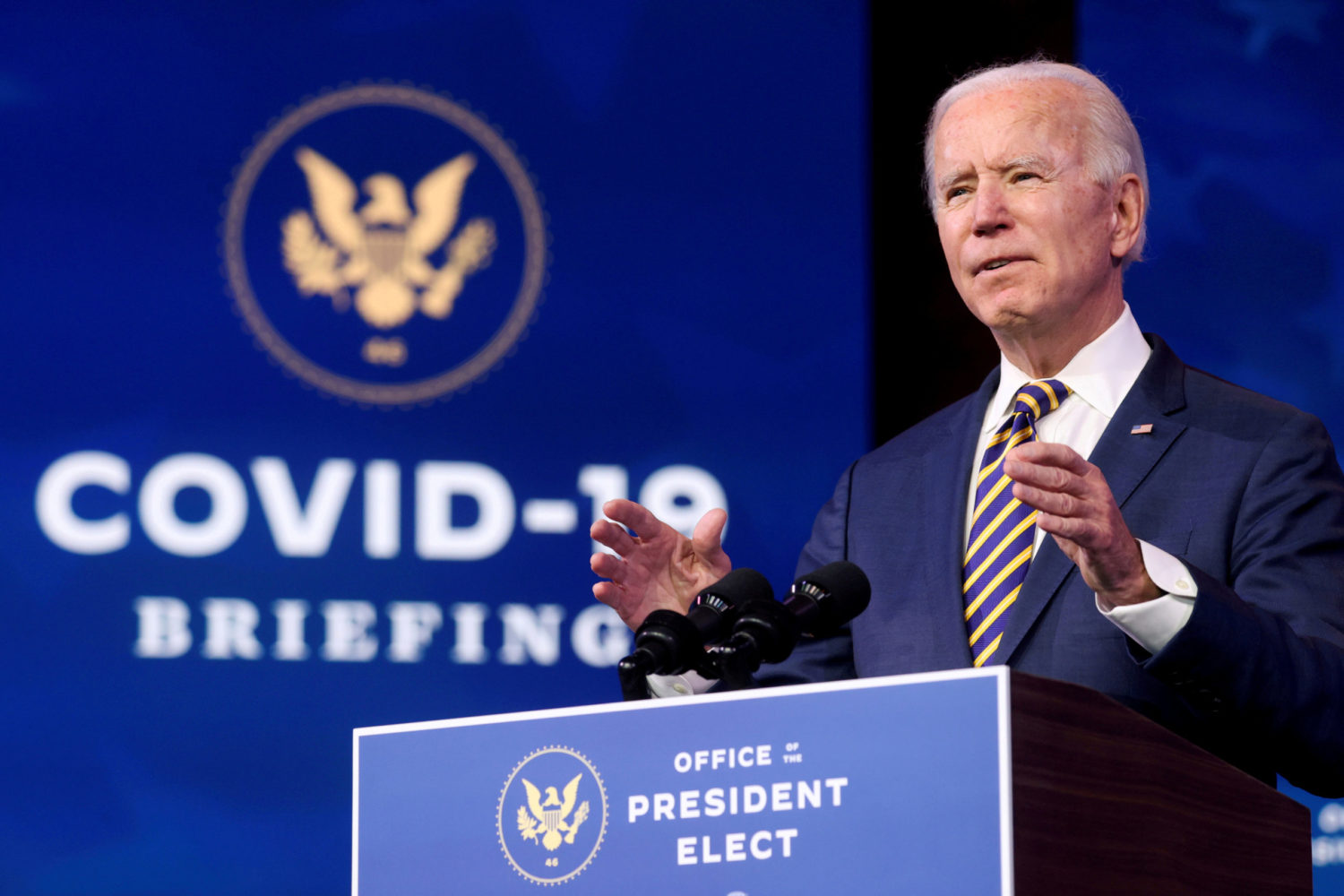
WASHINGTON (Reuters) – Democrats in the U.S. Senate were poised on Thursday to take a first step toward President Joe Biden’s $1.9 trillion COVID-19 relief proposal, in a marathon “vote-a-rama” session aimed at overriding Republican opposition to the package.

Senate Democrats need to pass a budget resolution to unlock a legislative tool called reconciliation, which would allow them to approve Biden’s proposal in the narrowly divided chamber with a simple majority. The House of Representatives approved the budget measure on Wednesday.

Most legislation must get at least 60 votes in the 100-seat Senate to pass. But the chamber is divided 50-50 and Republicans oppose the Democratic president’s proposal. Reconciliation would allow the Senate’s 48 Democrats and two independents to approve the relief package with a tie-breaking vote from Vice President Kamala Harris.

Senate Democrats and the Biden administration have left the door open to Republican participation but have said they want comprehensive legislation to move quickly to address a pandemic that has killed over 450,000 Americans and left millions more jobless.

“Seeing long lines of people waiting to get food around the country is something we should never see in the United States,” U.S. Treasury Secretary Janet Yellen said on ABC News’ “Good Morning America” program.

“This is really an urgent need. And we need to act big. We need to make sure that we provide a bridge so that people aren’t scarred indefinitely by this crisis,” she said.

But the Democrats’ march to add more assistance to last year’s $4 trillion in coronavirus relief could be complicated by the impeachment trial of Republican former President Donald Trump, which is set to begin next week and could distract from the legislation.

Once adopted, the budget resolution would provide spending instructions to House and Senate committees charged with crafting COVID-19 relief legislation.

The reconciliation measure is not a piece of legislation and does not require the president’s signature to take effect. If the Senate passes it without amendments, it will take effect immediately. If any amendments pass, the package would return to the House, which would need to vote on it again.

In show of bipartisanship, Senate Majority Leader Chuck Schumer, a Democrat, this week pledged that consideration of the budget resolution would be open to amendments from both parties in a process known informally as a “vote-a-rama,” which could run to late Thursday night or early Friday.

“We invite participation from both sides of the aisle,” Schumer on Thursday. “But I urge members not to lose sight of what this legislation will mean for the American people.”

Republicans expect to offer up to 20 amendments on issues ranging from energy and federal land use to executive orders.

(Reporting by David Morgan and Susan Heavey; Editing by Scott Malone and Jonathan Oatis)

U.S. calls for dialogue to resolve India’s farmers’ protests

By Sanjeev Miglani and Mayank Bhardwaj

NEW DELHI (Reuters) – The U.S. embassy in New Delhi urged India’s government on Thursday to resume talks with farmers whose months-long protests over agricultural reforms erupted into violence last week.

India’s Foreign Ministry said it had “taken note” of the comments and underlined ongoing efforts between Prime Minister Narendra Modi’s government and farmers groups to resolve the situation.

“We encourage that any differences between the parties be resolved through dialogue,” a U.S. embassy spokesperson said in a statement that also offered general support for the government’s efforts to “improve the efficiency of India’s markets and attract greater private sector investment.”

Modi’s government has held multiple rounds of talks with representatives of thousands of farmers who have camped, mostly peacefully, on the outskirts of New Delhi since late last year.

But no talks have been held since Jan 26., when some protesters clashed with police in the heart of the capital city following a military parade to mark Republic Day, and no indication has been given of when they might resume.

Television images of protesters occupying the ramparts of New Delhi’s historic Red Fort and later clashing with police drew international attention to the confrontation between Modi’s government and the farmers.

The farmers, who enjoy most support in northern India’s breadbasket states, argue that three new farm laws will hurt their interests while benefiting large firms.

But the government says the reforms will bring much-needed investment to a farm sector that accounts for nearly 15% of India’s $2.9 trillion economy but about half its workforce.

BARRICADES UP, INTERNET DOWN

Police remain on guard against further attempts by farmers to bring the protests into the capital, and have reinforced barricades at three main sites.

Earlier this week internet services were temporarily suspended in some areas, drawing widespread criticism, including from international activists and celebrities.

“We recognize that unhindered access to information, including the internet, is fundamental to the freedom of expression and a hallmark of a thriving democracy,” the U.S. embassy spokesperson said.

In response to social media posts on the internet shutdowns, India’s Foreign Ministry said on Wednesday that vested interest groups were mobilizing international support against the country.

“Any protests must be seen in the context of India’s democratic ethos and polity, and the ongoing efforts of the government and the concerned farmer groups to resolve the impasse,” ministry spokesman Anurag Srivastava said on Thursday.

Farm union leaders have been calling for a repeal of the new laws and to make the government’s crop price guarantee scheme legally binding, and for the withdrawal of legal cases against protesters.

But some farmer groups have expanded their list of demands.

At a rally in northern Haryana state on Wednesday, thousands of farmers from the politically influential Jat community backed a call to waive farm loans and increase crop prices paid by the government.

“If the government doesn’t concede to our demands, thousands more farmers will march towards Delhi,” Kek Ram Kandela, a leader among the Jat farmers, told the rally attended by more than 50,000 people.

(Additional reporting and Writing by Devjyot Ghoshal; Editing by Simon Cameron-Moore and Catherine Evans)

World faces around 4,000 COVID-19 variants as researchers explore mixed vaccine shots

By Guy Faulconbridge and Alistair Smout

LONDON (Reuters) – The world faces around 4,000 variants of the virus that causes COVID-19, prompting a race to improve vaccines, Britain said on Thursday, as researchers began to explore mixing doses of the Pfizer and AstraZeneca shots.

Thousands of variants have been documented as the virus mutates, including the so-called British, South African and Brazilian variants which appear to spread more swiftly than others.

British Vaccine Deployment Minister Nadhim Zahawi said it was very unlikely that the current vaccines would not work against the new variants.

“Its very unlikely that the current vaccine won’t be effective on the variants whether in Kent or other variants especially when it comes to severe illness and hospitalization,” Zahawi told Sky News.

“All manufacturers, Pfizer-BioNTech, Moderna, Oxford-AstraZeneca and others, are looking at how they can improve their vaccine to make sure that we are ready for any variant – there are about 4,000 variants around the world of COVID now.”

While thousands of variants have arisen as the virus mutates on replication, only a very small minority are likely to be important and to change the virus in an appreciable way, according to the British Medical Journal.

The so called British variant, known as VUI-202012/01, has mutations including a change in the spike protein that viruses use to bind to the human ACE2 receptor – meaning that it is probably easier to catch.

“We have the largest genome sequencing industry – we have about 50% of the world’s genome sequencing industry – and we are keeping a library of all the variants so that we are ready to respond – whether in the autumn or beyond – to any challenge that the virus may present and produce the next vaccine,” Zahawi said.

VACCINE RACE

The novel coronavirus – known as SARS-CoV-2 – has killed 2.268 million people worldwide since it emerged in China in late 2019, according to Johns Hopkins University of Medicine.

Israel is currently far ahead of the rest of the world on vaccinations per head of population, followed by the United Arab Emirates, the United Kingdom, Bahrain, the United States and then Spain, Italy and Germany.

Britain on Thursday launched a trial to assess the immune responses generated if doses of the vaccines from Pfizer and AstraZeneca are combined in a two-shot schedule.

The British researchers behind the trial said data on vaccinating people with the two different types of vaccines could help understanding of whether shots can be rolled out with greater flexibility around the world. Initial data on immune responses is expected to be generated around June.

The trial will examine the immune responses of an initial dose of Pfizer vaccine followed by a booster of AstraZeneca’s, as well as vice versa, with intervals of four and 12 weeks.

Both the mRNA shot developed by Pfizer and BioNtech and the adenovirus viral vector vaccine developed by Oxford University and AstraZeneca are currently being rolled out in Britain, with a 12-week gap between two doses of the same vaccine.

(Reporting by Guy Faulconbridge, Andy Bruce and Alistair Smout, editing by Estelle Shirbon and Nick Macfie)

No decisions made about U.S. troop levels in Afghanistan

WASHINGTON (Reuters) – No decisions have been made on U.S. troop levels in Afghanistan, the State Department said on Wednesday after a bipartisan report to Congress called on Washington to delay a Trump administration plan to pull all U.S. forces out by May 1.

“At this time, no decisions about our force posture have been made,” State Department spokesman Ned Price told reporters, saying the Biden administration was reviewing the U.S.-Taliban troop withdrawal pact negotiated by the Trump administration.

(Reporting by Arshad Mohammed and Lisa Lambert; Editing by Leslie Adler)

U.S. community health centers say they have given more vaccines than government data show

By Rebecca Spalding

(Reuters) – Some U.S. community health centers say they are doling out COVID-19 shots far faster than government data suggests, likely accounting for some of a gap between how states and the federal government describe the availability of vaccine doses.

The federal government said only about 60% of nearly 56 million doses of vaccines from Pfizer Inc or Moderna Inc that have shipped have been used. Yet states such as New York have said that their supplies are stretched thin.

Community health centers, which often serve people of color and those with low incomes, are an important piece of the Biden Administration’s plan for equitable COVID-19 vaccine distribution, which also includes pharmacies, mass vaccination sites, and hospitals.

Experts said data reporting issues at community health centers and other small providers likely represent some of the disparity, which has also been attributed to the slower-than-expected rollout pace at hospitals and nursing homes.

St. John’s Well Child and Family Center was allocated thousands of COVID-19 vaccines for their south Los Angeles community health centers. But weeks into their vaccination campaign, California state officials threatened to cut future deliveries for not administering doses fast enough.

The state’s data suggested the center had only given out 700 doses. St. John’s records showed it had administered shots into ten times that many arms.

“They think we’re sitting on thousands and thousands of doses,” St. John’s Chief Executive Jim Mangia said in an interview.

He has since begun working with officials and put 12 staffers on data entry – an expensive proposition for a center losing more than $100 on every shot due to mushrooming administrative costs, he said.

Four community health centers in New York and North Carolina said their experience has been was similar. Staff members spend hours each week entering data to meet state requirements, while juggling running vaccine clinics. Given the priority of protecting people from a deadly disease, keeping up with data entry sometimes fails.

The four centers said state reporting requirements were labor intensive and often involved manual data entry. Three said government registries have indicated they had doses on shelves at times when their supply had run out.

Six states including California, Pennsylvania, and Maryland told Reuters they had identified data reporting lags from some vaccinators. The states said they were working on measures to make their data more accurate.

New U.S. Centers for Disease Control and Prevention Director Rochelle Walensky said at a January White House media briefing that national data reflects a delay between when shots are given and when they are reported to states. She said the agency was working to better understand that delay.

MANY RULES TO FOLLOW

Beth Blauer, an executive director at Johns Hopkins University who has been tracking COVID-19 vaccines, said data is not being released in a way that can explain the “persistent deltas” between doses shipped and those used.

Blauer said an estimated 10% or less of doses distributed have gone to smaller providers, including community health centers. Their data reporting issues could account for only a small part of the gap, she said.

Rebecca Coyle, executive director at American Immunization Registry Association – a group for public health officials who track vaccination data – said it was no surprise community health centers and other small providers, like mom-and-pop pharmacies, would have greater data reporting challenges than large, well-resourced hospitals.

“It’s taking time to get folks up to speed in terms of what is required,” she said.

Roberta Kelly, chief nursing officer of Sun River Health, a community health center network in New York City, Long Island, and New York’s Hudson Valley, said she and other staff spend hours each week manually entering missing data to both the state’s and city’s vaccine registries.

The databases are both cumbersome to use and distinct, meaning much of the same information must be entered twice for shots given at their city locations, Kelly said, adding: “It’s like two different countries.”

A Sun River center in the New York City borough of Staten Island was highlighted at a Jan. 18 news conference by Governor Andrew Cuomo as one of the lowest-performing vaccinators in the city.

Kelly was puzzled by that conclusion. Doses are gone within days even when data suggests otherwise, she said.

Recently for instance, the city’s registry showed they had 250 doses available when in fact those doses had been given out days before.

“The system’s just not caught up with what’s actually happening on the ground,” Kelly said. “We’re following the rules and there are many of them.”

(Reporting by Rebecca Spalding; Editing by Caroline Humer and Bill Berkrot)

Biden decides to stick with Space Force as branch of U.S. military

WASHINGTON (Reuters) – President Joe Biden is looking at all policies put in place by Republican predecessor Donald Trump, with a view toward possibly rolling them back, but not so the U.S. Space Force.

“They absolutely have the full support of the Biden administration,” White House spokeswoman Jen Psaki told reporters on Wednesday about the Space Force, a day after her dismissal of a question about the service suggested Biden was less than enthusiastic about it.

The Space Force was created as a separate branch of the U.S. military by Trump, who spoke enthusiastically about the need for a force to protect American interests in orbit and celebrated its new flag in an Oval Office ceremony.

Since it was carved out of the Air Force, there had been speculation that Biden might seek to send the Space Force back to where it was before and deny Trump a signature achievement.

But Biden has decided to keep what has been called the world’s only independent space force, officially established in December 2019.

“We are not revisiting the decision to establish the Space Force,” Psaki said.

(Reporting by Nandita Bose and Steve Holland; Editing by Peter Cooney)