Rare bid to repeal war resolution advanced by U.S. Senate committee

By Patricia Zengerle

WASHINGTON (Reuters) – The U.S. Senate Foreign Relations Committee backed legislation on Wednesday that would repeal congressional authorizations for past wars with Iraq, a significant step in lawmakers’ effort to wrest back the power to declare war from the White House.

The 20-member panel backed the measure by voice vote with support from members of both parties, although at least seven Republicans asked to be recorded as “no” votes.

The committee’s action sent the joint resolution to the full Senate, where it is strongly supported by Democrats and backers say it is expected to garner enough Republican support to win the 60 votes needed for passage.

Senate Democratic Majority Leader Chuck Schumer said he planned a vote this year. “The Iraq War has been over for nearly a decade. An authorization passed in 2002 is no longer necessary in 2021,” Schumer said as he opened the Senate on Wednesday.

The legislation would repeal Authorizations for the Use of Military Force (AUMFs) passed in 1991 and 2002 for wars against Iraq under Saddam Hussein. Proponents of repeal argued that Iraq’s current government should be treated as a U.S. partner, not an enemy.

The House of Representatives backed repeal in June.

President Joe Biden’s administration supports the repeal, which is moving through Congress as opinion polls show Americans are weary of years of “forever wars” in Iraq, Afghanistan and elsewhere against militant groups.

Opponents said repeal would send a message of weakness in a volatile region. “I really believe that it would be a bad message to send… that we’re backing away from this,” said Senator Jim Risch, the top Foreign Relations Republican.

Democratic Senator Tim Kaine, a leader of the repeal effort, listed 10 reasons to vote yes. Among others, he called repeal a step toward Congress taking seriously “its most solemn responsibility” to send troops into combat, and prevent serious abuses in the future.

(Reporting by Patricia Zengerle; Editing by Howard Goller)

Tourists, residents evacuated by boat in Greece as wildfires rage

By Angeliki Koutantou and Karolina Tagaris

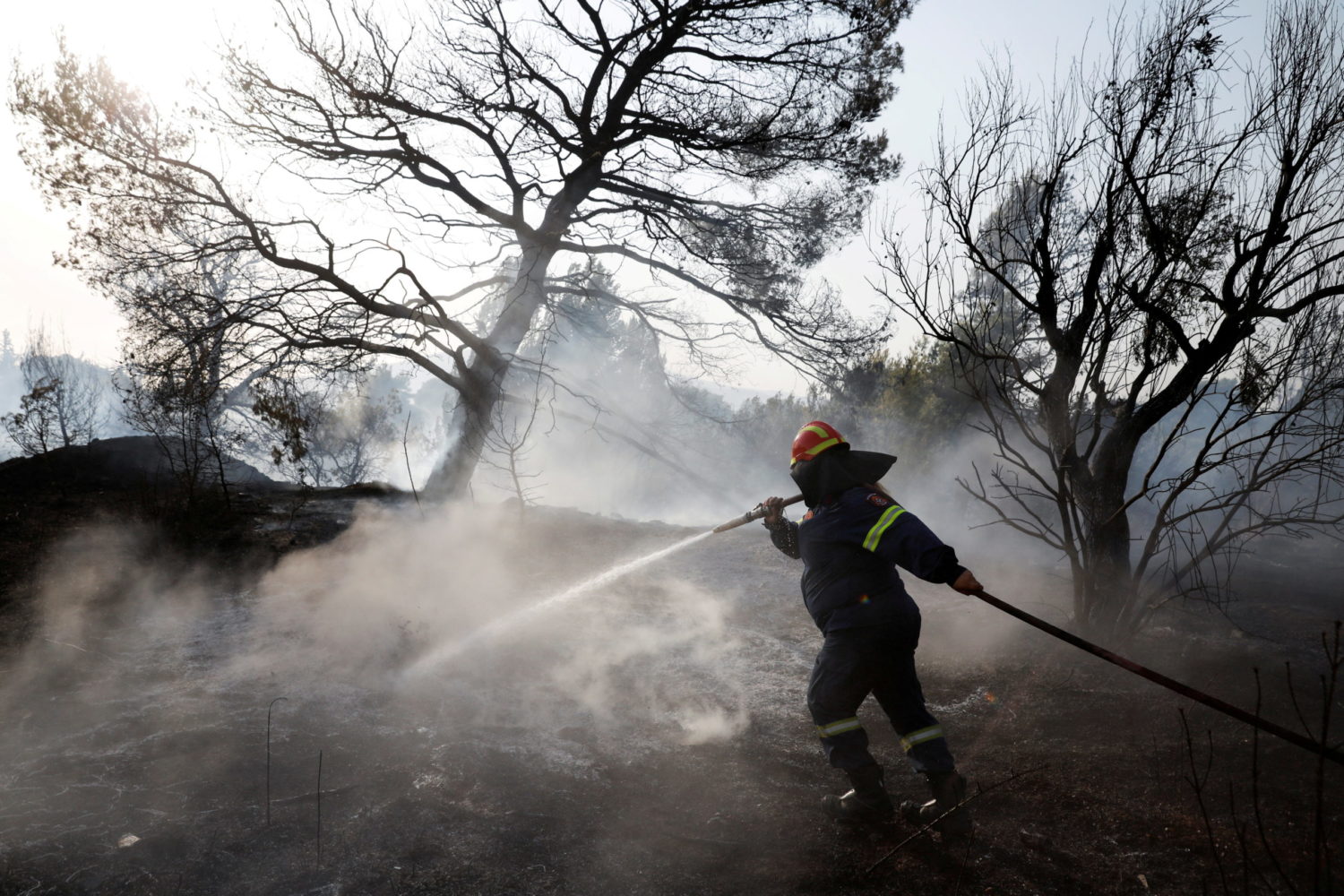
ATHENS (Reuters) -Scores of people on the Greek island of Evia fled to the shore to be evacuated by boat on Wednesday as a rapidly spreading wildfire tore through surrounding pine forests, leaving gutted buildings in its wake.

The fire, worsened by changing winds, has forced authorities on the island near Athens to evacuate several villages since late Tuesday.

Coast guard vessels picked up at least 50 people who had been evacuated from a beach close to the seaside village of Rovies on Wednesday and transferred them to a ferry, an official said.

“It was burning all night. The forest has been destroyed, villages were burned. We left behind our homes, we left our pets,” Christina Katsini, a Rovies resident, told Skai TV.

Tassos Baltas, a volunteer rescuer, said it was “raining ashes in Halkida”, Evia’s capital, some 100 km (62 miles) away.

Fires that had threatened houses on the northern outskirts of Athens on Tuesday eased slightly. But with Greece facing its most severe heatwave in 30 years, the risk remained high for the next few days in most parts of the country, authorities said.

Temperatures hovered above 40 degrees Celsius (107 Fahrenheit) for the third day.

“The weather conditions are extreme,” Deputy Citizens’ Protection Minister Nikos Hardalias said in a televised address. “We should remain on alert. We should avoid any – but any – activity that could cause a fire.”

Reinforcements arrived from Cyprus, and firefighters from France and two aircraft from Sweden were expected by Thursday, a Civil Protection Authority spokesperson said.

Fires were also burning in Halkidiki in northern Greece, the Peloponnese, in the regions of Messinia and Mani, and in Ilia, close to Ancient Olympia, which was the site of the first Olympic Games and was ordered to be evacuated.

Europe has been experiencing extreme weather this summer, from heavy flooding in the north to severe heatwaves and fires in parts of the Mediterranean, with Turkey hit by its most intense blazes on record.

Athens residents were told to stay indoors as a thick cloud of smoke hung over the city.

Fires near the town of Varympompi, north of the capital, damaged scores of buildings and destroyed more than 80 cars after breaking out on Tuesday.

“I saved my pets, that’s why I stayed,” said one Varympompi resident, Panagiotis, standing among burned cars and blackened pine trees. “I have goosebumps just talking about it; all the homes around me burned, nothing’s left.”

(Additional reporting by Giorgos Moutafis and Lefteris Papadimas, Writing by Karolina Tagaris)

U.S. to outfit border agents with body cameras in major oversight move

By Ted Hesson

WASHINGTON (Reuters) -The United States will require thousands of border agents to wear body cameras, according to three officials and government documents, a major operational change that could increase oversight of agents and also help capture criminal activity.

The cameras are expected to be rolled out in parts of Texas and New Mexico during the summer and expanded in the fall and winter to Arizona, California, and Texas’ busy Rio Grande Valley, which all border Mexico, according to a recent government assessment of how the devices could impact privacy. Agents in Vermont along the U.S. border with Canada will also be equipped with cameras, the assessment said.

U.S. border authorities plan to deploy a total of 7,500 body-worn cameras, with 6,000 in the field by the end of the year, a border agency official told Reuters.

Pro-immigrant activists will likely welcome the increased oversight that cameras could bring to an agency some have criticized for excessive use of force and institutional racism. But a union for border patrol agents also supports cameras, saying they could assist criminal investigations and help show that agents act professionally.

The American Civil Liberties Union and other groups have called on border patrol agents to use the cameras to improve accountability in the wake of several high-profile fatal shootings by law enforcement over the past decade.

Brandon Judd, president of the National Border Patrol Council, stressed that agents should have access to the footage, including when an agent is accused of wrongdoing.

Border Patrol’s parent agency, U.S. Customs and Border Protection (CBP), is the largest law enforcement agency in the United States, which presents a unique challenge for video footage collection and storage.

Recordings of illegal activity, use of force or agent misconduct could be used as evidence in investigations or prosecutions, the privacy assessment said.

The cameras could offer new insight into the policing of the southern border, where migrant arrests have risen to 20-year highs in recent months and encounters sometimes take place in remote areas.

In cases where footage could be used as evidence in a criminal case, it could be retained for up to 75 years, according to the privacy assessment. Footage that does not have value as evidence would be destroyed within 180 days.

After a bipartisan group of lawmakers spearheaded efforts to secure funding for bodycams, CBP awarded a total of about $21 million to Axon Enterprises Inc. for body cameras and to connect the cameras to a cloud-based storage system, according to the agency official.

The devices are the size of a deck of playing cards and will be affixed to the front of agents’ uniforms, the official said.

Axon declined to comment on the rollout.

CBP conducted a small pilot of body cameras in 2015, but ultimately opted not to deploy them then.

An agency assessment at the time said the cameras would likely reduce the use of physical force on the job, but cited a number of reasons not to adopt the devices, including cost and agent morale.

Gil Kerlikowske, who was CBP commissioner at the time, said another consideration was that the cameras “did not hold up particularly well” in the field, where they could be knocked off in the brush or mucked up with dust and dirt.

Body cameras have become more commonplace since the 2015 effort. The U.S. Department of Justice said in June that its agents would be required to wear cameras when serving search and arrest warrants.

Kerlikowske said many law enforcement officers support the idea, too.

“There are now police officers who won’t go on the street without their body camera,” he said. “They want that video image.”

(Reporting by Ted Hesson in Washington, editing by Ross Colvin, Aurora Ellis, Mica Rosenberg and Diane Craft)

Global COVID-19 cases surpass 200 million as Delta variant spreads

By Roshan Abraham and Kavya B

(Reuters) – Coronavirus cases worldwide surpassed 200 million on Wednesday, according to a Reuters tally, as the Delta variant threatens areas with low vaccination rates.

Cases are rising in at least 83 out of 240 countries, according to the tally, and straining healthcare systems.

“While we desperately want to be done with this pandemic, COVID-19 is clearly not done with us. And so our battle must last a little longer,” Dr. Rochelle Walensky, director of the U.S. Centers for Disease Control and Prevention, said this week.

At least 2.6% of the world’s population has been infected, with the true figure likely higher due to limited testing in many places. If the number of infected people were a country, it would be eighth most populous in the world, behind Nigeria, according to a Reuters analysis.

It took over a year for COVID-19 cases to hit 100 million mark, while the next 100 million were reported in just over six months, according to the analysis. The pandemic has left close to 4.4 million people dead.

The countries reporting the most cases on a seven-day average – the United States, Brazil, Indonesia, India and Iran – represent about 38% of all global cases reported each day.

The United States accounts for one in every seven infections reported worldwide. U.S. states with low vaccination rates such as Florida and Louisiana are seeing record numbers of COVID patients hospitalized, despite the nation giving 70% of adults at least one vaccine shot. The head of one Louisiana hospital warned of the “darkest days” yet.

Unvaccinated people represent nearly 97% of severe cases, according to the White House COVID-19 Response Team.

RISING CASES IN ASIA

Countries in Southeast Asia are also reporting rising cases. With just 8% of the world’s population, the region is reporting almost 15% of all global cases each day, according to a Reuters analysis.

Indonesia, which faced an exponential surge in COVID-19 cases in July, is reporting the most deaths on average and surpassed 100,000 total deaths on Wednesday. The country accounts for one in every five deaths reported worldwide each day. The Southeast Asian nation aims to gradually reopen its economy in September, Health Minister Budi Gunadi Sadikin said on Monday, citing that the wave of infections had passed its peak, with daily confirmed cases on the decline.

After suffering its worst outbreak in April-May, India is once again seeing a rising trend of cases. Last Friday, the country reported 44,230 new COVID-19 cases, the most in three weeks, fueling worries of a third wave of infections that has forced one state to lockdown.

China’s Wuhan city, where the virus first emerged in late 2019, will test its 12 million residents for the coronavirus after confirming its first domestic cases of the Delta variant. The city had reported no local cases since mid-May last year.

The Delta variant is upending all assumptions about the virus, with disease experts scrambling to find whether the latest version of coronavirus is making people, especially unvaccinated individuals, sicker than before.

The CDC said in an internal document that the variant, first detected in India, is as contagious as chickenpox and far more contagious than the common cold or flu.

A key issue, said Dr. Gregory Poland, a vaccine scientist at the Mayo Clinic, is that the current vaccines block disease, but they do not block infection by keeping the virus from replicating in the nose.

As a result, he said, “the vaccines we have currently are not going to be the be-all, end-all,” he said. “We are now in a scenario of our own making, where this is going to be years to decades to now defeat. … And we’re going to chase our tail with variants until we get a type of vaccine that offers infection and disease-blocking capabilities.”

Many countries are still facing shortages of testing kits, medicines and vaccines, as the Delta variant strains healthcare services in poorer nations. Wealthier nations are being urged to donate more vaccine to curb the outbreak globally.

The World Health Organization (WHO) is seeking $11.5 billion to fight the Delta outbreak, a draft report seen by Reuters shows, amid worries wealthy nations are partly bypassing its COVID-19 programs.

(Reporting by Roshan Abraham and Kavya B in Bengaluru; Additional reporting by Julie Steenhuysen in Chicago; Editing by Lisa Shumaker)

Factbox-Countries making COVID-19 vaccines mandatory

(Reuters) – A sharp upturn in new coronavirus infections due to the highly contagious Delta variant and a slowdown in vaccination rates have pushed governments to make COVID-19 shots mandatory for health workers and other high-risk groups.

A growing number of countries also stipulate that a shot, or a negative test, will be needed for dining out, among other activities.

Here are some countries’ vaccine mandates:

AUSTRALIA

Australia decided in late June to make COVID-19 vaccinations mandatory for high-risk aged-care workers and employees in quarantine hotels.

It has also made vaccinations obligatory for Paralympic athletes heading to Tokyo because unvaccinated members on the team could pose a health risk.

BRITAIN

It will be mandatory for care home workers in England to have coronavirus vaccinations from October.

English nightclubs and other venues with large crowds will require patrons to present proof of full vaccination from the end of September.

CANADA

Canada’s Treasury Board Secretariat said on July 20 it was considering whether COVID-19 vaccines should be required for certain roles and positions in the federal government, according to CBC News.

FRANCE

The French parliament on Aug. 2 approved a bill which will make COVID-19 vaccinations mandatory for health workers as well as require a bolstered health pass in many social venues.

The government said on July 19 that the planned 45,000 euro ($53,456) fine for businesses that do not check that clients have a health pass will be much lower, starting at up to 1,500 euros and increasing progressively for repeat offenders. Fines will not be imposed immediately.

GREECE

Greece on July 12 made vaccinations mandatory for nursing home staff with immediate effect and healthcare workers from September. As part of new measures, only vaccinated customers are allowed indoors in bars, cinemas, theatres and other closed spaces.

INDONESIA

Indonesia made COVID-19 inoculations mandatory in February, with the capital Jakarta threatening fines of up to 5 million rupiah ($357) for refusing.

ITALY

A decree approved by the Italian government in March mandates that health workers, including pharmacists, get vaccinated. Those who refuse could be suspended without pay for the rest of the year.

HUNGARY

Hungary’s government has decided to make vaccinations mandatory for healthcare workers, Prime Minister Viktor Orban told public radio on July 23.

KAZAKHSTAN

Kazakhstan will introduce mandatory COVID-19 vaccinations or weekly testing for people working in groups of more than 20, the health ministry said on June 23.

LEBANON

Lebanon is to limit entry to restaurants, cafes, pubs and beaches to people holding vaccine certificates or those who have taken antibodies tests, the tourism ministry said on July 30. Non-vaccinated employees of these establishments would be required to conduct a PCR test every 72 hours.

MALTA

Malta banned visitors from entering the country from July 14 unless they are fully vaccinated.

POLAND

Poland could make vaccinations obligatory for some people at high risk from COVID-19 from August.

RUSSIA

The Russian capital has unveiled a plan of all service sector workers to be fully vaccinated by Aug. 15, according to the Moscow Times.

Moscow residents no longer have to present a QR code demonstrating they have been vaccinated or have immunity in order to sit in cafes, restaurants and bars from July 19.

SAUDI ARABIA

In May, Saudi Arabia mandated all public and private sector workers wishing to attend a workplace get vaccinated, without specifying when this would be implemented.

Vaccination will also be required to enter any governmental, private, or educational establishments and to use public transportation as of Aug. 1.

Saudi citizens will need two vaccine doses before they can travel outside the kingdom from Aug. 9, state news agency SPA reported on July 19, citing the ministry of interior.

TURKMENISTAN

Turkmenistan’s healthcare ministry said on July 7 it was making vaccination mandatory for all residents aged 18 and over.

UNITED STATES

U.S. President Joe Biden announced on July 29 that all civilian federal workers will need to be vaccinated against the coronavirus or face regular testing, social distancing, mask requirements and travel limits, a source familiar with the matter said.

New York City will become the first major U.S. city to require, from Sept. 13, proof of vaccination for customers and staff at restaurants, gyms and other indoor businesses as the country enters a new phase of battling the Delta variant.

New York will require state employees to be vaccinated or get tested weekly, a mandate that will go into effect on Sept. 6, Governor Andrew Cuomo said.

The Port Authority of New York and New Jersey and the Metropolitan Transportation Authority will require their workers to get the vaccine or get tested weekly, Cuomo said on Aug. 2.

New Jersey state health care workers and employees who work in jails must by vaccinated by Sept. 7 or face testing twice a week.

California Governor Gavin Newsom said that all state employees would be ordered to get vaccinated starting Aug. 2 or undergo COVID-19 testing at least once a week.

Denver municipal employees and people working in high-risk settings in the city will be required to get vaccinated, Mayor Michael Hancock said on Aug. 2.

($1 = 0.8418 euros)

(Compiled by Paulina Cwikowska, Dagmarah Mackos and Oben Mumcuoglu; editing by Milla Nissi, Steve Orlofsky, Joe Bavier and Nick Macfie)

Beirut marks year since port blast with demands for justice

By Imad Creidi

BEIRUT (Reuters) – Thousands of Lebanese gathered near the port of Beirut on Wednesday to mark the first anniversary of a catastrophic explosion that devastated the city, demanding justice for the victims.

One year since the disaster, caused by a huge quantity of ammonium nitrate stored unsafely at the port for years, no senior official has been held to account, infuriating many Lebanese as their country also endures financial collapse.

One of the biggest non-nuclear explosions ever recorded, the explosion wounded thousands and was felt in Cyprus, more than 240 km (150 miles) away.

An investigation is stalling with requests denied for immunity to be lifted from senior politicians and former officials. All those sought for questioning by the Lebanese investigators have denied any wrongdoing.

“We will not forget and we will not forgive them ever. And if they can’t bring them to account, we will by our own hands,” said Hiyam al-Bikai, dressed in black and clutching a picture of her son, Ahmad, who was killed when masonry fell on his car.

A huge banner on a building overlooking the port said: “Hostages of a Murderous State.”

French President Emmanuel Macron, who has led Western pressure for reform in Lebanon, said its leaders owed the people the truth and heaped new criticism on the governing elite for failing to deal with the economic crisis.

The damage is still visible across much of Beirut. The port resembles a bomb site, its huge wrecked grain silo unrepaired.

Thousands of people, waving Lebanese flags and holding pictures of the dead, had marched towards the port, where prayers are expected to be held just after 6 p.m. (1500 GMT), coinciding with the time of the blast.

“We want our rights – the rights of the martyrs and victims. Their immunities are not more dear than the blood of the martyrs and victims,” said Hanan Hoteit, whose relative, Tharwat, was killed at the port.

A Human Rights Watch report released this week concluded there was strong evidence to suggest some Lebanese officials knew about and tacitly accepted the lethal risks posed by ammonium nitrate.

Reuters reported last August that Prime Minister Hassan Diab and President Michel Aoun were both warned in July last year that the chemicals posed a security risk and could destroy the capital if they exploded.

Aoun has said he is ready to testify if needed, and that he supports an impartial investigation.

Diab, who quit after the blast, has said his conscience is clear.

The chemicals arrived on a Russian-leased cargo ship that made an unscheduled stop in Beirut in 2013. An FBI report seen by Reuters last week estimated around 552 tonnes of ammonium nitrate exploded, less than the 2,754 tonnes that arrived.

That discrepancy is one of the many questions that remain unanswered. No one ever came forward to claim the shipment.

PRAYERS

Leading prayers at a hospital that was badly damaged in the blast, Greek Orthodox Archbishop Elias Audi said the investigation must continue until punishment is meted out to those who deserve it.

Nobody was above the law, he said, and “whoever obstructs justice is a criminal, even if they are highly placed.”

At the time of the explosion, Lebanese were already facing deepening hardship due to the financial crisis caused by decades of state corruption and waste.

The meltdown worsened throughout the last year with the governing elite failing to establish a new cabinet to start tackling the crisis even as poverty has soared and medicines and fuel have run out.

Hosting a donors’ conference for Lebanon, Macron pledged a further 100 million euros ($120 million) in emergency aid and 500,000 doses of COVID-19 vaccines. He is trying to raise more than $350 million.

“Lebanese leaders seem to bet on a stalling strategy, which I regret and I think is a historic and moral failure,” he said.

Pope Francis wished Macron success and said donors should help Lebanon “on a path of resurrection.” He said he had a great desire to visit Lebanon, where many had lost “even the illusion of living.”

The state has taken no steps towards reforms that might ease the economic crisis, with the sectarian elite locked in a power struggle over cabinet posts.

(Additional reporting by Philip Pullella at Vatican City and Michel Rose in Paris; Writing By Maha El Dahan/Tom Perry; Editing by Giles Elgood and Angus MacSwan)

Oil prices fall as Delta variant spread weighs

By Ahmad Ghaddar

LONDON (Reuters) -Oil prices fell sharply to a two-week low on Wednesday as the spread of the coronavirus Delta variant in top consuming countries outweighed the impact of Mideast geopolitical tensions and a fall in U.S. inventories.

Brent crude oil futures were down $1.80, or 2.5%, to $70.61 a barrel by 1349 GMT. U.S. West Texas Intermediate (WTI) crude fell $2.15, or 3.1%, to $68.41 a barrel. Both contracts were trading at their lowest since July 21.

“Worries continue to grow over the spread of the Delta variant in China, which has weighed heavily on oil prices in recent days,” analysts at bank ING said.

The United States and China, the world’s two biggest oil consumers, are grappling with rapidly spreading outbreaks of the highly contagious Delta variant that analysts anticipate will limit fuel demand at a time when it traditionally rises in both countries.

In China, the spread of the variant from the coast to inland cities has prompted authorities to impose strict measures to bring the outbreak under control.

An expected fall in U.S. oil inventories failed to arrest losses.

U.S. crude inventories fell by 879,000 barrels for the week ended July 30, according to two market sources, citing figures from industry group American Petroleum Institute (API).

Gasoline inventories fell by 5.8 million barrels and distillate stocks fell by 717,000 barrels, the data showed, according to the sources, who spoke on condition of anonymity.

Official Energy Information Administration numbers are due later on Wednesday.

Tensions in the Mideast Gulf also supported prices.

On Tuesday, three maritime security sources claimed Iranian-backed forces seized an oil product tanker off the coast of the United Arab Emirates, though Iran denied the reports.

This is the second attack on a tanker since Friday in the region, which includes the Strait of Hormuz. The United Kingdom and the United States are also blaming Iran for the earlier incident, in which drones crashed into the vessel and killed two sailors. Iran denies the reports.

(Additional reporting by Naveen Thukral in Singapore; editing by Jason Neely and Barbara Lewis)

Blast in Afghan capital as Taliban claim attack on minister’s compound

KABUL (Reuters) -An explosion near the office of Afghanistan’s main security agency wounded three people on Wednesday, hours after a bomb and gun attack on a minister’s compound brought surging Taliban violence to the capital.

The Taliban claimed responsibility for the late Tuesday attack on the home of acting Defense Minister Bismillah Mohammadi. There was no immediate claim for the Wednesday blast.

Mohammadi survived the attack on his compound in a heavily fortified part of Kabul, but the violence was a stark illustration of the deterioration in security as U.S.-led foreign forces complete their withdrawal and the Islamist insurgents seize swathes of territory.

Taliban spokesperson Zabihullah Mujahid said his group targeted the minister’s residence as an important meeting was underway there.

Government forces battled the attackers for more than four hours and the Ministry of Interior said at least eight civilians were killed and 20 wounded.

The blast on Wednesday near a facility of the National Directorate of Security wounded two civilians and a security official, police said.

The Taliban have stepped up their campaign to defeat the U.S.-backed government since April as foreign forces complete their withdrawal after 20 years of war.

Fighting has been particularly heavy around the city of Herat, near the western border with Iran, and Lashkar Gah and Kandahar in the south.

An Afghan military spokesman said an emergency had been declared in Lashkar Gah and government forces were getting reinforcements and U.S. air support. “Special forces have been sent to the area. They are in good morale,” armed forces spokesman General Ajmal Omar Shinwari told Reuters.

The loss of Lashkar Gah would be a huge blow for the government, which has pledged to defend strategic centers after losing many rural districts to the Taliban in recent months.

Scores of families have fled from their homes in the small city, capital of Helmand province, as government forces launched a counterattack against the Taliban.

The United Nations reported on Tuesday that at least 40 civilians had been killed in Lashkar Gah in the previous 24 hours.

On Wednesday, doctors were receiving hundreds of wounded people from Laskar Gah and neighboring Greshk as air strikes and ground clashes continued near medical facilities and residential districts.

“Hospitals are receiving dead bodies, injured and some pregnant women…civilians are the worst affected,” said Shir Ali Shaker, head of the Helmand Public Health Department.

Taliban fighters had taken control of some radio and TV stations in the city and were moving into homes to stop people from helping government forces, residents said.

(Reporting by Kabul bureau; Editing by Tom Hogue, Robert Birsel and Mark Heinrich)

Car bomb hits near Kabul ‘Green Zone’; six dead including attackers

KABUL (Reuters) -A car bomb blast followed by sporadic gunfire hit Afghanistan’s capital Kabul on Tuesday near the heavily fortified “Green Zone,” leaving three civilians and three attackers dead, security officials said amid an upturn in violence by Taliban militants.

At least seven other people were wounded, said health ministry spokesperson Ghulam Dastagir Nazari. An interior ministry spokesperson said security forces’ operations ended with the death of all attackers.

A senior security official said the blast appeared to have been caused by a car bomb and the target was the acting defense minister’s home and the adjoining residence of a member of parliament.

The attack – in the heart of one of Kabul’s most secure areas – came during an escalation in violence by the Taliban. Attacks have risen sharply since President Joe Biden announced U.S. troops would leave by September even as the Taliban intensified its attacks on major cities.

Three unidentified gunmen were killed at Tuesday’s attack site which is home to Afghan officials, lawmakers and prominent residents.

No group immediately claimed responsibility.

Minutes after the blast, hundreds of civilians in Kabul came out on to the streets and chanted Allahu Akbar (God is Greatest) to express their support for Afghan government forces and opposition to the Taliban.

The night-time march spilled across the city with mostly men and some women joining in the demonstrations, carrying candles and Afghan flags to signal united opposition to the hardline Islamist group.

“The whole world can choose to be silent about what is going on in Afghanistan but we can’t and won’t stay quiet anymore…we will stand side by side with our security forces until our last breath,” said a demonstrator in Kabul on condition of anonymity.

The country’s first Vice President Amrullah Saleh said the demonstrations were “historic moments” of “emotions and patriotism.”

“Allah o Akbar, death to Talib terrorists & their backer,” he said in a tweet at a time when Afghan forces flushed out militants in the overnight operations.

Last week, residents in the western province of Herat braved the streets despite nearby fighting to protest against the Taliban. Other cities quickly organized to join from their homes in the evenings, as a message of support for embattled security forces.

After Tuesday’s bomb attack, acting Defense Minister Bismillah Mohammadi said no harm was caused to him and his family members but some of his security guards were injured.

A Kabul police spokesperson said at least 30 civilians had been rescued from the blast site. The city’s Emergency Hospital said in a tweet it had so far received 11 people wounded in the attack.

Afghan forces appealed to residents of the southern city of Lashkar Gah to leave their homes and stay away from areas where the Taliban were taking control, as they intend to launch operations against the group where its fighters were travelling freely.

The loss of Lashkar Gah would be a huge strategic defeat for the government, which has pledged to defend strategic centers after losing much of the rural parts to the Taliban in recent months.

The Taliban said their fighters killed a district governor of central Maidan Wardak province on Tuesday, the latest in a series of killings by the insurgent group aimed at eliminating senior government officials and social activists.

(Reporting by Kabul bureau, Editing by Nick Tattersall, William Maclean and Alistair Bell)

WHO’s pandemic project faces cash crunch amid vaccine, oxygen shortages

By Francesco Guarascio

BRUSSELS (Reuters) – The World Health Organization (WHO) is seeking $11.5 billion in urgent funding to fight the more infectious Delta variant of the coronavirus, a draft report seen by Reuters shows, amid worries wealthy nations are partly bypassing its COVID-19 programs.

A large portion of the cash being requested from the WHO’s partners is needed to buy tests, oxygen and face masks in poorer nations, says the document which is expected to be released this week. And a quarter of it would be to buy hundreds of millions of vaccines for them that would otherwise go elsewhere.

The paper, still subject to changes, outlines the results and financial needs of the Access to COVID-19 Tools Accelerator (ACT-A), the program co-led by the WHO to distribute fairly COVID-19 vaccines, drugs and tests across the world.

The program, set up at the start of the pandemic, remains vastly underfunded, and its coordinators are now acknowledging it will remain so as many governments look to address global COVID needs “differently,” an ACT-A official told Reuters, speaking on condition of anonymity.

As a result, it has cut by nearly $5 billion its total request for funds, the document shows. But it still needs $16.8 billion, almost as much as what has been raised so far, and $7.7 billion is required urgently.

The document also calls for a further $3.8 billion, on top of the $7.7 billion, to take up options for 760 million doses of COVID-19 vaccines that would be delivered next year.

“These options to buy need to be exercised in the coming months or vaccine doses will be lost,” the document warns.

WHO Director-General Tedros Adhanom Ghebreyesus last week said that $7.7 billion were urgently needed, but did not give a breakdown of planned spending, and did not say how much extra money was needed for vaccines.

The WHO was not immediately available to comment.

The latest cash crunch will underscore concerns about the long-term future of the program, which has struggled to secure supplies and equipment to tame a pandemic that has killed more than 4.2 million.

The vaccine portion of the project, called COVAX, is increasingly reliant on donations from wealthy nations, rather than its own supplies, after key manufacturer India restricted exports of shots to boost domestic vaccinations.

But the United States, European Union and Japan have also donated vaccines directly to countries as part of their vaccine diplomacy drives. Japan has also said it’s a quicker process than going through COVAX.

Some countries have provided equipment directly to others too. Last month, Australia said it would donate oxygen-related equipment, antigen test-kits as well as vaccines to Indonesia.

The plea for cash comes as a review of the ACT-A gets under way, with France, Germany and Canada among the countries steering the process. A report on the program’s results and shortcomings is expected in September by consultancy Dalberg Global Development Advisors, the ACT-A official said.

OXYGEN NEEDS

Among ACT-A’s immediate needs are $1.2 billion for oxygen to treat seriously ill COVID-19 patients in poorer countries where supplies are low, the report says.

Oxygen has moved up the priority list given vaccines are not available, the ACT-A official said, highlighting the repercussions from the shortage of shots as the Delta variant spreads to 132 countries.

COVAX has delivered about 180 million vaccines, far short of its 2 billion target by the end of this year.

Oxygen is needed to “control the exponential death surges caused by the Delta variant,” the document says.

Global demand for medical oxygen is currently more than a dozen times greater than before the pandemic, the document says, but many countries are struggling to access sufficient supplies.

The urgent need for the most basic treatment against COVID-19 one and a half years into the pandemic shows how little has been done to combat the virus in most of the world, the ACT-A official said, noting: “There hasn’t been much progress. What was urgent three months ago is still urgent now.”

“Inequity in access to life-saving COVID-19 tools has never been more apparent,” the document says.

In rich nations, most people have already been vaccinated, including the younger who are less at risk from COVID-19, whereas in poorer nations the most vulnerable are still waiting for a first dose and there is a lack of basic materials, such as face masks and other personal protective equipment (PPE).

“Avoidable death and unsustainable pressure on health systems is mounting in many countries due to insufficient access to oxygen and PPE,” the document says.

At least $1.7 billion are urgently needed to buy protective devices for healthcare workers in poorer nations, the document says, and another $2.4 billion are needed to boost testing in low-income countries.

(Reporting by Francesco Guarascio @fraguarascio; Editing by Josephine Mason and Mark Potter)