10 dead, dozens trapped after landslide in India’s Himalayas – officials

By Devjyot Ghoshal and Alasdair Pal

NEW DELHI (Reuters) -A landslide in the mountainous Indian state of Himachal Pradesh has killed at least 10, injured 14 and left dozens trapped after boulders tumbled on to a major highway on Wednesday, smashing and burying several vehicles, Indian officials said.

Around 30 people are still trapped, including passengers inside a bus lying under the debris, Vivek Kumar Pandey, a spokesman for the paramilitary Indo-Tibetan Border Police, told Reuters.

“There has been a massive landslide on the Reckong Peo-Shimla highway,” Pandey said, later adding that “operations are under way, we are trying to reach the bus.”

Abid Hussain Sadiq, a top government official in the Kinnaur district where the incident happened, said that rescue operations could continue through the night in an attempt to find the survivors.

More than 200 personnel, including from the army, paramilitary forces and local police, are working along a stretch of National Highway 5 that runs along the Sutlej river and connects northern India to the border with China, officials said.

Local police chief Saju Ram Rana said the landside, which happened around noon on Wednesday, loosened large boulders and sent them cascading down the steep mountainside, blocking about 150 meters of the highway.

“The debris fell from quite high up,” Rana told Reuters, adding that heavy machinery was being brought in to clear the area.

In pictures shared by authorities on social media, helmeted rescue workers can be seen scrambling around the mangled remains of vehicles stranded among rocks and loose earth.

In late July, at least nine people were killed by a landslide in a different part of Kinnaur district, and dozens have been left stranded by landslides and flooding in recent weeks in another area of Himachal Pradesh, a scenic Himalayan state popular with tourists.

(Reporting by Devjyot Ghoshal and Alasdair Pal; Editing by Sanjeev Miglani, Kirsten Donovan)

Manchin concerned about “grave consequences” of U.S. Senate’s $3.5 trln spending plan

By Makini Brice and Susan Cornwell

WASHINGTON (Reuters) -U.S. Democratic Senator Joe Manchin on Wednesday said he had serious concerns about Senate Democrats’ planned $3.5 trillion spending plan, potentially gumming up efforts to move ahead with President Joe Biden’s top priorities.

The Democrat-led Senate approved a blueprint for the plan early on Wednesday morning in a 50-49 vote along party lines, after lawmakers sparred over the need for huge spending to fight climate change and poverty.

Now Biden’s Democratic Party embarks on weeks of debates about priorities including universal preschool, affordable housing and climate-friendly technologies, with progressives like Representative Alexandria Ocasio-Cortez seeking robust action on climate change and moderates including Senator Kyrsten Sinema expressing concern about the bill’s price tag.

Manchin, a moderate who often acts as a bridge between his party and the Republicans, said in a statement that he was worried about potentially “grave consequences” for the nation’s debt as well as the country’s ability to respond to other potential crises.

The vote followed about 14-1/2 hours of debate that started right after the Senate on Tuesday passed a $1 trillion infrastructure bill in a bipartisan 69-30 vote, proposing to make the nation’s biggest investment in decades in roads, bridges, airports and waterways.

“It’s been quite a night. We still have a ways to go, but we’ve taken a giant step forward to transforming America. This is the most significant piece of legislation that’s been considered in decades,” Democratic Senate Majority Leader Chuck Schumer told reporters after the budget resolution passed.

The bills have been a top priority for Biden, who has sought to enact sweeping changes during a time when Democrats hold fear loss of legislative control in the looming 2022 elections.

The Democrats plan to push the package through over the next few months, using a process called “budget reconciliation,” which allows them to pass legislation with a simple majority vote.

House Majority Leader Steny Hoyer, a Democrat, said the House would return from its summer break early on Aug. 23 to consider the budget resolution.

Republicans have railed against the $3.5 trillion spending plan. Senate Republican leader Mitch McConnell, who voted for the $1 trillion infrastructure bill, called the larger proposal “radical.”

Energy Secretary Jennifer Granholm told CNN on Wednesday morning that the Biden administration will push for both pieces of legislation and leave Congress to decide the order in which they are considered.

Granholm added that “there’s a lot to like” in the spending bill for Manchin, Sinema and other moderates, saying the hefty cost would be covered with taxes on people earning more than $400,000 a year and on corporations.

DEBT CEILING LOOMS

Dozens of Republican senators also signed a pledge not to vote to raise the nation’s borrowing capability when it is exhausted in the autumn to try to curtail Democrats’ spending plans.

“They (Democrats) shouldn’t be expecting Republicans to raise the debt ceiling to accommodate their deficit spending,” Senator Ron Johnson, a Republican who circulated the pledge, told the Wall Street Journal.

Failure to increase or suspend the statutory debt limit – now at $28.5 trillion – could trigger a federal government shutdown or a debt default.

Treasury Secretary Janet Yellen this week urged Congress to raise the debt limit in a bipartisan vote. On Tuesday, Yellen also endorsed moving forward with the larger spending package, saying the $1 trillion infrastructure plan should have a sequel.

UNCERTAIN FUTURE

On Tuesday, Biden lauded the 19 Republicans who voted for the bipartisan $1 trillion infrastructure measure. “Here on this bill, we’ve proven that we can still come together to do big things – important things – for the American people,” he said.

House Speaker Nancy Pelosi has said her chamber will not vote on the infrastructure bill or the larger spending package until both are delivered, which will require the Democratic leadership to hold its narrow majorities in Congress together to get the legislation to Biden’s desk.

Leading House progressive Democrats said on Tuesday that most progressives would not vote for the bipartisan infrastructure bill until the Senate also passes a “robust” second spending measure. That was in contrast to more moderate House Democrats, who want a quick vote on the infrastructure bill.

Polls show the drive to upgrade America’s infrastructure, hammered out over months by senators from both parties, is broadly popular with the public. The bill includes $550 billion in new spending, as well as $450 billion in previously approved infrastructure investment.

Democrats will begin crafting the reconciliation package for a vote on passage after they return from their summer break in September.

Following the budget resolution vote, Schumer filed a cloture petition on a compromise voting bill for the chamber to vote on upon its return in September. A previous attempt to overhaul electoral laws with sweeping legislation known as the “For the People Act” was blocked in June.

(Reporting by Susan Cornwell and Makini Brice, additional reporting by David Morgan, Susan Heavey and Lisa Lambert; Editing by Scott Malone, Shri Navaratnam, Kim Coghill and Hugh Lawson)

Blazes flare anew in Greece but spare ancient Olympia

By Lefteris Papadimas and Leon Malherbe

EVIA, Greece, (Reuters) – A big blaze that swelled overnight forced the evacuation of many villages on Greece’s Peloponnese peninsula on Wednesday, as exhausted firefighters battled wildfires for a ninth consecutive day and as fires also raged in Algeria, Turkey and elsewhere.

In the north of Evia, Greece’s second-largest island, flare-ups remained the main problem for firefighters, who were joined by volunteers to combat the flames.

In the Peloponnese, a flare-up started near ancient Olympia, the site of the first Olympic Games, but spread to Gortynia as it intensified late on Tuesday, burning virgin forest and prompting authorities to evacuate 20 villages.

About 580 Greek firefighters, helped by colleagues from France, Britain, Germany and the Czech Republic, were battling the blazes in Gortynia.

The fires broke out during Greece’s worst heatwave in three decades last week, with searing temperatures and dry heat causing tinder box conditions.

At the Pefki seaside resort on Evia, cafeteria owner Thrasyvoulos Kotzias, 34, looked at an empty beach.

“If we did not have these problems the beach at Pefki would be full of people. Right now it is just us,” he said.

“If helicopters and water bombing planes had come right away and operated for six, seven hours, the wildfire would have been put out in the first day,” he said.

A Russian Ilyushin Il-76 water bombing plane arrived in Athens on Tuesday to help firefighting operations and a second plane was due to be stationed in Thessaloniki, northern Greece.

‘HARD CHOICES’

Culture Minister Lina Mendoni told reporters the wildfires in the north of Athens had destroyed a large swathe of forest in the former royal estate at Tatoi, damaging seven buildings.

“What we have lived through is unprecedented, we cannot easily forget the images we saw,” said Mendoni, adding that the fires had largely spared cultural monuments.

More than 500 fires have burned across Greece in the last week, forcing the evacuation of dozens of villages and thousands of people.

“Our climate is changing and we need to make hard choices as a species to avoid the worst,” astronaut Thomas Pesquet tweeted from the International Space Station orbiting the Earth. “My heart goes out to all affected by the wildfires and the intense heat in the Mediterranean.”

At least 65 people have been killed in wildfires tearing through forests in northern Algeria, state television reported on Wednesday. Meanwhile Turkey’s northern coast was hit by flooding after some of the biggest wildfires in the country’s history had ravaged its southeast.

Credit ratings agency Moody’s said in a report that the wildfires in Greece had highlighted its vulnerability to climate change, though it said the related costs were manageable.

The government has announced a relief package of 500 million euros – about 0.3% of nominal economic output – but Moody’s noted that devastating wildfires in 2007 caused total estimated damage of nearly 3 billion euros, or 1.3% of nominal output.

“Aside from direct fiscal support, disruption triggered by wildfires, including power and water outages, poor air quality and road closures is also likely to weigh on tourism, a credit negative for the country’s local governments,” Moody’s said.

The U.N. climate panel sounded a dire warning this week that the world’s greenhouse gas levels were high enough to guarantee climate disruption for decades.

(Writing by George Georgiopoulos; Editing by Gareth Jones)

Florida, Texas schools defy governors’ bans on mask mandates as COVID cases soar

By Sharon Bernstein

(Reuters) – School districts in Florida and Texas are bucking their Republican governors’ bans on requiring masks for children and teachers as coronavirus cases soar in conservative areas with low vaccination rates.

The Broward County school board in Florida on Tuesday became the latest major district to flout an order by Republican Governor Rick DeSantis outlawing mask requirements in that state. The Dallas Independent School District said late Monday that it would also require masks, despite an order banning such mandates from Republican Governor Greg Abbott.

The acts of rebellion by school officials come as these states — along with Louisiana, Arkansas and others — are flooded with new cases after people resisted vaccines and mask mandates. Teachers and administrators are seeking to protect students, many of whom are under 12 years old and cannot get vaccinated.

Fueled by the highly contagious Delta variant, U.S. cases and hospitalizations have soared to six-month highs with no flattening of the curve in sight.

Based on population, Florida, Louisiana and Arkansas are leading the nation with new cases and how many COVID patients fill their hospitals. Texas is not far behind.

In Arkansas, where only eight intensive care beds were available for COVID patients on Monday, Republican Governor Asa Hutchison said he regrets supporting a ban on mask mandates in his state.

In Florida, where nearly one out of every three hospital beds are occupied by a coronavirus patient, a surgeon in Orlando said hospitals in the area were “overflowing” with the unvaccinated.

“We need a field hospital. Please help us,” Sam Atallah, a surgeon at AdventHealth wrote on Twitter on Monday. “We are in a state of emergency in Orlando.”

In Dallas, where some staff had threatened to quit if masks were not mandated to protect children, teachers and others, school district officials said they did not believe the governor’s order should be applied to them. Schools in Austin also plan to require masks.

“Governor Abbott’s order does not limit the district’s rights as an employer and educational institution to establish reasonable and necessary safety rules for its staff and student,” the Dallas district said on its website.

Dallas County Judge Clay Jenkins, the county’s top executive, said late on Monday that he asked a district court to block Governor Greg Abbott’s July order that prevents local governments from implementing mask mandates.

“The enemy is not each other,” Jenkins said in a statement. “The enemy is the virus, and we must all do all that we can to protect public health.”

In Florida, where lawsuits have also been filed challenging the anti-mask order, DeSantis has threatened to withhold salaries from school district officials who flout his ban.

The threat prompted a response from the administration of U.S. President Joe Biden, a Democrat, which is considering reimbursing school officials who lose their pay if DeSantis follows through on his threat.

“We’re continuing to look into what our options are to help protect and help support these teachers and administrators who are taking steps to protect the people in their communities,” White House Press Secretary Jen Psaki told reporters on Tuesday.

DeSantis stood by his statewide order banning mask mandates on Tuesday, saying it would allow parents to decide whether to mask their children for class.

“It’s about parental choice, not government mandate, and I think ultimately, parents will be able to exercise the choices that they deem appropriate for their kids,” DeSantis said at a briefing.

(Reporting by Sharon Bernstein in Sacramento; Additional reporting by Maria Caspani and Peter Szekely in New York and Brendan O’Brien in Chicago; Editing by Lisa Shumaker)

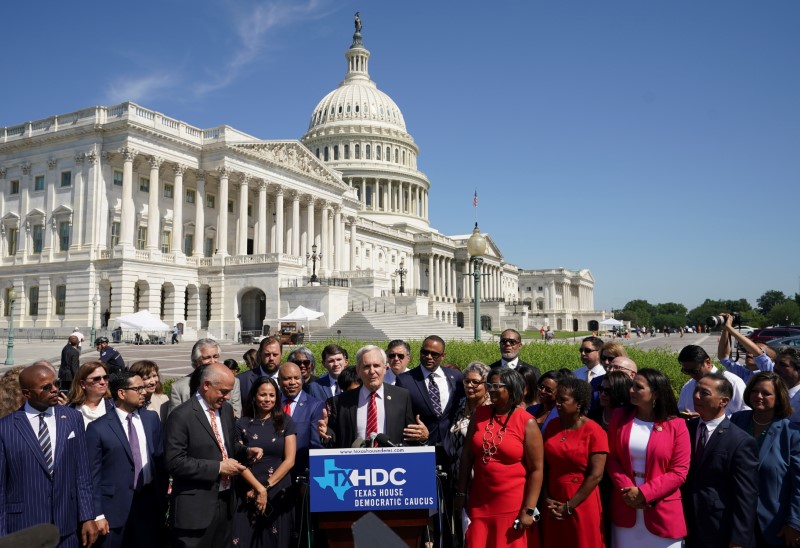
Texas Supreme Court blocks ruling protecting Democratic lawmakers from arrest -Washington Post

(Reuters) -The Texas Supreme Court on Tuesday blocked a rule protecting state Democratic lawmakers from arrest after they went to Washington to avoid a quorum as state Republicans attempt to pass voting restriction measures, the Washington Post reported.

Texas Governor Greg Abbott, a Republican, vowed to arrest more than 50 Democratic lawmakers who left the state on July 12, denying the state House of Representatives the quorum required to approve the voting limits and other measures on his special-session agenda.

On Sunday, Texas District Judge Brad Urrutia issued a temporary restraining order in a case filed by 19 Texas House Democrats against Abbott, challenging the state’s power to arrest them for political purposes, the Washington Post reported.

Texas is among several Republican-led states pursuing new voting restrictions in the name of enhancing election security. Former President Donald Trump has claimed that the presidential election last November was stolen from him through widespread fraud.

(Reporting by Brendan O’Brien in Chicago; Editing by Jonathan Oatis and Matthew Lewis)

New Zealand should only reopen border in early 2022, panel advises

WELLINGTON (Reuters) – New Zealand should keep its borders shut until early 2022 and reopen only after the vast majority of its adults have been vaccinated against the coronavirus, a government-appointed panel said on Wednesday.

It said the country, which last reported a local case of COVID-19 transmission in February, needs to stick to its strategy of eliminating the virus to avoid straining its health system, with the virus rapidly mutating overseas.

“The advisory group considers that an elimination strategy is not only viable, but also the best option at this stage of the pandemic,” the panel said in a report.

New Zealand Prime Minister Jacinda Ardern has won global plaudits for containing local transmission of COVID-19 through tough lockdowns and shutting the border in March 2020. The country has recorded just 2,500 cases and 26 deaths.

The government is set to announce plans this week for reopening, based on the experts’ advice.

“The challenge of dealing with regular importations of the virus through our borders should not be underestimated,” the panel said in a report.

“Hence we support the idea that re-opening of the borders in 2022 should start in a carefully planned, phased way…”

The panel recommended New Zealand’s vaccination program should be completed before reopening. So far only 21% of the country has been fully vaccinated.

“We need to do more to further strengthen our borders and bolster our health defenses, including through the vaccine rollout, before we can safely open the border further, and that will take a little more time to properly prepare,” Associate Minister of Health Ayesha Verrall said in a statement.

She said the panel’s advice had evolved due to the emergence of the highly infectious Delta variant.

Businesses and public sectors facing worker shortages have called for a more rapid opening up, but the panel said that would make the country vulnerable to infection.

Ardern last week opened one-way quarantine-free travel for seasonal workers from Samoa, Tonga and Vanuatu to address labor shortages in the horticulture industry.

New Zealand suspended a quarantine-free travel “bubble” with Australia in July following outbreaks of the Delta variant there.

(Reporting by Praveen Menon; Writing by Sonali Paul; Editing by Raju Gopalakrishnan)

Myanmar junta leader aims to solidify grip on power -U.N

By Michelle Nichols

UNITED NATIONS (Reuters) – The U.N. special envoy on Myanmar said on Tuesday the country’s military leader appears determined to solidify his grip on power following a February coup and ousted leader Aung San Suu Kyi’s political party could soon be disbanded.

Christine Schraner Burgener cited military ruler Min Aung Hlaing’s announcement this month that he was now prime minister in a newly formed caretaker government and also a formal annulment of the results of a November election, which was won by Suu Kyi’s National League for Democracy (NLD).

“I fear that we will soon hear also that the NLD party could be disbanded. This is an attempt to promote legitimacy against lack of international action taken,” Schraner Burgener told reporters. “I have to make clear that the U.N. does not recognize governments, so it’s up to the member states.”

She said unless U.N. member states act, Myanmar’s U.N. Ambassador Kyaw Moe Tun – an opponent of the junta – remains the country’s legitimate envoy at the world body in New York and Suu Kyi and Myanmar President Win Myint are the country’s leaders.

The junta, which argues that it is not a military government and came about through a constitutional transfer of power, has said it wants to appoint Aung Thurein – a member of Myanmar’s military from 1995 to 2021 – to be the U.N. ambassador.

U.N. credentials are initially considered by a nine-member committee appointed at the beginning of each annual session of the 193-member General Assembly, which starts in September.

Schraner Burgener stressed that it was up to member states to decide who should represent Myanmar, but she described it as a “crucial moment”.

“I’m still convinced that this was a coup, which was not yet successfully completed,” she said. “It was an unlawful act and we have still a legitimate government from the NLD.”

The United Nations has previously had to address competing claims for representation, some culminating with a vote in the General Assembly. The credentials committee is also able to defer a decision and leave a seat empty.

(Reporting by Michelle Nichols; Editing by Chizu Nomiyama and Philippa Fletcher)

U.S. Senate passes bipartisan $1 trillion infrastructure bill

By Richard Cowan and David Morgan

WASHINGTON (Reuters) -The U.S. Senate on Tuesday passed a $1 trillion infrastructure package that is a top priority for U.S. President Joe Biden, a bipartisan victory that could provide the nation’s biggest investment in decades in roads, bridges, airports and waterways.

The vote was 69-30 in the 100-seat chamber, with 19 Republicans voting yes. Immediately after that vote concluded, Senators pushed ahead with a follow-up $3.5 trillion spending package that Democrats plan to pass without Republican votes.

Polls show that the drive to upgrade America’s infrastructure, hammered out over months by a bipartisan group of senators over months of negotiations, is broadly popular with the public.

The bill still has to go to the House of Representatives and the spirit of cooperation in Congress that led to Tuesday’s vote will likely prove fleeting.

“Big news, folks: The Bipartisan Infrastructure Deal has officially passed the Senate,” Biden said on Twitter on Tuesday. “I hope Congress will send it to my desk as soon as possible so we can continue our work of building back better.”

Senate Majority Leader Chuck Schumer expects also to have the votes to pass the budget resolution laying the groundwork for $3.5 trillion to be spent on healthcare, climate change and other Biden priorities that Democrats will almost certainly have to pass over Republican objections in a maneuver known as “budget reconciliation.”

“When the Senate is run with an open hand rather than a closed fist senators can accomplish big things,” Schumer said shortly before the voting began.

Once that resolution is adopted, Democrats will begin crafting the reconciliation package for a vote on passage after they return from their summer break in September.

Democratic House Speaker Nancy Pelosi has said repeatedly that her chamber will not take up either bill until she has both in hand, meaning that months of work remain before Tuesday’s measure would go to Biden’s desk to be signed into law.

“The House will continue to work with the Senate to ensure that our priorities for the people are included in the final infrastructure and reconciliation packages,” Pelosi said after the vote.

The non-partisan Congressional Budget Office on Thursday said the infrastructure bill would increase federal budget deficits by $256 billion over 10 years — an assessment rejected by negotiators who said the CBO was undercounting how much revenue it would generate.

After working for two consecutive weekends on the infrastructure bill, a “vote-a-rama” session that could run late into the evening will be in store for the Senate.

Senate Minority Leader Mitch McConnell, who voted for the infrastructure bill, signaled that Republicans would try to use the voting sessions to pick off support from moderate Democrats for what he called a “radical” larger spending package that would create a permanent welfare state and usher in the largest peacetime tax hike in U.S. history.

“Every single senator will be going on record over and over and over,” McConnell added. “We will debate, and we will vote, and we will stand up, and we will be counted, and the people of this country will know exactly which senators fought for them.”

The budget plan would provide various Senate committees with top-line spending levels for a wide range of federal initiatives, including helping the elderly get home healthcare and more families afford early childhood education.

It also would provide tuition-free community college and foster major investments in programs to significantly reduce carbon emissions blamed for climate change.

Later, Senate committees would have to fill in the details for scores of federal programs.

The budget blueprint was formally unveiled on Monday, the same day a U.N. climate panel warned that global warming was reaching emergency levels, or what U.N. Secretary-General Antonio Guterres described as a “code red for humanity.”

Senate passage of the infrastructure bill and the budget plan would clear the way for it to begin a month-long summer break.

When Congress returns in September, it will not only debate the large investment measures but have to fund government activities for the fiscal year beginning on Oct. 1, increase Washington’s borrowing authority and possibly try to pass a voting reform bill.

(Reporting by Richard Cowan and David Morgan; Editing by Scott Malone and Alistair Bell)

New York Governor Cuomo resigns

By Jonathan Allen

NEW YORK (Reuters) – New York Governor Andrew Cuomo resigned on Tuesday following an inquiry that found he sexually harassed 11 women, mounting legal pressure and demands for his departure by President Joe Biden and others, a startling downfall for a man once seen as a possible U.S. presidential contender.

Cuomo, a Democrat who had served since 2011 as governor of the fourth most-populous U.S. state, made the announcement after New York Attorney General Letitia James on Aug. 3 released the results of a five-month independent investigation that concluded he had engaged in conduct that violated U.S. and state laws.

The investigation, detailed in a 168-page report, found that Cuomo groped, kissed or made suggestive comments to women including current and former government workers – one a state trooper – and retaliated against at least one woman who accused him of sexual misconduct. Cuomo denied wrongdoing.

Lieutenant Governor Kathy Hochul, a Democrat from western New York, will take over as governor of the state of more than 19 million people until the end of Cuomo’s term in December 2022 as outlined in the state’s constitution, becoming the first woman to hold the post.

Cuomo’s resignation marks the second time in 13 years that a New York governor has stepped down in scandal, after Eliot Spitzer quit in 2008 over his patronage of prostitutes. Cuomo also became the latest powerful man taken down in recent years following the rise of the #MeToo social movement against sexual abuse and harassment that has shaken politics, Hollywood, the business world and the workplace.

His resignation spared Cuomo from possible removal from office through impeachment proceedings in the state legislature. An ongoing impeachment investigation had only promised to intensify.

Cuomo, 63, was elected to three terms as governor, as was his late father, Mario Cuomo. He previously served as U.S. Department of Housing and Urban Development secretary from 1997 to 2001 under former President Bill Clinton.

Like his father, Andrew Cuomo never ran for president despite speculation about his possible national ambitions. He gained national prominence last year early in the COVID-19 pandemic after delivering daily news conferences as his state became the U.S. epicenter of the public health crisis.

The civil investigation found that the actions of Cuomo and his senior advisers violated multiple state and federal laws, but James did not pursue criminal charges. Local prosecutors are free to do so, meaning Cuomo still could face legal jeopardy.

Local prosecutors in Manhattan, Nassau County, Albany County and Westchester County said after the report’s release that they are looking into the matter and have requested evidence from the independent inquiry. New York City’s mayor said Cuomo should face criminal charges.

Cuomo had for months denied mounting allegations of sexual harassment – and renewed those denials after the investigative report was issued. But what was left of his political support crumbled after the findings were made public. Hours later, Biden – a friend of the governor for years – told reporters at the White House: “I think he should resign.”

Other prominent Democrats including the state’s two U.S. senators, Chuck Schumer and Kirsten Gillibrand, and U.S. House of Representatives Speaker Nancy Pelosi also lined up in calling on the party’s one-time star to resign.

Investigators concluded that Cuomo and his aides created a “toxic” and “hostile” workplace in an office gripped by bullying, fear and intimidation. The complaints about sexual harassment emerged after broader criticism by Democratic politicians in New York that Cuomo governed through intimidation.

Cuomo last year appeared to be a politician in ascent, presenting himself as an authoritative figure in televised news conferences on the pandemic. His image was burnished by television interviews with his younger brother, CNN host Chris Cuomo.

Shortly after James, a fellow Democrat, detailed the findings, Cuomo, the divorced father of three adult daughters, issued a video statement in which he said, “I never touched anyone inappropriately or made inappropriate sexual advances.”

“That is just not who I am,” Cuomo said in the video, as he argued that what women described as sexual advances were inoffensive gestures and comments inspired by a natural physical warmth arising from the culture in which he was raised. In the video, he indicated he had no plans to resign, mentioning specifically the fight against the pandemic.

A Marist Poll released a day after the report was issued showed that 59% of New Yorkers wanted Cuomo to resign, compared to 32% who said he should serve out his term and 9% who were unsure. Among Democrats, however, only 52% favored resignation.

(Reporting by Jonathan Allen and Joseph Ax; Writing by Will Dunham; Editing by Daniel Wallis and Howard Goller)

Taliban control 65% of Afghanistan, EU official says, after series of sudden gains

KABUL (Reuters) – Taliban insurgents tightened their grip on captured Afghan territory on Tuesday as civilians hid in their homes, and a European Union official said the militants now control 65% of the country after a string of gains as foreign forces pull out.

President Ashraf Ghani called on regional strongmen to support his government, while a U.N. official said advances made in human rights in the 20 years since the hardline Islamists were ousted from power were in danger of being erased.

In the capital Kabul, Ghani’s aides said he was seeking help from regional militias he has squabbled with over the years to rally to the defense of his government. He had also appealed to civilians to defend Afghanistan’s “democratic fabric.”

In the town of Aibak, capital of Samangan province on the main road between the northern town of Mazar-i-Sharif and Kabul, Taliban fighters were consolidating their control, moving into government buildings, residents said.

Most government security forces appeared to have withdrawn.

“The only way is self-imposed house arrest or to find a way to leave for Kabul,” said Sher Mohamed Abbas, a provincial tax officer, when asked about living conditions in Aibak.

“But then even Kabul is not a safe option anymore,” said Abbas, the sole bread winner for a family of nine.

Abbas said the Taliban had arrived at his office and told workers to go home. He and other residents said they had neither seen nor heard fighting on Tuesday.

For years, the north was the most peaceful part of the country with an only minimal Taliban presence.

The militants’ strategy appears to be to take the north, as well as the main border crossings in the north, west and south, and then close in on Kabul.

The Taliban, battling to defeat the U.S-backed government and reimpose strict Islamic law, swept into Aibak on Monday meeting little resistance.

Taliban forces now control 65% of Afghan territory, are threatening to take 11 provincial capitals and are trying to deprive Kabul of its traditional support from national forces in the north, a senior EU official said on Tuesday.

The government has withdrawn forces from hard-to-defend rural districts to focus on holding major population centers, while officials have appealed for pressure on neighboring Pakistan to stop Taliban reinforcements and supplies flowing over the porous border. Pakistan denies backing the Taliban.

The United States has been carrying out air strikes in support of government troops but said it was up to Afghan forces to defend their country. “It’s their struggle,” John Kirby, a Pentagon spokesperson, told reporters on Monday.

‘DEEPLY DISTURBING REPORTS’

Taliban and government officials have confirmed that the Islamists have overrun six provincial capitals in recent days in the north, west and south.

Security forces in Pul-e-Khumri, capital of Baghlan province, to the southeast of Aibak, were surrounded as the Taliban closed in on the town at a main junction on the road to Kabul, a security official said.

Gulam Bahauddin Jailani, head of the national disaster authority, told Reuters there was fighting in 25 of the 34 provinces and 60,000 families had been displaced over the past two months, with most seeking refuge in Kabul.

About 400,000 Afghans have been displaced in recent months and there has been an increase in numbers of people fleeing to Iran over the past 10 days, the EU official said.

Six EU member states warned the bloc’s executive against halting deportations of rejected Afghan asylum seekers arriving in Europe despite major Taliban advances, fearing a possible replay of a 2015-16 crisis over the chaotic arrival of more than one million migrants, mainly from the Middle East.

A resident of Farah, the capital and largest city of Farah province in western Afghanistan near the border with Iran, said the Taliban had taken the governor’s compound and there was heavy fighting between Taliban and government forces.

Civilians said the Taliban had captured all key government buildings in the city.

U.N. human rights chief Michelle Bachelet said reports of violations that could amount to war crimes and crimes against humanity were emerging, including “deeply disturbing reports” of the summary execution of surrendering government troops.

“People rightly fear that a seizure of power by the Taliban will erase the human rights gains of the past two decades,” she said.

The Taliban, ousted in the weeks after the Sept. 11, 2001 attacks on the United States, appeared to be in a position to advance from different directions on Mazar-i-Sharif. Its fall would deal a devastating blow to Ghani’s government.

Atta Mohammad Noor, a northern militia commander, vowed to fight to the end, saying there would be “resistance until the last drop of my blood.”

“I prefer dying in dignity than dying in despair,” he said on Twitter.

India sent a flight to northern Afghanistan to take its citizens home, officials said, asking Indians to leave. The United States and Britain have already advised their citizens to leave Afghanistan.

The United States will complete the withdrawal of its forces at the end of this month under a deal with the Taliban, which included the withdrawal of foreign forces in exchange for Taliban promises to prevent Afghanistan being used for international terrorism.

The Taliban promised not to attack foreign forces as they withdraw but did not agree to a ceasefire with the government.

(Reporting by Afganistan bureau, additional reporting by Emma Farge in Geneva and Sabine Siebold and John Chalmers in Brussels; Editing by Nick Macfie and Mark Heinrich)