War with Iran is the mother of all wars: Iran president

Iranian President Hassan Rouhani is seen during a meeting with Iran's Foreign Minister Mohammad Javad Zarif and with deputies and Senior directors of the Ministry of Foreign Affairs in Tehran, Iran, August 6, 2019. Official President website/Handout via REUTERS

GENEVA (Reuters) – War with Iran is the mother of all wars, Iranian President Hassan Rouhani said on Tuesday in a speech broadcast live on state TV, warning once again that shipping might not be safe in the Strait of Hormuz oil waterway.

Tensions have risen between Iran and the West since last year when the United States pulled out of an international agreement which curbed the Islamic Republic’s nuclear program in return for an easing of economic sanctions on Iran.

“Peace with Iran is the mother of all peace, war with Iran is the mother of all wars,” Rouhani said at the Foreign Ministry in a speech which also praised Foreign Minister Mohammad Javad Zarif after the United States imposed sanctions on him on July 31.

If the United States wants to have negotiations with Iran then it must lift all sanctions, Rouhani said, noting that Iran must be allowed to export oil.

Fuelling fears of a Middle East war with global repercussions, the Guards seized British tanker Stena Impero near the Strait of Hormuz in July for alleged marine violations, two weeks after British forces captured an Iranian oil tanker near Gibraltar accused of violating sanctions on Syria.

“A strait for a strait. It can’t be that the Strait of Hormuz is free for you and the Strait of Gibraltar is not free for us,” Rouhani said.

Approximately one-fifth of the world’s oil traffic passes through the strategic Strait of Hormuz.

The Guards seized an Iraqi oil tanker in the Gulf on Wednesday which they said was smuggling fuel and detained seven crewmen, Iran’s state media reported.

(Story corrects date of Iraqi ship’s seizure)

(Reporting by Babak Dehghanpisheh; Editing by Alison Williams)

‘We will make them pay’: North Korea launches missiles, condemns U.S.-South Korea drills

People watch a TV broadcasting a news report on North Korea firing two unidentified projectiles, in Seoul, South Korea, August 6, 2019. REUTERS/Kim Hong-Ji

By Josh Smith and Joyce Lee

SEOUL (Reuters) – North Korea fired missiles into the sea off its east coast for the fourth time in less than two weeks, South Korea said on Tuesday, as Pyongyang warned that hostile moves against it “have reached the danger line.”

The North, criticizing the U.S.-South Korean drills and their use of high-tech weapons, has fired a series of missiles and rockets since its leader Kim Jong Un and U.S. President Donald Trump agreed at a June 30 meeting to revive stalled denuclearization talks.

North Korea has said it is committed to diplomacy and it will wait until the end of the year for the United States to soften its policy of sanctions and political pressure over Pyongyang’s nuclear weapons and ballistic missile programs.

But if Washington and Seoul disregard North Korea’s repeated warnings, “we will make them pay (a) heavy price,” a North Korean foreign ministry spokesman said in a statement released through state news agency KCNA.

Trump has played down the tests by saying they did not break any agreement he had with Kim but the talks have yet to resume. Analysts believe the tests are designed both to improve North Korean military capabilities and to pressure Washington to offer more concessions.

“Part of what’s happening now is that North Korea is expressing frustrations with a general lack of progress on inter-Korean agenda while increasing leverage in U.S.-North Korea negotiations by demonstrating how its programs could and will continue to advance,” said Jenny Town, managing editor at 38 North, a website that tracks North Korea.

MULTIPLE MISSILE LAUNCHES

South Korea’s Joint Chiefs of Staff (JCS) said what appeared to be two short-range ballistic missiles were fired from near Kwail on North Korea’s west coast, about 125 km (80 miles) southwest of Pyongyang, in South Hwanghae province early on Tuesday. They were the fourth set of launches since July 25.

The missiles flew about 450 km (280 miles) and reached an altitude of 37 km (23 miles), the JCS said. U.S. and South Korean intelligence agencies deemed they had similar flight characteristics to the short-range ballistic missiles launched by North Korea on July 25, it said.

Kim Dong-yub, a military expert at South Korea’s Kyungnam University, said the latest launch area was significant because the flight path of 450 km meant that all of South Korea was in range of such missiles.

“It becomes difficult to detect the origin of the launch in advance because it is capable of launching a missile from most anywhere in North Korea, targeting all of South Korea,” he said.

South Korea’s defense ministry said on Tuesday the missile launch went against the spirit of easing tension on the Korean peninsula.

A United Nations report said on Monday Pyongyang has continued to enhance its nuclear and missile programs and used cyberattacks to take in $2 billion to fund the development.

The missile tests represent military advances, as well as help Kim strengthen his bargaining power with the United States, said Van Jackson, a former Pentagon official focused on Korea.

“Kim believes he doesn’t need to compromise to get what he wants, doesn’t need to conduct serious negotiations at the working level because he has recourse to Trump, and doesn’t need to restrain any of his missile testing or actions abroad as long as he doesn’t test an intercontinental ballistic missile,” Jackson said.

‘DO US HARM’

The launches on July 25 were the first since Trump and Kim met at the heavily armed Demilitarized Zone that separates the two Koreas on June 30. What was agreed at that meeting is now under scrutiny.

The North Korean foreign ministry spokesman said that the North remained committed to resolving issues through dialogue, but that the United States and South Korea’s joint military drills violate a pledge made by Trump to Kim.

Pyongyang “will be compelled to seek a new road as we have already indicated” if South Korea and the United States continue with hostile military moves, he said.

The arrival of new, U.S.-made F-35A stealth fighters in South Korea, the visit of a U.S. nuclear-powered submarine to a South Korean port, and U.S. tests of ballistic missiles are among the steps that have forced North Korea to continue its own weapons development, the spokesman said.

“The U.S. and South Korean authorities remain outwardly talkative about dialogue,” he said. “But when they sit back, they sharpen a sword to do us harm.”

South Korean media reported that U.S.-South Korea joint military exercises had started on Monday. A senior South Korean official said previously the drills would mainly involve computer simulations.

A JCS spokesman told a regular news briefing on Monday the allies were preparing for a joint exercise in the second half of the year but would not confirm the name of the drill or whether it had already started.

The testing of short-range missiles by North Korea is banned by a 2006 United Nations Security Council resolution demanding that North Korea suspend all activities related to its ballistic missile program.

Japan’s defense ministry said it did not see any imminent threat to Japanese security from the latest projectile launch by North Korea.

(Reporting by Josh Smith and Joyce Lee; Additional reporting by Matt Spetalnick and David Brunnstrom in WASHINGTON and Chris Gallagher in TOKYO; Editing by Paul Tait and Darren Schuettler)

Iran says will not tolerate ‘maritime offences’ in Gulf

Iran's Foreign Minister Mohammad Javad Zarif gestures during a news conference in Tehran, Iran August 5, 2019. Nazanin Tabatabaee/WANA (West Asia News Agency) via REUTERS.

By Tuqa Khalid

DUBAI (Reuters) – Iran runs security in the Strait of Hormuz and will no longer tolerate “maritime offenses” there, its foreign minister said on Monday, a day after it seized a second oil tanker near the strategic waterway that it accused of smuggling fuel.

Tanker traffic through the Strait has become a focus for an increasingly tense standoff between Washington and Tehran, into which Britain has also been dragged, and the United States has beefed up its military presence in the Gulf since May.

On Sunday, Iran’s elite Revolutionary Guards Corps seized the Iraqi tanker north of the Strait and detained its seven crew, state media reported. Guards commander Ramezan Zirahi was quoted as saying it was carrying 700,000 liters of fuel.

“Iran used to forgo some maritime offenses in … (the) Gulf but will never close (its) eyes anymore,” Foreign Minister Mohammad Javad Zarif told a televised news conference in Tehran.

“… Iran is responsible for the security and safety of the Strait of Hormuz and the region.”

Iran has threatened to block all exports via the Strait, through which a fifth of global oil traffic passes, if other countries comply with U.S. pressure to stop buying Iranian oil.

Zarif criticized U.S. sanctions imposed on him on Wednesday, saying Washington had closed the door to diplomacy over Iran’s 2015 nuclear deal, which U.S. President Donald Trump exited last year.

The deal with a handful of global powers had curbed Tehran’s nuclear work in return for an easing of sanctions, striking a delicate political balance that the U.S. pullout has destabilized.

Strains between Washington and Tehran have heightened further since the spring. In June, Iran’s downing of a U.S. drone prompted preparations for a U.S. retaliatory airstrike that Trump called off at the last minute.

Angered by intensified U.S. sanctions designed to strangle its vital oil trade and the failure of European parties to agree on a way of salvaging the nuclear agreement, Tehran has scaled back its commitments under the pact.

“Iran will leave its 2015 nuclear deal with powers if necessary,” Zarif said on Monday, adding that all measures taken by Iran were, however “reversible if its interests under the deal are secured.”

Iran has so far rejected calls by the Trump administration to negotiate a new deal.

Zarif called for improved ties with Iran’s rivals in the Middle East, where it has been involved in proxy wars for decades with Sunni Saudi Arabia.

He also labeled as “piracy” the seizure by Britain in July of an Iranian oil tanker near Gibraltar that London accused of violating sanctions on Syria.

Two weeks later, Iran’s Revolutionary Guards seized a British tanker, Stena Impero, near the Strait of Hormuz for alleged marine violations.

“Britain has been complicit in the U.S. economic terrorism against Iran,” Zarif said.

(Writing by Parisa Hafezi; Editing by John Stonestreet)

Putin to Trump: We’ll develop new nuclear missiles if you do

Russian President Vladimir Putin chairs a meeting with members of the Security Council at the Novo-Ogaryovo state residence outside Moscow, Russia August 5, 2019. Sputnik/Mikhail Klimentyev/Kremlin via REUTERS

By Andrew Osborn and Polina Devitt

MOSCOW (Reuters) – Russian President Vladimir Putin warned on Monday that Moscow would start developing short and intermediate-range land-based nuclear missiles if the United States started doing the same after the demise of a landmark arms control treaty.

The U.S. formally left the Intermediate Nuclear Forces (INF) treaty with Russia on Friday after determining that Moscow was violating the treaty and had already deployed one banned type of missile, an accusation the Kremlin denies.

The pact banned land-based missiles with a range of between 310 and 3,400 miles (500-5,500 km), reducing the ability of both countries to launch a nuclear strike at short notice.

Putin on Monday ordered the defense and foreign ministries and Russia’s SVR foreign intelligence service to closely monitor any steps the U.S. takes to develop, produce or deploy missiles banned under the defunct treaty.

“If Russia obtains reliable information that the United States has finished developing these systems and started to produce them, Russia will have no option other than to engage in a full-scale effort to develop similar missiles,” Putin said in a statement.

U.S. officials have said the United States is months away from the first flight tests of an American intermediate-range missile that would serve as a counter to the Russians. Any deployment would be years away, they have said.

Putin issued his warning after holding a meeting with Russia’s Security Council to discuss the U.S. move, which Moscow had argued against for months, warning it would undermine a key pillar of international arms control.

Putin said Russia’s arsenal of air and sea-launched missiles combined with its work on developing hypersonic missiles meant it was well placed to offset any threat emanating from the United States for now.

But he said it was essential for Moscow and Washington, the world’s largest nuclear powers, to resume arms control talks to prevent what he described as an “unfettered” arms race breaking out.

“In order to avoid chaos with no rules, restrictions or laws, we need to once more weigh up all the dangerous consequences and launch a serious and meaningful dialogue free from any ambiguity,” Putin said.

Officials from President Donald Trump’s administration, speaking on condition of anonymity, have said Russia has deployed “multiple battalions” of a cruise missile throughout Russia in violation of the defunct pact, including in western Russia, “with the ability to strike critical European targets”.

Russia denies the allegation, saying the missile’s range put it outside the treaty and rejected a U.S. demand to destroy the new missile, the Novator 9M729, known as the SSC-8 by the NATO Western military alliance.

(Additional reporting by Tom Balmforth, Editing by Ed Osmond)

Two Texas shooting victims die in hospital, raising death toll to 22

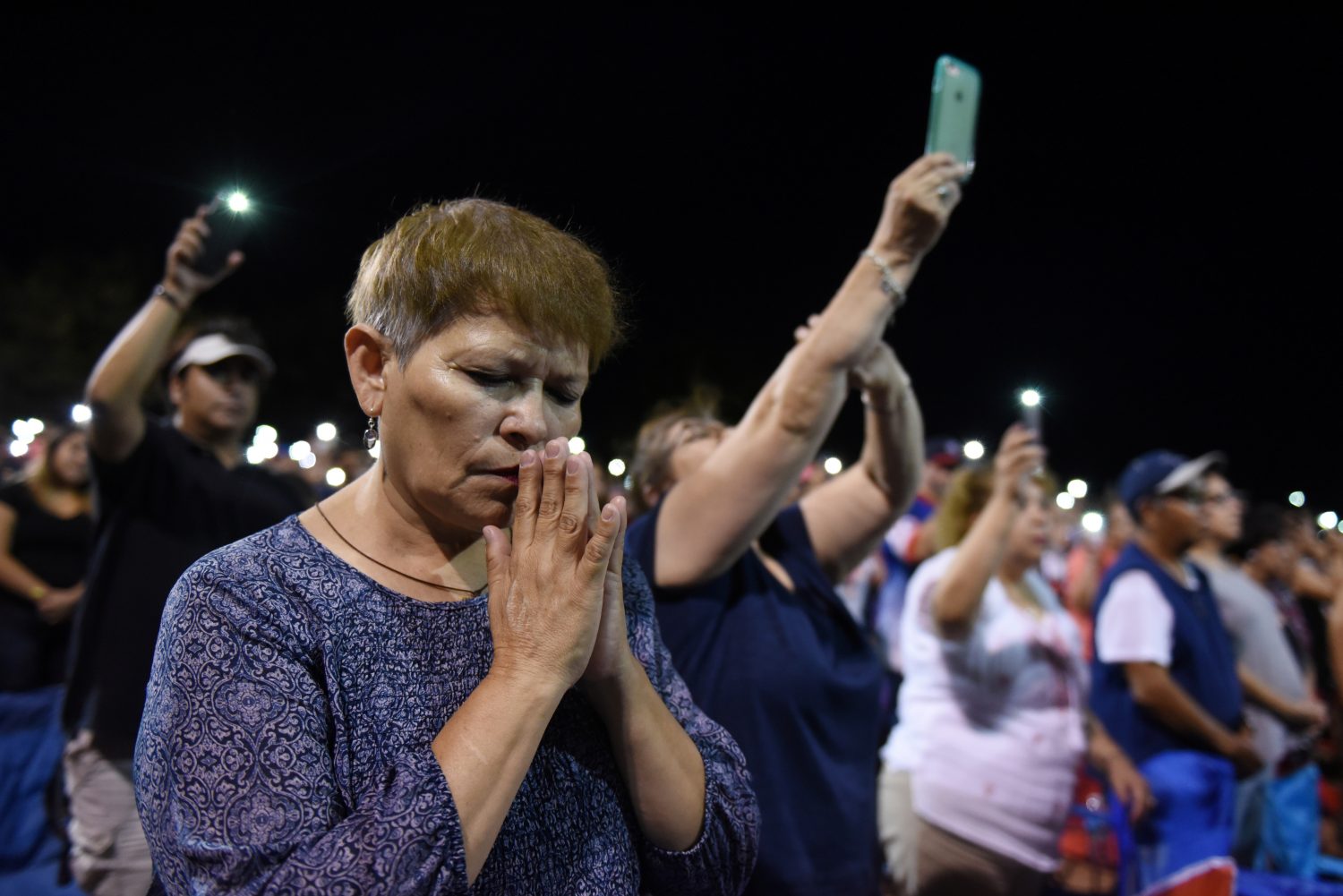
People pray during a vigil a day after a mass shooting at a Walmart store in El Paso, Texas, U.S. August 4, 2019. REUTERS/Callaghan O'Hare

By Julio-Cesar Chavez

EL PASO, Texas (Reuters) – The death toll rose to 22 people on Monday in a mass shooting at a Walmart store in El Paso, increasing with two deaths in a hospital days after a spate of shooting sprees, El Paso Police said on Twitter.

Two weekend gun massacres prompted U.S. President Donald Trump to condemn white supremacy.

Texas prosecutors charged a man with capital murder for the massacre in the heavily Hispanic border city that initially had claimed 20 lives.

Two victims died in the hospital on Monday morning, raising the grim total rose to 22, El Paso Police said on Twitter.

Texas Governor Greg Abbott said Saturday’s rampage appeared to be a hate crime and federal prosecutors called it domestic terrorism. Police cited a racist, anti-immigrant manifesto posted online shortly before the shooting, which they attributed to the suspect, Patrick Crusius, as evidence that the bloodshed was racially motivated.

A Texas prosecutor said the state will seek the death penalty against Crusius if he is found guilty.

It was the second of three separate public shooting sprees carried out in the United States in the span of a week. The dense cluster of massacres prompted fresh cries of alarm in a country accustomed to reports of young men gunning down strangers.

“In one voice, our nation must condemn racism, bigotry and white supremacy,” Trump said from the White House, calling the gunman “wicked” and criticizing blaming the internet and violent video games for fostering violence.

“It is too easy today for troubled youth to surround themselves with a culture that celebrates violence,” Trump said, a day after Democratic candidates for next year’s presidential election called for stricter gun laws and accused the president of stoking racial tensions.

U.S. gun control advocates have noted that the internet and video games are popular in many other countries where mass shootings are virtually unknown, in part because it is much harder to get a gun than in the United States.

Trump also proposed making it easier and quicker to stop those deemed as having certain forms of mental illness or being a risk to public safety from having guns.

State prosecutors have charged Crusius, a 21-year-old white man, with capital murder, according to the County of El Paso’s state court website. The single murder charge is likely a legal place holder to keep Crusius in custody until further charges can be filed for each of the dead and the wounded.

His grandparents, with whom Crusius had recently been living, said they were devastated by the attack.

“He lived with us in our house in Allen, Texas, while he attended Collin College,” the statement said, read aloud by a family friend to reporters outside the home on Sunday. “He moved out of our house six weeks ago, and has spent a few nights here while we were out of town.”

It was unclear if Crusius has a lawyer or when a bond hearing or other court appearances will occur.

The Federal Bureau of Investigation said in a statement on Sunday the attack “underscores the continued threat posed by domestic violent extremists and perpetrators of hate crimes.”

The agency said it remains concerned that more U.S.-based extremists could become inspired by these and previous high-profile attacks to engage in similar acts of violence.

The U.S. attorney for the western district of Texas, John Bash, said federal authorities were treating the El Paso massacre as a case of domestic terrorism.

“And we’re going to do what we do to terrorists in this country, which is to deliver swift and certain justice,” he told a news conference on Sunday. He said the attack appeared “to be designed to intimidate a civilian population, to say the least.”

FBI Director Christopher Wray told a congressional panel on July 23 that the bureau has recorded about 100 arrests of domestic terrorism suspects in the preceding nine months and that most investigations of that kind involve some form of white supremacy.

BACK-TO-BACK SHOOTINGS

The Texas rampage was followed just 13 hours later by another mass shooting, and came a week after a man shot dead three people at a California garlic festival before he was killed by police.

In Dayton, Ohio a gunman in body armor and a mask killed nine people in less than a minute and wounded 27 others in the downtown historic district before he was shot dead by police.

Trump has frequently derided many asylum seekers and other immigrants coming across the U.S. southern border as liars and criminals. At a political rally he held in May, after asking the crowd what could be done about immigrants coming in illegally, Trump smiled and joked after someone in the crowd yelled back: “Shoot them!”

El Paso Police Chief Greg Allen said the suspect was cooperating with investigators.

“He basically didn’t hold anything back,” Allen said at Sunday’s news conference, but declined to elaborate.

Police said the suspect opened fire with a rifle on shoppers, many of them bargain-hunting for back-to-school supplies, then surrendered to officers who confronted him outside the store.

Crusius comes from Allen, Texas, a Dallas suburb some 650 miles (1,046 km) east of El Paso, which lies along the Rio Grande across the U.S.-Mexico border from Ciudad Juarez.

A four-page statement posted on 8chan, an online message board often used by extremists and believed to have been written by the suspect, called the Walmart attack “a response to the Hispanic invasion of Texas.”

It also expressed support for the gunman who killed 51 people at two mosques in Christchurch, New Zealand, in March.

El Paso and Ciudad Juarez, together with the neighboring city of Las Cruces, New Mexico, form a metropolitan border area of some 2.5 million residents constituting the largest bilingual, bi-national population in North America.

(Reporting by Julio-Cesar Chavez in El Paso; Additional reporting by Alex Dobuzinskis and Steve Gorman in Los Angeles, Jonathan Allen in New York, Keith Coffman in Denver, Tim Reid in Las Vegas, Mark Hosenball in London, Daina Beth Solomon in Mexico City, Daniel Trotta, Barbara Goldberg and Matthew Lavietes in New York and Rich McKay in Atlanta; Editing by Frances Kerry and Nick Zieminski)

Lone wolf attackers inspire each other, NATO chief says

FILE PHOTO: NATO Secretary-General Jens Stoltenberg speaks during a news conference after a NATO Defence Ministers meeting in Brussels, Belgium June 27, 2019. REUTERS/Francois Walschaerts

WELLINGTON (Reuters) – Nations must work together to stop lone-wolf attackers, who take inspiration from each other, NATO’s secretary-general Jens Stoltenberg said on Monday, during a visit to a mosque in New Zealand where a gunman killed dozens of people in March.

His comments came as the United States reels from two mass shootings at the weekend that killed 29 people and injured dozens in Texas and Ohio, provoking calls for tighter gun controls and prompting worries over a resurgence of white nationalism and xenophobic politics.

Stoltenberg, making a two-day trip to New Zealand, visited Christchurch, where 51 Muslim worshippers were killed in the attacks on two mosques by a suspected white supremacist.

“These attacks are committed by lone wolves but they are at the same time connected because they use each other as inspiration and they refer to each other in the different manifestos,” Stoltenberg told state broadcaster TVNZ.

“It highlights that we have to fight terrorism in many different ways, with many different tools.”

The Texas shooter who killed 20 people at a Walmart store expressed support for the Christchurch gunman in his manifesto.

New Zealand authorities have charged Australian Brenton Tarrant, a suspected white supremacist, with murder following the attacks. He has pleaded not guilty to all charges.

Society has to stand up for values of freedom, openness and tolerance, Stoltenberg said.

“We see that many of the terrorists are one of us,” he said. “They are home-grown, they are coming from our own societies. So this is very much also about addressing the root causes.”

Prime Minister Jacinda Ardern, who is due to meet Stoltenberg on Tuesday, said New Zealand would only want to be remembered for the way it rejected the act of violence and hatred.

“This is a global challenge,” she told a news conference later in the day.

“Of course we can do what we can to defeat acts of hatred, violence and racism in our own domestic areas. But, as an international community, we should also be united against acts of hatred, violence and terrorism.”

(Reporting by Praveen Menon; Editing by Clarence Fernandez)

Cloudflare terminates 8chan as customer on ‘hate-filled’ content: CEO

A man takes part in a rally against hate a day after a mass shooting at a Walmart store, in El Paso, Texas, U.S. August 4, 2019. Graffiti reads "El Paso Is Not Alone" REUTERS/Jose Luis Gonzalez

(Reuters) – U.S. cybersecurity firm Cloudflare on Monday said it would terminate online message board 8chan as a customer after a gunman used the messaging forum prior to killing 20 people at a Walmart store in El Paso, Texas on Saturday.

The gunman is believed to have posted a four-page statement on 8chan, and called the Walmart attack “a response to the Hispanic invasion of Texas”.

Police in the Philippines, where 8chan is hosted, told Reuters they were investigating the messaging board but were unable to give details, such as when the inquiry began and what prompted it.

The suspect was officially identified as a 21-year-old white male from Allen, Texas, a Dallas suburb about 650 miles (1,046 km) east of El Paso, which lies along the Rio Grande, across the U.S.-Mexico border from Ciudad Juarez. Citing law enforcement officials, media named the suspect as Patrick Crusius.

The suspect’s post on 8chan expressed support for the gunman who killed 51 people at two mosques in Christchurch, New Zealand, in March.

“We just sent a notice that we are terminating 8chan as a customer effective at midnight tonight Pacific Time,” Cloudflare Chief Executive Matthew Prince said in a blog post.

“Based on evidence we’ve seen, it appears that he (gunman)posted a screed to the site immediately before beginning his terrifying attack.”

Prince’s blog added that while 8chan did not violate the law by not moderating the “hate-filled” content posted by users, it had “created an environment that revels in violating its spirit”.

(Reporting by Sathvik N in Bengaluru; Additional reporting by Karen Lema in MANILA; Editing by Sherry Jacob-Phillips and Clarence Fernandez)

U.S. hiring slows; shorter factory workweek a red flag

FILE PHOTO: An assembly line worker works on the production line at Renegade RV manufacturing plant in Bristol, Indiana, U.S., April 16, 2019. REUTERS/Tim Aeppel

By Lucia Mutikani

WASHINGTON (Reuters) – U.S. job growth slowed in July and manufacturers slashed hours for workers, which together with an escalation in trade tensions between the United States and China could give the Federal Reserve ammunition to cut interest rates again next month.

The Labor Department’s closely watched monthly employment report on Friday came a day after President Donald Trump announced an additional 10% tariff on $300 billion worth of Chinese imports starting Sept. 1, a move that led financial markets to fully price in a rate cut in September.

The U.S. central bank on Wednesday cut its short-term interest rate for the first time since 2008. Fed Chairman Jerome Powell described the widely anticipated 25-basis-point monetary policy easing as insurance against downside risks to the 10-year old economic expansion, the longest in history, from trade tensions and slowing global growth.

“Fed officials don’t exactly have mud in their eyes after cutting interest rates this week as job growth is slowing with the rest of the world,” said Chris Rupkey, chief economist at MUFG in New York. “We see nothing in today’s report to stop a second rate cut next month.”

Nonfarm payrolls increased by 164,000 jobs last month, the government said. The economy created 41,000 fewer jobs in May and June than previously reported. July’s job gains were in line with economists’ expectations.

Underscoring the moderation in hiring, the average workweek fell to its lowest level in nearly two years in July as manufacturers cut hours for workers. Hours were also reduced in other industries, contributing to the workweek’s drop to 34.3 hours, the fewest since September 2017, from 34.4 hours in June.

“The decline in hours worked suggests that employers may be pulling back more than headline hiring would suggest,” said Andrew Schneider, a U.S. economist at BNP Paribas in New York.

A measure of hours worked, which is a proxy for gross domestic product, fell 0.2% in July, pointing to weak output.

The U.S.-China trade war is taking a toll on manufacturing, with production declining for two straight quarters. Business investment has also been hit, contracting in the second quarter for the first time in more than three years and helping to hold back the economy to a 2.1% annualized growth rate. The economy grew at a 3.1% pace in the first quarter.

The White House’s “America First” policies are also restricting trade flows. A separate report from the Commerce Department on Friday showed sharp declines in both imports and exports in June, leading a 0.3% dip in the trade deficit to $55.2 billion during the month.

Job gains over the last three months averaged 140,000 per month, the fewest in nearly two years, compared to 223,000 in 2018. Economists say it is unclear whether the loss of momentum in hiring was due to ebbing demand for labor or a shortage of qualified workers.

Still, the pace of job gains remains well above the roughly 100,000 needed per month to keep up with growth in the working-age population. The unemployment rate was unchanged at 3.7% in July as 370,000 people entered the labor force.

Despite the lowest jobless rate in nearly 50 years, wage gains remain moderate, contributing to a tame inflation environment, which could be supportive of a rate cut at the Fed’s Sept. 17-18 policy meeting.

Inflation has undershot the central bank’s 2% target this year, rising 1.6% on a year-on-year basis in June after a 1.5% gain in May. Average hourly earnings rose 8 cents, or 0.3%, in July, after the same increase in June. That lifted the annual increase in wages to 3.2% in July from 3.1% in June.

Financial markets have fully priced in a rate cut in September and the chances for further easing in December have increased, according to CME Group’s FedWatch tool.

The dollar <.DXY> was trading lower against a basket of currencies, while U.S. Treasury prices rose. Stocks on Wall Street tumbled to a one-month low.

ECONOMY COOLING

Even with the step-down in employment growth and moderate wage gains, the labor market is supporting the economy as the stimulus from last year’s $1.5 trillion tax cut package fades. The economy is expected to grow around 2.5% this year.

There was some encouraging news on the jobs market. The labor force participation rate, or the proportion of working-age Americans who have a job or are looking for one, rose to 63.0% in July from 62.9% in June.

A broader measure of unemployment, which includes people who want to work but have given up searching and those working part-time because they cannot find full-time employment, fell two-tenths of a percentage point to 7.0% last month, the lowest level since December 2000.

The moderation in hiring was led by construction, which increased payrolls by 4,000 jobs after creating 18,000 positions in June.

Manufacturing employment rose by 16,000 jobs after advancing by 12,000 in June. The strong gains are at odds with weak factory activity. A survey on Thursday showed manufacturing employment hit its lowest level since November 2016 in July.

The sector, which accounts for more than 12% of the U.S. economy, is also battling an inventory bulge and design problems at aerospace giant Boeing Co <BA.N>. The manufacturing workweek dropped 0.3 hour to 40.4 hours, the lowest since November 2011. Factory overtime fell by 0.2 hour to 3.2 hours.

“A prolonged drop in hours worked signals that businesses may reduce hiring, with layoffs and cutbacks in private spending to potentially follow, said Beth Ann Bovino, U.S. chief economist at S&P Global Ratings in New York.

Government employment increased by 16,000 jobs in July, boosted by local government hiring, adding to June’s gain of 14,000. Professional and business services employment rose by 38,000 jobs last month.

There were also increases in healthcare, leisure and hospitality, financial activities and wholesale trade employment. But retail payrolls dropped by 3,600 jobs, declining for a sixth straight month.

(Reporting by Lucia Mutikani; Editing by Paul Simao)

China warns of retaliation after Trump threatens fresh tariffs

By Andrea Shalal, Alexandra Alper and Huizhong Wu

BEIJING/WASHINGTON (Reuters) – China on Friday said it would not be blackmailed and warned of retaliation after U.S. President Donald Trump vowed to slap a 10% tariff on $300 billion of Chinese imports from next month, sharply escalating a trade row between the world’s biggest economies.

Trump stunned financial markets on Thursday by saying he plans to levy the additional duties from Sept. 1, marking an abrupt end to a truce in a year-long trade war that has slowed global growth and disrupted supply chains.

Beijing would not give an inch under pressure from Washington, Chinese Foreign Ministry spokeswoman Hua Chunying said.

“If America does pass these tariffs then China will have to take the necessary countermeasures to protect the country’s core and fundamental interests,” Hua told a news briefing in Beijing.

“We won’t accept any maximum pressure, intimidation or blackmail. On the major issues of principle we won’t give an inch,” she said, adding that China hoped the United States would “give up its illusions” and return to negotiations based on mutual respect and equality.

Trump also threatened to further raise tariffs if Chinese President Xi Jinping fails to move more quickly to strike a trade deal.

The newly threatened duties, which Trump announced in a series of tweets after his top trade negotiators briefed him on a lack of progress in talks in Shanghai this week, would extend tariffs to nearly all Chinese goods that the United States imports.

The president later said if trade discussions failed to progress he could raise tariffs further – even beyond the 25 percent levy he has already imposed on $250 billion of imports from China.

Senior Chinese diplomat Wang Yi told reporters on the sidelines of an Association of Southeast Nations event in Thailand that additional tariffs were “definitely not a constructive way to resolve economic and trade frictions”.

U.S. Secretary of State Mike Pompeo, who was also in Bangkok, decried “decades of bad behavior” by China on trade and said Trump had the determination to fix it.

The news hit financial markets hard. On Friday, Asian and European stocks took a battering and safe-haven assets such as the yen, gold and government bonds jumped as investors rushed for cover.

Retail associations in the United States predicted a spike in consumer prices, hitting consumer stocks on Thursday on Wall Street, where Target Corp tumbled 4.2%, Macy’s Inc fell 6% and Nordstrom Inc was down 6.2%.

Asked about the impact on financial markets, Trump told reporters: “I’m not concerned about that at all.”

Moody’s said the new tariffs would weigh on the global economy at a time when growth is already slowing in the United States, China and the euro zone.

The tariffs may also force the Federal Reserve to again cut interest rates to protect the U.S. economy from trade-policy risks, experts said.

CHINESE RETALIATION?

One Chinese official told Reuters it was not the first time Trump had “flip-flopped”, and that though the time between the talks being declared constructive and Trump’s threat of new tariffs was short, officials in Beijing were already prepared.

“Discussion followed by a fight has become the normal pattern,” the official said.

Possible retaliatory measures by China could include tariffs, a ban on the export of rare earths that are used in everything from military equipment to consumer electronics, and penalties against U.S. companies in China, analysts say.

So far, Beijing has refrained from slapping tariffs on U.S. crude oil and big aircraft, after cumulatively imposing additional retaliatory tariffs of up to 25% on about $110 billion of U.S. goods since the trade war broke out last year.

China is also drafting a list of “unreliable entities” – foreign firms that have harmed Chinese interests. U.S. delivery giant FedEx is under investigation by China.

“China will deliver each retaliation methodically, and deliberately, one by one,” ING economist Iris Pang wrote in a note.

“We believe China’s strategy in this trade war escalation will be to slow down the pace of negotiation and tit-for-tat retaliation. This could lengthen the process of retaliation until the upcoming U.S. presidential election,” Pang said.

FRUSTRATED

U.S. Trade Representative Robert Lighthizer and Treasury Secretary Steven Mnuchin briefed Trump earlier this week on their first face-to-face meeting with Chinese officials since Trump met Xi at the G20 summit at the end of June and agreed to a ceasefire in the trade war.

“When my people came home, they said, ‘We’re talking. We have another meeting in early September.’ I said, ‘That’s fine, but until such time as there’s a deal, we’ll be taxing them,” Trump told reporters.

A source familiar with the matter said Trump grew frustrated and composed the tweets shortly after Lighthizer and Mnuchin told him China made no significant movement on its position.

Previous negotiations collapsed in May, when U.S. officials accused China of backing away from earlier commitments.

American business groups in China expressed disquiet over the latest round of U.S. tariffs. The U.S.-China Business Council said on Friday it was concerned the action “will drive the Chinese from the negotiating table, reducing hope raised by a second round of talks that ended this week in Shanghai”.

“We are particularly concerned about increased regulatory scrutiny, delays in licenses and approvals, and discrimination against U.S. companies in government procurement tenders,” said the U.S.-China Business Council’s President Craig Allen in an e-mail.

Ker Gibbs, the president of the American Chamber of Commerce in Shanghai, said that as market access in China “remains unnecessarily restricted”, the United States should continue its dialogue with Beijing, and “also work with like-minded countries to persuade China that fair and reciprocal trade and investment benefits all.”

CROPS AND DRUGS

Trump said Beijing had failed to fulfill promises to stop sales of the synthetic opioid fentanyl to the United States, which U.S. officials say was to blame for most of more than 28,000 synthetic opioid-related overdose deaths in the United States in 2017.

He also said Beijing had not followed through on a goodwill pledge to buy more U.S. agricultural products.

The U.S. Department of Agriculture on Thursday confirmed a small private sale to China of 68,000 tonnes of soybeans in the week ended July 25.

The United States also has yet to ease restrictions on U.S. companies’ sales to Chinese telecommunications giant Huawei, which Trump had pledged as a goodwill gesture to Xi after meeting at the G20 in Osaka.

(Reporting by Andrea Shalal, Alexandra Alper, Steve Holland, David Lawder, Tim Ahmann, Susan Heavey, Makini Brice, Nandita Bose and Jonathan Landay in Washington; and Huizhong Wu, Xu Jing, Stella Qiu, Se Young Lee, and Min Zhang in Beijing; and Brenda Goh in Shanghai; Writing by Ryan Woo and Michael Martina; Editing by Grant McCool, Shri Navaratnam and Alex Richardson)

U.S. pulls out of Soviet-era nuclear missile pact with Russia

FILE PHOTO: A component of SSC-8/9M729 cruise missile system is on display during a news briefing, organized by Russian defence and foreign ministries, at Patriot Expocentre near Moscow, Russia January 23, 2019. REUTERS/Maxim Shemetov

By Steve Holland and Andrew Osborn

WASHINGTON/MOSCOW (Reuters) – The United States formally withdrew from a landmark nuclear missile pact with Russia on Friday after determining that Moscow was in violation of the treaty, something the Kremlin has repeatedly denied.

Washington signaled it would pull out of the arms control treaty six months ago unless Moscow stuck to the accord. Russia called the move a ploy to exit a pact the United States wanted to leave anyway in order to develop new missiles.

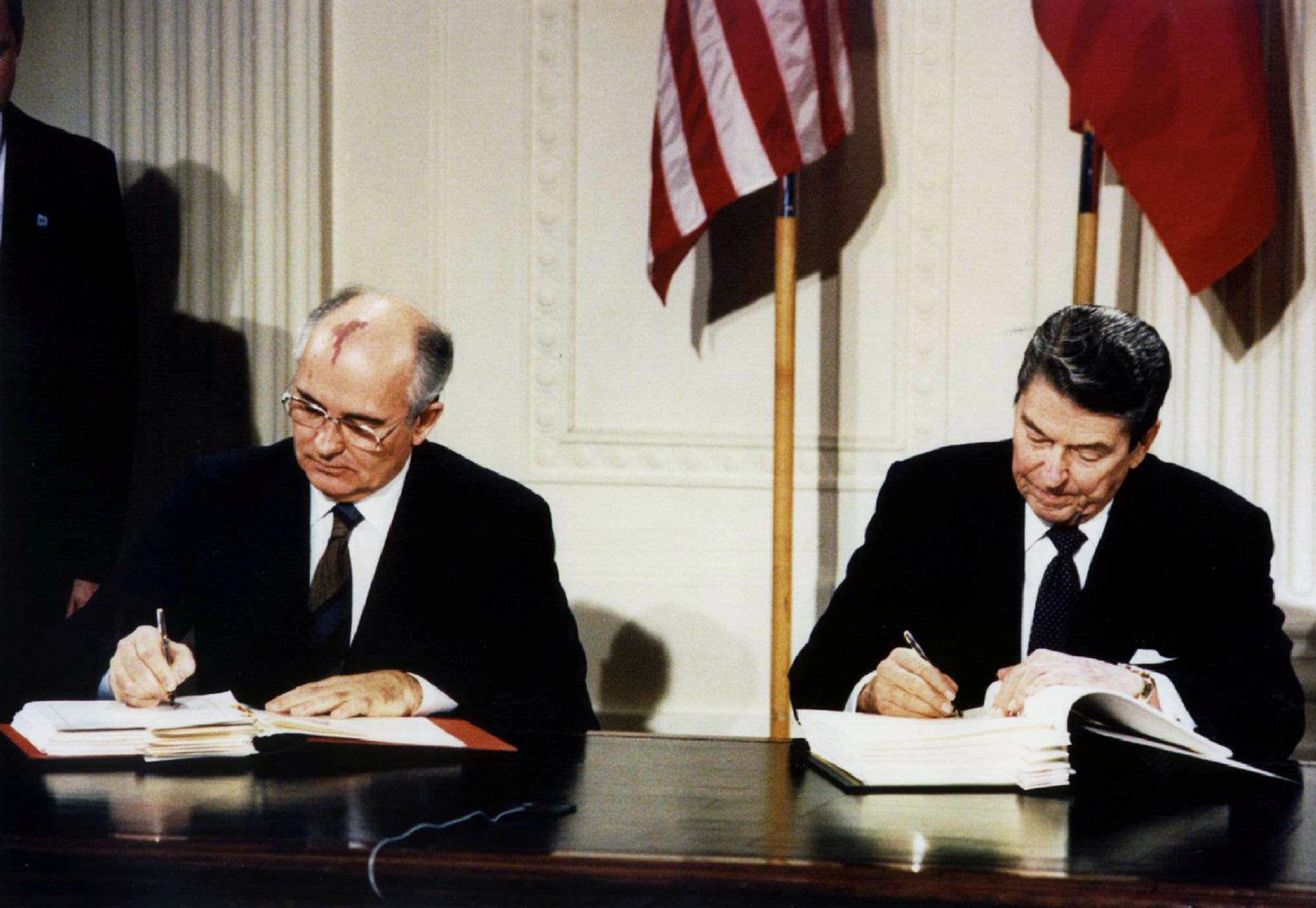
The 1987 Intermediate-range Nuclear Forces Treaty (INF) was negotiated by then-U.S. President Ronald Reagan and Soviet leader Mikhail Gorbachev.

FILE PHOTO: U.S. President Ronald Reagan (R) and Soviet President Mikhail Gorbachev sign the Intermediate-Range Nuclear Forces (INF) treaty in the White House December 8 1987. REUTERS//File Photo

FILE PHOTO: U.S. President Ronald Reagan (R) and Soviet President Mikhail Gorbachev sign the Intermediate-Range Nuclear Forces (INF) treaty in the White House December 8 1987. REUTERS//File Photo

It banned land-based missiles with a range of between 310 and 3,400 miles (500-5,500 km), thus reducing both countries’ ability to launch a nuclear strike at short notice.

“The United States will not remain party to a treaty that is deliberately violated by Russia,” Secretary of State Mike Pompeo said in a statement about the U.S. withdrawal.

“Russia’s non-compliance under the treaty jeopardizes U.S. supreme interests as Russia’s development and fielding of a treaty-violating missile system represents a direct threat to the United States and our allies and partners,” Pompeo said.

Senior administration officials, who spoke on condition of anonymity, said Russia had deployed “multiple battalions” of a cruise missile throughout Russia in violation of the pact, including in western Russia, “with the ability to strike critical European targets.”

Russia denies the allegation, saying the missile’s range puts it outside the treaty. It has rejected a U.S. demand to destroy the new missile, the Novator 9M729, known as the SSC-8 by the NATO Western military alliance.

Moscow has told Washington its decision to quit the pact undermines global security and removes a key pillar of international arms control.

RUSSIAN RESPONSE

Russia said on Friday it had asked the United States for a moratorium on the deployment of land-based short and intermediate-range nuclear missiles.

“A serious mistake has been made in Washington,” Russia’s Ministry of Foreign Affairs said in a statement.

“We have already introduced a unilateral moratorium and won’t deploy land-based short or medium-range missiles, if we get them, in regions where such U.S. missiles are not deployed,” it said.

President Vladimir Putin says Russia does not want an arms race and he has promised he will not deploy Russian missiles unless the United States does so first.

However, should Washington take such a step, he says he would be forced to deploy Russian hypersonic nuclear missiles on ships or submarines near U.S. territorial waters.

NATO Secretary-General Jens Stoltenberg dismissed Russia’s moratorium request on Friday, saying it was “not a credible offer” as he said Moscow had already deployed illegal missiles.

“There are no new U.S. missiles, no new NATO missiles in Europe, but there are more and more new Russian missiles,” he said.

The dispute is aggravating the worst U.S.-Russia friction since the Cold War ended in 1991. Some experts believe the treaty’s collapse could undermine other arms control agreements and speed an erosion of the global system designed to block the spread of nuclear arms.

‘WE DON’T WANT A NEW ARMS RACE’

NATO said it had agreed a defensive package of measures to deter Russia. That response would be measured and would only involve conventional weapons, it said.

NATO’s Stoltenberg said there would be “no rash moves” by the alliance which he said “would not mirror what Russia does.”

“We don’t want a new arms race,” Stoltenberg said.

NATO members Britain and Poland blamed Moscow for the INF treaty’s demise.

“Their contempt for the rules-based international system threatens European security,” British Foreign Secretary Dominic Raab said on Twitter.

European officials have voiced concern that if the treaty collapses, Europe could again become an arena for a nuclear-armed, intermediate-range missile buildup by the United States and Russia.

U.S. officials said the United States was months away from the first flight tests of an American intermediate-range missile that would serve as a counter to the Russians. Any deployment would be years away, they said.

“We are just at the stage of looking at how we might further the development of conventional options,” one official said.

The U.S. military plans to test a ground-launched cruise missile in the coming weeks and an intermediate-range ballistic missile in November, both of which would have been banned under the treaty.

But U.S. officials told Reuters that funding would run out for the tests without approval from Congress, where top Democrats have balked at Trump’s treaty pullout.

Trump has said he would like to see a “next-generation” arms control deal with Russia and China to cover all types of nuclear weapons, something Beijing has so far rejected.

(Reporting by Roberta Rampton and Steve Holland in WASHINGTON, Andrew Osborn in MOSCOW and Robin Emmott in BRUSSELS; Additional reporting by Idrees Ali and Phil Stewart; Editing by Jon Boyle, Peter Graff and Edmund Blair)