Deploying new U.S. missiles would be ‘reckless act’: North Korean media

FILE PHOTO: U.S. Secretary of Defence Mark Esper arrives for a meeting with Japanese Prime Minister Shinzo Abe at Abe's official residence in Tokyo, Japan, August 7, 2019. REUTERS/Issei Kato

By Josh Smith

SEOUL (Reuters) – Any move by the United States to place new ground-launched, intermediate-range missiles in South Korea could spark a “new Cold War” and an escalating arms race in the region, North Korean state media said on Wednesday.

U.S. Defense Secretary Mark Esper this month said he was in favor of placing ground-launched, intermediate-range missiles in Asia, a day after the United States withdrew from the Intermediate Nuclear Forces (INF) treaty with Russia.

“The U.S. pointed out that it is now examining a plan for deploying ground-to-ground medium-range missiles in the Asian region and South Korea has been singled out as a place for the deployment,” North Korea’s state news agency KCNA said.

“It is a reckless act of escalating regional tension, an act that may spark off a new Cold War and arms race in the Far Eastern region to deploy a new offensive weapon in South Korea,” it said in a commentary.

Other senior U.S. officials have said any deployment of such weaponry would be years away.

South Korea’s defense ministry has said there had been no discussion of placing American intermediate-range missiles in the country, and there were no plans to consider the idea.

The KCNA statement also criticized recent moves to improve military sites in South that host U.S. Terminal High Altitude Area Defense (THAAD) systems, which are designed to intercept ballistic missiles.

“It is a hard fact that the deployment of THAAD is pursuant to the U.S. strategy to contain great powers and hold supremacy in Northeast Asia, not the one for ‘shielding’ South Korea from someone’s ‘threat’,” KCNA said.

North Korea’s military has launched a series of missiles in recent weeks to protest what it sees as a military build-up in South Korea, as well as joint military exercises by South Korean and American troops stationed on the peninsula.

The launches have complicated attempts to restart talks between U.S. and North Korean negotiators over the future of the country’s nuclear weapons and ballistic missile programs, which prompted sanctions by the United Nations Security Council.

(Reporting by Josh Smith; Editing by Clarence Fernandez)

Predicting the next U.S. recession, investors apprehensive

FILE PHOTO: Ships and shipping containers are pictured at the port of Long Beach in Long Beach, California, U.S., January 30, 2019. REUTERS/Mike Blake

By Saqib Iqbal Ahmed

NEW YORK (Reuters) – A protracted trade war between China and the United States, the world’s largest economies, and a deteriorating global growth outlook has left investors apprehensive about the end to the longest expansion in American history.

The recent rise in U.S.-China trade war tensions has brought forward the next U.S. recession, according to a majority of economists polled by Reuters who now expect the Federal Reserve to cut rates again in September and once more next year.

Trade tensions have pulled corporate confidence and global growth to multi-year lows and U.S. President Donald Trump’s announcement of more tariffs have raised downside risks significantly, Morgan Stanley analysts said in a recent note.

Morgan Stanley forecast that if the U.S. lifts tariffs on all imports from China to 25 percent for 4-6 months and China takes countermeasures, the U.S. would be in recession in three quarters.

Goldman Sachs Group Inc <GS.N> said on Sunday that fears of the U.S.-China trade war leading to a recession are increasing and that Goldman no longer expects a trade deal between the world’s two largest economies before the 2020 U.S. presidential election.

Global markets remain on edge with trade-related headlines spurring big moves in either direction. On Tuesday, U.S. stocks jumped sharply higher and safe-havens like the Japanese yen and Gold retreated after the U.S. Trade Representative said additional tariffs on some Chinese goods, including cell phones and laptops, will be delayed to Dec. 15.

Besides watching developments on the trade front economists and investors are watching for signs they hope can alert them to a coming recession.

1. THE YIELD CURVE

The U.S. yield curve plots Treasury securities with maturities ranging from 4 weeks to 30 years. When the spread between the yield on the 3-month Treasury bill and that of the 10-year Treasury note slips below zero, as it did earlier this year, it points to investors accepting a lower yield for locking money up for a longer period of time.

As recession signals go, this so-called inversion in the yield curve has a solid track record as a predictor of recessions. But it can take as long as two years for a recession to follow a yield curve inversion.

The closely-followed yield spread between U.S. 2-year and 10-year notes has also narrowed – marking the smallest difference since at 2007 – according to Refinitiv data.

GRAPHIC – Yield curve as a predictor of recessions🙂

2. UNEMPLOYMENT

The unemployment rate and initial jobless claims ticked higher just ahead or in the early days of the last two recessions before rising sharply. Currently the U.S. unemployment rate is near a 50-year low.

“Although job gains have slowed this year, they continue to signal an above-trend economy,” economists at BofA Merrill Lynch Global Research said in a recent note.

Claims will be watched over the coming weeks for signs that deteriorating trade relations between the United States and China, which have dimmed the economy’s outlook and roiled financial markets, were spilling over to the labor market.

(GRAPHIC – Unemployment rate: )

3. GDP OUTPUT GAP

The output gap is the difference between actual and potential economic output and is used to gauge the health of the economy.

A positive output gap, like the one now, indicates that the economy is operating above its potential. Typically the economy operates furthest below its potential at the end of recessions and peaks above its potential towards the end of expansions.

However, the output gap can linger in positive territory for years before a recession hits.

(GRAPHIC – The GDP output gap peaks before recessions🙂

4. CONSUMER CONFIDENCE

Consumer demand is a critical driver of the U.S. economy and historically consumer confidence wanes during downturns. Currently consumer confidence is near cyclical highs.

(GRAPHIC – Consumer confidence is at cyclical highs: )

5. STOCK MARKETS

Falling equity markets can signal a recession is looming or has already started to take hold. Markets turned down before the 2001 recession and tumbled at the start of the 2008 recession.

The recent pullback in U.S. stocks has done its share to raise concerns about whether the economy is heading into a recession. On a 12-month rolling basis, the market has turned down ahead of the last two recessions. The 12-month rolling average percent move is now below the recent highs of January 2018 but still above higher than the lows hit in December.

(GRAPHIC – The S&P 500 has fallen during recessions🙂

6. BOOM-BUST BAROMETER

The Boom-Bust Barometer devised by Ed Yardeni at Yardeni Research measures spot prices of industrials inputs like copper, steel and lead scrap, and divides that by initial unemployment claims. The measure fell before or during the last two recessions and has retreated from a peak hit in April.

(GRAPHIC – The Boom-Bust Barometer🙂

7. HOUSING MARKET

Housing starts and building permits have fallen ahead of some recent recessions. U.S. homebuilding fell for a second straight month in June and permits dropped to a two-year low, suggesting the housing market continued to struggle despite lower mortgage rates.

(GRAPHIC – Housing starts have fallen before prior recessions: )

8. MANUFACTURING

Given the manufacturing sector’s diminished role in the U.S. economy, the clout of the Institute for Supply Management’s (ISM) manufacturing index as a predictor of U.S. GDP growth has slipped in recent years. However, it is still worth watching, especially if it shows a tendency to drop well below the 50 level for an extended period of time.

ISM said its index of national factory activity slipped to 51.2 last month, the lowest reading since August 2016, as U.S. manufacturing activity slowed to a near three-year low in July and hiring at factories shifted into lower gear, suggesting a further loss of momentum in economic growth early in the third quarter.

“The slowdown in manufacturing activity likely reflects, in part, the tariffs that went into effect over the course of last year,” economists at BofA Merrill Lynch Global Research said in a note on Friday.

(GRAPHIC – ISM Manufacturing Index: )

9. EARNINGS

S&P 500 earnings growth dipped ahead of the last recession. Earnings estimates for S&P 500 companies have been coming down but companies are still expected to post growth for most quarters this year.

(GRAPHIC – Earnings fell during the last recession: )

10. HIGH-YIELD SPREADS

The gap between high-yield and U.S. government bond yields rose ahead of the 2007-2009 recession and then widened dramatically.

Credit spreads typically widen when perceived risk of default rises. Spreads have fallen from their January highs.

(GRAPHIC – Junk bond yields jumped in the 2008 recession🙂

11. FREIGHT SHIPMENTS

The Cass Freight Index, a barometer of the health of the shipping industry produced by data company Cass Information Systems Inc, logged a 5.3% year-over-year decline in June. That marked the index’s seventh straight month with a negative reading on a year-over-year basis.

“Whether it is a result of contagion or trade disputes, there is growing evidence from freight flows that the economy is beginning to contract,” Broughton Capital analyst Donald Broughton wrote in the June Cass Freight Index report.

(GRAPHIC – Cass Freight Index – shipments🙂

12. MISERY INDEX

The so-called Misery Index adds together the unemployment rate and the inflation rate. It typically rises during recessions and sometimes prior to downturns. It has slipped lower in 2019 and does not look very miserable.

(GRAPHIC – The Misery Index: )

(Reporting by Saqib Iqbal Ahmed; Editing by Chizu Nomiyama)

Stopping America’s next hate-crime killers on social media is no easy task

By Sarah N. Lynch and Mark Hosenball

WASHINGTON/LONDON (Reuters) – The pattern is clear: Hate-filled manifestos posted on websites populated by white supremacists, followed by gun attacks against blacks, Jews, Muslims, or Latin American immigrants.

In some cases, the killers use their internet posts to praise previous attacks by other white nationalists. And after new assaults, the manifestos get passed around, feeding the cycle of propaganda and violence.

Following the racially-motivated attack that killed 22 people at a Walmart store in El Paso, Texas, President Donald Trump said he wants police to do more to stop extremists who are active online before they can turn to murder.

But identifying and stopping the extremists who plan to launch an attack is much easier said than done.

Law enforcement experts say that the constitutional right of free speech means police cannot arrest someone simply on the basis of extremist rants online, unless they make a specific threat.

“You couldn’t just open a case on the words,” said Dave Gomez, a retired FBI agent who has worked on cases of both international and domestic terrorism.

“Posting something like that on the internet doesn’t harm anybody,” he said, adding that police can only successfully investigate a white supremacist when you can “connect his words to an overt act.”

The White House will discuss violent extremism online with representatives from a number of internet and technology companies on Friday, according to a White House spokesman.

Social media companies are reluctant to spy on or censor their users, though increasingly they are responding to demands that they take down obvious incitements to violence. And civil rights groups warn that tighter monitoring can lead to unconstitutional abuses of power

Another former FBI agent, who asked not to be identified, said closer monitoring of extremists’ websites would anyway be unlikely to prevent new mass shootings.

“There is not enough manpower. There is not enough technology to properly monitor the internet,” he said. “This is the number one thing we always say in law enforcement: ‘You can’t stop crazy. You can’t even predict crazy.’”

Trump said after the mass shootings last weekend in El Paso and Dayton, Ohio, that he would ask the Justice Department to work with local, state and federal agencies as well as social media companies “to develop tools that can detect mass shooters before they strike.”

Even before those attacks, The FBI in early July requested bids for a contractor to help it detect national security threats by trawling through social media sites.

“The use of social media platforms by terrorist groups, domestic threats, foreign intelligence services, and criminal organizations to further their illegal activity creates a demonstrated need for tools to properly identify the activity and react appropriately,” the FBI said in its request.

PRESSURE

Top law enforcement and domestic security officials from the United States, the United Kingdom, Canada, Australia and New Zealand met with leading social media and internet companies in London last week, and pushed them to help authorities track suspicious users.

The government officials noted in an agenda paper for the meeting that some companies “deliberately design their systems in a way that precludes any form of access to content, even in cases of the most serious crimes.”

“Tech companies should include mechanisms in the design of their encrypted products and services whereby governments, acting with appropriate legal authority, can obtain access to data in a readable and usable format,” the agenda paper said.

A final statement from the meeting said little about encryption, however, and neither company nor government officials talked about what was discussed.

Facebook and Microsoft confirmed they attended but Google, which was invited, did not respond to a request for comment. Other attendees included Roblox, Snap and Twitter, the statement said.

FBI agents say that broad surveillance powers enacted by Congress in the wake of the Sept., 11, 2001 attacks helped them track international terrorist groups and stop people with links to foreign groups like al Qaeda and Islamic State before they could carry out crimes.

But they key law criminalizing “material support” for terrorism does not apply to investigations or prosecutions of domestic terrorists, such as violent white supremacists, that commit hate crimes.

This week, the FBI Agents Association called on Congress to make domestic terrorism a federal crime in order to give agents more tools.

The Electronic Frontier Foundation, which promotes internet civil liberties, said the sheer amount of users posting aggressive content online makes it almost impossible to identify and track the people who pose an actual threat.

“Even though it seems like there is another mass shooting every week, if you are looking at the number of mass shooters versus the total population, it’s still a tiny, tiny number which means this is still a very rare event,” said Jeremy Gillula, the group’s tech products director. “It’s like trying to predict where lightning is going to strike.”

(Reporting by Sarah N. Lynch and Mark Hosenball; Editing by Alistair Bell)

Walmart tells staff to pull violent video game signage from stores

FILE PHOTO: A police officer stands next to a police cordon after a mass shooting at a Walmart in El Paso,Texas, U.S. August 3, 2019. REUTERS/Jose Luis Gonzalez/File Photo

By Nandita Bose

(Reuters) – Walmart Inc said on Friday it has asked employees at its stores in the United States to take down signs and playable demos of violent video games but made no changes to its policy on selling firearms.

In an internal memo, Walmart also asked its employees to turn off hunting season videos immediately.

The largest U.S arms retailer, which has been under pressure to change its policies on gun sales, said it took the action following the death of 31 people in mass shootings in Texas and Ohio, one of which took place in a Walmart store.

Meanwhile, a petition started by a junior Walmart worker in California to protest the retailer’s sale of firearms has gathered more than 50,000 signatures. It will be sent to Chief Executive Officer Doug McMillon on Friday.

Thomas Marshall, an employee in San Bruno California who began the petition, told Reuters the decision to remove signage and displays of violent video games is good but not enough.

“They said they will be thoughtful and careful about their response, so we are respectful of that… But I disagree with violent video games and signage being the cause of what we are seeing in the United States,” Marshall said.

“They need to take some concrete step with the weapons they sell in their stores.”

Walmart’s steps are not good enough for a lot of critics including Senator and Democratic presidential candidate Elizabeth Warren, who tweeted on Friday that the retailer should “do the right thing – stop selling guns.”

The company told Reuters it has not changed its policies on sales of firearms and violent video games in its stores. It ended the sale of assault-rifle in 2015 and also raised the minimum age for gun purchases to 21 in 2018, bowing to years of public pressure.

Media reports said Walt Disney Co-owned networks ESPN and ABC have decided to delay the broadcast of an esports tournament of battle royale game ‘Apex Legends’ following the shootings.

Disney and its networks did not immediately respond to a Reuters request for comment.

Shares of videogame makers Electronic Arts, Take-Two Interactive Software and Activision Blizzard fell between 2.9% and 3.8% amid a broader selloff on Wall Street on Friday.

The stocks had tumbled on Monday after President Donald Trump, in response to the mass shootings, called for an end to the glorification of violence and blamed “gruesome and grisly video games” for that.

(Reporting by Nandita Bose in Washington; Additional reporting Uday Sampath in Bengaluru and Noel Randewich in San Fransisco; Editing by Maju Samuel and Arun Koyyur)

Trump says U.S., China still talking on trade but not ready for a deal

FILE PHOTO: U.S. President Donald Trump speaks about the shootings in El Paso and Dayton in the Diplomatic Room of the White House in Washington, U.S., August 5, 2019. REUTERS/Leah Millis

By Roberta Rampton

WASHINGTON (Reuters) – President Donald Trump said on Friday that the United States and China were still pursuing a trade agreement but he was not ready to make a deal.

Speaking to reporters at the White House before departing for fundraisers in New York state, Trump also said the United States would continue to refrain from doing business with Chinese telecoms equipment giant Huawei Technologies.

U.S. stocks extended losses after his comments, looking set to end a punishing week deep in the red on rising trade war worries.[.N]

“We’re doing very well with China. We’re talking with China. We’re not ready to make a deal – but we’ll see what happens,” Trump said.

“China wants to do something, but I’m not ready to do anything yet. Twenty-five years of abuse – I’m not ready so fast, so we’ll see how that works out.” the president added.

Trump said the United States would not do business with Huawei for the time being, although that might change with a trade deal.

The U.S. Commerce Department, which had effectively banned Huawei in May from purchasing U.S. technology, software and services over national security concerns, had been considering granting some licenses for American companies to sell certain products to Huawei.

(Reporting by Roberta Rampton and Jonas Ekblom; Writing by David Lawder and Humeyra Pamuk; Editing by Steve Orlofsky and Howard Goller)

Most Americans expect next mass shooting to happen in next three months: Reuters/Ipsos poll

Mourners taking part in a vigil at El Paso High School after a mass shooting at a Walmart store in El Paso, Texas, U.S. August 3, 2019. REUTERS/Jose Luis Gonzalez

By Maria Caspani

(Reuters) – Nearly half of all Americans expect another mass shooting will happen soon in the United States, according to a Reuters/Ipsos public opinion poll released on Friday, as the nation reels from rampages in California, Texas and Ohio.

The Aug. 7-8 survey found that 78% of Americans said it was likely that such an attack would take place in the next three months, including 49% who said one was “highly likely.” Another 10% said a mass shooting was unlikely in three months and the rest said they did not know.

The poll was conducted after two mass shootings earlier in August in El Paso, Texas, and Dayton, Ohio, and a third in Gilroy, California, last month that left 36 people dead. The attacks have rattled the country and renewed calls for tougher gun laws.

“You are on guard because you never know when it’s going to happen and where,” said Suzanne Fink, 59, a Republican from Troutman, North Carolina. “It has been happening much too often and it’s like a copycat effect.”

There is no set definition of a mass shooting, but the nonprofit organization Gun Violence Archive has tallied more than 250 such incidents so far this year alone – for an average of more than one a day – a widely cited figure that counts events in which four or more people were either shot and killed or shot and wounded.

Following the mass shootings in Texas and Ohio, Democrats, including several 2020 presidential candidates criticized Republican President Donald Trump for rhetoric they labeled as racist and hard-line immigration polices, saying they stoked violence.

Former Texas congressman and presidential candidate Beto O’Rourke on Wednesday called the shooting in El Paso “an act of terror inspired by your racism” in response to a tweet by Trump.

The president, who condemned “sinister ideologies” and hate in a televised speech on Monday, has expressed support for tightening background checks for gun purchases.

Republican Senate leader Mitch McConnell said on Thursday he would not call the Senate back early to consider new gun legislation, rejecting a plea from more than 200 U.S. mayors, including two whose cities endured mass shootings last weekend.

According to the poll, 69% of U.S. adults want “strong” or “moderate” restrictions placed on firearms.

The poll also found that half of all Americans, including two-thirds of Democrats and a third of Republicans, believe that “the way people talk about immigration encourages acts of violence.”

A majority of U.S. adults considers “random acts of violence,” including mass shootings, to be the biggest threat to their safety, while one in four pointed to politically or religiously motivated domestic terrorism as the biggest safety threat. About one in six cited foreign terrorism.

People cited mental health, racism and bigotry and easy access to firearms as the top three causes of mass shootings in the United States, while only about one in six – and one in four Republicans – said in the poll that video games were to blame.

In his speech on Monday, Trump mentioned video games and mental illness as factors in mass shootings. Research studies have shown little or no link between violent video games and shootings.

The Reuters/Ipsos poll was conducted online in English throughout the United States. It gathered responses from 1,116 adults and has a credibility interval, a measure of precision, of plus or minus 3 percentage points.

(Reporting by Maria Caspani; Editing by Chris Kahn and Jonathan Oatis)

Trump says ‘common sense things can be done’ on guns, wants NRA input

FILE PHOTO: U.S. President Donald Trump speaks to reporters as he departs on travel to Dayton, Ohio and El Paso, Texas following back-to-back mass shootings in the cities, on the South Lawn of the White House in Washington, U.S., August 7, 2019. REUTERS/Kevin Lamarque/File Photo

By Susan Heavey and Humeyra Pamuk

WASHINGTON (Reuters) – President Donald Trump on Friday called for “common sense” solutions to address gun violence without mentioning what specific measures he would support and saying the views of powerful National Rifle Association lobbyists should be considered.

Thirty-one people were killed in two weekend shootings in El Paso, Texas, and Dayton, Ohio, in attacks that shook the country and reopened a national debate on gun safety as Americans grapple with yet another mass shooting.

A week later, it remains unclear what, if any, specific steps the Republican president would back. Democrats are trying to galvanize public support for legislative action over what has been a contentious issue for years, even before Trump’s administration.

Trump earlier this week initially appeared to back background checks but then did not mention them in a public address on Monday that focused on mental illness and media culture. He later predicted congressional support for those background checks and blocking gun access to the mentally ill, but not for any effort to ban assault rifles.

He had promised to take action in early 2018 after 17 people were killed at a Parkland, Florida, high school but backed down after the NRA, a key financial donor to Republican politicians, weighed in.

On Friday, he appeared to want to balance any congressional action with the NRA’s views.

“I am the biggest Second Amendment person there is, but we all must work together for the good and safety of our Country,” he wrote. “Common sense things can be done that are good for everyone.”

Trump said he had “been speaking to the NRA, and others, so that their very strong views can be fully represented and respected.” The NRA, in a statement on Thursday, indicated it opposed further gun restrictions.

Congress is in recess but Trump said leaders of the House of Representatives and Senate were discussing expanding background checks for guns sales.

Republican Senate leader Mitch McConnell on Thursday rejected a plea from more than 200 mayors to call the Senate back early to consider gun legislation.

House Speaker Nancy Pelosi and Senate Democratic Leader Chuck Schumer said they had each spoken separately to Trump and that he had assured them he would review legislation that has already passed the Democratic-majority House.

The White House had said it would hold also a meeting with representatives from the technology industry on Friday to discuss violent extremism online. Trump is not scheduled to be at the White House for most of the day as he attends a fundraiser in the Hamptons in New York for his 2020 re-election campaign.

(Reporting by Susan Heavey; Writing by Humeyra Pamuk; Editing by Bill Trott)

Allegations of labor abuses dogged Mississippi plant years before immigration raids

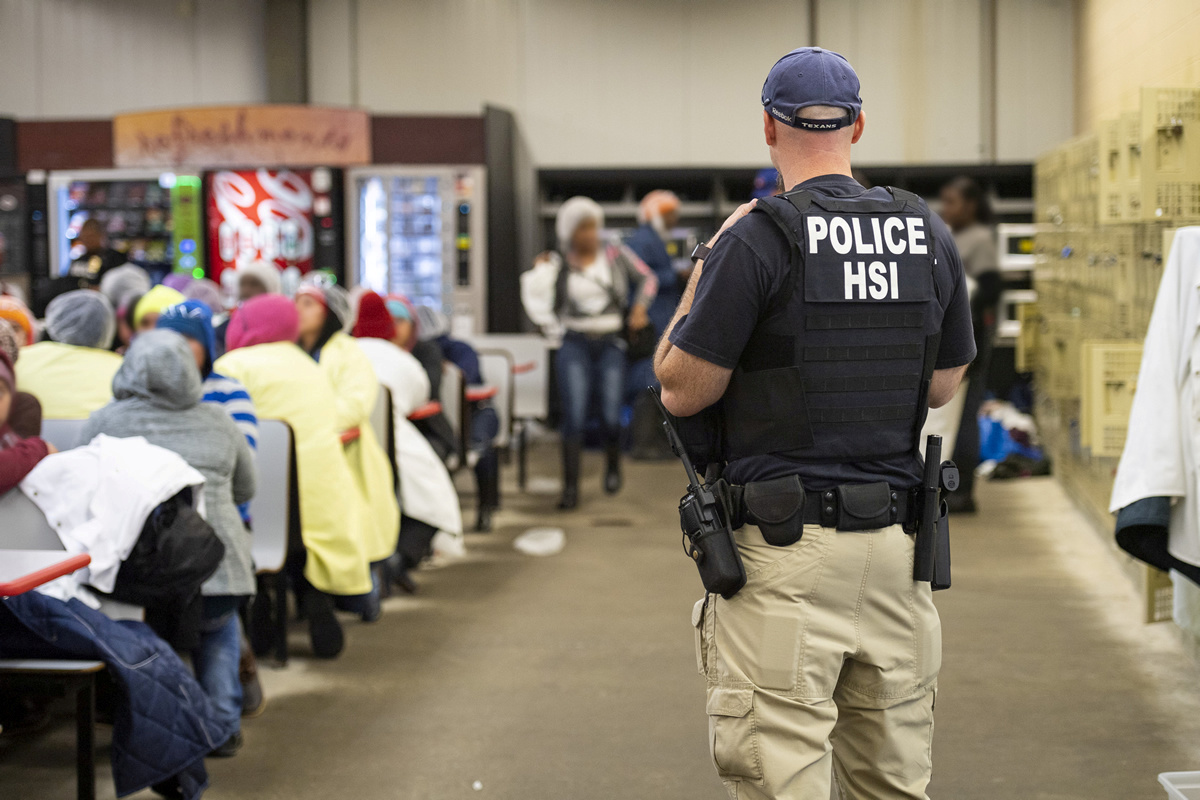
FILE PHOTO: Homeland Security Investigations (HSI) officers from Immigration and Customs Enforcement (ICE) look on after executing search warrants and making arrests at an agricultural processing facility in Canton, Mississippi, U.S. in this August 7, 2019 handout photo. Immigration and Customs Enforcement/Handout via REUTERS/File Photo

By Mica Rosenberg and Kristina Cooke

(Reuters) – Long before U.S. immigration authorities arrested 680 people at agricultural processing facilities in Mississippi this week, one of the five targeted companies faced allegations of serious labor violations including intimidation, harassment and exploitation of its largely immigrant work force, according to a federal lawsuit.

Last August, Illinois-based poultry supplier Koch Foods settled a multi-year lawsuit brought by the U.S. Equal Employment Opportunity Commission (EEOC) on behalf of more than 100 workers at the Morton, Mississippi, plant over claims the company knew – or should have known – of sexual and physical assaults against its Hispanic workers.

The workers’ complaints spanned 2004 to 2008, when the plant employed more than 500 people. They allege that a manager would grope women from behind while they were working, punch employees and throw chicken parts at them. Workers also alleged that supervisors coerced payments from them for everything from medical leave and promotions to bathroom breaks.

Privately-held Koch Foods, run by billionaire Joseph Grendys, did not respond to requests for comment. In court filings, the company called the claims of abuse and harassment “baffling” and “outrageous.” Koch said the plaintiffs made claims against the company as a means to obtain U.S. visas for crime victims who collaborate with law enforcement, according to the court documents.

The company settled the allegations last year by paying a $3.75 million and entering into a three-year consent decree to prevent future violations. It agreed to implement new policies such as creating a 24-hour complaint hot line and publicly posting anti-discrimination policies, according to the EEOC.

Some workers at the Mississippi plant who lacked legal immigration status alleged in court documents that supervisors threatened to turn them in to authorities if they spoke out about their concerns, according to the EEOC complaint.

Former federal officials and immigration attorneys said mass deportation operations like the ones conducted by U.S. Immigration and Customs Enforcement (ICE) on Wednesday in Mississippi can have a chilling effect on future labor complaints.

“If workers are being threatened with being turned over to ICE, and then here comes ICE and arrests workers,” people could be more reluctant to speak up, said John Sandweg, a former acting ICE director during the Obama administration.

In the EEOC lawsuit, one Koch Foods employee without legal immigration status alleged that a manager sexually harassed his wife and made him pay to use the bathroom, once waiting until he had soiled himself to give him permission to leave his spot on the production line.

“If he found out that I had talked about anything that he was doing, charging money, the way he mistreated us, the dirty words he used, he told me that if I went to complain in the office that he had contacts in immigration,” the worker said in a 2012 deposition that was filed as part of the suit. “And that he knew where I lived.”

Maria Cazorla, a Cuban immigrant and lead plaintiff in a lawsuit against the company that was wrapped into the EEOC case, said in an interview Thursday that a manager inappropriately touched her and hit her then-husband, also a co-worker, in the ribs while he was working.

According to Cazorla’s interview and court documents, her husband at the time was targeted by management and fired over his immigration status after she filed her lawsuit against the company in 2010. Cazorla, now a U.S. citizen, left the company and Mississippi and now renovates houses in Florida.

Even after the manager accused of some of the most serious violations was fired in 2008, workers continued to be subjected to threats of violence and reprisals in the workplace, the lawsuit said.

The EEOC enforces federal anti-discrimination laws and can investigate employee complaints. The agency tries to settle the claims but, if unsuccessful, it can file a lawsuit against employers for workplace discrimination.

Marsha Rucker, EEOC Regional Attorney based in Birmingham, Alabama who oversaw the lawsuit, said she did not believe the EEOC’s civil complaint was connected to the ICE action this week.

SCENES OF MASS ARRESTS

The dramatic operation on Wednesday was the biggest workplace immigration sweep since December 2006, when ICE targeted meatpacking plants in six states and arrested almost 1,300 people.

Some children of workers were left traumatized by their parents’ detention on what was for many the first day of school, according to local media reports.

“Government, please,” an 11-year-old girl said on a CBS News segment, weeping in front of a community center where she and other children were sent to spend the night. “My dad didn’t do nothing. He’s not a criminal.”

ICE officials told reporters on a call on Thursday that they had released 303 people for humanitarian reasons – if they were pregnant or a primary caretaker of children, for example. Among those released pending a hearing before an immigration judge were 18 “juveniles” who had been working in the plants, ICE said, including one 14-year-old.

Koch Foods has been the target of worksite enforcement in the past.

In August 2007, immigration agents arrested more than 160 employees of a Koch Foods chicken plant in Fairfield, Ohio, and paid about a half-million dollars in fines. At the time, ICE said Koch Foods was being investigated for federal crimes including encouraging, inducing or harboring immigrants in the United States illegally.

The company, which according to its website is not affiliated with Koch Industries or the Koch brothers, started with 13 employees deboning and cutting up chicken in one room in 1985. It now counts more than 13,000 employees and bills itself as one of the biggest poultry processors in the United States, with facilities in Alabama, Georgia, Ohio, Tennessee and Illinois as well as Mississippi.

In a letter to President Donald Trump, who has made cracking down on immigration a centerpiece of his administration, the National Chicken Council – a lobbying group – said the poultry industry “uses every tool available to verify the identify and legal immigration status of all prospective employees” but said there was no government system available to “confirm with confidence that new hires are legally authorized to work in the United States.”

(Mica Rosenberg reported from New York and Kristina Cooke from San Francisco; Editing by Julie Marquis and Marla Dickerson)

U.S. Midwest farm economy hit hard by record floods – Fed banks

FILE PHOTO: A levee breach is shown in this aerial photo, from flood damage near Bartlett, Iowa, U.S., March 29, 2019. REUTERS/Tom Polansek/File Photo

By P.J. Huffstutter

CHICAGO (Reuters) – U.S. farm incomes in the Midwest and Mid-Southern states declined yet again in the second quarter of 2019, as record floods devastated a wide swath of the Farm Belt, according to banker surveys released on Thursday by the Federal Reserve Banks of St. Louis and Kansas City.

Nearly two-thirds of the bankers surveyed by the St. Louis Fed said a majority of their farm customers were either significantly or modestly impacted by the flooding and other adverse weather earlier this year.

But in parts of the Midwest, federal trade-related aid to farmers and corn prices rising this spring due to the wet planting conditions slowed the pace of that income drop, according to bankers surveyed by the Kansas City Fed.

“These developments may have led to less pessimistic expectations about farm income in coming months,” the Kansas City Fed wrote in its survey.

The floods added more pain on farmers who have also been hurt by low crop prices and the trade war between Washington and Beijing, which has slashed shipments of U.S. agricultural products to China. The floods also battered earnings for global grain traders Cargill Inc and Archer Daniels Midland Co <ADM.N>, as heavy rains halted barge traffic on the Mississippi River, disrupted cattle shipments and caused some plants to be shuttered.

The St. Louis Fed said the second quarter marked the 22nd consecutive quarter for farm incomes dropping in the Eighth Federal Reserve District, which includes all or parts of seven Midwest and Mid-South states: Arkansas, Illinois, Indiana, Kentucky, Mississippi, Missouri and Tennessee.

The weaker income trend is expected to continue in the third quarter, dragged down by the ongoing trade fight between the United States and China, problems with crop production and depressed commodity prices, bankers in the Eighth District said.

The flooding and extreme weather also impacted local economies in western Missouri, Kansas, Nebraska and Oklahoma, according to the Kansas City Fed’s survey. The bank’s Tenth District also includes Colorado, Wyoming and portions of northern New Mexico.

Farm household spending and farm capital expenditures also were lower for the quarter for the Eighth District, compared with a year earlier, raising concerns about potential ripple effects overall on rural communities.

But bankers there said they did expect such belt-tightening to ease in the third quarter, as farmers prepare for the fall harvest season.

(Reporting By P.J. Huffstutter in Chicago; Editing by Matthew Lewis)

Petition by Walmart employee to protest gun sales gathers over 45,000 signatures

A police officer stands next to a police cordon after a mass shooting at a Walmart in El Paso,Texas, U.S. August 3, 2019. REUTERS/Jose Luis Gonzalez

By Nandita Bose

WASHINGTON (Reuters) – A petition started by a junior Walmart Inc <WMT.N> worker in California to protest the retailer’s sale of firearms, following two mass shootings over the weekend left 31 people dead in Texas and Ohio, has gathered more than 45,000 signatures.

Thomas Marshall, a 23-year-old category manager in San Bruno began his protest by emailing fellow employees and asking them to call in sick on Tuesday, leave work early on Wednesday, and to sign a Change.org petition.

The petition https://www.change.org/p/doug-mcmillon-stop-the-sale-of-guns-at-walmart-stores?utm_content=bandit-starter_cl_share_content_en-us%3Av4&recruited_by_id=fc7b5740-b810-11e9-be8a-6fbcafd3c27d&recruiter=989859201&utm_source=share_petition&utm_medium=copylink&utm_campaign=share_petition, which is open to the public, is steadily approaching its goal of 50,000 signatures.

“In light of these recent tragedies — a mere snapshot of the gun violence epidemic plaguing the United States — and in response to Corporate’s inaction, we as employees are organizing several days of action, to protest Walmart’s profit from the sale of firearms and ammunition,” the petition says.

Marshall told Reuters he and other organizers would send the petition to the company’s Chief Executive Doug McMillon after it reaches its target.

Marshall said he was shut out of the company’s email and messaging networks temporarily earlier this week after he started the protest, but that he has since been granted access.

Employees in San Bruno and in Portland, Oregon had walked out on Wednesday in protest of the company’s policy of selling firearms, Marshall said, adding that some Walmart employees in New York also held a minute of silence that day.

Walmart said 40 employees in San Bruno protested by walking out but did not confirm the other details.

“A lot more employees have been reaching out to me to express their support but a majority of those employees are very afraid of retaliation from the company,” he said.

NO CHANGE IN GUN SALE POLICY

Earlier this week, Walmart told Reuters there had been no change in its policy on gun sales after the recent mass shootings, one of which took place in a Walmart store.

Years of public pressure led Walmart, the largest U.S arms retailer, to end assault-rifle sales in 2015 and to raise the minimum age for gun purchases to 21 in 2018.

Some gun control activists and Walmart customers now want the retailer to drop sales of guns and ammunition altogether.

Walmart spokesman Randy Hargrove said on Thursday the company continued to feel there were more appropriate ways for employees to engage with the retailer, including through discussions with top leadership.

He said the company’s policy on selling firearms had not changed.

“We have worked very hard to be a responsible firearms retailer…Walmart does more in the area of background checks than what the federal law requires,” Hargrove added.

The retailer’s Chief Executive Doug McMillon sent a message to employees on social media late on Tuesday, assuring them the company was listening to their concerns.

“We will be thoughtful and deliberate in our responses, and we will act in a way that reflects the best values and ideals of our company,” McMillon said.

(Reporting by Nandita Bose in Washington; Editing by Bernadette Baum)