Trump orders more Iran curbs, Saudi shows attack evidence

By Stephen Kalin and Parisa Hafezi

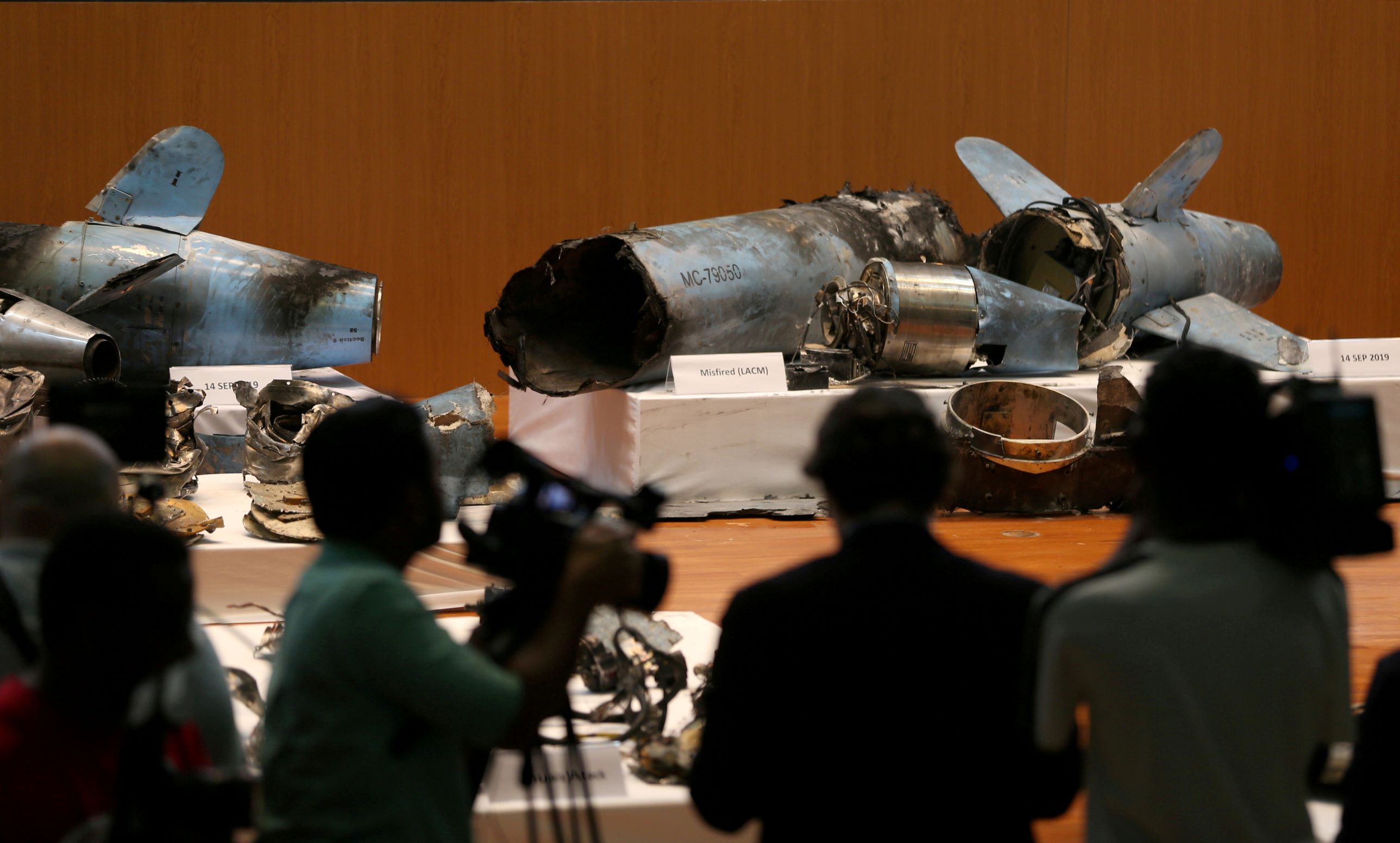
JEDDAH/DUBAI (Reuters) – U.S. President Donald Trump on Wednesday said he ordered a major increase in sanctions on Iran as Saudi Arabia displayed remnants of drones and missiles it said Tehran used in a crippling weekend attack on its oil facilities.

Trump gave no explanation in a brief Twitter posting announcing the order, but the initiative follows repeated U.S. assertions that the Islamic Republic was behind Saturday’s attack on the kingdom, a close U.S. ally.

“I have just instructed the Secretary of the Treasury to substantially increase sanctions on the country of Iran!,” he wrote.

Iran, however, again denied involvement in the Sept. 14 raids, which hit the world’s biggest crude processing facility and initially knocked out half of Saudi production.

“They want to impose maximum … pressure on Iran through slander,” Iran’s President Hassan Rouhani said.

“We don’t want conflict in the region … Who started the conflict?” he added, blaming Washington and its Gulf allies for the war in Yemen.

Yemen’s Houthi movement, an ally of Iran battling a Western-backed, Saudi-led coalition for more than four years, has claimed responsibility and said it used drones to assault state oil company Aramco’s sites.

However, the Saudi Defense Ministry held a news conference, displaying drone and missile debris it said was “undeniable” evidence of Iranian aggression. A total of 25 drones and missiles were used in the attacks launched from Iran not Yemen, the ministry spokesman added.

Saturday’s attack exposed the vulnerability of Saudi Arabia’s oil infrastructure and threw down a gauntlet to the United States, which wants to curb Tehran’s influence in the region.

Proof of Iranian responsibility could pressure Riyadh and Washington into a response, though both nations were stressing the need for caution.

Trump has said he does not want war and is coordinating with Gulf and European states.

Saudi Arabia’s Crown Prince Mohammed bin Salman said the hit on the world’s biggest crude exporter was a “real test of the global will” to confront subversion of the international order.

His envoy to London, Prince Khalid bin Bander, told the BBC the attack was “almost certainly” Iranian-backed, however: “We’re trying not to react too quickly because the last thing we need is more conflict in the region.”

“COMPELLING EVIDENCE”

U.S. Secretary of State Mike Pompeo was to meet Prince Mohammed in Jeddah on Wednesday to discuss the crisis before heading to the United Arab Emirates.

U.N. officials monitoring sanctions on Iran and Yemen were also heading to Saudi Arabia to investigate.

France, which is trying to salvage an international nuclear deal with Iran that Washington quit last year, said it wanted to establish the facts before reacting.

A U.S. official told Reuters the strikes originated in southwestern Iran. Three officials said they involved cruise missiles and drones, indicating a higher degree of complexity and sophistication than initially thought.

The officials did not provide evidence or explain what U.S. intelligence they were using for evaluating the attack, which cut 5% of global production.

Saudi Arabia said on Tuesday the 5.7 million barrels per day of output lost would be fully restored by the end of the month.

Oil prices fell after the Saudi reassurances, having surged more than 20% at one point on Monday – the biggest intra-day jump since the 1990-91 Gulf War. [O/R]

Saudi Arabia’s finance minister told Reuters on Wednesday the attack had no impact on revenues and Aramco was continuing to supply markets without interruption.

U.S. efforts to bring about a U.N. Security Council response look unlikely to succeed as Russia and China have veto powers and are expected to shield Iran.

Russian President Vladimir Putin, who has offered to sell Riyadh defense systems, called for a “thorough and impartial” probe during a phone call with Prince Mohammed.

The assault exposed serious gaps in Saudi air defense despite billions of dollars spent on Western military hardware and repeated attacks on vital assets during its four-and-a-half year foray into the Yemen war.

“The attack is like Sept. 11th for Saudi Arabia, it is a game changer,” said one Saudi security analyst.

IRAN-U.S. CONFLICT

Already frayed U.S.-Iran ties deteriorated further when Trump quit the nuclear pact and reimposed sanctions, severely hurting the Iranian economy. Iran has ruled out talks with Washington unless it returns to the pact.

Trump said he is not looking to meet Rouhani during a U.N. event in New York this month. Rouhani and his foreign minister may not attend the General Assembly at all unless U.S. visas are issued in the coming hours, state media reported Wednesday.

Washington and its Gulf allies want Iran to stop supporting regional proxies, including in Yemen, Iraq and Lebanon.

Despite years of air strikes against them, the Houthi movement boasts drones and missiles able to reach deep into Saudi Arabia, the result of an arms race since the Western-backed coalition intervened in Yemen in March 2015.

Iran’s clerical rulers support the Houthis, who ousted Yemen’s internationally recognized government from power in the capital Sanaa in late 2014. But Tehran denies it actively supports them with military and financial support.

Iran maintains the largest ballistic and cruise missile capabilities in the Middle East that could overwhelm virtually any Saudi missile defense system, according to think-tank CSIS, given the geographic proximity of Tehran and its proxy forces.

But even more limited strikes have proved too much for Saudi Arabia, including recent ones claimed by the Houthis on a civilian airport, oil pumping stations and the Shaybah oilfield.

(Reporting by Parisa Hafezi in Dubai and Stephen Kalin in Jeddah; Additional reporting by Guy Faulconbridge in London, Michelle Nichols in New York, Rania El Gamal, Davide Barbuscia and Marwa Rashad in Riyadh, Asma Alsharif and Sylvia Westall in Dubai, Alaa Swilam and Hisham El Saba in Cairo, Maria Kiselyova in Moscow; Tim Kelly in Tokyo, John Irish and Sudip Kar-Gupta in Paris, Phil Stewart and Steve Holland in Washington; Writing by Ghaida Ghantous and Andrew Cawthorne; Editing by Andrew Cawthorne and William Maclean)

Iran’s Khamenei rejects talks with United States

By Parisa Hafezi

DUBAI (Reuters) – Iran will never hold one-on-one talks with the United States but could engage in multilateral discussions if it returns to the 2015 deal on Iran’s nuclear program, Supreme Leader Ayatollah Ali Khamenei said on Tuesday, according to state television.

U.S. President Donald Trump has said he could meet Iranian President Hassan Rouhani, possibly at the U.N. General Assembly in New York later this month.

“Iranian officials, at any level, will never talk to American officials … this is part of their policy to put pressure on Iran … their policy of maximum pressure will fail,” state television quoted Khamenei as saying.

Khamenei said Iran’s clerical rulers were in agreement on this: “All officials in Iran unanimously believe it.

“If America changes its behavior and returns to (Iran’s 2015) nuclear deal, then it can join multilateral talks between Iran and other parties to the deal,” Khamenei said.

Trump has stepped up sanctions against Iran since last year when he withdrew from the nuclear pact between Iran and six world powers and reimposed sanctions that were lifted under the deal in return for Iran curbing its nuclear program.

In retaliation for the U.S. “maximum pressure” policy, Iran has gradually scaled back its commitments to the pact and plans to further breach it if the European parties fail to keep their promises to shield Iran’s economy from U.S. penalties.

“If we yield to their pressure and hold talks with Americans … This will show that their maximum pressure on Iran has succeeded. They should know that this policy has no value for us,” said Khamenei, who has the last say on all state matters.

Tensions between Tehran and Washington have spiked following a weekend attack on major oil sites in Saudi Arabia that sent oil prices soaring and raised fears of a new Middle East conflict.

Trump said on Monday it looked like Iran was behind the attacks but stressed he did not want to go to war. Iran has denied any involvement.

Iran’s regional rival, Saudi Arabia, said the attacks were carried out with Iranian weapons and it was capable of responding forcefully.

Saudi Arabia urged U.N. experts to help investigate the raid.

(Additional reporting by Asma Alsharif; Writing by Parisa Hafezi; Editing by Andrew Heavens, Robert Birsel)

Senators push for U.S. to expand mining for electric vehicle supply chain

WASHINGTON (Reuters) – U.S. senators voiced bipartisan support on Tuesday for the expansion of domestic mining and minerals recycling, part of a push to jumpstart the country’s electric vehicle supply chain and offset China’s rising dominance in the fast-growing space.

“China is consolidating control of the entire supply chain for clean technologies,” Senator Lisa Murkowski, the Republican chair of the Senate’s Energy and Natural Resources Committee, said at a hearing. “The United States is falling behind … and allowing that to happen is a strategic mistake.”

(Reporting by Ernest Scheyder)

Taliban attacks kill 48, Afghan leader unhurt as bomber targets rally

KABUL (Reuters) – Taliban suicide bombers killed 48 people in two separate attacks in Afghanistan on Tuesday, the deadliest taking place near an election rally by President Ashraf Ghani, though he was unhurt.

The attacks happened 11 days before Afghanistan’s presidential election, which Taliban commanders have vowed to violently disrupt, and follow collapsed peace talks between the United States and the insurgent group.

Ghani, who is seeking a second five-year term in voting on Sept. 28, was due to address a rally in Charikar, the capital of central Parwan province, when a suicide bomber attacked the gathering.

The blast killed 26 people and wounded 42, said Nasrat Rahimi, spokesman for the interior ministry.

“When the people were entering the police camp, an old man riding a motorcycle arrived on the highway and detonated his explosives, causing casualties,” said Parwan province’s police chief Mohammad Mahfooz Walizada.

In the wake of the attack, bodies littered the dusty ground as smoke rose from the site of the explosion, a giant blue billboard bearing the face of Ghani’s running mate Amrullah Saleh looming over the scene.

With sirens wailing, rescuers rushed to lift the wounded into the backs of pick-up trucks for evacuation.

“Women and children are among them and most of the victims seem to be the civilians,” said Abdul Qasim Sangin, head of Parwan’s provincial hospital.

The president was nearby but unharmed, and later took to Twitter to condemn the bombing at the rally.

“Taliban tried to break this unity by targeting innocent civilians,” he wrote. “They shamelessly accepted responsibility at a time when they’re cloaking acts of terror as efforts for peace.”

“PEOPLE WERE GIVEN WARNING”

In a separate incident, a man on foot blew himself up in the center of the capital Kabul, sending ambulances and Afghan forces rushing to the blast site.

“I was waiting at the entrance of the recruitment center,” said Mustafa Ghiasi, lying on a hospital bed after being wounded in the explosion. “I was behind two men in line when suddenly the blast struck.”

Twenty-two people were killed, and 38 were wounded, said Rahimi, the interior ministry spokesman. Most of the dead were civilians, including women and children, though six were security force members.

The Taliban said it carried out the two attacks, and a statement issued by a spokesman for the insurgents said they were aimed at security forces.

“People were given warning,” the statement said.

“Do not take part in the puppet administration’s election rallies, because all such gatherings are our military target,” said the statement. “If, despite the warning, someone get hurt, they themselves are to blame.”

Addressing the Kabul attack, Afghanistan’s president lashed out at the Taliban as the “coward enemy” for targeting civilians.

“I offer my heartfelt condolences to victims of today’s tragedies in Kabul and Parwan and pray for speedy recovery of those who were wounded,” Ghani wrote on his official Twitter account. “We stand united in this hour of grief.”

Pakistan, which denies accusations that it shelters the Taliban, also condemned the attack.

“We offer our heartfelt condolences to the bereaved families,” it said in a statement.

Security at rallies across the country has been tight following threats by the Taliban to attack meetings and polling stations. The group has vowed to intensify clashes with Afghan and foreign forces to dissuade people from voting in the upcoming elections.

Last week, peace talks between the United States and the Taliban collapsed. The two sides had been seeking to reach an accord on the withdrawal of thousands of American troops from Afghanistan in exchange for security guarantees from the insurgents.

The negotiations, which did not include the Afghan government, were intended as a prelude to wider peace negotiations to end more than more 40 years of war in Afghanistan.

(Reporting by Abdul Qadir Sediqi, Hameed Farzad, Hamid Shalizi; Writing by Paul Carsten; Editing by William Maclean and Alex Richardson)

Canada bids to reassure U.S., other allies after intelligence official arrested

Cameron Ortis, director general with the Royal Canadian Mounted Police's intelligence unit, is shown in a court sketch from his court hearing in Ottawa, Canada, September 13, 2019. Lauren Foster-MacLeod/Handout via REUTERS

By David Ljunggren

OTTAWA (Reuters) – Canada is working to reassure the United States and other allies after a top police intelligence official was charged with leaking secrets, Prime Minister Justin Trudeau said on Tuesday.

Cameron Ortis, a director general with the national police force’s intelligence unit, had access to highly sensitive domestic and foreign intelligence, and his arrest last week sparked fears of a possible major security breach.

Ortis was charged on Friday under a 2012 security information law used to prosecute spies.

Security experts say the case could damage Canada’s standing inside the Five Eyes intelligence-sharing network that also includes the United States, Australia, New Zealand and Britain.

“We are in direct communications with our allies on security, not only the Five Eyes group,” Trudeau said during a campaign stop in St. John’s, Newfoundland.

“We are also working with them to reassure them, but we want to ensure that everyone understands that we are taking this situation very seriously.”

Canadian security officials are working urgently to see what if any data might have been leaked, said a senior source with direct knowledge of the situation.

Canada’s allies are working on the assumption that if any secrets were shared, China and Russia are likely to have been the main beneficiaries, said a second source with direct knowledge of the matter.

Canadian officials say China, in particular, has been aggressively seeking to obtain sensitive information.

The Canadian Broadcasting Corp., citing government documents, said the U.S. Federal Bureau of Investigation had tipped off Canada as it probed a separate criminal matter. The FBI discovered in 2018 that someone had contacted the head of Canadian company Phantom Secure offering to sell secrets.

The chief executive of the firm last year pleaded guilty to facilitating international narcotics traffic by supplying drug cartels with encrypted communications devices.

Royal Canadian Mounted Police (RCMP) Commissioner Brenda Lucki is expected to provide a “short update” and answer questions on the case on Tuesday at 1 p.m. EDT (1700 GMT).

On Monday, Lucki said the leaks could have hurt allied nations’ intelligence operations and promised that “mitigation strategies are being put in place as required.”

(Additional reporting by Kelsey Johnson and Steve Scherer in Ottawa; Editing by Edmund Blair and Bernadette Baum)

Saudi oil output to recover in two or three weeks after attack: sources

A satellite image showing damage to oil/gas Saudi Aramco infrastructure at Abqaiq, in Saudi Arabia in this handout picture released by the U.S Government September 15, 2019. U.S. Government/DigitalGlobe/Handout via REUTERS

By Alex Lawler and Parisa Hafezi

LONDON/DUBAI (Reuters) – Saudi Arabia sought to calm markets on Tuesday after an attack on its oil facilities, with sources in the kingdom saying output was recovering much more quickly than initially forecast and could be fully back in two or three weeks.

International oil companies, fellow members of the OPEC oil cartel and global energy policymakers had heard no updates on the impact of the weekend attack from the Saudis for 48 hours, according to sources with knowledge of the situation.

And on Monday, sources briefed on state oil giant Aramco’s operations had said it could take months for output to recover.

The attack knocked out half of Saudi Arabia’s oil production, or 5% of global output, sending prices soaring when trading resumed on Monday. So the new prediction of a quick return to normal output sent prices down sharply on Tuesday.

The kingdom is close to restoring 70% of the 5.7 million barrels per day lost due to the attack, a top Saudi official said, adding that Aramco’s output would be fully back online in the next two to three weeks.

The Saudi energy minister will hold a news conference on Tuesday at 1715 GMT, giving what would be the first official update since Aramco announced on Sunday that attacks on its plants in Abqaiq and Khurais had knocked out 5.7 million barrels per day.

While the Houthi group, which is fighting a Saudi-led coalition in Yemen, was quick to claim responsibility for the attack, U.S. President Donald Trump blamed Iran. That accusation prompted Iran’s supreme leader on Tuesday to rule out talks with Washington.

NUCLEAR ACCORD

Trump said on Monday that it looked like Iran was behind the strike at the heart of the Saudi oil industry, but stressed he did not want to go to war. Iran denied it was to blame.

“Iranian officials, at any level, will never talk to American officials … this is part of their policy to put pressure on Iran,” Iranian state TV quoted Ayatollah Ali Khamenei as saying.

He said talks could only take place if the United States returned to a nuclear accord between Iran and the West that Trump abandoned last year.

U.S.-Iran relations deteriorated after Trump quit the accord and reimposed sanctions over Tehran’s nuclear and ballistic programs. He also wants Iran to stop supporting regional proxies, including the Houthis.

But a day after warning that the United States was “locked and loaded” to respond to the incident, Trump dialed down his rhetoric, saying on Monday there was “no rush” to do so and that Washington was coordinating with Gulf Arab and European states.

“I’m not looking at options right now. We want to find definitively who did this.”

Britain and Germany agreed they needed to work with international partners to form a collective response and de-escalate tensions as efforts continued to establish exactly what happened, Prime Minister Boris Johnson’s spokesman said.

German Chancellor Angela Merkel said the Iran nuclear pact, which European parties are trying to salvage, is one building block “we need to get back to”.

Saudi Arabia, which has supported tougher U.S. sanctions on Iran, said an initial investigation showed the strikes were carried out with Iranian weapons.

INVESTIGATION

Riyadh asked international experts to join its investigation, which indicates the attack did not come from Yemen, the foreign ministry said. U.S. officials say they believe it came from the opposite direction, possibly from Iran.

Iranian President Hassan Rouhani said Yemenis had launched the strikes in retaliation for attacks by a Saudi-led coalition that has been battling the Houthis for four years. Riyadh says Tehran arms the group, which has fired missiles and drones on Saudi cities, a charge both deny.

King Salman, heading a cabinet meeting on Monday, said Riyadh would handle the consequences of “cowardly attacks” that target vital Saudi installations, world crude supplies and global economic stability. The cabinet urged the world to confront those threats “regardless of their origin”.

The assault damaged the world’s biggest crude oil processing plant, triggering the largest jump in oil prices in decades. It was the worst such attack on regional oil facilities since Saddam Hussein torched Kuwait’s oil wells during the 1990-91 Gulf war.

However, dollar-denominated bonds issued by the Saudi government and Aramco rebounded on Tuesday, in a sign investors’ concern may be abating.

Trump said he was sending Secretary of State Mike Pompeo to Saudi Arabia soon, but he had not made any commitments to protect the Saudis. “That was an attack on Saudi Arabia, and that wasn’t an attack on us. But we would certainly help them.”

(Reporting by Parisa Hafezi and Steve Holland; Additional reporting by Reuters teams in London, Dubai, Riyadh, Cairo, Berlin, Paris, Singapore and New Delhi; Writing by Ghaida Ghantous; Editing by Giles Elgood and Andrew Cawthorne)

U.S. agency says Walmart likely discriminated against female workers: WSJ

(Reuters) – Walmart Inc likely discriminated against 178 female workers by paying less or denying promotions or both because of their gender, the U.S. Equal Employment Opportunity Commission said in memos reviewed by The Wall Street Journal, the newspaper said on Tuesday.

The agency urged Walmart and the women who filed complaints to come to a “just resolution,” which could include a settlement and changes to Walmart’s employment practices, after finding “reasonable cause” to believe there was gender discrimination, the newspaper said.

Walmart is the world’s largest retailer, and according to the newspaper has 1.5 million U.S. employees.

Randy Hargrove, a Walmart spokesman, said Walmart told the EEOC it was willing to engage in a “conciliatory process,” though in most cases the agency’s reasonable cause findings were “vague and non-specific.”

He also said the cases involved allegations that were more than 15 years old and were “not representative of the positive experiences millions of women have had working at Walmart.”

A lawyer who has acted as a co-counsel for women who filed complaints could not immediately be reached for comment.

In 2011, Walmart convinced the U.S. Supreme Court not to let roughly 1.5 million female workers complaining about pay and promotions sue in a class action, with a majority of justices concluding the women had too little in common to sue as a group.

More than 1,900 women have since pursued cases and filed charges with the EEOC accusing the Bentonville, Arkansas-based retailer of gender discrimination, the Journal said.

The charges involving the 178 women come from more than 30 states, and it is rare for the EEOC to pursue that many cases against one employer over such a wide geographic area, the newspaper added, citing labor lawyers.

An EEOC spokesman told the newspaper that the agency cannot discuss investigations or the administrative process until litigation is filed.

(Reporting by New York Newsroom; Editing by David Gregorio)

Workers picket GM plants as UAW contract talks resume

By Nick Carey and Ben Klayman

DETROIT (Reuters) – Negotiators for General Motors Co and the United Auto Workers were continuing talks Monday afternoon to resolve a strike that shut down the automaker’s highly profitable U.S. operations.

The UAW on Sunday launched the first company-wide strike at GM in 12 years, saying negotiations toward a new national agreement covering about 48,000 hourly workers had hit an impasse.

Workers took to picket lines outside GM factories, waving signs declaring “UAW On Strike.” During the walkout, UAW members will get $250 a week from the union’s strike fund.

The UAW confirmed Monday morning that talks had resumed and GM said the talks were continuing more than five hours later. Lost production could cost GM up to $50 million a day in pretax profit, RBC Capital Markets estimated in a note Monday. GM could make up the lost production with overtime work after a settlement.

Moody’s Investors Service said in a note Monday the critical issue is whether GM will “secure the operating flexibility necessary” to address challenges including higher hourly costs than foreign automakers, a potential severe downturn in U.S. auto sales and the need for automakers “to begin transitioning to the production of more electric vehicles that will likely require fewer workers to assemble.”

Company and union officials say there are a number of issues to be resolved and that no immediate resolution on Monday is expected.

Contract talks with GM have been overshadowed by a mushrooming U.S. federal corruption probe into top union officials. The investigation has raised questions about UAW President Gary Jones, who a source said was an unnamed official cited in a searing federal complaint last week detailing alleged embezzlement by union leaders.

The strike quickly became a political issue, as both U.S. President Donald Trump and Democrats who want to unseat him in 2020 weighed in. Trump and Democrats see the votes of UAW members in the Midwest as critical to victory.

Trump on Monday told reporters he hoped the strike was a short one after taking to Twitter to urge the UAW and GM to “get together and make a deal!” GM spokesman Tony Cervone said the automaker “couldn’t agree more” with Trump’s call.

GM Chief Executive Mary Barra met with Trump ahead of the strike deadline. Trump has attacked GM for Barra’s decision to stop building small cars at an assembly plant in Lordstown, Ohio. The state is pivotal to Trump’s re-election.

The union wants to stop GM from closing Lordstown and an assembly plant in Detroit. The UAW has said workers deserve higher pay after years of record profits for GM in North America.

GM argues the plant shutdowns are necessary responses to market shifts, and that UAW wages and benefits are expensive compared with competing non-union auto plants in southern U.S. states.

GM initially insisted the UAW dramatically boost its share of healthcare costs but largely dropped that demand, union and company officials said.

In a statement Sunday, GM outlined its offer to the union, saying the package included solutions for the Michigan and Ohio assembly plants currently lacking products, $7 billion in U.S. investment and a signing bonus of $8,000 per worker.

A person familiar with GM’s offer said the company could produce a future electric pickup truck at the Detroit-Hamtramck plant that now has no future assignment.

GM could also build an electric vehicle battery plant in Lordstown, and go through with the proposed sale of the plant to a group affiliated with electric vehicle start-up Workhorse Group Inc.

A new battery plant could give some UAW workers at Lordstown the chance to remain with GM.

The UAW’s top negotiator at GM said the company’s proposal came just two hours before the strike deadline and laid the blame for the strike on the automaker.

“Had we received this proposal earlier in the process, it may have been possible to reach a tentative agreement and avoid a strike,” UAW Vice President Terry Dittes wrote in a letter to GM on Sunday, according to a copy viewed by Reuters.

GM shares closed down 4.3% on Monday.

ECONOMY COULD FEEL IMPACT

A strike will very quickly shut down GM’s operations across North America and could hurt the broader U.S. economy. Prolonged industrial action would also cause hardship for GM hourly workers on greatly reduced strike pay. Suppliers of parts and services to GM’s U.S. operations could also suffer from a long shutdown, as could dealers and consumers.

GM’s workers last went out on a brief two-day strike in 2007 during contract talks. A more painful strike occurred in Flint, Michigan, in 1998, lasting 54 days and costing the No. 1 U.S. automaker more than $2 billion.

The UAW has framed the plant closures as a betrayal of workers who made concessions in 2009 to help GM through its government-led bankruptcy.

Some of those concessions are now matters of disagreement. The union wants to limit GM’s use of temporary workers in its plants, and narrow the pay gap between new hires and veteran workers.

The strike will test both the union and GM at a time when the U.S. auto industry is facing slowing sales and rising costs associated with launching electric vehicles and curbing emissions.

The impact of the strike on dealers and car shoppers will be delayed. GM started off the strike with healthy levels of inventory of some its key, high-margin vehicles.

A prolonged strike could delay the planned introduction next spring of GM’s redesigned full-size SUVs in Arlington, Texas. Among the company’s most profitable vehicles, they include the Cadillac Escalade, the GMC Yukon and the Chevrolet Tahoe and Suburban.

(Reporting by Nick Carey, David Shepardson, Ben Klayman and Joseph White; Writing by Nick Carey and Joseph White; Editing by Andrea Ricci)

Size matters. Big U.S. farms get even bigger amid China trade war

By Mark Weinraub

HAZELTON, N.D. (Reuters) – As the 2018 harvest approached, North Dakota farmer Mike Appert had a problem – too many soybeans and nowhere to put them. Selling was a bad option. Prices were near-decade lows as U.S. President Donald Trump’s trade war with China weighed heavily on the market. Temporary storage would only buy him a little bit of time, particularly in an area where cold weather can damage crops stored in plastic bags.

So Appert, who farms 48,000 acres (19,425 hectares), cut a check for $800,000 to build eight new permanent steel bins. That allowed him to hold onto his bumper crop and wait for prices to recover.

He sold half of the 456,000 bushels stored on his farm throughout the following summer, earning about $1 more per bushel and avoiding storage at nearby CHS elevators or an Archer Daniels Midland Co. processor in the area.

But most farmers do not have $800,000 to spend on steel bins, and many are going under. The number of U.S. farms fell by 12,800 to 2.029 million in 2018, the smallest ever, as the trade war pushes more farmers into retirement or bankruptcy.

Roger Hadley, who farms 1,000 acres in Indiana, was unable to plant any corn and soybeans this year after heavy rains added to farmers’ woes.

He spent most of the summer trying to plant a combination of grasses, a so-called cover crop, so he could apply for government aid and try again next year.

“The guys that got rich are getting richer,” Hadley said. “It has frustrated a lot of guys.”

In farming, size does matter. The farms left standing after the trade war will likely be some of the biggest in the business. Appert’s operations are more than 100 times bigger than the average American farm and the advantages provided by that magnitude are becoming even more critical as the trade war stretches into a second year.

The declining number of U.S. farmers could hurt the world’s top grain merchants such as ADM and Bunge, who will have fewer suppliers. Additionally, farmers will have less need to rent space in the merchants’ grain silos as big farmers like Appert have plentiful storage on their own farms.

ADM said it would continue changing to meet the needs of its customers. Bunge did not respond to an email seeking comment.

By the end of 2018, the average U.S. farm size rose to 443 acres, a 12-year high and up from 441 million in 2017, according to the latest U.S. Department of Agriculture data.

And the biggest farmers are growing their operations even more as retiring farmers choose to lease their land rather than selling it.

When land becomes available for lease, only the biggest farmers can readily shoulder the costs needed to expand.

The size of the loans smaller farmers would need to buy equipment, for example, are too big for applicants with little collateral, said Dave Kusler, president of the Bank of Hazelton in Hazelton, North Dakota.

“It is almost impossible with what the costs are,” Kuslersaid. “In this area, you can’t make a living on 1,000 acres.”

Critics say the Trump administration’s policy of compensating growers for lost sales due to the trade war pays the bigger farm operations more since payments are calculated by acres farmed.

The Environmental Working Group, a conservation organization, said in a recent study the top 1% of aid recipients received an average of more than $180,000 while the bottom 80% were paid less than $5,000 in aid.

Appert said that big farmers receive bigger outright payments but less per acre than small farms because of a $500,000 cap per farm.

‘BOOM, BOOM, BOOM’

Big farms can reap the full benefits of new high-tech equipment that boosts farm yields.

Doug Zink, who farms 35,000 acres near Carrington, North Dakota, said he likes to trade in his fleet of four combines and planters nearly every year to ensure that his equipment is under warranty, which saves thousands of dollars in maintenance costs and helps avoid breakdowns during key seeding and planting periods.

They also receive deep discounts – as much as $40,000 for some combine harvesters that can cost as much as $400,000 – allowing them to upgrade more often.

Manufacturers are increasingly willing to cut such deals to keep clients as the number of customers falls. Deere & Co <DE.N> said that it will reduce production by 20% at its facilities in Illinois and Iowa in the second of half of the year. Rival agricultural machine makers AGCO Corp <AGCO.N> and CNH Industrial <CNHI.N> have also slashed production to keep inventory in line with retail demand.

Large farms also have the easiest access to capital, with bankers still eager to provide loans to growers with plenty of collateral. “The ag trend is going to larger farms,” Kusler, the bank president in Hazelton, North Dakota, said, “The loans get much larger.”

Appert had no problem getting a loan to finance expansion.

“If you want to get a mortgage and buy a piece of land it is just boom, boom, boom,” he said.

(Reporting by Mark Weinraub; Editing by Caroline Stauffer and Marguerita Choy)

Trump says he does not want war after attack on Saudi oil facilities

By Steve Holland and Rania El Gamal

WASHINGTON/DUBAI (Reuters) – U.S. President Donald Trump said on Monday it looked like Iran was behind attacks on oil plants in Saudi Arabia but stressed he did not want to go to war, as the attacks sent oil prices soaring and raised fears of a new Middle East conflict.

Iran has rejected U.S. charges it was behind the strikes on Saturday that damaged the world’s biggest crude-processing plant and triggered the largest jump in crude prices in decades.

Relations between the United States and Iran have deteriorated since Trump pulled out of the Iran nuclear accord last year and reimposed sanctions over Tehran’s nuclear and ballistic programs. Washington also wants to pressure Tehran to end its support of regional proxy forces, including in Yemen where Saudi forces have been fighting Iran-backed Houthis for four years.

The United States was still investigating if Iran was behind the Saudi strikes, Trump said, but “it’s certainly looking that way at this moment”.

Trump, who has spent much of his presidency trying to disentangle the United States from wars he inherited, made clear, however, he was not going to rush into a new conflict on behalf of Saudi Arabia.

“I’m somebody that would like not to have war,” Trump said.

Several U.S. Cabinet members, including Secretary of State Mike Pompeo and Energy Secretary Rick Perry, have blamed Tehran for the strikes. Pompeo and others will travel to Saudi Arabia soon, Trump said.

A day after saying the United States was “locked and loaded” to respond to the incident, Trump said on Monday there was “no rush” to do so.

“We have a lot of options but I’m not looking at options right now. We want to find definitively who did this,” he said.

Iranian President Hassan Rouhani said the strikes were carried out by “Yemeni people” retaliating for attacks by a Saudi-led military coalition in a war with the Houthi movement.

“Yemeni people are exercising their legitimate right of defense,” Rouhani told reporters during a visit to Ankara.

Iranian Foreign Ministry spokesman Abbas Mousavi called the allegations “unacceptable and entirely baseless.”

The attacks cut 5% of world crude oil production.

Oil prices surged by as much as 19% after the incidents, the biggest intraday jump since the 1990-91 Gulf crisis over Iraq’s invasion of Kuwait. Prices retreated from their peak after Trump said he would release U.S. emergency supplies and producers said there were enough stocks globally to make up for the shortfall.

Japan said it will consider coordinated release of its oil reserves and other measures if needed to ensure sufficient supplies in the wake of the attacks.

Crude prices were down around 1% in Asian trade on Tuesday.

“The question is how long it takes for the supply to get back online,” said Esty Dwek, head of global market strategy at Natixis Investment Managers.

“However, the (geopolitical) risk premium … which has been basically ignored by markets in favor of growth worries in recent months, is likely to be priced in going forward,” she said.

SAUDI SUSPICIONS

Saudi Arabia said the attacks were carried out with Iranian weapons and urged U.N. experts to help investigate the raid.

Crown Prince Mohammed bin Salman said Iranian threats were not only directed against the kingdom but against the Middle East and the world.

While the prince did not directly accuse Tehran, a Foreign Ministry statement reported him as calling on the international community to condemn whoever was behind the strike.

“The kingdom is capable of defending its land and people and responding forcefully to those attacks,” the statement added.

Saudi Arabia and Iran have been enemies for decades and are fighting a number of proxy wars.

Trump said he had not made commitments to protect the Saudis.

“No, I haven’t promised Saudis that. We have to sit down with the Saudis and work something out,” he said. “That was an attack on Saudi Arabia, and that wasn’t an attack on us. But we would certainly help them.”

Two sources briefed on state oil company Saudi Aramco’s operations told Reuters it might take months for Saudi oil production to return to normal. Earlier estimates had suggested it could take weeks.

Saudi Arabia said it would be able to meet oil customers’ demand from its ample storage, although some deliveries had been disrupted. At least 11 supertankers were waiting to load oil cargoes from Saudi ports, ship tracking data showed on Monday.

RISING TENSIONS

Tension in the oil-producing Gulf region has dramatically escalated this year after Trump imposed severe U.S. sanctions on Iran aimed at halting its oil exports altogether.

For months, Iranian officials have issued veiled threats, saying that if Tehran is blocked from exporting oil, other countries will not be able to do so either. But Iran has denied a role in specific attacks, including bombings of tankers in the Gulf and previous strikes claimed by the Houthis.

Trump has said the goal from his “maximum pressure” approach is to force Iran to negotiate a tougher agreement and has left open the possibility of talks with Rouhani at an upcoming U.N. meeting. Iran says there can be no talks until Washington lifts sanctions.

U.N. Yemen envoy Martin Griffiths told the U.N. Security Council on Monday it was “not entirely clear” who was behind the strike but he said it had increased the chances of a regional conflict.

But the U.S. ambassador to the world body, Kelly Craft, said emerging information on the attacks “indicates that responsibility lies with Iran” and there is no evidence it came from Yemen.

Iran’s Yemeni allies have promised more strikes to come. Houthi military spokesman Yahya Sarea said the group carried out Saturday’s predawn attack with drones, including some powered by jet engines.

“We assure the Saudi regime that our long arm can reach any place we choose and at the time of our choosing,” Sarea tweeted. “We warn companies and foreigners against being near the plants that we struck because they are still in our sights.”

U.S. officials say they believe the attacks came from the opposite direction, possibly from Iran itself rather than Yemen, and may have involved cruise missiles. Wherever the attacks were launched, however, they believe Iran is to blame.

The attacks have raised questions about how Saudi Arabia, one of the world’s top spenders on weaponry, much of it supplied by U.S. companies, was unable to protect oil plants from attack.

Sensing a commercial opening, President Vladimir Putin said Russia was ready to help Saudi Arabia by providing Russian-made air defense systems to protect Saudi infrastructure.

Russia and China said it was wrong to jump to conclusions about who was to blame for the attack on Saudi Arabia.

(Reporting by Steve Holland in Washington and Rania El Gamal in Dubai; Writing by William Maclean, Mike Collett-White and Doina Chiacu; Editing by Alistair Bell, Peter Cooney & Simon Cameron-Moore)