U.S. Navy sailor shoots dead two, then himself, at Pearl Harbor base

American Flag - VOTE

By Dan Whitcomb

(Reuters) – A U.S. Navy sailor shot dead two civilians working at Hawaii’s historic military base of Pearl Harbor on Wednesday and wounded a third before turning his gun on himself, military officials said.

Authorities did not identify the victims or the gunman, described by a witness as wearing a U.S. Navy uniform, but local media reported they were all men. Base officials said the victims were civilians working for the Department of Defense.

It was not immediately clear what the gunman’s motive was for the shooting, three days before the 78th anniversary of the Dec. 7, 1941 attack on the naval base that led the United States to declare war on Japan and enter World War Two.

The gunman died of “an apparent self-inflicted gunshot wound”, and the third victim was in stable condition in hospital, military officials told a news briefing.

“We have confirmed that two (victims) are deceased,” said the regional commander, Rear Admiral Robert Chadwick.

The gunman “has tentatively been identified as an active-duty sailor assigned to USS Columbia SSN 771,” he said.

The base, a combined U.S. Air Force and Navy installation located eight miles (13 km) from the state capital of Honolulu, was placed on lockdown for about two hours after the incident at about 2:30 p.m. Hawaii Standard Time.

“We have no indication yet whether they (the victims) were targeted or if it was a random shooting,” Chadwick said.

He said he also did not know the type of weapon used by the attacker and that bringing personal weapons on the base was not authorized.

Emergency services sent ambulances and firefighters to the scene, which was secured by late Wednesday and the base reopened.

An unidentified witness told Hawaii News Now he had heard gunfire near Drydock 2 of the base and looked up from his desk to see the gunman, wearing an U.S. Navy uniform, put the weapon to his head and shoot himself.

“Details are still emerging as security forces at Joint Base Pearl Harbor-Hickam investigate,” Hawaii Governor David Ige said, using the official name of the base.

The White House had offered him assistance from federal agencies as needed, Ige said.

A White House spokesman said: “The president has been briefed on the shooting…and continues to monitor the situation.”

Hawaii police detectives are assisting the military in an investigation that could require up to 100 witnesses to be interviewed, local media said.

(Reporting by Dan Whitcomb; Additional reporting by Kanishka Singh in Bengaluru, Steve Gorman in Culver City, Jeff Mason in Washington, D.C. and Rich McKay in Atlanta; Editing by Stephen Coates, Clarence Fernandez and Timothy Heritage)

U.S. bishop accused of sex abuse cover-up steps down

VATICAN CITY (Reuters) – A New York state bishop who had been at the center of a sex abuse crisis stepped down on Wednesday after learning the conclusions of a Vatican investigation, becoming the latest high-ranking prelate toppled by the decades-old scandal.

Pope Francis accepted the resignation of Bishop Richard Malone of Buffalo, New York, and named Albany Bishop Edward Scharfenberger, to administer the Buffalo diocese until a new bishop can be appointed.

Malone, 73, who has been under pressure to resign for years, stepped down two years before bishops’ normal retirement date.

A long line of priests and bishops have been toppled by the Roman Catholic Church’s abuse crisis, which exploded onto the international stage in 2002 when the Boston Globe newspaper revealed priests had sexually abused children for decades and church leaders had covered it up.

Patterns of widespread abuse of children have since been reported across the United States and Europe, in Chile and Australia, undercutting the 1.2 billion-member Church’s moral authority and taking a toll on its membership and coffers.

Malone, who met with the pope last month, has been accused of covering up or mishandling the abuse of dozens of minors by priests in his diocese in western New York.

Last year, a whistleblower in his office released documents to WKBW, a New York news channel, indicating that Malone withheld scores of priests’ names from a list his office published of clergy accused of sexual abuse.

He has denied the accusations.

His diocese is facing more than 200 child sex abuse lawsuits, according to the New York Times. A new state law this year temporarily waived statutes of limitations for people who were victims of sexual abuse as children, allowing hundreds of people to sue over decades-old crimes.

Malone acknowledged “tremendous turmoil” in his diocese in a statement on Wednesday.

He said he had made mistakes in not addressing what he described as personnel issues more swiftly. He said the conclusions of the Vatican investigation, which have not been published, were a factor in his decision but that he was resigning “freely and voluntarily.”

In September, a poll by the local newspaper, The Buffalo News, showed that about 85% of Roman Catholics or lapsed Roman Catholics in the area said he should resign.

Scharfenberger said he supported Malone’s resignation.

“I think he made a prudent decision to withdraw as he did at the time that he did,” he said in a news conference.

(Reporting By Philip Pullella; Additional reporting by Jonathan Allen in New York; Editing by Scott Malone)

Kim Jong Un rides again as North Korea warns U.S. against using military force

By Josh Smith

SEOUL (Reuters) – North Korea said it would take “prompt corresponding actions” if the United States resorts to military force, state media reported on Wednesday, as tensions rise ahead of Pyongyang’s year-end deadline for stalled denuclearization talks.

The statement came just hours after North Korea announced it would convene a rare gathering of top ruling-party officials later this month, and state media showed photos of leader Kim Jong Un taking a second symbolic horse ride on the country’s sacred Mt. Paektu.

U.S. President Donald Trump, in Britain for a NATO summit, said on Tuesday that Washington could use military force against North Korea “if we have to”, though he added he still hoped for talks.

Kim was “displeased to hear” those comments, Pak Jong Chon, chief of the General Staff of the Korean People’s Army, said in a statement carried by North Korea’s state news agency KCNA.

“I clearly state here that if the U.S. uses any armed forces against the DPRK, we will also take prompt corresponding actions at any level,” Pak said, using the initials of North Korea’s official name, the Democratic People’s Republic of Korea.

“The use of armed forces against the DPRK will be a horrible thing for the U.S.”

North Korea and the United States are still technically at war and the state of truce could turn into an “all-out armed conflict any moment” even by accident, Pak said.

For the second time in two months, Kim visited Mt Paektu on horseback, this time accompanied by senior military officers, aimed at instilling the mountain’s “indefatigable revolutionary spirit” in the people, KCNA reported.

Kim has warned the United States it has until the end of the year to offer more concessions or North Korea will pursue an unspecified “new path”. Analysts believe that may include a resumption of intercontinental ballistic missile launches or nuclear tests.

Washington has urged North Korea to give up significant portions of its nuclear arsenal before punishing international sanctions are eased, while Pyongyang has accused the United States of “gangster-like” demands for unilateral disarmament.

U.S. officials have called for more talks, while playing down the deadline as “artificial” and warning that it would be a “huge mistake and a missed opportunity” for North Korea to take any provocative steps.

But North Korean state media have carried a steady chorus of statements in recent weeks, saying Washington should not ignore the warning and dismissing U.S. calls for talks as a stalling tactic.

SENIOR LEADERS TO MEET

North Korea announced that a Plenary Meeting of the Central Committee of the ruling Workers’ Party of Korea would meet sometime in late December.

KCNA said the plenum would discuss and decide on “crucial issues” in light of the “changed situation at home and abroad”.

The timing of this plenum is unusual because it comes before the year-end deadline, as well as before Kim’s expected New Year’s address, said Rachel Minyoung Lee, an analyst with NK News, a website that monitors North Korea.

“That Pyongyang is opting to hold this meeting before the end of the year indicates its strong resolve,” she said. “Taking the party plenum announcement and the Mount Paektu visit together, the ‘resolve’ seems to be that North Korea will not cave in to the U.S., and that it will keep charging on despite the difficulties.”

Kim has often visited Mt. Paektu around the time of major developments in North Korea, including missile launches.

Kim said there was a need to prepare for “the harshness and protracted character of our revolution,” according to KCNA.

Lee said the fact that Kim was accompanied by senior army officers rather than party officials, combined with other recent military-related announcements by state media, suggests North Korea “will likely transition to a more militaristic line”.

While Kim’s plans are still unclear, the signals suggest the window for diplomacy is closing fast, if it is not already shut, said John Delury of Seoul’s Yonsei University.

“The message is ‘buckle up, it’s going to be a big year for us next year’,” he said. “And not a year of diplomacy and summitry, but rather of national strength.”

(Reporting by Josh Smith. Editing by Lincoln Feast and Gareth Jones)

PG&E failed to inspect transmission lines that caused deadly 2018 wildfire: state probe

PG&E failed to inspect transmission lines that caused deadly 2018 wildfire: state probe
By Kanishka Singh

(Reuters) – Bankrupt California power producer PG&E Corp <PCG.N> did not properly inspect and replace transmission lines before a faulty wire sparked a wildfire that killed more than 80 people in 2018, a probe by a state regulator has concluded.

The Caribou-Palermo transmission line was identified as the cause of the Camp Fire last year, which virtually incinerated the Northern California town of Paradise and stands as the state’s most lethal blaze.

“PG&E failed to maintain an effective inspection and maintenance program to identify and correct hazardous conditions on its transmission lines … as are necessary to promote the safety and health of its patrons and the public,” a 700-page report by the California Public Utilities Commission said.

The report was dated Nov. 8, 2019. It was released to the public on Monday.

The probe concluded that PG&E’s inspection shortcomings were part of a pattern of ‘inadequate’ execution of those tasks.

In response to the report, PG&E acknowledged the role of its equipment in the fire and apologized.

“We remain deeply sorry about the role our equipment had in this tragedy, and we apologize to all those impacted by the devastating Camp Fire,” the company told Reuters in an emailed statement, adding that it accepted the probe’s conclusion that the company’s electrical transmission lines caused that fire.

The utility filed for bankruptcy in January, citing potential civil liabilities of more than $30 billion from wildfires linked to its gear.

Last week, U.S. Bankruptcy Judge Dennis Montali ruled that PG&E is strictly liable for fires tied to its equipment, even if the utility was not negligent.

PG&E was fined $1.6 billion for a deadly 2010 gas pipeline explosion in San Bruno, California.

(The refiled story fixes typo in headline)

(Reporting by Kanishka Singh in Bengaluru. Editing by Gerry Doyle)

‘Very, very nasty’: Trump clashes with Macron before NATO summit

By Michel Rose and Estelle Shirbon

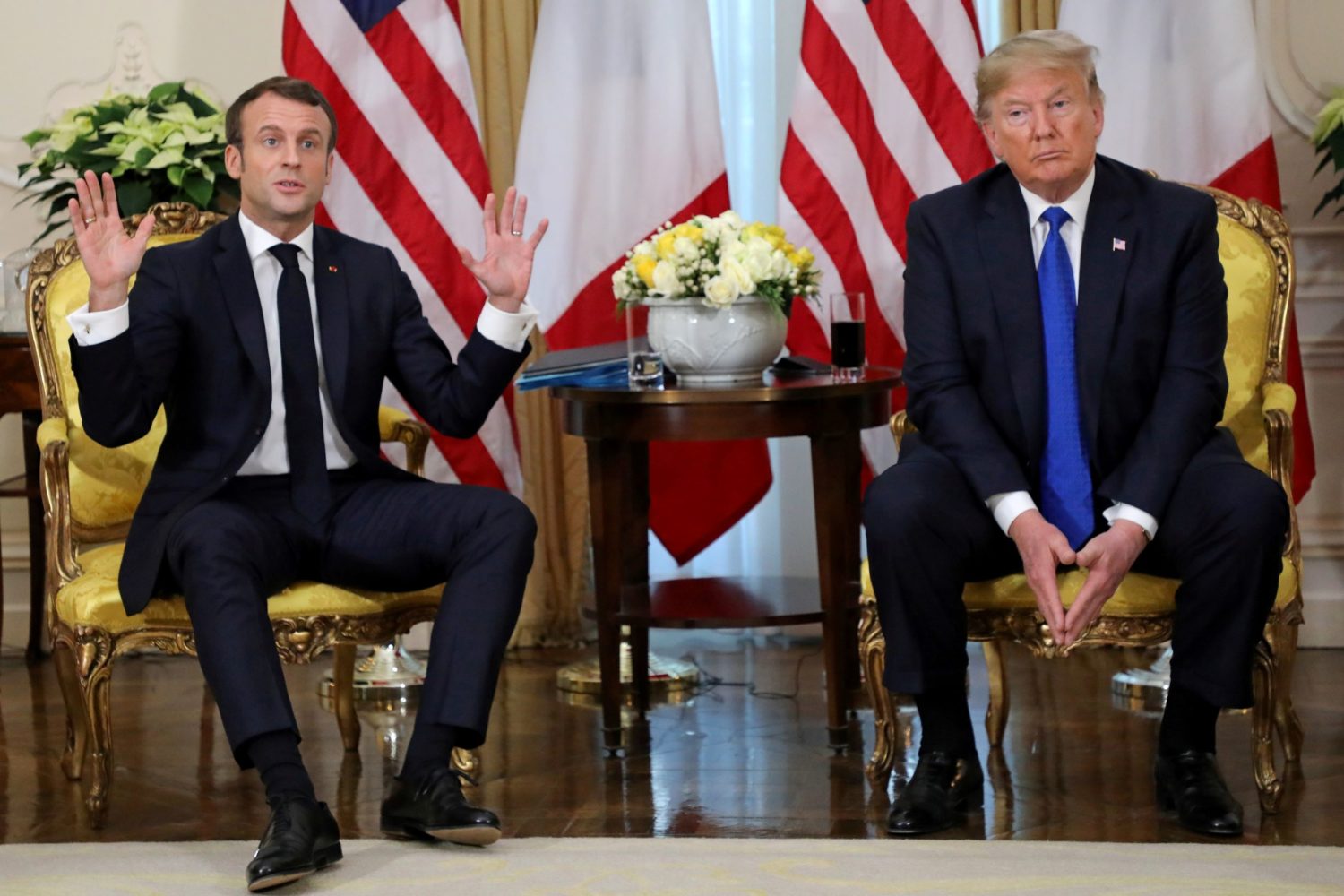
LONDON (Reuters) – U.S. President Donald Trump and French leader Emmanuel Macron clashed over the future of NATO on Tuesday before a summit intended to celebrate the 70th anniversary of the Western military alliance.

In sharp exchanges underlining discord in a transatlantic bloc hailed by backers as the most successful military pact in history, Trump demanded that Europe pay more for its collective defense and make concessions to U.S. interests on trade.

Macron, the French president, stood by comments he made last month describing NATO as suffering from a lack of strategic purpose akin to “brain death”, and criticized fellow NATO member Turkey, which he accused of working with Islamic State proxies.

Washington and Paris have long argued over NATO’s purpose – France opposed the 2003 Iraq war – but the new tensions will add to doubts over the alliance’s future that have grown with Trump’s ambivalence over U.S. commitments to defend Europe.

Trump said Macron’s criticism of NATO was “very, very nasty” and questioned whether the U.S. military should defend any countries that were “delinquent” on alliance targets for national military spending.

“It’s not right to be taken advantage of on NATO and also then to be taken advantage of on trade, and that’s what happens. We can’t let that happen,” Trump said of transatlantic disputes on issues ranging from the aerospace sector to a European digital services tax on U.S. technology giants.

All 29 member states have a target of spending 2% of their gross domestic product on defense and Trump has singled out Germany for falling short of that goal.

But Macron stood by his criticism of NATO and said its real problem was a failure to forge a clear purpose since the end of the Cold War.

“If we invest money and put our soldiers’ lives at risk in theaters of operation we must be clear about the fundamentals of NATO,” he said in a tweet at the end of a day overshadowed by tensions between the French and U.S. leaders.

A French presidency official said Trump often makes strident statements ahead of bilateral meetings and cools his rhetoric later. He noted that Macron and Trump “exchanged jokes and were very relaxed” at a joint news conference in London.

COLLECTIVE DEFENSE AT STAKE

Turkey threatened to block a plan to defend Baltic states and Poland against Russian attacks unless NATO backed Ankara in recognizing the Kurdish YPG militia as terrorists.

The YPG’s fighters have long been U.S. and French allies against Islamic State in Syria. Turkey considers them an enemy because of links to Kurdish insurgents in southeastern Turkey.

“If our friends at NATO do not recognize as terrorist organizations those we consider terrorist organizations … we will stand against any step that will be taken there,” Turkish President Tayyip Erdogan said before traveling to London.

Erdogan has already strained alliance ties with a move to buy Russian air defense systems. Trump said he was looking at imposing sanctions on Ankara over the issue.

The uncertainty over the plan for Poland and the Baltic states, drawn up at their request after Russia annexed Crimea from Ukraine in 2014, raises issues about security on all of NATO’s frontiers.

Under the North Atlantic Treaty Organization’s 1949 founding treaty, an attack on one ally is an attack on all its members, and the alliance has military strategies for collective defense across its territory.

The summit, in a hotel in Hertfordshire just outside London, begins on Wednesday.

On Tuesday evening, alliance leaders attended a reception hosted by Queen Elizabeth at Buckingham Palace.

The British monarch, in a teal-colored matching jacket and skirt, greeted the summiteers and accompanying partners, including former fashion model Melania Trump, who was wearing a bright yellow dress with matching cape and purple sleeves.

They were then welcomed to 10 Downing Street by British Prime Minister Boris Johnson, host of the summit a little over a week before the country faces an election.

Several hundred protesters gathered in London’s Trafalgar Square, holding placards reading: “Dump Trump” and “No to racism, no to Trump”. A police line divided them from a small group of Trump supporters wearing Make America Great Again caps, waving American flags and shouting: “Build the wall”.

In Washington on Tuesday, Democrats in the U.S. House of Representatives laid out their impeachment case against Trump, accusing him of using the powers of his office to solicit foreign interference in the 2020 election.

Hoping to placate Trump, Europe, Turkey and Canada will pledge at the summit some $400 billion in defense spending by 2024, and agree to a reduction of the U.S. contribution to fund the alliance itself.

The allies will approve a new strategy to monitor China’s growing military activity, and identify space as a domain of warfare, alongside air, land, sea and computer networks.

Trump said he believed Russia wanted deals on arms control and nuclear issues, and that he would be willing to bring China into such accords.

(Reporting by Steve Holland, Phil Stewart, Robin Emmott and Iona Serrapica in London, Ali Kucukgocmen in Istanbul, Joanna Plucinska in Warsaw and Vladimir Soldatkin in Moscow; Writing by Mark John and John Chalmers; Editing by Timothy Heritage and Peter Cooney)

New Jersey mayor sues New York City over moving homeless with ‘offer they can’t refuse’

NEW YORK (Reuters) – Newark Mayor Ras Baraka’s administration has sued New York Mayor Bill de Blasio, accusing the fellow Democrat of dumping his city’s population of homeless people on New Jersey’s biggest city.

The lawsuit naming the city of New York, its mayor and his homelessness czar, Steven Banks, accuses the de Blasio administration’s Special One-Time Assistance, or SOTA, program of using strong-arm tactics to send people across the Hudson River to find a place to live.

“This case concerns an unlawful program of ‘coerced’ migration,” Newark lawyers say in court documents filed in U.S. District Court in New Jersey on Monday.

New York City officials are accused of “forcing SOTA recipients to accept the proverbial ‘offer they can’t refuse,'” the documents said, explaining that the phrase from the 1972 American Mafia film “The Godfather” is “really a command, ‘Do what we say or else.'”

The lawsuit accuses New York of violating federal commerce laws. It cites several former New York shelter residents who were hustled through tours of New Jersey apartments and pressured to quickly commit to one, with the SOTA Program paying landlords a full year’s rent up front.

“She was told by case managers in her shelter that she should look in New Jersey, in the cities of Newark or Paterson, because New York landlords were leery of the SOTA program and because she would find something quicker in New Jersey,” Newark’s lawyers said in court filings.

The de Blasio administration did not immediately respond to a request for comment.

Baraka, Newark’s mayor since 2014 and the son of poet and African-American activist Amiri Baraka, and de Blasio, a former Democratic presidential candidate who touts himself as a progressive, appeared together in Newark last year to announce a tenant initiative aimed at keeping people in their homes, in part by ending illegal evictions. The New Jersey program was modeled after one in New York City and both mayors praised one another for pursuing the initiatives.

The vast majority of New Yorkers experiencing homelessness – over 63,000 homeless men, women and children – spend the night instead within the city’s shelter system where they remain unseen, according to The Bowery Mission nonprofit group. In a city of 8.5 million people, nearly one in every 121 New Yorkers is currently homeless.

(Reporting by Barbara Goldberg in New York; Editing by Scott Malone and Jonathan Oatis)

U.S.-China trade deal ‘stalled because of Hong Kong legislation’: Axios

(Reuters) – A trade deal between United States and China was now “stalled because of Hong Kong legislation”, news website Axios reported on Sunday, citing a source close to U.S. President Donald Trump’s negotiating team.

The deal was stalled also because time was needed to allow Chinese President Xi Jinping’s domestic politics to calm, the report added, citing the unnamed source.

China’s Foreign Ministry said on Thursday that legislation signed by Trump on Wednesday backing protesters in Hong Kong was a serious interference in Chinese affairs.

(Reporting by Rama Venkat in Bengaluru; Editing by Sam Holmes)

China suspends U.S. military visits to Hong Kong, sanctions U.S.-based NGOs

BEIJING (Reuters) – China said on Monday U.S. military ships and aircraft won’t be allowed to visit Hong Kong, and also announced sanctions against several U.S. non-government organizations for encouraging protesters to “engage in extremist, violent and criminal acts.”

The measures were announced by China’s Foreign Ministry in response to U.S. legislation passed last week supporting anti-government protesters. It said it had suspended taking requests for U.S. military visits indefinitely, and warned of further action to come.

“We urge the U.S. to correct the mistakes and stop interfering in our internal affairs. China will take further steps if necessary to uphold Hong Kong’s stability and prosperity and China’s sovereignty,” said ministry spokeswoman Hua Chunying said at a daily news briefing in Beijing.

China last week promised it would issue “firm counter measures” after U.S. President Donald Trump signed into law the “Hong Kong Human Rights and Democracy Act,” which supports anti-government protesters in Hong Kong and threatens China with potential sanctions.

There are fears that the row over Hong Kong could impact efforts by Beijing and Washington to reach preliminary deal that could de-escalate a prolonged trade war between the two countries.

The U.S.-headquartered NGOs targeted by Beijing include the National Endowment for Democracy, the National Democratic Institute for International Affairs, the International Republican Institute, Human Rights Watch, and Freedom House.

“They shoulder some responsibility for the chaos in Hong Kong and they should be sanctioned and pay the price,” said Hua.

In more normal times, several U.S. naval ships visit Hong Kong annually, a rest-and-recreation tradition that dates back to the pre-1997 colonial era which Beijing allowed to continue after the handover from British to Chinese rule.

Visits have at times been refused amid broader tensions and two U.S. ships were denied access in August.

The USS Blue Ridge, the command ship of the Japanese-based Seventh Fleet, stopped in Hong Kong in April – the last ship to visit before mass protests broke out in June.

Foreign NGOs are already heavily restricted in China, and have previously received sharp rebukes for reporting on rights issues in the country including the mass detention of Uighur Muslims in Xinjiang.

(Reporting by Cate Cadell and Beijing Monitoring Desk; Editing by Tom Hogue & Simon Cameron-Moore)

‘No invasion since 1914’ – Mexico bristles at U.S. terror designation plan

MEXICO CITY (Reuters) – President Andres Manuel Lopez Obrador said on Friday Mexico had not been invaded for more than a century and he would not permit another foreign intervention, reflecting tensions over a Trump administration plan to designate drug cartels based in Mexico as terrorist groups.

Designating groups as foreign terrorist organizations is aimed at disrupting their finances through the imposition of U.S. sanctions. While it does not directly give authority for overseas military operations, many Mexicans are nervous that it would lead to unilateral U.S. action against gangs.

“Since 1914 there hasn’t been a foreign intervention in Mexico and we cannot permit that,” Lopez Obrador said at a regular news conference, referring to the U.S. occupation of the port of Veracruz 105 years ago.

“Armed foreigners cannot intervene in our territory,” he said, instead offering more cooperation with the United States on fighting drug gangs, which have shown their power with a series of battles with security forces and civilians in recent months.

U.S. Attorney General William Barr will visit Mexico next week to discuss further security cooperation, Mexico’s foreign minister said earlier. The U.S. embassy in Mexico did not immediately respond to a request for comment.

Lopez Obrador was responding to comments by U.S. President Donald Trump this week that he was working to designate Mexican cartels as terrorist groups.

The planned Barr visit will be the highest level meeting since a gangland massacre of a U.S.-Mexican family triggered Trump’s terrorist comments.

“What we need to address organized crime is more mutual cooperation, not elements that will put distance between us or create hostilities,” said Ebrard.

(Reporting by Anthony Esposito, Miguel Angel Gutierrez and Abraham Gonzalez; Editing by Chizu Nomiyama and Bill Berkrot)

Texas chemical fire that forced evacuations burns for third day

HOUSTON (Reuters) – The fire at a petrochemical plant that prompted thousands of people to flee from four Texas communities burned for a third day on Friday with officials huddling as investigations were launched.

The fiery blast at a TPC Group facility on Port Neches, Texas, on Wednesday injured three workers, blew locked doors off their hinges and was felt in communities far from the site. The plant makes chemicals used in production of synthetic rubber, resins and an octane-boosting component of gasoline.

Firefighting crews continued to battle the blaze on Friday, according to TPC, and local mayors, fire officials were called to a meeting with the region’s top executive. Federal and state investigators were searching for the cause of the blaze and a Texas pollution regulator criticized the spate of such fires.

About 60,000 residents in four communities near the site were ordered to leave their homes Wednesday afternoon when a major, secondary blast prompted fears of flames reaching large storage tanks of the petrochemicals.

(Reporting by Gary McWilliams; Editing by Chizu Nomiyama)