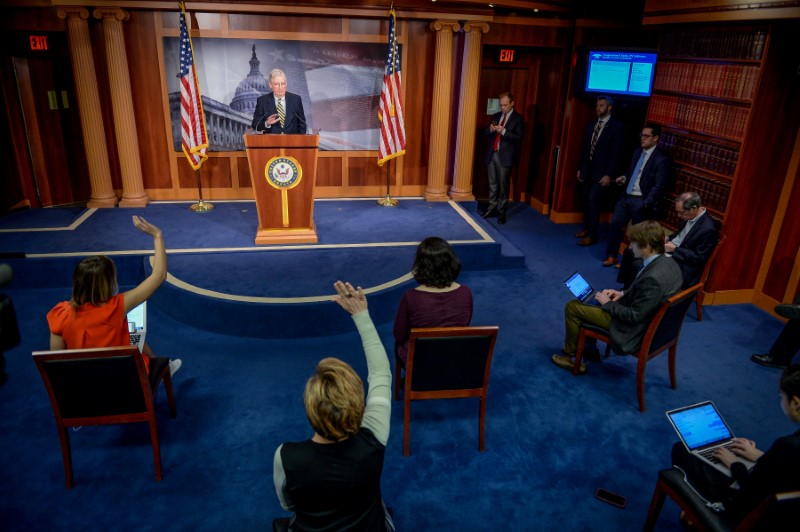
U.S. senators look to quickly pass massive coronavirus bill, head home

By David Morgan and Richard Cowan

WASHINGTON (Reuters) – U.S. senators will vote on Wednesday on a $2 trillion bipartisan package of legislation to alleviate the devastating economic impact of the coronavirus pandemic, hoping it will become law quickly.

Top aides to Republican President Donald Trump and senior Senate Republicans and Democrats said they had agreed on the unprecedented stimulus bill in the early hours of Wednesday, after five days of marathon talks.

“We’re going to pass this legislation later today,” Republican Senate Majority Leader Mitch McConnell said after the deal was announced early on Wednesday.

The Senate was due to convene at 12 p.m. EDT (1600 GMT), though timing of the vote was unclear. Trump supports the measure, the White House said.

“We’re really looking forward to this vote today so that he can sign it into law,” White House spokeswoman Stephanie Grisham said on Fox News.

The massive bill is expected to include a $500 billion fund to help hard-hit industries and a comparable amount for direct payments of up to $3,000 apiece to millions of U.S. families.

It will also include $350 billion for small-business loans, $250 billion for expanded unemployment aid and at least $100 billion for hospitals and related health systems.

It would be the largest rescue package ever approved by Congress and the third such effort to be passed this month.

“We have greatly strengthened the bill and we’re proud of what we’ve done,” Senate Democratic Leader Chuck Schumer said on CNN. He said he thought the chamber would pass the legislation on Wednesday.

The package aims to flood the U.S. economy with cash in a bid to stem the impact of a pandemic that has killed more than 730 people in the United States and infected more than 53,470, shuttered thousands of businesses, thrown millions out of work and led states to order 100 million people – nearly a third of the population – to stay at home.

Wall Street on Wednesday extended its massive bounce from the previous session after Congress reached the deal on the package. All three major U.S. stock indexes were up in early trading.

The bill is expected to pass the Republican-led Senate easily, more so because Republican Senator Rand Paul, the only senator to vote against an earlier round of emergency virus funding, may be unable to vote after testing positive for COVID-19, the disease caused by the coronavirus.

It also must pass the Democratic-led House of Representatives. House Speaker Nancy Pelosi, who proposed a more far-reaching rescue package, did not say whether she would support the Senate version.

“House Democrats will now review the final provisions and legislative text of the agreement to determine a course of action,” she said in a statement.

House members left Washington 10 days ago, but the lower chamber could quickly pass the bill without requiring them to return if all members agree to do so. If just one of the chamber’s 430 members objects, that could lead to delays.

It also must be signed by Trump, who said on Tuesday he wanted Americans to end “social distancing” restrictions intended to slow the spread of the virus and return to work by Easter, April 12.

That concerned health officials, who fear ending the lockdown too soon could bring more virus-related deaths.


(Reporting by Richard Cowan; Additional reporting by Doina Chiacu and Patricia Zengerle; Writing by Andy Sullivan and Patricia Zengerle; Editing by Clarence Fernandez and Jonathan Oatis)

Pentagon leaders suggest coronavirus outbreak could continue for months

WASHINGTON (Reuters) – Senior Pentagon leaders said on Tuesday that the coronavirus pandemic which has hit the United States could continue for months.

“I think we need to plan for this to be a few months long at least and we’re taking all precautionary measures to do that,” U.S. Defense Secretary Mark Esper said when asked how long the outbreak may last and how long the military would continue the support efforts to counter it.

“I am fully confident that at the end of the day, in a period of months, we will get through this,” Esper said during a virtual town hall.

At the same event, Chairman of the Joint Chiefs of Staff General Mark Milley said that while it was unclear how long the outbreak would last, taking models from the experience of other countries, which may or may not apply to the United States, the outbreak could last into July.

(Reporting by Idrees Ali; Editing by Chizu Nomiyama)

McConnell, Pelosi, Mnuchin see deal soon on $2 trillion U.S. coronavirus aid

By David Morgan and Richard Cowan

WASHINGTON (Reuters) – Senior Democrats and Republicans said on Tuesday they were close to reaching a deal on a $2 trillion coronavirus economic stimulus package, raising hopes that the U.S. Congress could soon act to try to limit the economic fallout from the pandemic.

“At last, I believe, we’re on the five-yard line,” Senate Majority Leader Mitch McConnell said, using a football analogy meaning close to scoring, as the chamber opened its session on Tuesday morning.

“We are very close,” added McConnell, the top Republican in Congress.

House of Representatives Speaker Nancy Pelosi, the top Democrat in Congress, said the two sides had agreed to more oversight provisions of a $500 billion fund to help hard-hit businesses, resolving a key sticking point.

“I think there is a real optimism that we could get something done in the next few hours,” Pelosi told CNBC.

Steven Mnuchin, President Donald Trump’s treasury secretary, told reporters that lawmakers hope to have a draft ready within the next two to three hours. He confirmed the changes to the industry fund. “There’s better oversight,” Mnuchin said.

Democrats have twice blocked attempts to advance the bill, saying it did not provide enough money for states and hospitals, lacked sufficient aid for unemployed Americans and did not include adequate supervision of a massive fund to aid big businesses.

Those concerns appear to have been addressed.

“I’m very optimistic that there will be a deal announced this morning,” Democratic Senator Chris Coons said on MSNBC.

Wall Street jumped at the open on Tuesday as signs that Washington was nearing a deal on the rescue package gave a shot of optimism to markets reeling under the biggest selloff since the global financial crisis more than a decade ago.

Trump’s administration has launched a major push for action to try to blunt the economic impact of the pandemic and steep stock market decline, after he spent weeks dismissing the risks.

As talks concluded late on Monday, Senate Democratic Leader Chuck Schumer said the two sides were nearing an agreement and he expected that the legislation would be voted upon on Tuesday.

‘ALL OF THE NONSENSE’

Republicans, Democrats and top Trump aides had negotiated for days over the package, which would be the third and largest passed to address the crisis if it is backed by both the Republican-majority Senate and Democratic-majority House and signed by the Republican president.

“Congress must approve the deal, without all of the nonsense, today. The longer it takes, the harder it will be to start up our economy,” Trump wrote on Twitter on Tuesday.

The coronavirus pandemic has killed more than 550 people in the United States and sickened more than 43,800, shuttered thousands of businesses, thrown millions out of work and led state governors to order about 100 million people – nearly a third of the nation’s population – to stay at home.

Pelosi has introduced her own $2.5 trillion counterproposal that also includes $4 billion that would allow states to conduct the November presidential and congressional elections by mail.

That legislation would likely be irrelevant if a bipartisan deal is forged in the Senate.

While details of the emerging bipartisan bill were not available, it is expected to provide financial aid for Americans out of work because of the virus and help for struggling industries such as airlines.

Republicans normally hold a slim 53-47 majority in the Senate, meaning they need Democratic support to garner the 60 votes required to advance most legislation.

But the coronavirus has affected their ranks, giving Democrats even more leverage. Republican Senator Rand Paul has tested positive for coronavirus and four other Republicans are also unable to vote because they were exposed to Paul or others with the virus.

(Additional reporting by Doina Chiacu, Lisa Lambert and Susan Heavey; Writing by Andy Sullivan and Patricia Zengerle; editing by Scott Malone, David Gregorio and Will Dunham)

U.S. could become next coronavirus epicenter, WHO says

By Emma Farge

GENEVA/TOKYO (Reuters) – The World Health Organization said on Tuesday that the United States could become the global epicenter of the coronavirus pandemic, which finally forced reluctant organizers to postpone the Tokyo 2020 Summer Olympics.

Britain joined the ranks of countries in lockdown to try to hold back the virus, and data showed business activity collapsing from Australia and Japan and Western Europe at a record pace in March, with the United States showing expected to be just as dire.

“The coronavirus outbreak represents a major external shock to the macro outlook, akin to a large-scale natural disaster,” analysts at BlackRock Investment Institute said.

But amid the gathering gloom, the Chinese province of Hubei, where the virus was first identified in December, said it would lift travel restrictions on people leaving the region as the epidemic eases there.

Confirmed coronavirus cases around the world exceeded 377,000 across 194 countries and territories as of early Tuesday, according to a Reuters tally, more than 16,500 of them fatal.

In Geneva, WHO spokeswoman Margaret Harris told reporters there had been a “very large acceleration” in infections in the United States.

Over the previous 24 hours, 85 percent of new cases were in Europe and the United States, and of those, 40 percent were in the United States.

As of Monday, the virus had infected more than 42,000 people there, killing at least 559.

Asked whether the United States could become the new epicenter, Harris said: “We are now seeing a very large acceleration in cases in the U.S. So it does have that potential.”

Some U.S. state and local officials have decried a lack of coordinated federal action, saying that having localities act on their own has put them in competition for supplies.

President Donald Trump acknowledged the difficulty.

“The World market for face masks and ventilators is Crazy. We are helping the states to get equipment, but it is not easy,” he tweeted.

OLYMPIC ORGANIZERS GIVE IN

Olympic Games organizers and the Japanese government had clung to the hope that the world’s biggest sporting event could go ahead, but finally bowed to the inevitable to make Tokyo 2020 the latest and biggest victim of a ravaged sporting calendar.

After a call with International Olympic Committee (IOC) president Thomas Bach, Japan’s Prime Minister Shinzo Abe said the July 24-Aug. 9 event would be rescheduled for the summer of 2021 at the latest – as proof of victory over the coronavirus.

“President Bach said he is in agreement, 100%.”

It was the first time in the Olympics’ 124-year history that they had been postponed, though they were canceled outright three times during the two 20th-century world wars.

Of the top 10 countries by case numbers, Italy has reported the highest fatality rate, at around 10%, which at least partly reflects its older population. The fatality rate globally – the ratio of deaths to confirmed infections – is around 4.3%, though national figures can vary widely according to how much testing is done.

Britain, believed by experts to be about two weeks behind Italy in the outbreak cycle, on Tuesday began curbs on movement without precedent in peacetime after Prime Minister Boris Johnson ordered the country to stay at home.

The streets of the capital were eerily quiet as all but essential shops closed and people only went to work if it was unavoidable.

Johnson had resisted pressure to impose a full lockdown even as other European countries had done so, but was forced to change tack as projections showed the health system could become overwhelmed.

Meanwhile China’s Hubei province, the original center of the outbreak, will lift curbs on people leaving the area, but other regions will tighten controls as new cases double due to imported infections.

The provincial capital Wuhan, which has been in total lockdown since Jan. 23, will lift its travel restrictions on April 8.

However, the risk from overseas infections appears to be on the rise, prompting tougher screening and quarantine measures in major cities such as the capital Beijing.

Interactive graphic tracking global spread of coronavirus

(Additional reporting by Emma Farge, Stephanie Nebehay, Karolos Grohmann, Leika Kihara, Sakura Murakami, Lusha Zhang and Huizhong Wu; Writing by Nick Macfie; Editing by Jon Boyle and Angus MacSwan)

U.S. states, cities desperate for coronavirus help, military prepares

By Stephanie Kelly and Doina Chiacu

NEW YORK/WASHINGTON (Reuters) – U.S. governors and mayors on Monday became more desperate in their pleas for help from the federal government to fight coronavirus as the military prepared to set up field hospitals in New York and Seattle to ease the strain on creaking health services.

New York City Mayor Bill de Blasio urged U.S. lawmakers to approve an economic relief package and appealed for ventilators and medical equipment, even asking for help from private citizens.

“Anyone out there who can help us get these supplies, we have only days to get them in place. That is the reality,” de Blasio told CNN. New York, the most populous U.S. city, is now at the epicenter of the outbreak in the United States.

Karine Raymond, a nurse at Jack D. Weiler Hospital in New York’s Bronx borough, said most nurses were unable to get specialized N95 masks and even simpler surgical masks were in short supply. Nurses are being told to wear them for as long as possible, she said.

“We are the be all and end all and lifeline to these patients, and yet we are being contaminated and cross contaminating,” Raymond said.

As health authorities struggled to cope with the rising number of sick people and the U.S. Senate failed to advance an economic stimulus package, Defense Secretary Mark Esper said the U.S. military is preparing to deploy field hospitals to New York and Seattle.

The planned hospitals, essentially tent facilities that can be rapidly set up, can only handle a limited number of patients and are less suited to treating highly infectious people who need to be isolated. But they can relieve pressure on hospitals by treating patients with illnesses other than COVID-19.

The Army Corps of Engineers is preparing to convert hotels and dormitories into treatment facilities for sick patients as the number of U.S. coronavirus cases nationwide topped 40,000 on Monday, more than 500 of whom have died.

New York’s de Blasio urged U.S. lawmakers to provide more help.

“I want to appeal to everyone in the House and Senate, you have got to help cities, towns, countries, states, public hospitals, private hospitals. You’ve got to get all of them direct relief,” he said.

A far-reaching economic package for the coronavirus crisis failed to advance in the Senate after Democrats said it contained too little money for hospitals and not enough restrictions on a fund to help big businesses. Democrats predicted a modified version would win passage soon.

Both Democrats and Republicans say they are aware that failure to agree on the bill could have a devastating effect on states, cities and businesses, and trigger further heavy losses in U.S. stock markets.

The U.S. Federal Reserve rolled out an unprecedented new array of programs aimed at blunting the “severe disruptions” to the economy caused by the coronarvirus outbreak.

The central bank will back the purchases of corporate bonds and direct loans to companies. It will expand its asset holding by as much as needed to stabilize financial markets and roll out a program to get credit to small and medium-sized business.

The steps briefly lifted U.S. stock index futures more than 3% but share prices quickly dropped back into the red, putting the S&P 500 <.SPX> on pace for its worst month since World War Two.

With the addition of Maryland, Indiana, Michigan and Massachusetts on Monday, 15 out of 50 U.S. states have now imposed restrictions on people’s movements to curtail the virus, putting the country on a track similar to those of the most devastated European countries such as Italy and Spain.

The population affected by the state lockdowns amounts to more than 150 million people out of a U.S. total of about 330 million.

STAY AT HOME

In what appeared to send a conflicting message about the federal government’s efforts to combat the coronavirus health crisis, a senior White House advisor said that President Donald Trump is considering measures to reopen the U.S. economy.

Trump issued guidelines a week ago that he said aimed to slow the spread of the disease over 15 days. Late on Sunday, he tweeted: “We cannot let the cure be worse than the problem itself,” adding that at the end of the 15-day shutdown period, “we will make a decision as to which way we want to go.”

Trump senior economic adviser Larry Kudlow followed up on Monday, telling Fox News: “The president is right … We’re going to have to make some difficult trade-offs.”

A lack of coordinated federal action was causing chaos for states and municipalities, and even putting them in competition with each other for resources, the governors of New York, New Jersey and Illinois said.

The states “are all out looking for the same thing,” New Jersey Governor Phil Murphy told CNN on Monday.

Leaving states to fend for themselves has put them in bidding wars with the Federal Emergency Management Agency, other U.S. states and even against other countries, Illinois Governor J.B. Pritzker said.

“We’re competing against each other on what should be a national crisis where we should be coming together and the federal government should be leading, helping us,” Pritzker told the “Today” program.

New York Governor Andrew Cuomo called on Washington to put in place the federal defense production act to eliminate this “ad hoc” system. Trump on Sunday defended his decision to hold off using this power, on the grounds that nationalizing businesses “is not a good concept.”

General Motors Co <GM.N> and medical equipment maker Ventec are speeding up efforts under a partnership code-named “Project V” to build ventilators at a GM plant in Kokomo, Indiana, to help combat the coronavirus outbreak.

(Reporting by Stephanie Kelly, Susan Heavey, Doina Chiacu, Dan Levine and Nathan Layne; Writing by Daniel Trotta and Sonya Hepinstall; Editing by Howard Goller and Alistair Bell)

‘Dilly-dallying around’: Testy U.S. Senate nears coronavirus relief vote

By David Morgan and Andy Sullivan

WASHINGTON (Reuters) – Tempers boiled over in the U.S. Senate on Monday as lawmakers moved toward another vote on a far-reaching coronavirus economic stimulus package even though Republicans and Democrats said they were still at odds over details that had stalled the package over the weekend.

Both sides said they were close to an agreement on the massive bill, which Treasury Secretary Steven Mnuchin said carried a $2 trillion price tag. But they remained at odds over provisions to help businesses, as well as the amount of money to provide to hospitals and state and local governments.

Senate Majority Leader Mitch McConnell and several other Republicans angrily accused Democrats of trying to take advantage of the crisis to advance their political agenda with unrelated provisions. McConnell said the Senate, controlled by President Donald Trump’s fellow Republicans, would hold another procedural vote on the package after it fell short on Sunday.

U.S. Senate Majority Leader Mitch McConnell (R-KY) speaks to the media after a meeting to wrap up work on coronavirus economic aid legislation, during the coronavirus disease (COVID-19) outbreak, in Washington, U.S., March 22, 2020. REUTERS/Mary F. Calvert

“This is not a juicy political opportunity. This is a national emergency,” McConnell said as the Senate opened its session.

Senate Democratic Leader Chuck Schumer suggested the vote would again fall short unless the measure included more guardrails to avoid misuse of the $500 billion earmarked to help struggling industries.

“Our goal is to reach a deal today and we’re hopeful, even confident that we will meet that goal,” Schumer said. He said the upcoming vote would be “irrelevant” if negotiations were not complete.

Republican Senator John Thune angrily accused the Democrats of “dilly-dallying around.”

“The country is burning and your side wants to play political games,” Thune said.

Mnuchin said the two sides made progress on Monday morning.

“We knocked off a bunch of things on the list already and we’re closing in on issues,” Mnuchin told reporters after exiting Schumer’s office. He did not give specifics.

U.S. stocks fell on Monday as the coronavirus forced more U.S. states into lockdown, eclipsing optimism from an unprecedented round of policy easing by the Federal Reserve.

The bill represents a third effort by Congress to blunt the economic toll of the pandemic that has killed at least 428 people in the United States and sickened more than 34,000, leading state governors to order nearly a third of the nation’s population to stay at home and putting much business activity on hold.

The measure includes financial aid for ordinary Americans, small businesses and critically affected industries, including airlines.

Republicans said Democrats were seeking to add unrelated provisions, such as expanded tax credits for wind and solar power and increased leverage for labor unions.

Democrats said Republicans were also trying to add provisions that would exclude nonprofit groups from receiving small-business aid, and extend a sexual abstinence-education program that is due to expire in May.

The speaker of the House of Representatives, Nancy Pelosi, released her own version, which would add billions of dollars to help states conduct elections by mail.

Republicans normally hold a slim 53-47 majority in the chamber, short of the 60 votes they need to advance most legislation.

But the coronavirus threat has affected their ranks. Republican Senator Rand Paul said he tested positive for the virus on Sunday, and several others have self-quarantined as a precautionary measure. Republicans only mustered 47 votes in a procedural vote on Sunday.

(Reporting by David Morgan and Andy Sullivan; Additional reporting by Susan Cornwell; Writing by Andy Sullivan; Editing by Scott Malone, Will Dunham and Jonathan Oatis)

U.S. surgeon general says coronavirus outbreak ‘to get bad’ this week

By Susan Heavey

WASHINGTON (Reuters) – The U.S. surgeon general issued his starkest warning to date on Monday about the health risk posed by the coronavirus outbreak, warning Americans that the crisis was “going to get bad” this week.

The country’s top public health official, Surgeon General Jerome Adams, sounded the alarm as nearly one-third of Americans awoke to “stay at home orders.”

As of Sunday night, states with a population totaling more than 100 million people have imposed restrictions to curtail the virus, which has infected nearly 35,000 people and killed 428 in the United States, putting the country on a track similar to those of devastated European countries such as Italy and Spain.

“This week it’s going to get bad,” Adams told NBC’s “Today” show, saying there were more people out to see Washington’s famed annual cherry blossoms than there were blossoms. “This is how the spread is occurring. Everyone needs to be taking the right steps right now: stay home.”

Trump imposed a 15-day national action plan a week ago urging Americans to follow the direction of the “stay at home” orders of state and local officials.

At the same time, he has also been far more optimistic than health experts have been about the prognosis for the outbreak while also voicing concern about the negative effect of shutting down wide swathes of the economy.

“We cannot let the cure be worse than the problem itself,” Trump tweeted in all capital letters overnight. “At the end of the 15-day period, we will make a decision as to which way we want to go.”

Also on Monday, the U.S. Federal Reserve mounted an extraordinary new array of programs to offset the disruptions to the economy caused by the outbreak, backstopping an unprecedented range of credit for households, small businesses and major employers.

CONGRESS MEETS

Congress was trying to address concerns over the economy, which is forecast to shrink as a result of emergency measures. U.S. Senate Democrats and Republicans were working on an economic relief bill, aware that failure to strike a deal could trigger further heavy losses in U.S. stock markets.

The Senate was due to reconvene at noon ET (1600 GMT) to consider the bill, which Democrats argue favors corporate interests at the expense of healthcare workers, hospitals and state and local governments. Republicans in turn accused them of obstructing a badly needed stimulus in the midst of a national emergency.

Independent experts have suggested far more than 15 days will be needed to halt the spread.

New Jersey Governor Phil Murphy on Monday called on the federal government to do more to provide personal protective equipment, noting that all states “are all out looking for the same thing” in competition with each other.”We need a lot more,” Murphy told CNN. “Anything they could do is going to make a huge difference.”Murphy reiterated his call for the federal government to collectively provide $100 billion in direct cash assistance to New Jersey, New York, Connecticut and Pennsylvania.

Trump on Sunday defended his decision to hold off using his powers under the Defense Protection Act to ramp up supplies, telling reporters at a news conference that nationalizing businesses “is not a good concept.”

Murphy noted that on one day last week 15,000 New Jersey residents applied for unemployment benefits, crashing the state’s computer systems.”We need the feds to come in a big way to help us,” Murphy said. “Folks are hurting.”

The first of two U.S. military hospital ships was dispatched on Monday to boost hospital bed capacity as the number of U.S. coronavirus cases swells.

The U.S. Naval Ship Mercy departed San Diego with nearly 900 staff on board to take on non-coronavirus patients and allow local personnel to manage those on shore with the virus, the Pentagon said in statement. Trump on Sunday said the Mercy would be dispatched to Los Angeles while the USNS Comfort would go to New York.

(Reporting by Susan Heavey, Doina Chiacu and Nathan Layne; Writing by Daniel Trotta; Editing by Howard Goller)

Ohio, Louisiana become latest U.S. states to declare coronavirus lockdowns

By Jonnelle Marte and Barbara Goldberg

NEW YORK (Reuters) – As U.S. cases of coronavirus spiked on Sunday, Ohio and Louisiana became the latest states to announce broad lockdowns to slow the spread of the virus with nearly one in three Americans under orders to stay at home.

The two states join New York, California, Illinois, Connecticut and New Jersey, home to 100 million Americans combined, as cases nationwide top 33,000 with at least 390 dead, according to a Reuters tally.

“Every piece of evidence that I can lay my hands on indicates that we’re at an absolutely crucial time in this war and what we do now will make all the difference in the world,” said Ohio Governor Mike DeWine. “What we do now will slow this invader. It will slow this invader so our health care system … will have time to treat casualties.”

Ohio has 351 cases and three deaths while Louisiana has 837 cases and 20 deaths, several in a senior care facility.

The mayor of New York City, the epicenter of the nation’s coronavirus epidemic, on Sunday described the outbreak as the biggest domestic crisis since the Great Depression and called for the U.S. military to mobilize to help keep the healthcare system from becoming overwhelmed.

“If we don’t get more ventilators in the next 10 days people will die who don’t have to die,” said Mayor Bill de Blasio, as the nation’s most populous city saw COVID-19 cases top 9,600 and deaths climbed to 63.

New York Governor Andrew Cuomo urged the federal government to take over acquisition of medical supplies so states do not have to compete with each other for desperately needed resources. He also repeated a request for the Army Corps of Engineers to build temporary hospitals.

Help is not coming quickly enough, Cuomo said.

“Time matters, minutes count, and this is literally a matter of life and death,” he said. “At the same time, there is not going to be chaos, there is not going to be anarchy. Life is going to go on. Different. But life is going to go on.”

The number of cases of the highly contagious respiratory illness in the United States and Spain are exceeded only by China and Italy. Italy reported record numbers of daily coronavirus deaths last week.

“This is going to be the greatest crisis domestically since the Great Depression,” de Blasio told CNN, referring to the economic crisis of the 1930s. “This is why we need a full-scale mobilization of the American military.”

Around the globe, billions are adapting to a new reality, with countries like Italy, Spain and France on lockdown and several South American nations taking similar measures to try to stay ahead of the contagion, as global cases exceeded 315,000 and deaths top 13,000.

The lockdown affecting large segments of the American public to try to curb the spread of the coronavirus is likely to last 10 to 12 weeks, or until early June, U.S. Treasury Secretary Steven Mnuchin said on Sunday.

Lawmakers in Washington are nearing a deal that could pump a record $1 trillion into the economy to limit the economic damage from the coronavirus and will vote on the bill Monday.

Speaking on “Fox News Sunday,” Mnuchin said the package would give an average U.S. family of four a one-time payment of $3,000.

Republican U.S. Senator Rand Paul of Kentucky on Sunday became the first member of the Senate to announce he had tested positive for coronavirus. At least two members of the House of Representatives previously said they tested positive.

MEDICAL CRISIS

De Blasio said the city is not getting needed medical supplies from the federal government to contend with the rapid spread of the sometimes deadly illness.

Hospitals are scrambling for protective equipment for healthcare workers and for ventilators as they brace for a wave of patients who will need help breathing as severe cases often lead to pneumonia and decreased lung function.

Over the past week, U.S. President Donald Trump’s administration has been pushing for aggressive steps to stem the economic hit, after Trump spent several weeks downplaying the virus’ risks.

Anthony Fauci, director of the U.S. National Institute of Allergy and Infectious Diseases, on Sunday said the White House recognized the urgency of New York’s situation.

“Not only is New York trying to get resources themselves, but we’re going to be pouring it in from the federal government,” he told CBS News.

U.S. drugmaker Merck & Co Inc said it delivered 500,000 donated masks to New York City on Sunday morning.

Cuomo warned that 40% to 80% of New York state residents may eventually contract coronavirus. He chastised those who were still congregating in parks and other places and not practicing social distancing. He noted 53% of the cases in New York are between the ages of 18 and 49.

“It’s insensitive, arrogant, self-destructive … and it has to stop, and it has to stop now,” he said, adding he was giving New York City authorities 24 hours to come up with a plan to deal with the situation. “This is not a joke and I’m not kidding.”

(Reporting by Jonnelle Marte and Barbara Goldberg in New York; Additional reporting by Andrea Shalal and Susan Heavey in Washington; Writing by Lisa Shumaker; Editing by Bill Berkrot)

U.S. FDA approves first rapid coronavirus test with 45 minutes detection time

By Kanishka Singh

(Reuters) – The U.S. Food and Drug Administration has approved the first rapid coronavirus diagnostic test, with a detection time of about 45 minutes, as the United States struggles to meet the demand for coronavirus testing.

The test’s developer, California-based molecular diagnostics company Cepheid, said on Saturday it had received an emergency use authorization from the FDA for the test, which will be used primarily in hospitals and emergency rooms. The company plans to begin shipping it to hospitals next week, it said.

The FDA confirmed its approval in a separate statement. It said the company intends to roll out the availability of its testing by March 30.

Under the current testing regime, samples must be sent to a centralized lab, where results can take days.

“With new tools like point-of-care diagnostics, we are moving into a new phase of testing, where tests will be much more easily accessible to Americans who need them,” U.S. Secretary of Health and Human Services Alex Azar said on Saturday.

The United States is not even close to meeting domestic demand for coronavirus testing. Many medical experts have predicted that delayed and chaotic testing will cost lives, potentially including those of doctors and nurses.

On Friday, Anthony Fauci, director of National Institute of Allergy and Infectious Diseases, was asked whether the United States can currently meet demand for tests.

“We are not there yet,” Fauci said.

The diagnostic test for the virus that causes COVID-19 has been designed to operate on any of Cepheid’s more than 23,000 automated GeneXpert Systems globally, the company said.

The systems do not require users to have special training to perform testing, and are capable of running around the clock, Cepheid President Warren Kocmond said in the statement.

The company did not give further details or say how much the test will cost.

The U.S. FDA has been pushing to expand screening capacity for the virus while the World Health Organization has called for “order and discipline” in the market for health equipment needed to fight the outbreak.

(Reporting by Kanishka Singh in Bengaluru; Editing by Sonya Hepinstall and Daniel Wallis)