First U.S. COVID-19 reinfection case identified in Nevada study

By Deena Beasley

(Reuters) – Researchers for the first time have identified someone in the United States who was reinfected with the novel coronavirus, according to a study that has not yet been reviewed by outside experts.

The report, published online, describes a 25-year-old man living in Reno, Nevada, who tested positive for the virus in April after showing mild illness. He got sick again in late May and developed more severe COVID-19, the disease caused by the virus.

Cases of presumed reinfection have cropped up in other parts of the world, but questions have arisen about testing accuracy. Earlier this week, University of Hong Kong researchers reported details of a 33-year-old man who had recovered in April from a severe case of COVID-19 and was diagnosed four months later with a different strain of the virus.

Researchers at the University of Nevada, Reno School of Medicine and the Nevada State Public Health Laboratory said they were able to show through sophisticated testing that the virus associated with each instance of the Reno man’s infection represented genetically different strains.

They emphasized that reinfection with the virus is probably rare, but said the findings imply that initial exposure to the virus may not result in full immunity for everyone.

(Reporting by Deena Beasley; Editing by Dan Grebler)

U.S. to carry out fifth federal execution after 17-year pause

By Jonathan Allen

(Reuters) – The U.S. government was due to execute Keith Nelson, a convicted child murderer, on Friday afternoon in what would be its fifth execution since it resumed carrying out capital punishment this summer after a 17-year hiatus.

The execution was scheduled to take place at 4 p.m. (2000 GMT) at the U.S. Department of Justice’s execution chamber in Terre Haute, Indiana, using lethal injections of pentobarbital, a powerful barbiturate.

On Thursday, a federal judge overseeing legal challenges to the execution protocol by Nelson and other death row inmates ruled that the Justice Department’s protocol violated drug safety laws.

Judge Tanya Chutkan of the U.S. District Court in Washington ordered Nelson’s execution be delayed until the Justice Department revised its protocol to comply with the Food, Drug, and Cosmetic Act, including a requirement that a drug can only be issued on a clinician’s prescription.

The Justice Department challenged the injunction delaying the execution in the U.S. Appeals Court for the District of Columbia Circuit. The appeals court overturned the injunction on Thursday evening, ruling that Chutkan had not established that violations of the act constituted “irreparable harm.”

Chutkan spoke with lawyers representing Nelson and the Justice Department in a telephone conference on Friday as she considered a request by Nelson’s lawyers to revise her order or issue a new one blocking Friday’s execution.

Nelson, who was convicted of raping and murdering 10-year-old Pamela Butler in Kansas in 1999, is one of more than a dozen inmates on federal death row in Terre Haute, Indiana, who sued the Justice Department over its lethal injection protocol, which was announced in 2019, replacing the old three-drug protocol last used in 2003.

Three of those plaintiffs have since been executed by the Justice Department after the U.S. Supreme Court swiftly dismissed earlier injunctions issued by Chutkan delaying the executions to allow the litigation to proceed.

MGM Resorts to lay off 18,000 furloughed U.S. employees

(Reuters) – Casino operator MGM Resorts International informed its staff on Friday it would lay off 18,000 furloughed employees in the United States as the coronavirus-induced travel curbs hurt its operations.

The company will start the process on Monday, according to a letter from Chief Executive Officer Bill Hornbuckle to employees and seen by Reuters. MGM employed nearly 52,000 full time and 18,000 part-time people in the United States as of Dec. 31.

“Federal law requires companies to provide a date of separation for furloughed employees who are not recalled within six months. Regrettably, August 31, marks (that) date,” Hornbuckle said in the letter.

Many companies have decided to cut jobs as the U.S. economy recorded its sharpest contraction in at least 73 years in the second quarter due to pandemic-led disruptions, with corporate profits sinking deeper.

MGM was forced to close all of its casinos and furlough about 62,000 of its workforce in the United States in March due to the lockdowns.

It brought back tens of thousands of employees when many of its casinos opened for business as the restrictions eased, but it still had to leave out 18,000 of them.

Hornbuckle said that employees who will be laid off will remain in the company’s recall list and if hired back by the end of 2021, they shall retain their seniority and benefits.

Earlier in the day, Coca-Cola said it would cut thousands of jobs as sales had slumped, while United Airlines confirmed it was preparing for the biggest pilot furloughs and will need to remove 2,850 pilots this year.

(Reporting by Ankit Ajmera and Sanjana Shivdas in Bengaluru; Editing by Sherry Jacob-Phillips and Arun Koyyur)

Oil markets flat as restarts begin at storm-hit energy operations

By Erwin Seba

HOUSTON (Reuters) – Energy companies on Friday continued efforts to restore operations at U.S. Gulf Coast offshore platforms and refineries shut by Hurricane Laura as oil markets largely shrugged off the storm’s impact.

Some 300 offshore production facilities and half-dozen refineries halted ahead of a Category 4 storm that hit the coast of Louisiana early Thursday with winds of 150 mile per hour (240 kph). The destructive winds cut a narrow path through the area, sparing facilities not directly in its path.

However, Citgo Petroleum’s 418,000-barrel per day Lake Charles, Louisiana, plant was on the storm’s path, and repairs could take four to six weeks, according to Mizuho Securities. The company did not reply to requests for comment.

Motiva Enterprises, operator of the largest U.S. refinery, and Valero Energy Corp on Friday began restarting their Port Arthur, Texas, refineries.

U.S. crude futures traded at $43.08 per barrel at midday, up four cents, up slightly from $42.34 a week ago. U.S. gasoline futures were up 2 cents, less than 2% higher than they were a week ago.

About 84%, or 1.56 million barrels per day, of U.S. Gulf of Mexico crude output and 60% of natural gas offshore production were shut on Thursday, the U.S. Department of Interior reported.

Exxon Mobil Corp said its 369,024 bpd Beaumont, Texas, refinery, about 50 miles (80 km) west of the storm’s landfall, required “minor repairs,” a spokesman said. The company was taking steps to restart once power and port operations were restored.

Cheniere Energy Inc’s and Cameron LNG’s Cameron liquefied natural gas plants in Louisiana took almost no pipeline gas early on Friday, according to preliminary data from Refinitiv.

“Refiners may be reluctant to quickly return to production when the product they make is a money losing proposition,” Robert Yawger, director of energy futures at Mizuho Securities, wrote on Friday.

The ports of Beaumont, Orange and Sabine, Texas, and Cameron and Lake Charles, Louisiana, remained closed on Friday, according to the U.S. Coast Guard.

Houston, the United States’ largest energy export port, restarted operations on Thursday and had nearly halved the list of 53 vessels waiting on Thursday to reenter the port.

One-way movement and other restrictions were in place on Friday at points along the Houston Ship Channel, according to the U.S. Coast Guard.

(Reporting by Erwin Seba; writing by Gary McWilliams; Editing by Marguerita Choy and David Gregorio)

Musk’s Neuralink venture promises to reveal a ‘working’ brain-computer device

By Tina Bellon

(Reuters) – Billionaire entrepreneur Elon Musk’s neuroscience startup Neuralink on Friday is expected to detail its latest innovations for implanting minuscule computer chips in human brains, fueling expectations among scientists who closely watch the company.

Co-founded by Musk in 2016, Neuralink aims to implant wireless brain-computer interfaces that include thousands of electrodes in the most complex human organ to help cure neurological conditions like Alzheimer’s, dementia and spinal cord injuries and ultimately fuse humanity with artificial intelligence.

The company said it will provide an update on its work during a live webcast late on Friday afternoon, with Musk tweeting that the presentation will include a “working Neuralink device.”

Musk, who frequently warns about the risks of artificial intelligence, is no stranger to revolutionizing industries as chief executive of electric vehicle company Tesla Inc and aerospace manufacturer SpaceX.

During a Neuralink presentation in July 2019, Musk said the company was aiming to receive regulatory approval to implant its device in human trials by the end of this year.

“This has a very good purpose, which is to cure important diseases — and ultimately to secure humanity’s future as a civilization relative to AI,” Musk said at the time.

The company promises to implant a sensor roughly eight millimeters in diameter, or smaller than a fingertip, potentially under only local anesthesia. With the help of a sophisticated robot, flexible threads or wires smaller than a human hair are implanted in brain areas responsible for motor and sensory functions.

Neuroscience experts said that while Neuralink’s mission to read and stimulate brain activity in humans is feasible, the company’s timeline appeared overly ambitious.

“Everyone in the field would be very impressed if they actually showed data from a device implanted in a human,” said Graeme Moffat, a neuroscience research fellow at the University of Toronto.

Small devices that electronically stimulate nerves and brain areas to treat hearing loss and Parkinson’s disease have been implanted in humans for decades.

Neuroscientists have also conducted brain implant trials with a small number of people who have lost control of bodily functions due to spiral cord injuries or neurological conditions like strokes. Humans in those trials could control robotic limbs or small objects, like a computer keyboard or mouse cursor, but have yet to complete more sophisticated tasks.

Most of the current cutting-edge research in brain-machine interface is conducted on animals, scientists note, with safety challenges and lengthy regulatory approval procedures preventing larger human trials.

Brain-machine interface science has had a surge in investment and business activity over the past five years, largely thanks to advancements in material, wireless and signaling technology.

But scientists still face a range of issues, including preventing tissue scarring around the implant, the quality of measurements and the development of machine-learning algorithms to interpret brain signals, said Amy Orsborn, an assistant professor at the University of Washington who researches neural interfaces.

“I don’t think we know what the magic bullet is, we only know the problem,” Orsborn told Reuters.

(Reporting by Tina Bellon in New York; Editing by Joe White and Dan Grebler)

Peru, with world’s deadliest outbreak, readies to start vaccine tests

By Marco Aquino

LIMA (Reuters) – Peru will start testing coronavirus vaccines from China’s Sinopharm and U.S. drugmaker Johnson & Johnson in September, researchers said, which should help the country gain faster access to inoculations once the vaccines are approved.

Sinopharm began this week to recruit up to 6,000 volunteers in Peru, which Reuters data indicates has the highest number of COVID-19 deaths in relation to its population size. A team of Chinese scientists is expected to arrive in the Andean nation next week to work with local researchers, said Germán Málaga, a doctor and lead vaccine investigator at Lima’s Cayetano Heredia University.

“This is going to happen around Sept. 3, to begin vaccinations on Sept. 8,” he said. Sinopharm’s clinical trials in Peru are being done with Cayetano Heredia and the state-run Universidad Mayor de San Marcos.

Peru has recorded around 622,000 cases of the coronavirus, the fifth highest case load in the world, and 28,277 deaths. It now has the world’s deadliest fatality rate per capita, with 86.67 deaths per 100,000 people, a Reuters tally shows, just ahead of Belgium.

Sinopharm will also do clinical coronavirus vaccine trials elsewhere in Latin America, including in Argentina.

Other Chinese laboratories that will be conducting trials in the region include Sinovac Biotech, which will work in Brazil and Chile, and Walvax Biotechnology Co Ltd and CanSino Biologics Inc, which will test in Mexico, authorities have said.

Johnson & Johnson’s Janssen unit will start tests with some 4,000 volunteers in Peru around Sept. 24, Prime Minister Walter Martos told reporters on Thursday.

“We are contacting other companies, laboratories, from Britain and other countries that are going to help us immunize at least 70% of the local population,” Martos said.

J&J said earlier this week that it would conduct Phase III trials for its vaccine in Chile, Argentina and Peru.

Peru, a country of nearly 33 million people and the world’s no. 2 copper producer, has been particularly hard-hit by the pandemic, both in terms of infections and economic impact. The economy crumbled over 30% in the second quarter of the year.

The death toll could also be higher than official figures suggest. A national registry shows that between April and August there were 68,192 more deaths compared to the same period in 2019. Excess deaths often give a better indication of the true number of fatalities.

Researcher Málaga and Carlos Castillo, the chief adviser for immunizations and vaccines at Peru’s health ministry, said that carrying out clinical trials would help Peru get faster access to vaccines when they were ready.

“There is an unwritten agreement, in the sense that in the country where a clinical trial is being carried out, it has priority access to vaccine availability,” Castillo said.

(Reporting by Marco Aquino and Reuters TV; Editing by Adam Jourdan and Rosalba O’Brien)

Remnants of Hurricane Laura drench Arkansas as storm heads east

(Reuters) – The remnants of Hurricane Laura were dousing Arkansas on Friday morning and due to bring rain to the East Coast over the weekend.

Now a tropical depression, Laura had proved less damaging than feared, despite arriving in Louisiana this week as one of the most powerful hurricanes recorded in the United States.

The storm killed at least six people in Louisiana, including four who were killed when trees fell into homes, damaged buildings in Louisiana and Texas and knocked out power for hundreds of thousands of residents.

U.S. President Donald Trump is expected to head to the Gulf Coast over the weekend to survey the damage.

The storm was forecast to drop heavy rain over Arkansas, Mississippi, Alabama, Tennessee, Missouri and Kentucky as it headed out to the East Coast, the National Weather Service said.

At its peak upon making landfall on Thursday morning, Laura had maximum sustained winds of 150 miles per hour (241 km per hour), faster than even Hurricane Katrina, which sparked deadly levee breaches in New Orleans in 2005 after arriving with wind speeds of 125 mph.

What would have been a dangerous 20-foot (6-m) storm surge that forecasters had predicted could move 40 miles (64 km) inland was avoided when Laura tacked east just before landfall, Louisiana Governor John Bel Edwards said. That meant a mighty gush of water was not fully pushed up the Calcasieu Ship Channel, which would have given the storm surge an easy path far inland.

(Reporting by Jonathan Allen in New York; Editing by Marguerita Choy)

‘I Have A Dream’: New march on Washington to mark fraught anniversary of King’s speech

By Makini Brice

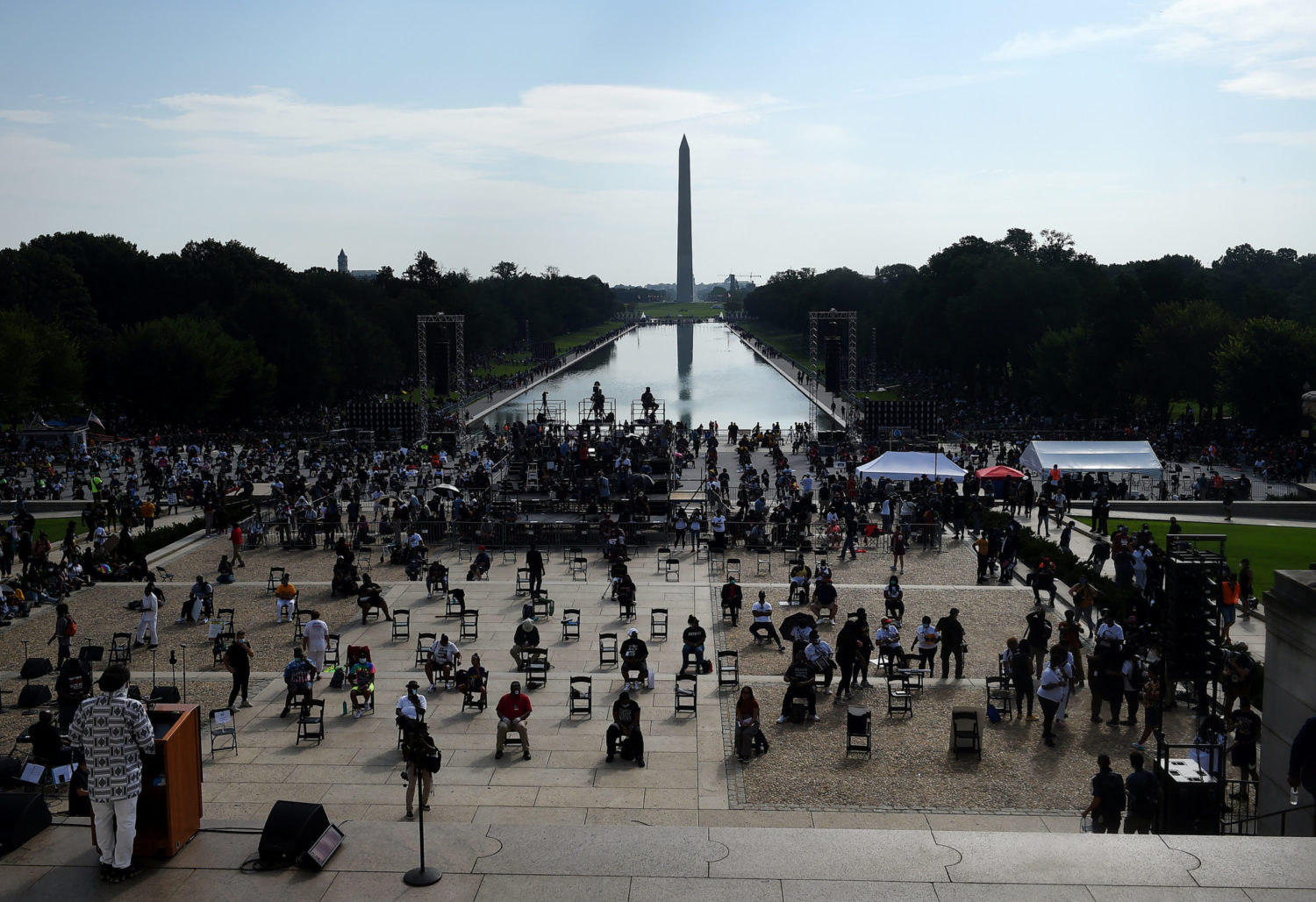
WASHINGTON (Reuters) – Tens of thousands of people were expected to march in Washington, D.C. on Friday to denounce racism, protest police brutality and commemorate the anniversary of the march in 1963 where civil rights leader Martin Luther King Jr. made his “I Have a Dream” speech.

In his historic and often-repeated speech, King envisioned a time his children would “one day live in a nation where they will not be judged by the color of their skin but by the content of their character.”

Its 57th anniversary comes at the end of a summer of racial unrest and nationwide protests, sparked by the death of George Floyd, an unarmed African American, after a Minneapolis police officer kneeled on his neck for nearly nine minutes.

Earlier this week, protests seized Kenosha, Wisconsin, after police officers shot another African-American man, Jacob Blake, multiple times in front of his young children while his back was turned. Blake survived the shooting, but has been paralyzed, his lawyers told reporters earlier this week.

Friday’s protest, called “Commitment March: Get Your Knee Off Our Necks,” was planned in the wake of Floyd’s death by civil rights activist Reverend Al Sharpton’s National Action Network.

Ben Crump, the civil rights lawyer representing Blake and Floyd’s family, will speak, as will Sharpton, members of Floyd’s family, and King’s son, Martin Luther King III, among others.

After speeches at the Lincoln Memorial, participants will walk to the Martin Luther King memorial about a half mile away.

This summer’s uprisings drew parallels to those seen in 1968, after King’s own murder, five years after his famous speech.

The march also comes as Black people suffered disproportionately from the coronavirus pandemic, which has killed about 180,000 Americans. Blacks have been more likely to be sickened and die from the virus and to lose jobs from the economic fallout.

Washington requires people coming from so-called coronavirus high-risk states, which currently includes both Wisconsin and Minnesota, to quarantine for 14 days when visiting the district.

Organizers say they are taking the pandemic into account by restricting access to buses from those states, distributing masks and checking temperatures. There will also be free COVID-19 testing provided at the event.

Washington Mayor Muriel Bowser, who received national attention when the district painted “Black Lives Matter” on the street steps away from the White House, has warned attendees that it may be difficult to socially distance during the march.

In addition to the live march, there will be a virtual commemoration featuring Reverend William Barber, a prominent civil rights activist and the co-chair of the Poor People’s Campaign. It will also include civil rights activists, politicians, artists and entertainers.

Kerrigan Williams, a founder of Freedom Fighters DC, said the group was organizing its own march on Friday after the March on Washington to promote a more radical agenda that includes replacing police departments with other public safety systems.

She said the group believes “the march on Washington is too reformist and performative for our taste.”

Separately, a wing of the Movement for Black Lives, a network of Black activists and organizations, has scheduled the “Black National Convention” on Friday night, following national conventions by the Democratic and Republican parties over the past two weeks.

The three-hour live streamed convention, which has been in the works since last fall, will feature about 100 Black activists and discussions about criminal justice and capitalism, said Jessica Byrd, an organizer for the event.

“We feel like it’s going to be a Black political Homecoming weekend,” she said.

(Reporting by Makini Brice; Additional reporting by Katanga Johnson; Editing by Heather Timmons and David Gregorio)

J&J to start mid-stage coronavirus vaccine trials in three European countries

By Nathan Allen

MADRID (Reuters) – Johnson & Johnson’s Janssen unit will begin mid-stage trials for its coronavirus vaccine in Spain, the Netherlands and Germany next week, Spain’s health minister said on Friday, as the U.S. drugmaker expands testing for its experimental shot.

The Phase II trial will last two months and include 550 participants across the three countries, including 190 people in Spain, Salvador Illa told a news conference in Madrid.

“It’s a vote of confidence in our health system,” Illa said, adding it was the first human trial for a coronavirus vaccine to be approved in Spain.

The study will focus on healthy people between the ages of 18 and 55 as well as people over 65.

Johnson & Johnson said the study will evaluate the safety and the ability to induce an immune response from single dose and two-dose regimens of the vaccine candidate, the company said in a statement.

Spain, which has western Europe’s highest tally of coronavirus cases, is also working with AstraZeneca via the European Union’s vaccine procurement program to secure sufficient doses.

J&J’s website says if the latest trials are successful, it will begin final Phase III studies, in which even more volunteers will receive the experimental vaccine.

More than 150 potential vaccines are being developed and tested globally to combat the COVID-19 pandemic, with 30 in human trials.

There is so far no approved vaccine, except one authorized in Russia before large-scale trials.

J&J is carrying out tests in the United States and Belgium, and this week added Chile, Argentina and Peru to the list of Latin American nations where it plans to conduct Phase III trials on 60,000 volunteers, in a study that will also cover Brazil, Colombia and Mexico.

The company’s potential vaccine uses “viral vectors” to generate immune responses, similar to the approach taken by the University of Oxford and AstraZeneca in their experimental vaccine, as well as China’s CanSino.

(Reporting by Nathan Allen and Jose Elías Rodríguez; editing by Mark Potter and Jason Neely)

Sinovac’s coronavirus vaccine candidate approved for emergency use in China- source

BEIJING (Reuters) – Sinovac Biotech Ltd’s coronavirus vaccine candidate CoronaVac was approved in July for emergency use as part of a program in China to vaccinate high-risk groups such as medical staff, a person familiar with the matter said.

China National Biotec Group (CNBG), a unit of state-owned pharmaceutical giant China National Pharmaceutical Group (Sinopharm), also said it had obtained emergency use approval for a coronavirus vaccine candidate in social media platform WeChat on Sunday.

CNBG, which has two vaccine candidates in phase 3 clinical trials, did not say which of its vaccines had been cleared for emergency use.

China has been giving experimental coronavirus vaccines to high-risk groups since July, and a health official told state media in an interview aired last week that authorities could consider modestly expanding the emergency use program to try to prevent possible outbreaks during the autumn and winter.

Officially, China has given little details on which vaccine candidates have been given to high-risk people under the emergency use program and how many people have been vaccinated.

State media reported in June, prior to the emergency use program, that employees at state firms travelling overseas were allowed to take one of the two vaccines being developed by CNBG, while China’s military had also approved the use of CanSino Biologics’ vaccine candidate.

Seven vaccines against the coronavirus are in final trial stages around the world, and four of them are from China.

But no vaccine has yet passed the final stage of trials proving it is safe and effective – conditions usually required to be met to get regulatory approval for mass use. COVID-19 has killed over 800,000 people worldwide.

(Reporting by Roxanne Liu in Beijing and Miyoung Kim in Singapore; Editing by Ana Nicolaci da Costa)