Putin sees ‘a lot of issues’ at first summit with Biden

By Steve Holland and Vladimir Soldatkin

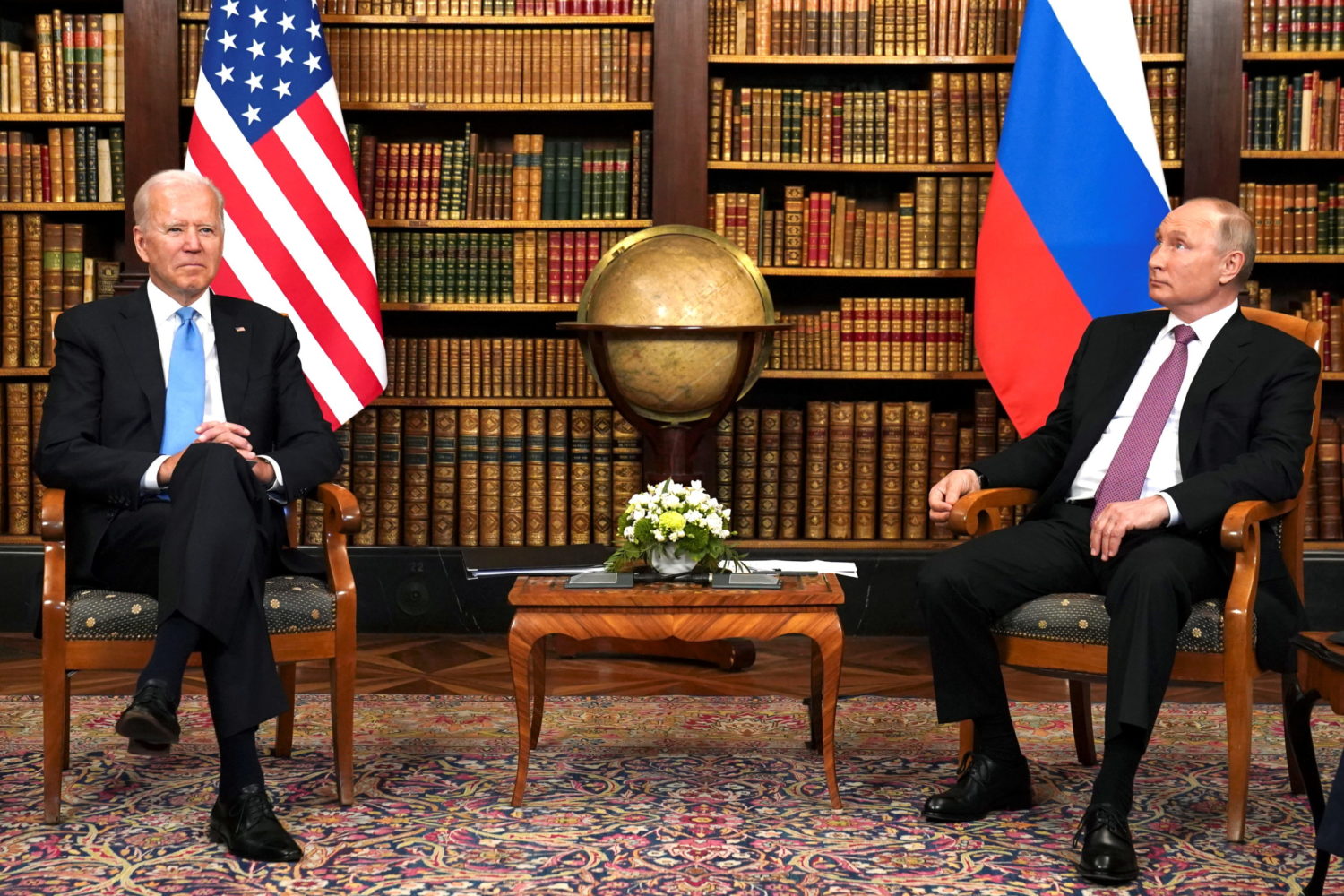
GENEVA (Reuters) -With deep disagreements likely and expectations of solving them low, U.S. President Joe Biden and Russian President Vladimir Putin sat down in a lakeside Geneva villa on Wednesday for their first summit since Biden took office.

Both have said they hope their talks can lead to more stable and predictable relations, even though they are at odds over everything from arms control and cyber-hacking to election interference and Ukraine.

Putin and Biden shook hands on arrival before going inside.

“Mr President, I’d like to thank you for your initiative to meet today,” Putin said, sitting next to Biden, adding: “U.S. and Russian relations have a lot of issues accumulated that require the highest level meeting.”

Biden said they would try to determine areas of cooperation and mutual interest. “It is always better to meet face to face.”

Aides had earlier downplayed hopes for the summit.

“We’re not expecting a big set of deliverables out of this meeting,” a senior U.S. official told reporters, saying the leaders were expected to talk for four or five hours.

“I’m not sure that any agreements will be reached,” said Putin’s foreign policy adviser, Yuri Ushakov.

The first bilateral round lasted almost two hours, the TASS news agency cited Kremlin spokesman Dmitry Peskov as saying.

The two leaders were taking a short break before resuming with a larger group, the RIA news agency said.

Continued discussions were expected to include U.S. Secretary of State Antony Blinken and Russian Foreign Minister Sergei Lavrov.

Relations between Moscow and Washington have been deteriorating for years, notably with Russia’s 2014 annexation of Crimea from Ukraine, its 2015 intervention in Syria and U.S. charges – denied by Moscow – of meddling in the 2016 election that brought Donald Trump to the White House.

They sank further in March when Biden said he thought Putin was a “killer”, prompting Russia to recall its ambassador to Washington for consultations. The United States recalled its ambassador in April.

The senior U.S. official said the United States was looking at “areas where working together can advance our national interests and make the world safer”.

Peskov said the two presidents would “need to determine how to proceed with the heads of the diplomatic missions”, according to Russian news agencies.

While the issues may be vexing, the immediate surroundings of Villa La Grange, an elegant mansion set in a 30-hectare (75-acre) park overlooking Lake Geneva, will be serene.

The summit perimeter was under heavy police guard.

ARMS CONTROL

Arms control is one domain where progress has historically been possible despite wider disagreements.

In February, Russia and the United States extended for five years the New START treaty, which caps the number of strategic nuclear warheads they can deploy and limits the land- and submarine-based missiles and bombers to deliver them.

The senior U.S. official said Biden would also define areas of vital national interest where Russian misconduct would bring a response. Biden signed an executive order in April giving Washington wide latitude to impose sanctions on Moscow.

In a sign of the strain in ties, the talks will not include any meals, and Putin, 68, and Biden, 78, are expected to hold separate news conferences rather than a joint one.

“No breaking of bread,” said the senior U.S. official.

Vladimir Frolov, a former Russian diplomat, told Reuters Putin wanted Russia to be treated with respect, as members of the Soviet Politburo were in the 1960s-1980s, with “a symbolic recognition of Russia’s geopolitical parity with the U.S.”.

“In exchange, they (Moscow) would be willing to cut back on some of the loony stuff,” Frolov said. This might mean “no poisonings, no physical violence, no arrests/kidnappings of U.S. and Russian nationals; no interference in domestic politics”.

Dmitri Trenin, director of the Carnegie Moscow Center think-tank, set the bar low for Wednesday’s talks.

“The principal takeaway, in the positive sense, from the Geneva meeting would be making sure that the United States and Russia did not come to blows physically, so that a military collision is averted,” he said.

In contrast to Trump, whose 2018 summit with Putin in Helsinki included a meeting accompanied only by interpreters, Biden and Putin are not expected to have any solo dealings.

Standing beside Putin in Helsinki, Trump refused to blame him for meddling in the 2016 U.S. election, casting doubt on the findings of his own intelligence agencies and sparking a storm of domestic criticism.

(Reporting by Steve Holland and Vladimir Soldatkin; Additional reporting by Humeyra Pamuk and Stephanie Nebehay in Geneva, Tom Balmforth and Andrew Osborn in Moscow; Writing by Arshad Mohammed and Giles Elgood; Editing by Mary Milliken, Sonya Hepinstall, Kevin Liffey, Edmund Blair and Gareth Jones)

Canada May inflation accelerates at fastest pace in a decade

By Julie Gordon

OTTAWA (Reuters) -Inflation in Canada in May accelerated at its fastest pace in a decade for a second month in a row, driven by surging shelter and vehicle prices, as the impact of the statistical comparison to tanking prices last year eased, data showed on Wednesday.

Canada’s annual inflation rate accelerated to 3.6%, from 3.4% in April, Statistics Canada said. That was slightly ahead of analyst expectations that the annual rate would rise to 3.5%.

“The whole base-effect narrative is getting pretty tired. We’re dealing with durable month-over-month increases that could be supply-chain driven in Canada,” said Derek Holt, vice president of Capital Market Economics at Scotiabank.

Shelter prices rose 4.2% in May, the largest jump since 2008, Statscan said. This as the homeowners’ replacement cost index rose 11.3%, the largest yearly increase since 1987.

Canada’s housing prices have skyrocketed through the pandemic and were up 38.4% year-over-year in May, even as recent homes sales figures suggest the frenzy may be passing.

The jump in inflation comes as many Canadian provinces continued to face shutdowns in May amid a harsh third wave of COVID-19 infections. Most regions have now begun to reopen.

“The amazing thing is if you’re getting relatively hot month-over-month numbers like this in lockdown, just wait until we start to reopen the economy,” said Holt.

CPI common, which the Bank of Canada calls the best gauge of the economy’s underperformance, was 1.8%, just below analyst expectations of 1.9%. CPI median was 2.4% and CPI trim 2.7%.

The Bank of Canada targets the 2% mid-point of a 1-3% inflation control range. It expects inflation to stay around 3% through the summer before easing later in the year.

“For the Bank of Canada … they do see this as being largely temporary, and that it will pass. I don’t think there’s anything here yet to change their view on that,” said Doug Porter, chief economist at BMO Capital Markets.

The central bank said earlier this month that inflation could remain higher than projected if supply imbalances and pressures on capacity persist, which might lead it to reduce stimulus more quickly than currently expected.

The Canadian dollar held on to modest gains after the data, trading at about 1.2176 to the U.S. dollar, or 82.13 cents.

(Reporting by Julie Gordon in Ottawa, additional reporting by Jeff Lewis, Fergal Smith and Nichola Sminather in TorontoEditing by Mark Potter and Bernadette Baum)

U.S. housing starts miss expectations amid higher lumber prices

By Lucia Mutikani

WASHINGTON (Reuters) -U.S. homebuilding rebounded less than expected in May as very expensive lumber and shortages of other materials continued to constrain builders’ ability to take advantage of an acute shortage of houses on the market.

The report from the Commerce Department on Wednesday also showed permits for future home construction falling to a seven-month low. Housing completions also declined while the number of homes authorized for construction but not yet started rose to the highest level since 1999, indicating supply will likely remain tight for a while and boost house price inflation.

“Shortages of materials and labor have builders struggling to increase production of new homes, though the demand remains strong,” said Robert Frick, corporate economist at Navy Federal Credit Union in Vienna, Virginia. “Potential home buyers should expect tight inventories and rising prices for both new and existing homes for the foreseeable future.”

Housing starts rose 3.6% to a seasonally adjusted annual rate of 1.572 million units last month. Data for April was revised down to a rate of 1.517 million units from the previously reported 1.569 million units.

Groundbreaking activity rose in the Midwest, the West and the densely populated South, but fell in the Northeast.

Economists polled by Reuters had forecast starts increasing to a rate of 1.630 million units. Last month’s increase still left starts below March’s rate of 1.725 million units, which was the highest level since June 2006. Building starts, however, jumped 50.3% on a year-on-year basis in May.

Though lumber prices dropped from a record high set in early May, softwood lumber prices increased 154.3% year-on-year in May, according to the latest producer pricer data.

A survey from the National Association of Home Builders on Tuesday showed confidence among single-family homebuilders fell to a 10-month low in June.

The NAHB blamed the ebb in sentiment on “higher costs and declining availability for softwood lumber and other building materials,” noting that was driving up prices of new houses “which has slowed the strong pace of home building.”

Tariffs on steel imports are also adding to building costs.

U.S. stocks opened lower as investors awaited hints from the Federal Reserve on when it would start tapering its massive bond buying program. The dollar was steady against a basket of currencies. U.S. Treasury prices rose.

DEMAND BOOM

Demand for bigger and more expensive accommodations amid the COVID-19 pandemic, which has left millions of Americans still working from home, is driving a housing market boom. But supply is tight, with the inventory of previously owned homes near record lows.

Permits for future homebuilding fell 3.0% to a rate of 1.681 million units in May. Building permits surged 34.9% compared to May 2020. They are running slightly ahead of starts, suggesting moderate gains in homebuilding in the months ahead.

Single-family homebuilding, the largest share of the housing market, increased 4.2% to a rate of 1.098 million units in May.

Building permits for single-family homes fell 1.6% to a rate of 1.130 million units. The number of housing units authorized to be built but not started increased 0.8% to a rate of 238,000 at the end of May, the highest since the government started tracking the series in January 1999.

The housing market has been the star performer in the economy’s recovery from the COVID-19 recession, which started in February 2020. Residential construction investment has enjoyed double-digit growth since the third quarter of last year. Most economists expect housing will have a neutral impact on gross domestic product growth in the second quarter.

Starts for the volatile multi-family segment rose 2.4% to a pace of 474,000 units in May. Building permits for multi-family housing projects dropped 5.8% to a rate of 551,000 units. With millions of Americans vaccinated against COVID-19 and the economy reopening, people are returning to cities.

Housing completions fell 4.1% to a rate of 1.368 million units last month. Single-family home completions dropped 2.6% to a rate of 978,000 units.

Realtors estimate that single-family housing starts and completion rates need to be in a range of 1.5 million to 1.6 million units per month to close the inventory gap.

The stock of housing under construction rose 0.5% to a rate of 1.324 million units last month.

(Reporting By Lucia Mutikani; Editing by Chizu Nomiyama and Andrea Ricci)

U.S. defends minority farmer debt relief despite legal fight

CHICAGO (Reuters) – The U.S. Agriculture Department (USDA) is defending efforts to wipe clean government-backed loans to farmers facing decades of discrimination, despite a temporary restraining order on the debt relief plan issued by a U.S. District court last week.

A USDA spokesperson said the agency will be ready to process payments on an estimated $4 billion in debt relief for 17,000 Black, Indigenous, Hispanic and Asian farmers once legal battles are resolved. It planned to start the payments in June.

“USDA will continue to forcefully defend its ability to carry out this act of Congress and deliver debt relief to socially disadvantaged borrowers,” a USDA spokesperson said on Tuesday.

The spokesperson said the government cannot appeal the restraining order, which pauses payments until the U.S. District Court for the Eastern District of Wisconsin rules more broadly on a lawsuit over whether or not the debt relief program discriminates against non-minority farmers.

For decades, USDA employees and programs have discriminated against socially disadvantaged farmers by denying loans and delaying payments, resulting in $120 billion in lost farmland value since 1920, according to a 2018 Tufts University analysis. The Biden administration’s loan forgiveness program is aimed at addressing those systemic inequities.

The lawsuit, filed by the Wisconsin Institute for Law and Liberty on behalf of 12 white farmers, aims to halt the debt relief by claiming it excludes farmers on the basis of race. It is one of several lawsuits filed after the USDA detailed plans to implement the minority farmer debt-relief provision, which is part of the American Rescue Plan Act that Congress passed in March.

Judge William C. Griesbach, U.S. District Judge for the Eastern District of Wisconsin, granted the temporary restraining order on June 10.

“The obvious response to a government agency that claims it continues to discriminate against farmers because of their race or national origin is to direct it to stop,” Griesbach said in the decision.

Some Black farmers are not surprised the relief has stalled, having seen previous government anti-discrimination efforts underdeliver.

“Talk is cheap. I can’t buy grain with it. I want to know when you’re going to help some farmers,” said Lloyd Wright, a Virginia farmer who served as the director of the USDA’s Office of Civil Rights in the late 1990’s and early 2000’s.

Wright said Black farmers have been promised relief from federal discrimination in the past, only to be repeatedly disappointed. He suggests eligible farmers continue paying on loans, so they do not end up behind if the program is permanently blocked.

(Reporting by Christopher Walljasper; Editing by Marguerita Choy)

Sudan’s prime minister warns of risk of chaos, civil war

By Khalid Abdelaziz

KHARTOUM (Reuters) – Sudan’s prime minister warned on Tuesday of the risk of chaos and civil war fomented by loyalists of the previous regime as he sought to defend reforms meant to pull the country out of a deep economic crisis and stabilize a political transition.

Abdalla Hamdok made the comments in a televised address days after young men carrying clubs and sticks blocked roads in the capital Khartoum following the removal of fuel subsidies.

Hamdok’s government serves under a fragile military-civilian power-sharing deal struck after a popular uprising spurred the army to overthrow veteran leader Omar al-Bashir in April 2019.

The transition is meant to last until the end of 2023, leading to elections.

“The deterioration of the security situation is mainly linked to fragmentation between components of the revolution, which left a vacuum exploited by its enemies and elements of the former regime,” Hamdok said.

He said that without reform of Sudan’s sprawling security sector, which expanded under Bashir as he fought multiple internal conflicts, Sudan will continue to face internal and external threats.

“These fragmentations can lead us to a situation of chaos and control by gangs and criminal groups, just as it can lead to the spread of conflict among all civilian groups and might lead to civil war.”

Though Sudan has won international praise for economic reforms since Bashir’s fall and has made progress towards debt relief, many Sudanese face food shortages or have struggled to make ends meet as prices have soared over the past year.

Inflation hit 379% in May and electricity or water outages occur daily.

While roadblocks have often been used in protests triggered by economic or political grievances since 2018, a Reuters witness saw more aggression around the barriers set up in recent days.

The state government said police and prosecutors would deal with what it called the gangs involved in blocking the roads, but there appeared to be little police presence on the streets.

(Additional reporting by Alaa Swilam; Writing by Aidan Lewis; Editing by Mark Heinrich)

U.S. opens $3 billion aviation manufacturing wage subsidy program

By David Shepardson

WASHINGTON (Reuters) – The U.S. Transportation Department said Tuesday it had launched a $3 billion aviation manufacturing payroll subsidy program that will cover up to half of eligible companies’ compensation costs for as long as six months.

The program, funded by Congress, requires companies to commit to not conducting furloughs without employee consent or laying off employees covered by subsidies during the six-month period. Applications must be filed by July 13.

Companies eligible include aircraft, engine, propeller or component manufacturers and companies that repair or overhaul airplanes and parts.

The subsidy program cannot cover more than 25% of an employer’s total U.S. workforce as of April 2020 and can only cover employees with total annual compensation of $200,000 or less.

To qualify, a company must have involuntarily furloughed or laid off at least 10% of its total workforce, or have experienced at least a 15% decline in 2020 total operating revenues.

More than 100,000 jobs have been lost in the aerospace industry since the start of the COVID-19 pandemic, according to the Transportation Department. Before then, the U.S. aerospace industry was estimated to employ approximately 2.2 million workers, including 1.2 million who worked in various parts of the supply chain nationwide.

Boeing Co, which has had extensive job cuts, Raytheon Technologies and Spirit Aerosystems did not immediately respond to questions about whether they are considering applying. General Electric’s aviation unit said it would not seek assistance from the program.

The International Association of Machinists and Aerospace Workers had strongly urged Congress to fund the program.

Congress has provided assistance to other aviation industry firms, including giving U.S. airlines $54 billion for payroll since March 2020 and that funding will continue to pay much of airline workers’ salaries through Sept. 30.

(Reporting by David Shepardson; Editing by Chizu Nomiyama and Cynthia Osterman)

New York governor lifts remaining COVID-19 restrictions, calls it a ‘momentous day’

By Maria Caspani and Jonathan Allen

NEW YORK (Reuters) -New York is lifting all state-mandated coronavirus restrictions after reporting that 70% of the state’s adults have received at least one dose of COVID-19 vaccine, Governor Andrew Cuomo announced on Tuesday.

“It is an important milestone, and we’re going to keep pushing to do more,” Cuomo told a news conference, adding that the state would continue to encourage more New Yorkers to get vaccinated.

Restrictions across commercial and social settings will be lifted immediately. Cuomo said some limitations based on guidelines from the U.S. Centers for Disease Control and Prevention would remain in place, with mitigation measures still required in public transit and healthcare settings.

Cuomo, whose state was the epicenter of the U.S. COVID-19 public health crisis last year, also said individuals and businesses could still choose to adopt some precautions.

The governor, who won praise in the early days of the pandemic for his televised news conferences but later became entangled in accusations of sexual misconduct, abuse of power and allegations of mishandling nursing homes during the crisis, made a triumphant entrance at the World Trade Center in New York City on Tuesday to mark what he called a “momentous day.”

“New York State has fully vaccinated a larger share of adults than any other big state in the country,” he told a cheering crowd that included first responders and hospitality workers.

On Tuesday night, fireworks all across the state will celebrate the milestone, Cuomo announced, and the Empire State Building and other state landmarks will be lit in blue and gold, New York’s colors.

Most U.S. states have moved to ease or lift coronavirus restrictions as the virus abates and vaccinations progress.

New York joined California, where restrictions including physical distancing, mask requirements and capacity limits for restaurants, stores and other businesses that cater to consumers end on Tuesday.

(Reporting by Maria Caspani and Jonathan Allen in New York, Editing by Will Dunham, Chizu Nomiyama and Bill Berkrot)

Explainer: California reopens, mostly, on Tuesday

By Jane Lanhee Lee

OAKLAND, Calif. (Reuters) – California is opening up from COVID-19 restrictions on Tuesday, but tech companies and other offices are not changing as fast as Disneyland, gyms and stores.

Here is what is changing for California offices, and what is not.

WHAT IS GETTING EASIER?

Governor Gavin Newsom issued an executive order to reopen the state on June 15, a decision ending physical distancing, mask requirements and capacity limits for restaurants, stores and other businesses that cater to consumers.

The state health department is requiring the continued wearing of masks in a few places, such as public transit and healthcare settings. Indoor concerts and events with more than 5,000 attendees will be required to confirm proof of vaccination or negative COVID-19 results.

HOW ABOUT OFFICES?

Workplace rules are dictated by the California Occupational Safety and Health Standards Board, which has debated keeping restrictions in place longer than the governor. Under the newest proposal, which will be voted on June 17, fully vaccinated office workers will not need to wear a mask in normal circumstances. However, businesses would have to confirm a person has been vaccinated before taking off a mask in an office, and some businesses have been reluctant to ask.

WHAT IS BIG TECH DOING?

Tech companies in Silicon Valley, which were among the first to go fully remote during the pandemic, are treading carefully. Many are waiting until after the Labor Day holiday, on Sept. 7, or even until 2022, to reopen offices fully.

While some like Twitter Inc have given employees the option to never return to the office, others like Alphabet Inc’s Google and Facebook Inc are allowing some employees to go remote permanently while setting minimum requirements for in-office work by many employees.

Apple is requiring workers return to the office on Mondays, Tuesdays and Thursdays from early September.

Many companies are also giving on-site employees the option to work remotely for several weeks a year.

Collaboration-app firm Slack Technology Inc’s latest survey released on Tuesday showed 93% of about 10,000 workers surveyed said they want flexibility in when they work.

Slack executive Brian Elliott said many employees want a set time during the day to collaborate but the ability to work other hours on their own terms. The survey also showed 21% were likely to jump to a new company in the next year and over half are looking, making flexibility a more important component for attracting or retaining employees.

DO COMPANIES HAVE A CHOICE?

Businesses such as restaurants can require vaccine verification or negative COVID-19 tests. Newsom said on Monday the state later this week would be announcing more about a digital version of the vaccine card issued by the U.S. Centers for Disease Control and Prevention.

San Francisco’s first major conference in reopened California will be Dreamforce, an annual event by sales software company Salesforce.Com Inc, which drew over 171,000 registered attendees in 2019.

The conference this year, which will be both virtual and in person, is scheduled for Sept. 21-23, in cities including San Francisco, New York, Paris and London. Salesforce said those attending in person will be required to be fully vaccinated, in line with state regulations.

(Reporting by Jane Lanhee Lee; Additional reporting by Stephen Nellis and Paresh Dave; Editing by Leslie Adler and Bill Berkrot)

U.S. lays out plan to confront white supremacist violence

By Jarrett Renshaw and Jan Wolfe

(Reuters) -President Joe Biden’s administration on Tuesday unveiled a plan to address the threat of violence posed by white supremacists and militias, five months after members of those groups joined in a deadly attack on the U.S. Capitol.

The White House released a 30-page plan for increased information sharing between federal and local officials and social media companies, additional resources to identify and prosecute threats and new deterrents to prevent Americans from joining dangerous groups.

The administration conducted a sweeping assessment earlier this year of domestic terrorism that labeled white supremacists and militia groups as top national security threats. The issue took on new urgency after a Jan. 6 assault on the Capitol by supporters of then-President Donald Trump who were trying to overturn Biden’s election victory.

The new strategy stopped short of calling for new laws to fight domestic threats, and officials on Tuesday did not offer many details on specific new resources.

“We concluded that we didn’t have the evidentiary basis, yet, to decide whether we wanted to proceed in that direction or whether we have sufficient authority as it currently exists at the federal level,” said a senior administration official, who spoke on condition of anonymity in advance of the announcement.

In a speech on Tuesday, U.S. Attorney General Merrick Garland said in the “coming days and months” he would convene an interagency task force dedicated to combating domestic terrorism. Garland said he has already “begun to reinvigorate” that task force.

Garland said the Jan. 6 attack by Trump supporters had shown white supremacists and militia groups to be the country’s greatest domestic security threat.

“In the FBI’s view, the top domestic violent extremist threat comes from racially or ethnically motivated violent extremists, specifically those who advocated for the superiority of the white race,” Garland said.

In his budget proposal released last month, Biden, who succeeded Trump on Jan. 20, sought $100 million in additional funding to train and hire analysts and prosecutors to disrupt and deter terrorist activity.

“The threat is elevated,” the administration official said. “Tackling it means ensuring that we do have the resources and personnel to address that elevated threat.”

The administration is also toughening the federal government’s screening methods to better identify employees who may pose insider threats. They are looking to share those techniques with private companies.

That effort includes an ongoing review by the Department of Defense over how and when to remove military members who are found to be engaged in known domestic terrorist groups.

The Defense Department review is looking at, among other things, how to define extremists, the senior administration official said.

“They are doing this in a way they feel ratchets up the protection but also respects expression and association protections,” the official said.

(Reporting By Jarrett Renshaw;Editing by Howard Goller)

How UK PM Johnson decided to delay COVID reopening

By Alistair Smout

LONDON (Reuters) – British Prime Minister Boris Johnson on Monday delayed by a month his plans to lift the last COVID-19 restrictions in England after modelling showed that thousands more people might die due unless reopening was pushed back.

The move was due to the rapid spread of the Delta coronavirus variant, which is more transmissible, associated with lower vaccine effectiveness against mild disease and could cause more hospitalizations in the unvaccinated.

He said the extra time would be used to speed up Britain’s vaccination program – already one of the world’s furthest advanced – with two thirds of the population expected to have had two shots by July 19.

Here are the details behind the decision:

WHAT AND WHO ARE THE MODELS AND THE MODELLERS?

Models commissioned by the government showed that without a delay to the planned June 21 reopening, in some scenarios hospitalizations could match previous peaks in cases when ministers feared the health system could be overwhelmed.

Three models, made by the London School of Hygiene and Tropical Medicine, Imperial College London and the University of Warwick, fed into the government’s pandemic modelling subgroup SPI-M-O.

All three found that a delay would lower the peak of a new wave fueled by the Delta variant. A two-week extension would have a significant effect, but four weeks would reduce the peak in hospital admissions by around a third to a half, SPI-M-O said.

SPI-M-O will make fresh projections before July 19 when the full reopening is now expected to take place, with Johnson saying that he does not want to delay reopening again.

WHAT ABOUT THE VACCINES?

Britain has one of the fastest vaccine rollouts in the world, with over half of adults receiving both doses and more than three quarters receiving at least one, which has led some to question why restrictions need to be extended.

The modelers warned that while protection from vaccines was not perfect, without them, England would be heading back into lockdown.

Imperial epidemiologist Anne Cori told reporters that differences in who was eligible, in rates of uptake, and the fact that vaccine effectiveness was not 100%, all combined to create the possibility of a large wave of hospitalizations.

VACCINE AND DELTA

One worrying aspect of the Delta variant is evidence that it reduces protection from vaccines against symptomatic infection, although experts still hoped it would work against severe disease.

As Johnson announced the postponement, Public Health England published data showing shots made by Pfizer and AstraZeneca offer high protection against hospitalization from the variant identified in India of 96% and 92% respectively after two doses.

Asked if that data, released after the models were made, would have an impact on the projections, Cori said they had used different efficacy assumptions for their models, and PHE figures would help to narrow down the range of likely scenarios.

“The optimistic vaccine efficacy or perhaps the central (scenarios) are definitely more likely than the most pessimistic set of vaccine efficacies we had looked at,” she said.

WHAT ARE THE SOCIAL-ECONOMIC COSTS?

Many lawmakers in Johnson’s own party expressed dismay at the delay, with Steve Baker saying some people “increasingly believe they are never going to see true freedom again.”

Kevin McConway, emeritus professor of applied statistics at The Open University, said the delay would buy time to learn more about the Delta variant, and get more shots in arms.

But he said increased risks of opening on June 21 were hard to quantify, and economic costs were not being modelled with anywhere near the same rigor.

“I do wonder how the government can make good decisions on the balance between restrictions on what we can do, if they have detailed modelling of infections, vaccines, hospitalizations and deaths (including information on the likely uncertainties), but no detailed modelling (that I’ve seen) on the economic and social costs of the restrictions,” he said.

(Reporting by Alistair Smout; Editing by Josephine Mason and Alison Williams)