North Korea increases pressure with latest missile launches

People watch a TV showing a file picture of a North Korean missile for a news report on North Korea firing short-range ballistic missiles, in Seoul, South Korea, August 2, 2019. REUTERS/Kim Hong-Ji

By Josh Smith

SEOUL (Reuters) – North Korea fired missiles for the third time in eight days on Friday, a series of launches that analysts say are designed to improve military capabilities and pressure the United States and South Korea as they seek to restart denuclearization talks.

U.S. officials, who have been hoping to revive the stalled talks with North Korea, played down the launches. The North has been testing missiles despite U.S. President Donald Trump’s June 30 meeting with its leader Kim Jong Un, where they agreed to revive the talks.

The diplomatic process may have some bumps but conversations with North Korea are “going on even as we speak”, U.S. Secretary of State Mike Pompeo said in Bangkok, where he is attending a meeting of the Association of Southeast Asian Nations (ASEAN).

South Korea’s government said the latest projectiles fired by the North appeared to be new short-range ballistic missiles.

They flew 220 km (135 miles) and reached an altitude of 25 km (15 miles), the Joint Chiefs of Staff (JCS) in Seoul said.

A U.S. official said U.S. intelligence had detected at least one projectile, and possibly more, that did not pose a threat to North America. U.S. officials said initial information indicated they were similar to two other short-range missile tests by Pyongyang since last week.

North Korean state media said Kim oversaw the firing of what they described as a new large-caliber, multiple-launch guided rocket system on Wednesday. He also observed the launch of a short-range ballistic missile last week.

The launches appear intended to put pressure on South Korea and the United States to stop planned military exercises later this month and offer other concessions.

Kim’s government was assiduously improving military capabilities as well as signaling negotiating demands with the tests, said Leif-Eric Easley, an international relations expert at Seoul’s Ewha University.

“The aim is not only to increase Pyongyang’s ability to coerce its neighbors, another goal is to normalize North Korea’s sanctions-violating tests as if they were as legitimate as South Korea’s defensive exercises.”

‘NO PROBLEM’

Trump was asked at the White House before he set off for a campaign trip to Ohio if he thought Kim was testing him and said the launches did not violate the North Korean leader’s promises.

Trump also said they were short-range missiles. “We never made an agreement on that. I have no problem,” he said.

While Trump says he never made an agreement on short-range missiles, the 15-member United Nations Security Council unanimously demanded in 2006 that North Korea suspend all activities related to its ballistic missile program and “re-establish its pre-existing commitments to a moratorium on missile launching”.

The U.N. Security Council met behind closed doors in New York on Thursday to discuss the latest missile launches.

Foreign ministers attending ASEAN’s East Asia summit of 18 nations expressed concern that the North’s missile tests were having a negative impact on dialogue, a Thai foreign ministry official said.

After the meeting, representatives of Britain, France and Germany urged North Korea to engage in meaningful talks with the United States and said international sanctions need to be fully enforced until Pyongyang has dismantled its nuclear and ballistic missile programs.

Pompeo said the U.N. sanctions remained fully in place.

“We’re working with countries all across the world, many in this region, doing great work to enforce those,” he said.

Pompeo also said he was disappointed his North Korean counterpart had canceled a planned trip to the ASEAN meet.

“I think it would’ve given us an opportunity to have another set of conversations,” he said. “I hope it won’t be too long before I have a chance to do that.”

Nuclear envoys from the United States, South Korea and Japan met on the sidelines of the ASEAN meeting on Friday, where they were expected to discuss the North’s latest tests and ways to restart working-level talks between the United States and North Korea.

No immediate impact was seen on Japan’s security after the North’s latest launch, Japan’s defense ministry said.

Andrei Lankov, director of Korea Risk Group, a think tank, said the latest missile tests do not mean Pyongyang was no longer interested in talks with the United States.

“On the contrary, the choice of the short-range missile is a sign that, for the time being, Pyongyang remains serious about making a deal with the U.S.,” he wrote in a report for NK News, a website that monitors North Korea.

(Reporting by Josh Smith in SEOUL, Hyonhee Shin and Patpicha Tanakasempipat in BANGKOK, David Brunnstrom, Phil Stewart, Alexandra Alper and Idrees Ali in WASHINGTON, Michelle Nichols in NEW YORK, and Kaori Kaneko in TOKYO; Editing by Paul Tait and Clarence Fernandez)

U.S. still hopes for talks after latest North Korean missile tests

People watch a TV broadcast of a news report on North Korea firing short-range ballistic missiles, in Seoul, South Korea, July 31, 2019. REUTERS/Kim Hong-Ji

By Josh Smith and David Brunnstrom

SEOUL/WASHINGTON (Reuters) – North Korea’s latest missile launches did not violate a pledge its leader Kim Jong Un made to U.S. President Donald Trump, a senior U.S. official said on Thursday, but efforts to resume denuclearization talks remained in doubt.

Kim oversaw the first test firing of what North Korean state media called a “new-type large-caliber multiple-launch guided rocket system” on Wednesday.

North Korean television showed rockets launching from a vehicle that had been blurred in photos to obscure its features.

U.S. officials said North Korea appeared to have carried out a new projectile launch early on Friday Korea time, adding that initial information indicated the activity was similar to the other recent tests. The officials said it was unclear how many projectiles had been launched in the latest test.

The launches came days after North Korea tested two short-range ballistic missiles on July 25 and despite a meeting between Kim and Trump on June 30 at which the agreed to revive stalled denuclearization talks.

The tests appeared intended to put pressure on South Korea and the United States to stop planned military exercises and offer other concessions and came as diplomats criss-crossed the region this week in the hope of restarting the talks.

“The firing of these missiles don’t violate the pledge that Kim Jong Un made to the president about intercontinental-range ballistic missiles,” U.S. national security adviser John Bolton said in an interview with Fox Business Network.

“But you have to ask when the real diplomacy is going to begin, when the working-level discussions on denuclearization will begin,” he said.

“We’ve been waiting to hear since June the 30th,” Bolton told the network in a subsequent interview. “We’re ready for working-level negotiations. The president’s ready, when the time is right, for another summit. Let’s hear from North Korea.”

South Korea and Japan were concerned by the launches, “because they’re within range, we think, of this particular missile,” Bolton added without mentioning the tens of thousands of U.S. troops based in both countries.

NUCLEAR ARSENAL

Massachusetts Institute of Technology professor Vipin Narang said the missile tests were part of the North Korean leader’s approach to diplomacy: “He’s saying it will take more than a photo op to get things moving.”

While Trump and his administration have sought to play down the tests, Narang said they were a stark reminder that every day Washington and its allies fail to secure an agreement North Korea continues to improve and expand its nuclear and missile arsenals.

On Thursday, Secretary of State Mike Pompeo said he hoped talks would start soon, though he “regretted” that a highly anticipated meeting with North Korean Foreign Minister Ri Yong Ho would not take place in Thailand this week.

Ri has canceled a trip to an Association of Southeast Asian Nations (ASEAN) conference in Bangkok that Pompeo is attending.

“We stand ready to continue our diplomatic conversation,” Pompeo told a news conference in Bangkok, adding that he was optimistic Kim would deploy his team for working-level talks “before too long”.

At the United Nations on Thursday, Britain, France and Germany called on North Korea to engage in “meaningful” talks with the United States and said international sanctions needed to be fully enforced until Pyongyang dismantled its nuclear and ballistic missile programs.

Their statement came after a closed-door U.N. Security Council meeting on the latest launches.

U.N. Secretary-General Antonio Guterres said the launches were a reminder of the need to restart denuclearization talks.

China, North Korea’s neighbor and main ally, welcomed the U.S. readiness to restart working-level talks, top Chinese diplomat Wang Yi said in Bangkok, following talks with Pompeo.

While China has signed up for U.N. sanctions on North Korea, Chinese President Xi Jinping urged Trump in a meeting in Japan last month “to show flexibility and meet the North Koreans half way, including easing sanctions in due course.”

The United States and North Korea have yet to narrow key differences and a summit between Trump and Kim in Vietnam in February collapsed over U.S. demands for North Korea’s complete denuclearization and North Korean demands for sanctions relief.

North Korea has accused Washington of breaking a promise by planning to go ahead with military drills with South Korea this month and has said they could derail dialogue.

It has also warned of a possible end to its freeze on nuclear and long-range missile tests in place since 2017, which Trump has repeatedly held up as evidence of the success of his engagement with Kim.

A senior U.S. defense official said on Wednesday that the United States did not plan to make changes to the drills.

‘FAT TARGET’

South Korea’s Joint Chiefs of Staff said North Korea had fired ballistic missiles on Wednesday that flew about 250 km (155 miles).

Such launches are banned under U.N. resolutions designed to press North Korea to give up its nuclear weapons and missile programs.

North Korean images of the launches appeared to show a type of multiple-launch rocket system (MLRS). Such systems form a major part of North Korea’s conventional arsenal, according to a 2018 assessment by South Korea’s defense ministry.

North Korean media said the tests verified the combat effectiveness of the overall rocket system and Kim predicted: “it would be an inescapable distress to the forces becoming a fat target of the weapon.”

The North Korean military has nearly 5,500 MLRS, along with 8,600 field guns, 4,300 tanks, and 2,500 armored vehicles, the ministry said.

(Reporting by Josh Smith in SEOUL and David Brunnstromin WASHINGTON; Additional reporting by Hyonhee Shin, Cate Cadell, Panu Wongcha-um and Patpicha Tanakasempipat in BANGKOK, David Alexanderand Idrees Ali in WASHINGTON, and Michelle Nichols in NEW YORK; Editing by Robert Birsel and Clarence Fernandez)

Trump threatens new tariffs as U.S.-China trade tensions spike again

FILE PHOTO: Farmer Dave Walton holds soybeans in Wilton, Iowa, U.S. May 22, 2019. Picture taken May 22, 2019. REUTERS/Kia Johnson

By David Lawder and Andrea Shalal

WASHINGTON (Reuters) – U.S. President Donald Trump on Thursday moved to impose a 10% tariff on a remaining $300 billion list of Chinese imports starting Sept. 1, after U.S. and Chinese negotiators failed to kickstart trade talks between the world’s two largest economies.

The levies – which would hit a wide swath of consumer goods from cell phones and laptop computers to toys and footwear – ratchet up tensions in a war of tit-for-tat tariffs that have disrupted global supply chains and roiled financial markets for more than a year.

U.S. stocks fell after the news and oil prices plummeted, and further fallout was expected. The IMF has warned that tariffs already in place will shave 0.2% off global economic output in 2020.

The benchmark S&P 500, which had been in solidly positive territory on Thursday afternoon, lost significant ground after Trump tweeted about the tariffs, and was last down 0.6% on the day. Benchmark U.S. Treasury yields also fell.

“Trade talks are continuing, and during the talks the U.S. will start, on September 1st, putting a small additional Tariff of 10% on the remaining 300 Billion Dollars of goods and products coming from China into our Country. This does not include the 250 Billion Dollars already Tariffed at 25%,” Trump tweeted.

Trump also faulted China for not making good on promises to buy more American agricultural products and criticized China’s President Xi Jinping for failing to do more to stem sales of the synthetic opioid fentanyl.

The president’s tweets followed a briefing by Trade Representative Robert Lighthizer and Treasury Secretary Steven Mnuchin on their talks in Shanghai, their first face-to-face meeting with Chinese officials since Trump and Xi agreed to a trade ceasefire at a G20 summit in June.

The talks ended on Wednesday with little sign of progress, although both countries described the negotiations as constructive. Another round of meetings between the negotiators has been scheduled for September.

Trump had been pressing Xi to crack down on a flood of fentanyl and fentanyl-related substances from China, which U.S. officials say is the main source of a drug blamed for most of more than 28,000 synthetic opioid-related overdose deaths in the United States in 2017.

Xi promised Trump at a summit in Argentina in December that Beijing would take action. China had pledged that from May 1 it would expand the list of narcotics subject to state control to include the more than 1,400 known fentanyl analogs, which have a slightly different chemical makeup but are addictive and potentially deadly, as well as any new ones developed in the future.

Talks between the United States and China collapsed in May after U.S. officials accused China of pulling back from earlier commitments. Washington sharply hiked tariffs on $200 billion worth of Chinese goods and Beijing retaliated, escalating the trade dispute.

Trump subsequently threatened to impose 25% sanctions on the remaining $300 billion in Chinese imports, prompting warnings from Walmart and other major U.S. retailers of a sharp spike in consumer prices. Thursday’s tweets indicated those goods would face a lower tariff rate than initially threatened.

While the United States bemoans the lack of larger Chinese agricultural purchases, Beijing has been pressing Washington to relax restrictions on sales to Chinese telecommunications giant Huawei as it had promised.

The U.S. Department of Agriculture on Thursday confirmed private sales to China of 68,000 tonnes of soybeans in the week ended July 25.

The sale was the first to a private buyer since Beijing offered to exempt five crushers from the 25% import tariffs imposed more than a year ago. Soybean futures opened lower on Thursday as traders shrugged off the small amount, and losses accelerated after Trump’s tweets.

(Additional reporting by Stella Qiu and Beijing Monitoring Desk; additional reporting by David Lawder, Jonathan Landay and Andrea Shalal in Washington and Mark Weinraub and Karl Plume in Chicago; Editing by Sonya Hepinstall)

China buys U.S. soybeans for first time since June

FILE PHOTO: Soybeans fall into a bin as a trailer is filled at a farm in Buda, Illinois, U.S., July 6, 2018. REUTERS/Daniel Acker/File Photo

By Mark Weinraub and Karl Plume

CHICAGO (Reuters) – The U.S. Department of Agriculture on Thursday confirmed private sales to China of 68,000 tonnes of soybeans for the 2019/20 marketing year, the first such purchase by a private buyer since the trade war between the world’s two largest economies broke out more than a year ago.

It was the first new soybean purchase by China since a 544,000-tonne sale was announced in late June, and the first since Beijing offered to exempt five private crushers in the country from 25-percent import tariffs on U.S. beans arriving by the end of the year.

In its weekly export sales report, the USDA also said China bought 66,800 tonnes of soybeans for 2018/19 delivery, including 62,000 tonnes that had previously been listed as headed for unknown destinations. But China also canceled previous purchases totaling 72,900 tonnes for the current marketing year, USDA said.

Widespread market rumors last week suggested that a large Chinese crusher purchased a small number of soybean cargoes for shipment in October from terminals in the U.S. Pacific Northwest, traders said.

Prices for soybeans shipped to Asia from the PNW this autumn are lower than prices for beans shipped from rival exporter Brazil if China’s import tariffs are removed, U.S. export traders said.

Large purchases, however, are not expected as China’s hog herd, the largest consumer of the soybean meal produced from raw beans, has been decimated by the deadly African swine fever. Soy crushing margins are also unprofitable, limiting demand.

Although just a fraction of the 87 million tonnes of soybeans the world’s top buyer is expected to import over the 2019/20 (Sept/Aug) season, the purchase was significant. The 25-percent tariff on U.S. soybeans made imports from rival suppliers like Brazil and Argentina far more attractive to private crushers.

Chinese state-owned firms have purchased some 14 million tonnes of U.S. soy since an initial trade war truce was struck by U.S. President Donald Trump and China’s Xi Jinping in December, but less than 10 million tonnes have been shipped so far.

Latest U.S.-China trade talks called ‘constructive’ by both sides

Chinese Vice Premier Liu He, at right, looks over as United States Trade Representative Robert Lighthizer, third from left gestures near Treasury Secretary Steve Mnuchin, second from left before the start of talks at the Xijiao Conference Center in Shanghai, China July 31, 2019. Ng Han Guan/Pool via REUTERS

By Brenda Goh and David Stanway

SHANGHAI (Reuters) – U.S. and Chinese negotiators wrapped up a brief round of trade talks on Wednesday that both sides described as “constructive,” including discussions over further Chinese purchases of American farm goods and an agreement to reconvene in September.

The first face-to-face talks since a ceasefire was agreed to last month in the trade war between the world’s two largest economies amounted to a working dinner on Tuesday at Shanghai’s historic Fairmont Peace Hotel and a half-day meeting on Wednesday, before U.S. Trade Representative Robert Lighthizer and Treasury Secretary Steven Mnuchin flew out.

“The meetings were constructive, and we expect negotiations on an enforceable trade deal to continue in Washington … in early September,” White House spokeswoman Stephanie Grisham said in a statement.

“Both sides, according to the consensus reached by the two leaders in Osaka, had a candid, highly effective, constructive and deep exchange on major trade and economic issues of mutual interest,” China’s Commerce Ministry said in a statement shortly after the U.S. team left Shanghai.

It was not immediately clear what, if any, further agricultural products China agreed to buy from the United States and when – an issue that had become a bone of contention after U.S. President Donald Trump said China had not made good on promised purchases.

“The Chinese side confirmed their commitment to increase purchases of United States agricultural exports,” the White House’s Grisham said, offering no other details.

Representatives for the U.S. Trade Representative’s office did not immediately respond to a request for comment.

The Chinese statement said negotiators discussed more Chinese purchases of agricultural products from the United States, but did not say there was any agreement to buy more.

The talks began amid low expectations. Trump on Tuesday warned China against waiting out his first term to finalize any trade deal, saying if he wins re-election in the November 2020 U.S. presidential contest, the outcome will be worse for China.

Fresh fears over the trade war and concerns about a protracted fight with little near-term progress weighed on global markets on Wednesday.

Chinese Foreign Ministry spokeswoman Hua Chunying said on Wednesday that she was not aware of the latest developments during the talks, but that it was clear it was the United States that continued to “flip flop”.

“I believe it doesn’t make any sense for the U.S. to exercise its campaign of maximum pressure at this time,” Hua told a news briefing in response to a question about the tweets.

“It’s pointless to tell others to take medication when you’re the one who is sick,” she said.

EARLY FINISH

The U.S.-China trade war has disrupted global supply chains and shaken financial markets as each side has slapped tariffs on billions of dollars of each other’s goods.

An official Chinese government survey released on Wednesday showed factory activity shrank for the third month in a row in July, underlining the growing strains the dispute has placed on the No. 2 economy.

The Shanghai talks were expected to center on “goodwill” gestures, such as Chinese commitments to purchase U.S. agricultural commodities and steps by the United States to ease some sanctions on Chinese telecoms equipment giant Huawei Technologies Co Ltd, a person familiar with the discussions told Reuters earlier.

Those issues are somewhat removed from the primary U.S. complaints in the trade dispute such as Chinese state subsidies, forced technology transfers and intellectual property violations – all topics the White House in its statement said were discussed. China’s account of the discussions did not mention any of the non-agricultural issues.

Trump and Chinese President Xi Jinping agreed in June at the G20 summit in Osaka, Japan, to restart trade talks that stalled in May, after Washington accused Beijing of reneging on major portions of a draft agreement. The collapse in talks prompted a steep U.S. tariff hike on $200 billion of Chinese goods.

The U.S. Commerce Department put Huawei on a national security blacklist in May, effectively banning U.S. firms from selling to Huawei, a move that enraged Chinese officials.

Trump said after the Osaka meeting that he would not impose new tariffs on a final $300 billion of Chinese imports and would ease some U.S. restrictions on Huawei if China agreed to make purchases of U.S. agricultural products.

But so far, U.S. semiconductor and software makers are still mostly in the dark about the administration’s plans.

In Sao Paulo on Tuesday, U.S. Commerce Secretary Wilbur Ross said decisions on license applications by U.S. firms to resume some sales to Huawei could come as early as next week.

Hu Xijin, editor-in-chief of China’s nationalistic Global Times tabloid, run by the ruling Communist Party’s People’s Daily newspaper, wrote on Twitter that the negotiators had “efficient and constructive” exchanges.

“The two sides discussed increasing purchase of U.S. farm products and the U.S. side agreed to create favorable conditions for it. They will hold future talks,” Hu said, without elaborating.

(Reporting by Brenda Goh, David Stanway, Yilei Sun, Engen Tham, and Josh Horwitz in Shanghai, and Huizhong Wu in Beijing; and Roberta Rampton, David LAwder and Andrea Shalala in Washington; Writing by Michael Martina in Beijing and Susan Heavey in Washington; Editing by Simon Cameron-Moore, Kim Coghill and Will Dunham)

Explainer: What do you do after a data breach?

FILE PHOTO: The logo and ticker for Capital One are displayed on a screen on the floor of the New York Stock Exchange (NYSE) in New York, U.S., May 21, 2018. REUTERS/Brendan McDermid/File Photo

(Reuters) – A hacker has stolen the personal information of over 100 million people from Capital One Financial Corp, the company said this week, in the latest high-profile breach of sensitive consumer data.

Security experts say data breaches will continue to happen as cyber criminals and state-backed hackers target the protected information held by companies and government agencies.

Such attacks leave consumers vulnerable to fraud and identity theft. Here are some steps you can take to assess the severity of the breach and better secure yourself:

WHAT WAS COMPROMISED?

Breaches often cover a wide range of data. Information which is already publicly available, such as your name or email address, is seen as less of a concern.

Other details, however, can be extremely sensitive and need to remain private. For example, full credit card numbers, which could be used to make fraudulent purchases in your name, or passwords for your online accounts.

Even if stolen, the data may still be protected by encryption. Hacks by foreign governments are also usually seen as less dangerous for general consumers compared to data thefts by financially-motivated criminal gangs because most spy agencies do not sell or trade such information.

Much of the information stolen from Capital One was already public, including names and addresses of over 100 million people in the United States and Canada. But the breach also included 140,000 Social Security numbers which could be used to steal people’s identities.

To assess the severity of the breach, try and determine what information was compromised and in what format it was stolen.

AM I AFFECTED?

Try to establish if your data is likely to have been compromised in the breach. Are you a customer of the affected company? Do you know what data they hold on you? Does the breach only concern data collected in a specific time period?

Answering those questions will allow you to judge the level of risk, but remember some organizations may hold your data without you being aware. Those include credit-reporting companies such as Equifax Inc <EFX.N>, which suffered a breach in 2017 that affected 147 million people.

Breached companies are usually obliged to notify the people who are impacted, but this does not always happen immediately. Affected companies will typically post guidance for consumers on their own websites about data breaches.

Under the European Union’s General Data Protection Regulation (GDPR), companies have to inform victims of severe data breaches “without undue delay.” They must then describe in “clear and plain language” the nature of the breach, the likely consequences and what measures being taken to deal with it.

IS THIS A SCAM?

If you think you data was compromised, be on high alert for scams and fraud.

Watch your bank account balances and payment card statements carefully, especially if you believe your financial information has been compromised. If you spot any unusual activity, contact your bank or card provider immediately and inform the appropriate law enforcement agency.

Be aware of so-called “phishing” websites purporting to offer information about the breach, or even compensation, but actually set up by criminals to try and trick you into revealing more personal details or making a payment to the wrong account.

Fraudsters may also contact you directly, by phone or email, and could now be armed with large amounts of detailed personal information which will make them harder to spot. If you’re unsure about someone’s identity, find the affected company’s contact information and contact them independently.

Experts recommend changing passwords frequently and using a combination of letters, characters and symbols to maintain a complex passphrase that is less likely to be guessed.

(Reporting by Jack Stubbs and Christopher Bing; Editing by Jonathan Weber and Susan Thomas)

U.S. abortion rights groups sue over Missouri law

FILE PHOTO: Abortion rights advocates attend a rally after a judge granted a temporary restraining order on the closing of Missouri's sole remaining Planned Parenthood clinic in St. Louis, Missouri, U.S. May 31, 2019. REUTERS/Lawrence Bryant

By Rich McKay

(Reuters) – Prominent U.S. abortion rights groups Planned Parenthood and the American Civil Liberties Union filed a federal lawsuit late on Tuesday in an effort to stop a new Missouri law that bans almost all terminations of pregnancies after eight weeks.

The new law was signed by Republican Governor Mike Parson in May and is set to go into effect on Aug. 28.

The 31-page complaint filed in the U.S. District Court for the Western District of Missouri contends that the legislation is unconstitutional. It asks for an injunction to stop the law from being enacted next month until the complaint is resolved.

“Without this relief, the bans will have a devastating effect on patients seeking access to abortion in the state,” lawyers wrote in the complaint.

The law is one of the most restrictive in the nation and activists contend it effectively forbids most abortions since many women do not know they are pregnant yet at eight weeks.

In a perennially divisive moral and political fight, similar laws have been proposed in more than a dozen other U.S. states as Republican-controlled legislatures flex their muscles.

Efforts to roll back Roe v. Wade, the U.S. Supreme Court decision legalizing abortion in 1973, have been emboldened by two appointments by President Donald Trump giving conservatives a solid majority on the court.

Neither representatives for the Missouri governor’s office, nor lawyers for the ACLU and Planned Parenthood, were immediately available for comment early Wednesday.

Parson said in May the new law would make Missouri “one of the strongest pro-life states in the country.”

The legislation allows for an abortion after the eighth week only in the case of medical emergencies, and provides no exceptions for victims or rape or incest.

Plaintiffs in the Missouri complaint said the law conflicts with more than four decades of binding precedent, would prohibit “the vast majority of pre-viability abortions”, and denied patients healthcare they were entitled to.

Planned Parenthood is engaged in separate litigation with the state to keep a St. Louis clinic open. If Missouri officials succeed in closing the clinic, it would become the only U.S. state without a legal abortion facility.

(Reporting by Rich McKay in Atlanta; Editing by Andrew Cawthorne)

Trump administration opens door to importing medicine from Canada

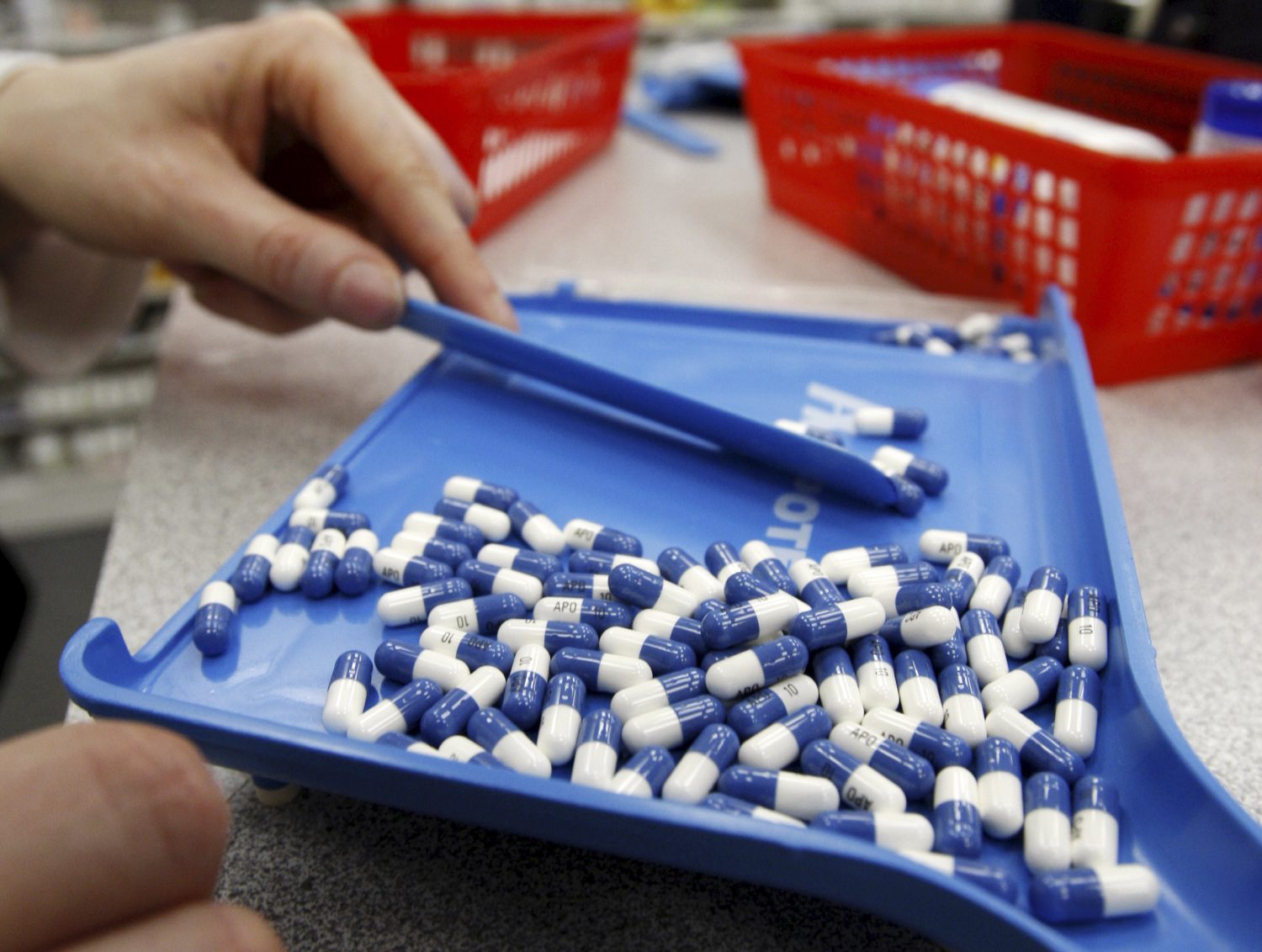
A pharmacist counts pills in a pharmacy in Toronto in this January 31, 2008 file photo. REUTERS/Mark Blinch/Files

By Michael Erman

(Reuters) – The Trump administration took a first step on Wednesday toward allowing the importation of medicines from Canada, an action the president has advocated as a way to bring cheaper prescription drugs to Americans.

The U.S. Department of Health and Human Services said it and the Food and Drug Administration will propose a rule that will allow it to authorize states and other groups to pursue pilot projects related to importing drugs from Canada.

The agency also said that it would allow drugmakers to bring drugs that they sell more cheaply in foreign countries into the United States for sale here, potentially enabling them to sell below their contracted prices in the U.S.

Drug industry shares were lower slightly, with the NYSE Arca Pharmaceutical Index <.DRG> off 0.25 percent versus a broader flat market. Wall Street analysts said importation was far from being put into place and was limited to certain drugs from Canada.

Health and Human Services Secretary Alex Azar said he has had prior discussion with Canada about importation and that it would be up to the states, pharmacies and distributors to address any hurdles.

“There are hurdles of course, but the hurdles now are known. They are being laid out and they are surmountable,” he said during a call with reporters.

Canadian officials were not immediately available for comment. Reuters has previously reported that Canada opposes any U.S. plans to buy Canadian prescription drugs that might threaten the country’s drug supply or raise costs for its own citizens.

Many drug purchase agreements in Canada forbid the re-export of drugs to other countries, according to a Canadian government memo obtained by Reuters.

“Given the size of the U.S. market and of large states such as Florida, which alone is two-thirds of the population of Canada, reliance on imports from Canada would have limited viability as a long term solution to the high cost of drugs in the U.S.,” Health Canada said in a statement on July 17.

Evercore ISI analysts Ross Muken and Michael Newshel said in a research note that any implementation is still far away given the technical steps of rulemaking and that the proposals will face challenges. For instance, he said, most Republicans in Congress oppose importation.

The first part of the proposal would allow states, wholesalers or pharmacists to submit plans for pilot projects for Canadian drugs if their raw materials are manufactured in the same plant as the U.S. version and are in line with the FDA’s approval. It would exclude biologics, infused drugs, injected drugs, inhaled drugs for surgery and certain parenteral drugs.

The Trump Administration has experienced several recent failures in its efforts to bring down drug prices. Its plans to make drugmakers disclose prices in TV ads had to be thrown out after it lost a legal battle with drugmakers, and it abandoned efforts to force pharmacy benefit managers to pass discounts onto Medicare recipients.

Drug pricing is an important election issue for Trump and also for Democrats, many of whom have said they would support importing medicines to lower U.S. drug prices. Pharmaceutical companies have opposed importing medicine.

(Reporting by Manas Mishra in Bengaluru; Michael Erman and Caroline Humer in New York and Allison Martell in Toronto; Editing by Steve Orlofsky)

North Korea tests more missiles despite efforts at diplomatic solutions

People watch a TV that shows a file picture of a North Korean missile for a news report on North Korea firing short-range ballistic missiles, in Seoul, South Korea, July 31, 2019. REUTERS/Kim Hong-Ji

By Josh Smith and Hyonhee Shin

SEOUL (Reuters) – North Korea fired two short-range ballistic missiles early on Wednesday, the South Korean military said, only days after it launched two similar missiles intended to pressure South Korea and the United States to stop upcoming military drills.

The firings follow launches on July 25, North Korea’s first missile tests since leader Kim Jong Un and U.S. President Donald Trump met on June 30 and agreed to revive stalled denuclearization talks.

The series of missile tests raises the stakes for U.S. and South Korean diplomats crisscrossing the region this week in the hope of restarting talks aimed at persuading Pyongyang to give up its nuclear weapons and ballistic missile programs.

“North Korea’s actions do not help ease military tensions, nor do they help keep the momentum for talks that are underway,” South Korean Foreign Minister Kang Kyung-wha told reporters in Seoul before leaving for a Southeast Asian security forum in Bangkok.

Kang urged North Korea to halt the missile launches.

U.S. Secretary of State Mike Pompeo and the top U.S. North Korea negotiator were also headed to the Association of Southeast Asian Nations (ASEAN) Regional Forum in the Thai capital, where Pompeo said he was holding out hope that U.S. officials could meet North Korean counterparts.

Trump and Pompeo both played down last week’s launches and Pompeo has continued to express hope for a diplomatic way forward with North Korea.

The latest launch comes ahead of newly appointed U.S. Secretary of Defense Mark Esper’s first official visit to Seoul, which the Pentagon said on Tuesday was scheduled as part of a tour through Asia in August.

U.S. military forces in South Korea were aware of Wednesday’s launch, a spokesman said.

NEW MISSILES

Wednesday’s launches were from the Wonsan area on North Korea’s east coast, from which last week’s missiles had been fired, South Korea’s Joint Chiefs of Staff (JCS) said in a statement. It said it was monitoring in case of more launches.

The JCS said later the North had fired ballistic missiles that flew about 250 km (155 miles) and appeared to be similar to those of last week.

The missiles, dubbed the KN-23, are designed to evade missile defense systems by being easier to hide, launch, and maneuver in flight, experts said.

Kim described the two KN-23s launched last week as having a “low-altitude gliding and leaping flight” pattern that would make them hard to intercept.

Analysts said the range and altitude of Wednesday’s flights could indicate a demonstration or test of those capabilities.

South Korean defense minister Jeong Kyeong-doo told a defense forum in Seoul that stopping a missile like the KN-23 would be difficult, although South Korea’s missile defense systems would be able to detect and intercept them.

South Korea’s defense ministry also told lawmakers in Seoul it had concluded that a new submarine the North showcased last week was capable of carrying up to three ballistic missiles.

Japanese Prime Minister Shinzo Abe said there was no impact from Wednesday’s launch on Japan’s security.

“We will continue to closely cooperate with the United States and others,” Abe told reporters.

Chief Cabinet Secretary Yoshihide Suga said Japan would still seek a summit with North Korea, without conditions, despite the latest launch.

‘BARGAINING CHIP’

Trump and Kim met on June 30 in the Demilitarized Zone (DMZ) between the two Koreas but Pyongyang has since accused Washington of breaking a promise by planning to hold joint military exercises with South Korea next month and warned the drills could derail talks.

Later on Wednesday, state news agency KCNA repeated calls for the United States and South Korea to end their “hostile” joint drills, but did not mention the missile launches.

“It is a prerequisite for improving the inter-Korean relations and ensuring peace on the Korean peninsula to call an overall and permanent halt to anti-North war drills, the root cause of confrontation and war,” it said in a commentary.

Moves by the United States and South Korea to rename the approaching exercises were simply double-dealing that proved “confrontational maniacs remain unchanged in their black-hearted intention to stifle” North Korea by force, it added.

A top South Korean official said last month the drills would mainly involve computer simulations.

North Korea has also warned of a possible end to its freeze on nuclear and long-range missile tests that has been in place since 2017, which Trump has repeatedly upheld as evidence of the success of his engagement with Kim.

Henri Feron, a senior fellow at the Washington-based Center for International Policy, said the United States and South Korea may need to consider a temporary suspension of the drills, or propose other measures to reduce tensions.

“I do think there is a high risk that talks will end altogether if Washington and Seoul continue to ignore North Korea’s concern with the exercises,” he said.

A summit between Trump and Kim in Vietnam in February collapsed after they failed to reconcile differences between Washington’s demands for Pyongyang’s complete denuclearization and North Korean demands for sanctions relief.

Trump says he has a good relationship with Kim and Pompeo said on Monday he hoped working-level talks could occur soon.

Pompeo told reporters traveling with him to Asia on Tuesday he did not know when this would happen but hoped U.S. Special Representative for North Korea Stephen Biegun and his new counterpart could meet soon.

North Korean Foreign Minister Ri Yong Ho canceled a planned visit to the ASEAN forum in Bangkok but Pompeo said the Americans were still open to a meeting.

Harry Kazianis, of Washington’s Center for the National Interest think tank, said the latest launches were a clear attempt by North Korea to put pressure on Washington.

Other analysts have said North Korea will be emboldened to press more aggressively for U.S. concessions by Trump’s apparent eagerness to hold up his engagement with Pyongyang as a foreign policy success ahead of his 2020 re-election bid.

(Reporting by Hyonhee Shin and Josh Smith in SEOUL, Eric Beech and David Brunnstrom in WASHINGTON; Additional reporting by Kaori Kaneko and Chris Gallagher in TOKYO; Editing by Paul Tait and Clarence Fernandez)

The Fed will soon cut U.S. interest rates. What will it mean for your wallet?

FILE PHOTO: Federal Reserve Board building on Constitution Avenue is pictured in Washington, U.S., March 19, 2019. REUTERS/Leah Millis/File Photo

By Trevor Hunnicutt and Jason Lange

NEW YORK/WASHINGTON (Reuters) – A decision by the Federal Reserve to cut interest rates may do little at this point to cut some of the costs that matter to many U.S. consumers.

From mortgages to credit cards, banks and other lenders may resist offering substantially lower rates to consumers, analysts said, even if the central bank makes a widely expected cut to its policy rate, currently targeted between 2.25% and 2.50%.

For one thing, some borrowing costs are already low and markets have already priced in expectations the Fed would support the economy. Mortgage rates have also dropped, with rates on the average 30-year U.S. home loan falling under 4.1%, near a 22-month low, more than half a point below the average since the global financial crisis more than a decade ago, according to the Mortgage Bankers Association.

“If we drive down into the mid-3.7%, mid-3.8% range, you’re talking about historic affordability from a purchasing power standpoint,” said Mark Fleming, chief economist for First American Financial Corp, which provides insurance related to real estate transactions. “There’s not a lot of wiggle room here in the first place. I think we established five or six years ago that a mortgage rate around 3.5% or 3.6% is a floor. That’s about as low as you can go.”

That low mortgage level was when the Fed’s rates were near zero and the central bank was buying mortgage bonds in the aftermath of the financial crisis to drive longer-term rates even lower – a far cry from where policy is now.

At the same time, one of the Fed’s main goals in cutting rates is to bring inflation up to the 2% level policymakers consider healthy, and maybe even higher to make up for long periods of missing that target. If the Fed succeeds, longer-term bonds most sensitive to inflation could fall in price, causing their yields to rise. Because U.S. mortgages are benchmarked to those longer-term bonds, rates could rise again.

For many consumers, the obstacle to buying a house has not been mortgage rates, but stricter lending standards that reduced access to mortgages in the first place. Big price increases and limited supply have also made housing less affordable. Lower rates could make housing even more out of reach by spurring demand, driving prices even higher.

Financing for new cars might be a different story, though, especially given the large role of automakers themselves in the car loan business. Those businesses have an incentive to increase lending to support the auto market.

Savers, meanwhile, have been rewarded in recent months for shopping around for higher-yielding savings accounts and certificates of deposit. Thanks to increased competition, some online banks have been pushing yields up for those products even with the expected rate cut.

That could change if the Fed is embarking on a prolonged series of rate cuts, as some investors are betting. But the biggest factor could still be overall competition between financial institutions for savers’ money, said Morningstar Inc analyst Eric Compton.

Consumers, however, are in a much better place than they have been in years, by some measures. They have higher take-home pay, lower debt and better credit scores than during the financial crisis. “You’ve got consumers that are pretty healthy, savings rates are pretty good,” said Neal Van Zutphen, president of Intrinsic Wealth Counsel Inc, a financial planner. “They’re taking advantage of this anticipatory drop in rates.”

(Reporting by Trevor Hunnicutt in New York and Jason Lange in Washington; Editing by Leslie Adler)