Facebook suspends Russian Instagram accounts targeting U.S. voters

FILE PHOTO: Silhouettes of mobile users are seen next to a screen projection of Instagram logo in this picture illustration taken March 28, 2018. REUTERS/Dado Ruvic/Illustration/File Photo

Facebook suspends Russian Instagram accounts targeting U.S. voters
By Jack Stubbs and Christopher Bing

LONDON/WASHINGTON (Reuters) – Facebook Inc. said on Monday it has suspended a network of Instagram accounts operated from Russia that targeted Americans with divisive political messages ahead of next year’s U.S. presidential election, with operators posing as people within the United States.

Facebook said it also had suspended three separate networks operated from Iran. The Russian network “showed some links” to Russia’s Internet Research Agency (IRA), Facebook said, an organization Washington has said was used by Moscow to meddle in the 2016 U.S. election.

“We see this operation targeting largely U.S. public debate and engaging in the sort of political issues that are challenging and sometimes divisive in the U.S. right now,” said Nathaniel Gleicher, Facebook’s head of cybersecurity policy.

“Whenever you do that, a piece of what you engage on are topics that are going to matter for the election. But I can’t say exactly what their goal was.”

Facebook also announced new steps to fight foreign interference and misinformation ahead of the November 2020 election, including labeling state-controlled media outlets and adding greater protections for elected officials and candidates who may be vulnerable targets for hacking.

U.S. security officials have warned that Russia, Iran and other countries could attempt to sway the result of next year’s presidential vote. Officials say they are on high alert for signs of foreign influence campaigns on social media.

Moscow and Tehran have repeatedly denied the allegations.

Gleicher said the IRA-linked network used 50 Instagram accounts and one Facebook account to gather 246,000 followers, about 60% of which were in the United States.

The earliest accounts dated to January this year and the operation appeared to be “fairly immature in its development,” he said.

“They were pretty focused on audience-building, which is the thing you do first as you’re sort of trying to set up an operation.”

Ben Nimmo, a researcher with social media analysis company Graphika who Facebook commissioned, said the flagged accounts shared material that could appeal to Republican and Democratic voters alike.

Most of the messages plagiarized material authored by leading conservative and progressive pundits. This included recycling comments initially shared on Twitter that criticized U.S. congresswoman Alexandria Ocasio-Cortez, Democratic presidential candidate Joe Biden and current President Donald Trump.

“What’s interesting in this set is so much of what they were doing is copying and pasting genuine material from actual Americans,” Nimmo told Reuters. “This may be indicative of an effort to hide linguistic deficiencies, which have made them easier to detect in the past.”

Attorneys for Concord Management and Consulting LLC have denied any wrongdoing. U.S. prosecutors say the firm is controlled by Russian catering tycoon Evgeny Prigozhin and helped orchestrate the IRA’s operations.

Gleicher said the separate Iranian network his team identified used more than 100 fake and hacked accounts on Facebook and Instagram to target U.S. users and some French-speaking parts of North Africa. Some accounts also repurposed Iranian state media stories to target users in Latin American countries including Venezuela, Brazil, Argentina, Bolivia, Peru, Ecuador and Mexico.

The activity was connected to an Iranian campaign first identified in August last year, which Reuters showed aimed to direct internet users to a sprawling web of pseudo-news websites which repackaged propaganda from Iranian state media.

The accounts “typically posted about local political news and geopolitics including topics like public figures in the U.S., politics in the U.S. and Israel, support of Palestine and conflict in Yemen,” Facebook said.

(Reporting by Jack Stubbs; Additional reporting by Elizabeth Culliford in San Francisco; Editing by Chris Reese, Tom Brown and David Gregorio)

WikiLeaks founder Assange appears confused at extradition hearing

WikiLeaks founder Assange appears confused at extradition hearing
By Andrew MacAskill

LONDON (Reuters) – WikiLeaks founder Julian Assange appeared confused at a London court hearing on Monday, struggling to recall his name and age in his first public appearance in months as he sought to fight his extradition to the United States.

Assange, 48, who spent seven years holed up in Ecuador’s embassy before he was dragged out in April, faces 18 counts in the United States including conspiring to hack government computers and violating an espionage law. He could spend decades in prison if convicted.

On Monday he appeared clean-shaven, without the long beard he had worn at his last public appearance in May, when he was sentenced to 50 weeks jail for skipping bail. He appeared in good health, with his white hair combed back and wearing a navy suit over a light blue sweater and white shirt.

But he mumbled and stuttered for several seconds as he gave his name and date of birth at the start of a preliminary hearing in the case.

When the judge asked him at the end of the hearing if he knew what was happening, he replied “not exactly”, complained about the conditions in jail, and said he was unable to “think properly”.

“I don’t understand how this is equitable,” he said. “I can’t research anything, I can’t access any of my writing. It’s very difficult where I am.”

Assange is being held in British jail pending the U.S. extradition, having served his sentence for skipping bail.

He fled to the embassy in 2012 to avoid being sent to Sweden to face sex crimes accusations. He says the U.S. charges against him are a political attempt to silence journalists and publishers, and the Swedish allegations were part of a plot to catch him. Sweden is reviewing the sex crimes cases.

The former Mayor of London Ken Livingstone was among Assange’s supporters in the public gallery, while protesters gathered outside court.

Assange’s lawyer Mark Summers argued that Assange’s extradition hearing, scheduled for February 2020, should be delayed by three months due to the complexity of the case.

“The evidence in this case would test the limits of most lawyers,” Summers told the court. He cited the difficulty of communicating with Assange who he said doesn’t have a computer in prison. The judge denied the request to delay the hearing.

Australian-born Assange made international headlines in early 2010 when WikiLeaks published a classified U.S. military video showing a 2007 attack by Apache helicopters in Baghdad that killed a dozen people, including two Reuters news staff.

WikiLeaks later angered the United States by publishing caches of leaked military documents and diplomatic cables.

Admirers have hailed Assange as a hero for exposing what they describe as abuse of power by modern states and for championing free speech. As he entered the dock, people in the public gallery raised their fists in solidarity with him.

His detractors have painted him as a dangerous figure complicit in Russian efforts to undermine the West.

(Reporting by Andrew MacAskill; Editing by Alistair Smout and Peter Graff)

U.S. troops cross into Iraq from Syria

U.S. troops cross into Iraq from Syria
By Kawa Omar

DOHUK, Iraq (Reuters) – United States troops have crossed into Iraq from Syria through the Sahela border crossing in the northern province of Dohuk, Reuters witnesses said on Monday.

Reuters video images showed armored vehicles carrying troops into Iraq, part of the U.S. withdrawal from Syria. A Reuters cameraman saw more than 100 vehicles crossing.

An Iraqi Kurdish security source also told Reuters that U.S. troops had crossed into the semi-autonomous Kurdistan Region of Iraq.

About 30 trailers and Hummers carrying heavier duty equipment crossed, with troops in cars coming through, the source added. A second security source in Mosul also said U.S. troops had crossed into Iraq from Sahela.

U.S. Defense Secretary Mark Esper said on Saturday that all of the nearly 1,000 troops withdrawing from northern Syria are expected to move to western Iraq to continue the campaign against Islamic State militants and “to help defend Iraq”.

On Thursday, Turkey agreed in talks with U.S. Vice President Mike Pence to a five-day pause in an offensive into northeastern Syria to allow time for the Kurdish fighters to withdraw from a “safe zone” Ankara aims to establish near its border with Syria.

The truce also aimed to ease a crisis triggered by President Donald Trump’s abrupt decision this month to withdraw all 1,000 U.S. troops from northern Syria, a move criticized in Washington and elsewhere as a betrayal of loyal Kurdish allies who had fought for years alongside U.S. troops against Islamic State.

(Reporting by Kawa Omar; Additional reporting by Raya Jalabi in Erbil and Jamal Badrani in Mosul; Writing by Ahmed Aboulenein; Editing by Clarence Fernandez)

Last Soviet leader Gorbachev urges Russia, U.S. to hold nuclear talks

FILE PHOTO: Late U.S. President Ronald Reagan (R) and then-Soviet leader Mikhail Gorbachev sign the Intermediate-Range Nuclear Forces (INF) treaty in the White House, December 8, 1987. REUTERS/Stringer

Last Soviet leader Gorbachev urges Russia, U.S. to hold nuclear talks
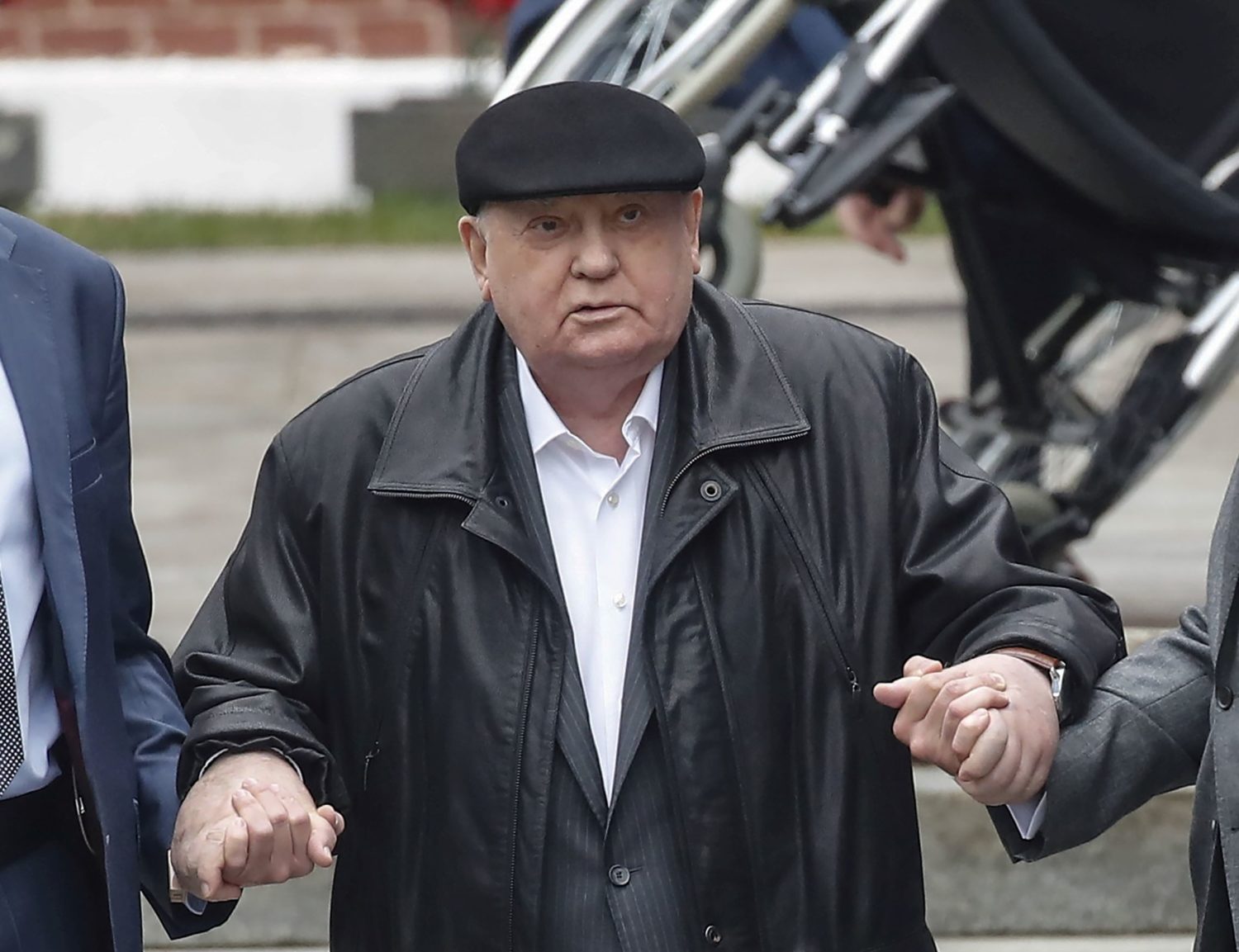
MOSCOW (Reuters) – Mikhail Gorbachev, the last Soviet leader, warned on Friday that the world was drifting into a dangerous era of militarised politics and appealed to Moscow and Washington to sit down for urgent nuclear arms control talks.

Gorbachev, whose 1980s arms control push and democracy-oriented reforms helped end the Cold War, made the comments to the daily newspaper Izvestia two months after the demise of a landmark nuclear pact he signed in 1987.

“There are dangerous trends – they are all in plain sight. I would single out two. They are the disregard for international law and the militarization of world politics,” Gorbachev said.

U.S. President Donald Trump’s administration formally pulled out of the Intermediate-Range Nuclear Forces Treaty (INF) in August, accusing Moscow of violating it, and then tested a missile with a range previously banned under the treaty.

Moscow denies flouting the accord, but President Vladimir Putin has said Russia now has no option but to produce previously banned missiles to ensure its own security.

The last major nuclear arms control treaty between Russia and the United States, the New START treaty, is due to expire in 2021. It limits the number of strategic nuclear warheads the world’s two biggest nuclear powers can deploy.

Putin has said Moscow is ready to extend the pact, but has complained about what he sees as a U.S. refusal to engage properly on the subject. U.S. officials have said it could be scrapped when it expires and replaced with something else.

Gorbachev, 88, said the collapse of the INF treaty made the need for U.S.-Russia talks all the more urgent. Although Gorbachev has no direct influence in Washington and Moscow these days, his views still carry weight with some policymakers given his role in helping craft the global arms control architecture.

“…It turned out this treaty was the most important pillar of strategic stability. We need talks so that its destruction does not exacerbate the threat of war,” said Gorbachev.

(Reporting by Tom Balmforth; Editing by Andrew Osborn/Mark Heinrich)

Cartel gunmen terrorize Mexican city, free El Chapo’s son

Cartel gunmen terrorize Mexican city, free El Chapo’s son
By Dave Graham and Lizbeth Diaz

MEXICO CITY (Reuters) – Heavily armed fighters surrounded security forces in a Mexican city on Thursday and made them free one of drug lord Joaquin ‘El Chapo’ Guzman’s sons, after his capture triggered gunbattles and a prison break that sent civilians scurrying for cover.

Security Minister Alfonso Durazo said a patrol by National Guard militarized police first came under attack from within a house in the city of Culiacan, 1,235 km (770 miles) northwest of Mexico City.

After entering the house, they found four men, including Ovidio Guzman, who is accused of drug trafficking in the United States.

The patrol was quickly outmatched by cartel gunmen, however, and it was withdrawn to prevent lives being lost, the government said. Simultaneously, fighters swarmed through the city, battling police and soldiers in broad daylight. They torched vehicles and left at least one gas station ablaze.

“The decision was taken to retreat from the house, without Guzman, to try to avoid more violence in the area and preserve the lives of our personnel and recover calm in the city,” Durazo told Reuters.

The reaction to Guzman’s capture was on a scale rarely seen during Mexico’s long drug war, even after his more famous father’s arrests. The chaos was continuing as night fell.

A large group of inmates escaped from the city prison. Residents cowered in shopping centers and supermarkets as gunfire roared. Black plumes of smoke rose across the skyline.

Families with young children left their cars and lay flat in the road. Bullets cracked up ahead. “Dad, can we get up now?” a small boy said to his father in a video posted on Twitter.

“No, stay there on the floor,” the man replied, his voice trembling.

Cristobal Castaneda, head of security in Sinaloa, told the Televisa network that two people had been killed and 21 injured, according to preliminary information. He said police had come under attack when they approached roadblocks manned by gunmen. He advised residents not to leave their homes.

It was not immediately clear if members of the patrol were harmed in the standoff. Reuters TV showed scenes of at least three bodies lying next to cars on the street.

WARNED OF REPRISALS

The chaos in Culiacan, long a stronghold for the Guzmans’ Sinaloa cartel, will increase pressure on President Andres Manuel Lopez Obrador, who took office in December promising to pacify a country weary after more than a decade of drug-war fighting. Murders this year are set to be at a record high.

Thursday’s events follow the massacre of more than a dozen police in western Mexico earlier this week, and the killing of 14 suspected gangsters by the army a day later.

Falko Ernst, senior analyst for the International Crisis Group in Mexico, said the release of Ovidio Guzman set “a dangerous precedent” and sent a message that the state itself, including the army, could be blackmailed and was not in control.

Presumed cartel members apparently intercepted a radio frequency used by security forces, one video showed, warning of reprisals against soldiers if Guzman was not freed.

A state police spokesman confirmed to Reuters that several prisoners escaped from a prison during the chaos. Video footage showed a group of at least 20 prisoners running in the streets. It was not immediately clear how many had escaped.

“They are freeing them,” a panicked woman said in the video apparently filmed from an tall building. “No we can’t go outside!” she said as other voices debated making a dash for their car.

In another video, a man driving repeatedly shouted: “There is a big gunfight,” before taking a sharp turn and leaving his car at a gas station to take cover. His voice then became inaudible because of the rattling roar of automatic gunfire.

‘El Chapo’ Guzman led the Sinaloa cartel for decades, escaping from prison twice before being arrested and extradited to the United States. He was found guilty in a U.S. court in February of smuggling tons of drugs and sentenced to life in prison.

He is believed to have about 12 children including Ovidio. The U.S. Department of Justice unveiled an indictment against Ovidio and another of the brothers in February, charging them with conspiracy to distribute cocaine, methamphetamine, and marijuana in the United States.

The indictment gave Ovidio’s age as 28, and said he had been involved in trafficking conspiracies since he was a teenager.

Jose Luis Gonzalez Meza, a lawyer for the Guzmans, told news network Milenio that Ovidio had been in touch with the family and said he was free.

(Additional reporting by Stefanie Eschenbacher; Writing and additional reporting by Frank Jack Daniel; Editing by Raju Gopalakrishnan)

Russia protests after catching U.S. diplomats near military test site

Russia protests after catching U.S. diplomats near military test site
By Tom Balmforth and Andrew Osborn

MOSCOW (Reuters) – Russia said on Thursday it would issue a formal note of protest to the United States after police caught three U.S. diplomats in what it said was a restricted area near a closed military testing site.

The diplomats were stopped by police after they arrived by train on Monday and were sent back, the Russian Foreign Ministry said. Though protected by diplomatic immunity, they are accused of breaking the law as they did not have the special permits foreigners needed to visit the area.

The area where they were intercepted is of heightened interest to Western intelligence agencies after a mysterious military accident took place there in August. The incident saw radiation levels briefly spike and killed at least five employees of Russia’s Rosatom state nuclear corporation.

Thomas DiNanno, a senior U.S. State Department official, said last week that Washington had determined that the explosion was the result of a nuclear reaction that had occurred during the recovery of a Russian nuclear-powered cruise missile after a failed test.

The diplomatic incident adds a new irritant to already fraught U.S.-Russia ties, which remain strained over everything from tit-for-tat diplomatic expulsions to nuclear arms control tensions.

A spokesman for the U.S. State Department said the diplomats had been on official travel and had properly notified Russian authorities of their travel.

But Russia’s Foreign Ministry said the diplomats, whom it described as military attaches, had been found in a restricted area far from the city of Arkhangelsk which they had said they planned to visit.

“Evidently they got lost. We’re ready to give the American embassy a map of Russia,” the foreign ministry said late on Wednesday, according to Russia’s REN TV channel.

Russian Foreign Ministry spokeswoman Maria Zakharova complained on Thursday that U.S. military diplomats regularly ignored Russia notification requirements and tried to get into restricted military areas.

She called on Washington to observe diplomatic norms, while the Kremlin said there were strict rules governing sensitive military objects that people had to follow.

Russian media reports said the diplomats’ offence was usually punishable by deportation. But the foreign ministry was quoted as saying that Moscow was unlikely to escalate the incident in that way.

“…They have immunity so I think there will just be further proceedings to establish how this was possible,” Yevgeny Ivanov, a deputy foreign minister, was quoted as saying by the TASS news agency.

(Additional reporting by Anton Kolodyazhnyy; Editing by William Maclean)

Pence announces ceasefire deal with Erdogan to end Turkey’s Syria offensive

Pence announces ceasefire deal with Erdogan to end Turkey’s Syria offensive
By Orhan Coskun and Humeyra Pamuk

ANKARA (Reuters) – U.S. Vice President Mike Pence said on Thursday he had reached a deal with Turkish President Tayyip Erdogan for a ceasefire in northern Syria to end an eight-day-old Turkish offensive against Kurdish-led forces.

Speaking after crisis talks with Erdogan in Ankara, Pence said that under the deal all military operations would be paused to allow a pullback of Kurdish YPG militia over a 120-hour period. The Turkish military operation would end once that withdrawal was complete, Pence told a news conference.

“Today the United States and Turkey have agreed to a ceasefire in Syria,” Pence told a news conference after more than four hours of talks at the presidential palace in Ankara.

“The Turkish side will pause Operation Peace Spring in order to allow for the withdrawal of YPG forces from the safe zone for 120 hours,” Pence said. “All military operations under Operation Peace Spring will be paused, and Operation Peace Spring will be halted entirely on completion of the withdrawal.”

Pence said U.S. forces in the region had already begun to facilitate a safe disengagement of YPG units.

The deal struck with Erdogan also provided for Turkey not to engage in military operations in the flashpoint Syrian border town of Kobani.

Pence said the United States and Turkey had committed to a peaceful resolution of Ankara’s demand for a “safe zone” in northern Syria near Turkey’s border, one of the objectives of the Turkish offensive.

Pence added that he had spoken to U.S. President Donald Trump after the talks and that Trump had expressed his gratitude for the ceasefire accord.

The deal was a major contribution to relations between NATO allies Turkey and the United States, which have become strained in recent months.

After Pence and Erdogan met at the presidential palace, talks between Turkish and U.S. delegations continued for over four hours – well past their expected duration.

Pence’s mission was to persuade Erdogan to halt the internationally condemned offensive, but Turkish officials had said before the meeting began that the action would continue regardless.

The Turkish assault has created a new humanitarian crisis in Syria with 200,000 civilians taking flight, a security alert over thousands of Islamic State fighters abandoned in Kurdish jails, and a political maelstrom at home for President Donald Trump.

Trump has been accused of abandoning Kurdish-led fighters, Washington’s main partners in the battle to dismantle Islamic State’s self-declared caliphate in Syria, by withdrawing troops from the border as Ankara launched its offensive on Oct. 9.

Trump had defended his move on Wednesday as “strategically brilliant”. He said he thought Pence and Erdogan would have a successful meeting, but warned of sanctions and tariffs that “will be devastating to Turkey’s economy” otherwise.

(Additional reporting by Stephanie Nebehay in Geneva, Ellen Francis in Beirut and Susan Heavey in Washington; Editing by Dominic Evans and Mark Heinrich)

China says it hopes to reach phased trade pact with U.S. as soon as possible

China says it hopes to reach phased trade pact with U.S. as soon as possible
BEIJING (Reuters) – China hopes to reach a phased agreement in a protracted trade dispute with the United States and cancel tariffs as soon as possible, the Commerce Ministry said on Thursday, adding that trade wars had no winners.

A phased agreement would help restore market confidence and reduce uncertainty, ministry spokesman Gao Feng told reporters, adding that both sides were maintaining close communication.

“The final goal of both sides’ negotiations is to end the trade war and cancel all additional tariffs,” Gao said. “This would benefit China, the U.S. and the whole world. We hope that both sides will continue to work together, advance negotiations, and reach a phased agreement as soon as possible.”

Chinese premier Li Keqiang said both China and the United States need to resolve the issues through dialogue. He made the comments on Thursday when he met delegates led by Evan Greenberg, chairman of the U.S.-China Business Council.

“China will create an internationalized business environment ruled by law where domestic and foreign firms are treated equally,” Li said. “Property and intellectual property rights will be strictly protected.”

White House economic adviser Larry Kudlow meanwhile said he saw momentum to finalize the initial phase of a trade deal which could be signed at the APEC forum next month in Chile.

U.S. President Donald Trump on Oct. 11 outlined the first phase of a deal and suspended a threatened tariff hike, but officials on both sides said much more work needed to be done.

Trump had originally planned to proceed with a rise in tariffs to 30% from 25% on about $250 billion worth of Chinese goods last week. But the U.S. administration has yet to make a decision on how to address planned 10% tariffs on roughly $156 billion of Chinese goods due to take effect on Dec. 15.

U.S. and Chinese trade negotiators are working on nailing down a Phase 1 trade deal text for their presidents to sign next month, U.S. Treasury Secretary Steven Mnuchin said on Wednesday.

Mnuchin said the Trump administration’s “objective” was for the agreement to be signed between the presidents of the two countries at a Nov. 16-17 summit of Asia-Pacific Economic Cooperation countries in Santiago, Chile.

Working-level representatives from both countries were working on specifics of an agreement now, Gao said.

There have been positive signs from China in recent days.

China’s securities regulator on Friday unveiled a firm timetable for scrapping foreign ownership limits in futures, securities and mutual fund companies for the first time. Increasing foreign access to the sector is among the U.S. demands at the trade talks.

A day before, the U.S. Department of Agriculture confirmed net sales of 142,172 tonnes of U.S. pork to China in the week ended Oct. 3, the largest weekly sale to the world’s top pork market on record.

Trump said China had agreed to make purchases of $40 billion to $50 billion of U.S. agricultural goods. Mnuchin said the purchases would be scaled up to that amount annually.

On Wednesday, Li said China would remove business restrictions on foreign banks, brokerages and fund management firms, without giving details.

“Since this year, under the effect of China-U.S. trade frictions, trade and investment between the U.S. and China have fallen,” Gao said.

“This fully demonstrates that trade wars have no winners.”

(Reporting by Gabriel Crossley; Writing by Ryan Woo; Editing by Alex Richardson and Nick Macfie)

Classes canceled for 361,000 students as Chicago teachers go on strike

Classes canceled for 361,000 students as Chicago teachers go on strike
By Brendan O’Brien

CHICAGO (Reuters) – Teachers in the Chicago Public Schools system, the third-largest school district in the U.S., went on strike on Thursday after protracted labor negotiations between the union and district leadership failed to produce a deal.

The work stoppage canceled classes for 361,000 students, but school buildings stayed open for children who need a place to go during the strike, officials said. Schools will serve breakfast and lunch, but all after-school activities, including sports, tutoring and field trips, have been canceled.

Teachers planned to picket at more than 500 schools across the city beginning at 6:30 a.m. (1530 GMT) before holding a downtown rally and march in the afternoon.

The strike is the latest in a recent wave of work stoppages in school districts across the United States in which demands for school resources have superseded calls for higher salaries and benefits. In Chicago and elsewhere, teachers have emphasized the need to help under-funded schools, framing their demands as a call for social justice.

Thousands of Chicago teachers staged a one-day walkout in 2016 to protest the lack of a contract and failures to stabilize the finances.

In addition to wage increases, the Chicago Teachers Union (CTU) is demanding more funding to ease overcrowded classrooms and hire more support staff, such as nurses and social workers, two perennial issues plaguing the district.

On Wednesday, Chicago Mayor Lori Lightfoot said the district’s bargaining team has offered 80 proposed changes to the current contract related to issues the union requested.

The proposal would provide teachers with a 16% raise over five years along with support for oversized classes, enforceable targets for reducing class sizes and adding more support staff across the district, she said.

The mayor said the union’s full list of demands would cost the district an additional $2.5 billion annually.

CPS finances “are still recovering from the brink of insolvency, and we do not have unlimited funds,” the mayor said.

The district’s credit ratings remain at the non-investment, or “junk” status, although they have improved in the wake of a revised statewide school funding formula that boosted revenue for CPS operations and pension payments.

In addition to school buildings, district officials also encouraged students to go to public libraries and community organizations where educational programs and activities will be offered during the strike. District officials said students will be able to use mass transit for free during the strike.

(Reporting by Brendan O’Brien in Chicago; Editing by Gerry Doyle)

Pence meets Erdogan to urge halt to Turkey’s Syria offensive

U.S. Vice President Mike Pence arrives at Esenboga International Airport in Ankara, Turkey, October 17, 2019. REUTERS/Huseyin Aldemir

Pence meets Erdogan to urge halt to Turkey’s Syria offensive
By Orhan Coskun and Humeyra Pamuk

ANKARA (Reuters) – U.S. Vice President Mike Pence met President Tayyip Erdogan in Turkey on Thursday on a mission to persuade him to halt an offensive against Kurdish fighters in northeast Syria, but Turkish officials said the action would continue regardless.

The assault has created a new humanitarian crisis in Syria with 200,000 civilians taking flight, a security alert over thousands of Islamic State fighters abandoned in Kurdish jails, and a political maelstrom at home for President Donald Trump.

Trump has been accused of abandoning Kurdish-led fighters, Washington’s main partners in the battle to dismantle Islamic State’s self-declared caliphate in Syria, by withdrawing troops from the border as Ankara launched its offensive on Oct. 9.

Trump defended his move on Wednesday as “strategically brilliant”. He said he thought Pence and Turkish President Tayyip Erdogan would have a successful meeting, but warned of sanctions and tariffs that “will be devastating to Turkey’s economy” otherwise.

The White House released a letter from Trump to Erdogan from Oct. 9 that said: “Don’t be a tough guy” and “Don’t be a fool!” Turkish broadcaster CNN Turk said Turkey had rejected Trump’s appeal to reach a deal to avoid conflict and the letter was “thrown in the trash”.

A Turkish official told Reuters: “The letter Trump sent did not have the impact he expected in Turkey because it had nothing to take seriously.

“What is clear is that Turkey does not want a terrorist organization on its border and the operation will not stop because of the reaction that has been coming.”

Pence and Secretary of State Mike Pompeo did not speak to reporters before the start of the meeting with Erdogan, but the official said they were likely to convey the same U.S. demands, adding: “However, negotiating with a terrorist organization or turning back from the ongoing operation are not on the agenda.”

On Monday, White House economic adviser Larry Kudlow told CNBC that the United States was prepared to levy additional sanctions on if necessary “to keep Turkey in line”.

A top aide to Erdogan, Ibrahim Kalin, said Turkey’s foreign ministry was preparing to retaliate for the sanctions by its NATO ally.

UNTIL GOALS MET

Erdogan has dismissed the sanctions and rejected a global chorus of calls to halt the offensive, which Turkey says will create a “safe zone” extending 20 miles (32 km) into northeast Syria to ensure the return of millions of Syrian refugees and clear the area of Kurdish militia Ankara views as terrorists.

Turkey will end its operation when Kurdish forces withdraw from the “safe zone” and “no power” can deter the operation until it reaches its goals, the Turkish leader said.

Trump has defended his move to withdraw troops from Syria as part of a wider effort to bring U.S. soldiers home from “endless wars”, despite criticism by members of his own Republican Party.

Turkey’s operation has allowed Syrian President Bashar al-Assad to send his Russian-backed forces to an area that had been beyond his control for years in the more than eight-year-old Syrian war.

It also prompted the Syrian Democratic Forces (SDF), of which the Kurdish YPG is the main component, to strike a deal with Damascus for its help in countering Turkish forces.

Russia has promised Turkey that the Syrian Kurdish YPG militia targeted by the offensive will not be in the Syrian territories across the border, Turkish Foreign Minister Mevlut Cavusoglu told the BBC on Thursday.

Earlier in the day, Russia’s foreign ministry spokeswoman said Syria should get control over its border with Turkey as part of any settlement of the conflict in the region.

Assad vowed that Syria would respond to the Turkish offensive on any part of its territory with “all legitimate means” available, Syrian state media said on Thursday.

Ankara views the U.S.-backed YPG as a terrorist organization because of its link to Kurdish militants waging an insurgency inside Turkey, and had been infuriated by Washington’s support.

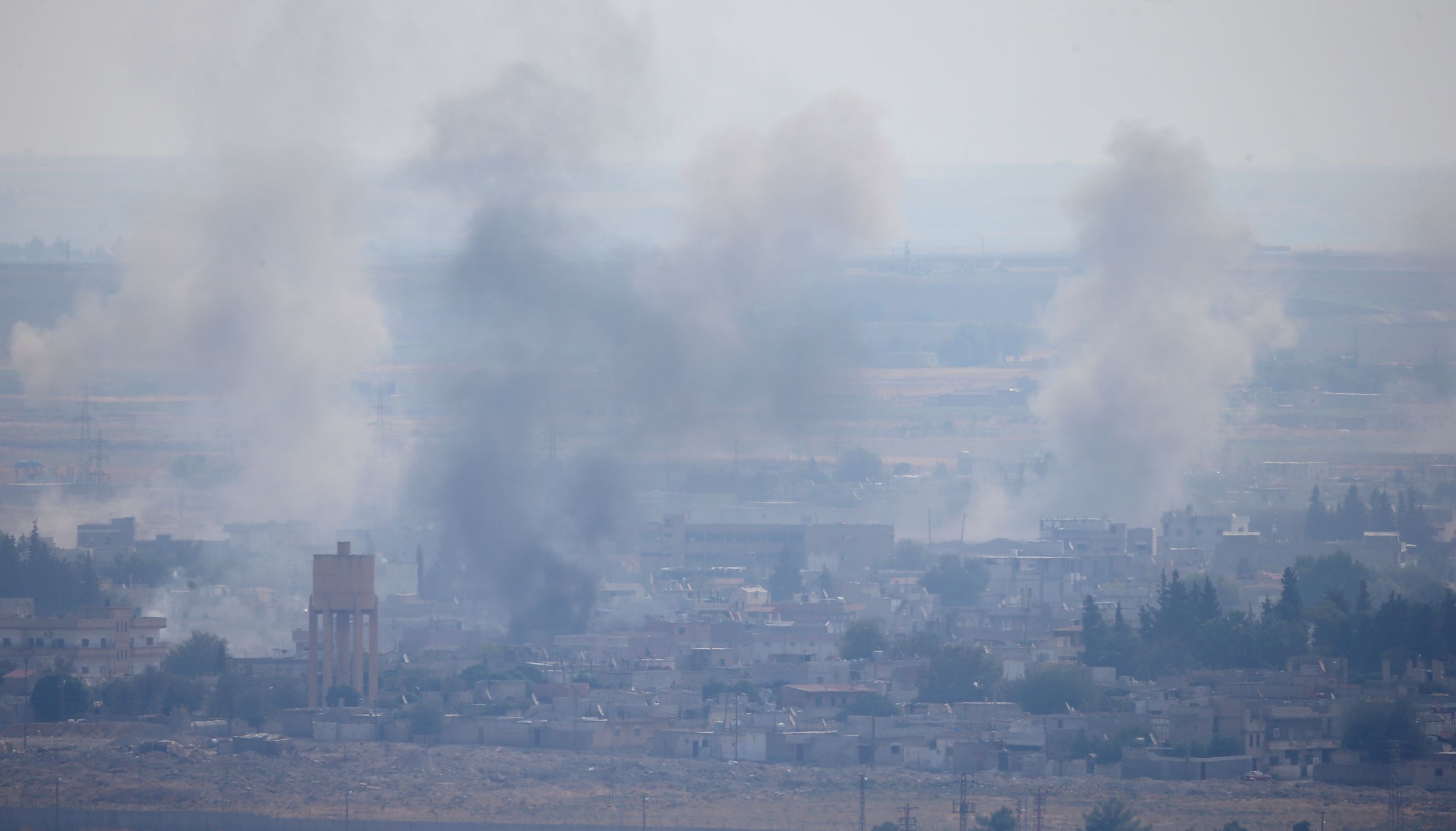
A Reuters cameraman along the Turkish border with Syria said clashes continued around the border town of Ras al Ain on Thursday and that Turkish warplanes were flying overhead after a lull in fighting overnight.

Ankara had previously said it has taken control of Ras al Ain and Tel Abyad, two key towns along the frontier.

The region’s Kurdish-led authority called for a corridor “to evacuate dead and wounded civilians” from Ras al-Ain. It said people were trapped in the town, urging foreign powers including the U.S.-led coalition and Russia, to intervene to get them out.

Syrian troops accompanied by Russian forces have meanwhile entered Kobani, a strategic border city and potential flashpoint for a wider conflict, said the British-based monitor the Syrian Observatory for Human Rights.

Lebanon’s al-Mayadeen TV reported that Russian-backed Syrian forces had also set up outposts in Raqqa, the one-time capital of Islamic State’s caliphate, which the Kurds captured in 2017 at the peak of their campaign with U.S. support.

Hezbollah’s al-Manar TV said from the Tabqa military air base near Raqqa that Syrian government troops had advanced in that area.

“We entered the Tabqa military airport easily, there was no difficulty,” an army officer told the channel from the base, where Islamic State fighters executed scores of Syrian troops and circulated a video of their corpses in 2014.

Soldiers entered Tabqa and nearby villages on Monday, state media said, a deployment that restored the state’s foothold in that part of Syria for the first time in years.

With U.S. air power and special forces, the SDF had battled for weeks in 2017 to take Tabqa and a nearby hydroelectric dam – the country’s largest dam – from Islamic State.

CIVILIAN CASUALTIES

The Kurdish-led administration in the region said theTurkish offensive had killed 218 civilians, including 18 children since it started a week ago. The fighting has also wounded more than 650 people, it said.

Turkish authorities say 20 people have been killed in Turkey by bombardment from Syria, including eight people who were killed in a mortar attack on the town of Nusaybin by YPG militants on Friday, according to the local governor’s office.

In Geneva, humanitarian agencies said they were struggling to meet the needs of up to 200,000 civilians who had fled the fighting and reported water shortages in the Syrian city of Hasaka.

The operation has also created a land-rush between Turkey and Russia – now the undisputed foreign powers in the area – to partition Kurdish areas that were formerly under U.S protection.

Russia, Assad’s most powerful ally, has called the offensive “unacceptable” and said it must be limited in time and scale.

(Additional reporting by Stephanie Nebehay in Geneva, Ellen Francis in Beirut and Susan Heavey in Washington; Editing by Dominic Evans and Mark Heinrich)