U.S. increases support for Taiwan, China threatens to strike back

By Ben Blanchard and Yew Lun Tian

TAIPEI/BEIJING (Reuters) – U.S. President Donald Trump has signed into law an act that requires increased U.S. support for Taiwan internationally, prompting a denunciation by China, which said it would strike back if the law was implemented.

China claims democratic and separately ruled Taiwan as its own territory, and regularly describes Taiwan as the most sensitive issue in its ties with the United States.

While the United States, like most countries, has no official relations with Taiwan, the Trump administration has ramped up backing for the island, with arms sales and laws to help Taiwan deal with pressure from China.

The Taiwan Allies International Protection and Enhancement Initiative (TAIPEI) Act, signed by Trump into law on Thursday with strong bipartisan support, requires the U.S. State Department to report to Congress on steps taken to strengthen Taiwan’s diplomatic relations.

It also requires the United States to “alter” engagement with nations that undermine Taiwan’s security or prosperity.

Taiwan complains that China is poaching the dwindling number of countries that maintain formal ties with Taipei and has prevented it from participating in bodies like the World Health Organization.

China says Taiwan is merely one of its provinces, with no right to the trappings of a state.

Taiwan President Tsai Ing-wen posted a picture on her Twitter page of Taiwan’s flag fluttering next to the U.S. one under the words “Friends in freedom, partners in prosperity”, to welcome Trump’s signing of the law.

It was “a testament to Taiwan-U.S. friendship & mutual support as we work together to address global threats to human health & our shared democratic values”, she wrote in English.

‘RESOLUTE STRIKE’

China has stepped up its military drills around Taiwan in recent weeks despite the outbreak of the coronavirus, which emerged in a central Chinese province late last year and spread rapidly in China and beyond.

Taiwan says China should focus more on fighting the disease than menacing it.

China is already angry about U.S. accusations it poorly handled the coronavirus outbreak, and the new law adds to Sino-U.S. tension.

Chinese foreign ministry spokesman Geng Shuang said the U.S. act contravened international law, was a “crude” interference in China’s internal affairs and obstructed other sovereign states from developing normal relations with China.

“We urge the United States to correct its mistakes, not implement the law, or obstruct the development of relations between other countries and China, otherwise it will inevitably encounter a resolute strike back by China,” Geng said, without giving details.

One of the authors of the act, Senator Cory Gardner, said it was needed to respond to Chinese pressure on, and bullying of, Taiwan.

“This bipartisan legislation demands a whole-of-government approach to ramp up our support for Taiwan, and will send a strong message to nations that there will be consequences for supporting Chinese actions that undermine Taiwan,” he said in a statement.

The United States has been particularly concerned about China hiving off Taiwan’s allies in the Pacific and Latin America, areas of the world Washington traditionally considers its zone of influence.

Taiwan now only has diplomatic relations with 15 countries, almost all small and developing nations like Nauru, Belize and Honduras.

(Reporting by Ben Blanchard; Editing by Robert Birsel)

U.S. has most coronavirus cases in world, next wave aimed at Louisiana

By Maria Caspani and Daniel Trotta

NEW YORK (Reuters) – The number of U.S. coronavirus infections climbed above 82,000 on Thursday, surpassing the national tallies of China and Italy, as New York, New Orleans and other hot spots faced a surge in hospitalizations and looming shortages of supplies, staff and sick beds.

With medical facilities running low on ventilators and protective masks and hampered by limited diagnostic testing capacity, the U.S. death toll from COVID-19, the respiratory disease caused by the virus, rose beyond 1,200.

“Any scenario that is realistic will overwhelm the capacity of the healthcare system,” New York Governor Andrew Cuomo told a news conference. He described the state’s projected shortfall in ventilators – machines that support the respiration of people have cannot breathe on their own – as “astronomical.”

“It’s not like they have them sitting in the warehouse,” Cuomo added. “There is no stockpile available.”

At least one New York City hospital, New York-Presbyterian/Columbia University Medical Center in Manhattan, has begun a trial of sharing single ventilators between two patients.

While New York was the coronavirus epicenter in the United States this week, the next big wave of infections appeared headed for Louisiana, where demand for ventilators has already doubled. In New Orleans, the state’s biggest city, Mardi Gras celebrations late last month are believed to have fueled the outbreak.

Louisiana Governor John Bel Edwards said New Orleans would be out of ventilators by April 2 and potentially out of bed space by April 7 “if we don’t flatten the infection curve soon.”

“It’s not conjecture, it’s not some flimsy theory,” Edwards told a press conference. “This is what is going to happen.”

Nurse Tina Nguyen administers a nasal swab at a coronavirus testing site outside International Community Health Services in the Chinatown-International District during the coronavirus disease (COVID-19) outbreak in Seattle, Washington, U.S. March 26, 2020. REUTERS/Lindsey Wasson

About 80% of Louisiana’s intensive care patients are now on breathing machines, up from the normal rate of 30-40%, said Warner Thomas, chief executive of Ochsner Health System, the state’s hospital group.

Scarcities of protective masks, gloves, gowns and eyewear for doctors and nurses – reports abound of healthcare workers recycling old face masks, making their own or even using trash bags to shield themselves – have emerged as a national problem.

“Our nurses across the country do not have the personal protective equipment that is necessary to care for COVID patients, or any of their patients,” Bonnie Castillo, head of the largest U.S. nurses union, National Nurses United, told MSNBC.

In an ominous milestone for the United States as a whole, at least 82,153 people nationwide were infected as of Thursday, according to a Reuters tally from state and local public health agencies. China, where the global pandemic emerged late last year, had the second highest number of cases, 81,285, followed by Italy with 80,539.

At least 1,204 Americans have died from COVID-19, which has proven especially dangerous to the elderly and people with underlying chronic health conditions, Reuters’ tally showed.

MORE BEDS NEEDED

For New York state, Cuomo said a key goal was rapidly to expand the number of available hospital beds from 53,000 to 140,000.

New York hospitals were racing to comply with Cuomo’s directive to increase capacity by at least 50%. At Mount Sinai Hospital’s Upper East Side location, rooms were being constructed within an atrium to open up more space for beds.

At Elmhurst Hospital in New York’s borough of Queens, about a hundred people, many wearing masks with their hoods pulled up, lined up behind barriers outside the emergency room entrance, waiting to enter a tent to be screened for the coronavirus.

The city coroner’s office has posted refrigerated trucks outside Elmhurst and Bellevue Hospital to temporarily store bodies of the deceased.

Deborah White, vice chair of emergency medicine at Jack D. Weiler Hospital in the city’s Bronx borough, said 80% of its emergency room visits were patients with coronavirus-like symptoms.

A ventilator shortfall and surge in hospitalizations has already raised the prospect of rationing healthcare.

Asked about guidelines being drafted on how to allocate ventilators to patients in case of a shortage, New Jersey Governor Phil Murphy told reporters such bioethical discussions “haunted him” but were unavoidable.

Outside New York and New Orleans, other hot spots appeared to be emerging around the country, including Detroit.

Brandon Allen, 48, was buying groceries in Detroit for his 72-year-old mother, who has tested positive and was self-quarantining at home.

“It’s surreal,” Allen said. “People around me I know are dying. I know of a couple people who have died. I know a couple of people who are fighting for their lives. Everyday you hear of another person who has it.”

RECORD UNEMPLOYMENT CLAIMS

Desperate to slow virus transmissions by limiting physical contact among people, state and local governments have issued stay-at-home orders covering about half the U.S. population. A major side effect has been the strangulation of the economy, and a wave of layoffs.

The U.S. Labor Department reported Thursday the number of Americans filing claims for unemployment benefits last week soared to a record of nearly 3.28 million – almost five times the previous weekly peak of 695,000 during the 1982 recession.

Dr. Anthony Fauci, director of the U.S. National Institute of Allergy and Infectious Diseases, said warmer weather may help tamp down the U.S. outbreak as summer approaches, though the virus could re-emerge in the winter.

“We hope we get a respite as we get into April, May and June,” Fauci said on WNYC public radio.

Washington state Governor Jay Inslee said he may extend a stay-at-home order tentatively set to expire April 6, encouraged by what he called a “very modest improvement” in the Seattle area.

Washington experienced the first major U.S. outbreak of COVID-19 and has been among the hardest-hit states. As of Thursday the state reported about 3,200 cases and 147 deaths.

In California’s Coachella Valley, a region rife with retirees who are especially vulnerable, 25 members of the state’s National Guard helped a non-profit distribute food to people stuck in their homes, as most of the regular volunteers are senior citizens.

More than 10,000 troops have been deployed in 50 states to provide humanitarian aid during the pandemic.

(Reporting by Maria Caspani in New York and Daniel Trotta in Milan; Additional reporting by Gabriella Borter, Catherine Koppel, Lucia Mutikani, Doina Chiacu, Susan Heavey, Nathan Layne, Lisa Lambert, Michael Martina, Rebecca Cook, Barbara Goldberg, Rich McKay and Dan Whitcomb; Writing by Will Dunham and Steve Gorman; Editing by Howard Goller, Bill Tarrant, Cynthia Osterman and Daniel Wallis)

Crazy haircut? Shave? Americans in coronavirus lockdown try out makeovers

Crazy haircut? Shave? Americans in coronavirus lockdown try out makeovers
By Barbara Goldberg

NEW YORK (Reuters) – Jacob Kunthara’s wife and three adult children had never seen him without the mustache he sported for 45 years. During Coronavirus lockdown this week at home in Gilbert, Arizona, he shaved and covered up with a face mask, which he whipped off at dinner to shock his entire family.

Fiona Riebeling of New Haven, Connecticut, used a fork, barbeque skewer and nail scissors to transform her sleek long hair into jaunty bangs.

Across the U.S., the COVID-19 “stay at home” order with no end in sight has been seen by many as a once-in-a-lifetime chance to experiment with a dramatically different look, knowing that if the new image is a flop, they have several weeks behind closed doors to grow back or restyle the hair on their faces or heads.

“This is the most radical thing I’ve done ever,” said Kunthara, 62, a civil engineer whose home is about 25 miles (40 km) southeast of Phoenix.

After being forced to work at home for a week, Kunthara wielded his razor last weekend and then donned a face mask for a pre-dinner family prayer session, which ended in his stunning facial strip-tease.

“I thought, ‘Maybe this is the best time to try something. I’m home, we cannot go anywhere,'” Kunthara said.

Riebling said she had to improvise her haircut after watching a YouTube tutorial and realizing she had none of the proper tools.

“I scrounged around my apartment and did it ‘Little Mermaid’ style with thingamabobs,” said Riebeling, 23, a pre-school teacher, referring to the Disney movie in which a mermaid combs her hair using a fork she finds in a sunken ship.

“Being in quarantine takes off a lot of the pressure that you normally might feel going out in public and worrying about your appearance,” said Riebeling, who snipped away during a video conference call with two girlfriends also stuck in their homes, including an investment banker in New York and an occupational therapy student in Chicago.

“We’re limited right now in our movement and what we can do. That’s scary for a lot of people. To find places where you can feel empowered and make decisions about yourself, your body, how you choose to be in the world is a great way of reminding yourself that you are in control of as much as you can be,” Riebeling said.

When an Indianapolis call center deployed staff to work at home last week, employee Ed Maudlin scratched his years-old bushy beard and thought, “I wonder what I look like under there?”

Knowing only his girlfriend and whoever he chose to share his photos with online would see him before his office reopens in “at least a month,” Maudlin this week shaved his beard and his head.

“I decided to go with the full all-over – Nobody will know,” said Maudlin, 45, who said he expects facial and head hair will grow back by the time he’s returned to a shared office.

“I figure I will come out of this looking like maybe I need a bit of a haircut rather than looking like Tom Hanks on the island,” said Maudlin referring to the role Hanks, who this month became one of the first celebrities to test positive for COVID-19, played in the 2000 film “Cast Away.”

(Reporting by Barbara Goldberg in New York; Editing by David Gregorio)

How many Americans have coronavirus? New Reuters poll might offer a hint

By Maurice Tamman

NEW YORK (Reuters) – The official count of coronavirus infections in the United States sits at about 70,000 cases, but a chronic shortage of tests means only a fraction of the people infected are being counted. So how can we know how many Americans actually might have the disease?

A Reuters/Ipsos poll conducted in the past several days could offer what one behavioral health expert called a “fascinating” hint of the possible numbers.

In the nationwide poll, 2.3% of Americans surveyed said they’ve been diagnosed with the coronavirus, a percentage that could translate to several million people.

Of course, it’s impossible to know if the answers are a result of misinformed self-diagnoses, untested professional diagnoses or test-confirmed infections. But Carnegie Mellon University professor Baruch Fischhoff, who studies risk perception and analysis, said that the poll results shouldn’t be viewed as merely a collective neurotic reaction to the pandemic.

Given the shortage of coronavirus test kits, it may well be a broadly accurate estimate of the extent of the infection across the United States, he said. “It may be the best available data,” he said.

A further 2.4% of those polled said they have been in close contact with someone who has tested positive. And in an illustration of the degrees of separation with the deadly virus, a further 2.6% said they knew someone who has been in close contact with a person who has tested positive.

The poll, which surveyed 4,428 adults between March 18 and 24, shows a dramatic increase in those saying they have tested positive for the virus from a similar poll conducted just a few days earlier. In the Reuters/Ipsos poll of 1,115 Americans conducted March 16 and 17, about 1% said they were infected.

The latest poll also suggests that Latinos are far more likely to come in contact with people who may be infected than whites; the same appears true for younger people compared to older Americans. The disease appears to be concentrated in the Northeast, according to the poll, but the survey also suggests it’s widespread throughout the country.

David Cates, director of behavioral health at Nebraska Medical Center in Omaha, was intrigued by the results.

“Going back to that concept of the wisdom of crowds, you’re getting a response that may actually be closer to reality than confirmed testing,” he said. “And that is just absolutely fascinating.”

But he said the conflicting information from officials and in the media, as well as the shortage of testing, may also explain some of the response to the poll.

“They are listening to the news and thinking, ‘Yeah, you know, that’s what my father has, and that’s what I have,'” he said. “And this is probably what’s going on with the neighbor.”

Still, the poll results may fill some gaps in knowledge in the face of limited testing.

For example, Fischhoff said, on March 15, Ohio Gov. Mike DeWine estimated there were about 100,000 infections in his state, which represents about 1% of the state’s population, despite there only being a handful of confirmed cases at the time. The governor’s office declined to comment on the estimate.

“You know, with the doubling rate in the country, it’s not implausible that the infected rate was 1% and now it’s 2.3%,” he said.

He commented on another finding in the poll, the difference in proximity between rural and urban areas. In rural communities, according to the poll, about 9% of people said they were either infected; had contact with someone infected; or knew someone infected in their extended social network. In denser urban areas, that rate rose to 13%.

“As you would expect, as you’ve got greater density, you’d expect a higher rate,” he said.

Northwestern University economics professor Charles Manski said he was gratified to see that older Americans may have less exposure to infected people than other age groups. The disease poses a particular risk for the elderly.

Only 6% of Americans 55 and over said they were either infected; had contact with someone infected; or knew someone infected in their extended social network, the poll showed. That compares to 19% for adults under 35.

He said older people tend to have smaller social circles, which might explain part of the results, but he also thinks older Americans are being more careful than their younger counterparts.

Monica Schoch-Spana, a medical anthropologist with the Johns Hopkins Center for Health Security in Baltimore, Maryland, said the results also illustrate the risk to some ethnic communities as the broader economy shrinks and many retreat into their homes.

High-risk, low-paying jobs that have not been shut down – such as hospital custodial workers, farm laborers, delivery drivers and warehouse workers – tend to have a high percentage of minority workers.

The poll shows that about 16% of Latinos said they were either infected; had contact with someone infected; or knew someone infected in their extended social network, compared to about 9% for whites.

She also noted that the poll is a rare example of a subject that doesn’t have a massive partisan divide: About 14% of Democrats said they are infected or know of someone infected, compared to about 10% of Republicans.

(Reporting by Maurice Tamman; editing by Kari Howard)

U.S. attorney general seeks to expand home confinement as coronavirus spreads in prisons

By Sarah N. Lynch

WASHINGTON (Reuters) – U.S. Attorney General William Barr said Thursday he has directed the federal Bureau of Prisons (BOP) to expand its use of home confinement for inmates in appropriate cases, as the coronavirus has continued to spread in the federal prison system.

A total of six inmates and four prison staffers have tested positive for COVID-19, Barr said, adding that several federal facilities including two in New York City are now on lock-down as a result.

The First Step Act, signed into law by U.S. President Donald Trump in late 2018, expanded the BOP’s powers to maximize the amount of time that lower-risk inmates can spend in home confinement, when possible.

“I’ve asked and issued a memorandum just today to the Bureau of Prisons to increase the use of home confinement,” Barr told reporters during what Barr said was the department’s first-ever “virtual” press conference in order to practice social-distancing.

“One of the things we have to assess is whether that individual…will be more safe in the particular circumstance in which they are going to find themselves. And in many cases, that may not be the case.”

He added that any inmate released on home confinement will still face a 14-day quarantine.

The plans by the Justice Department to increase the use of home confinement comes as criminal justice advocates and union officials representing prison workers have called on Barr to implement tougher measures to prevent the coronavirus from spreading throughout the federal prison system.

Some local jails and prisons in states such as New Jersey, meanwhile, have taken more drastic steps by releasing “low-risk” inmates serving county jail sentences [L1N2BG1M6]

The BOP has not signaled it would take such a step, though it has stepped up safe guards, including through the implementation of a policy requiring all new inmates to be quarantined for 14 days.

(Reporting by Sarah N. Lynch; Editing by Marguerita Choy)

Tempers rise in U.S. Senate as vote nears on $2 trillion coronavirus bill

By David Morgan and Richard Cowan

WASHINGTON (Reuters) – U.S. senators were set to vote on Wednesday on a $2 trillion bipartisan package of legislation to alleviate the devastating economic impact of the coronavirus pandemic, although critics from the right and left threatened to hold up the bill.

Top aides to Republican President Donald Trump and senior Senate Republicans and Democrats said they agreed on the unprecedented stimulus bill in the early hours of Wednesday after five days of talks.

The massive bill includes a $500 billion fund to help hard-hit industries and a comparable amount for direct payments of up to $3,000 apiece to millions of U.S. families.

Several Republican senators said the bill needed to be changed to ensure that laid-off workers would not be paid more than they earned on the job.

“This bill pays you more not to work than if you were working,” Republican Senator Lindsey Graham, a Trump ally, told a news conference.

In response, Senator Bernie Sanders, who is running for the Democratic presidential nomination, said he was prepared to block the bill if Republicans do not drop their objections.

That came after leaders of both parties predicted a Wednesday vote.

“Today the Senate will act to help the people of this country weather this storm,” Republican Senate Majority Leader Mitch McConnell said after the chamber convened at noon (1600 GMT).

Senate Democratic leader Chuck Schumer said his party was willing to pass the bill as quickly as possible.

“Help is on the way. Big help. Quick help,” he said on the Senate floor.

Trump is ready to sign the measure into law, the White House said, but it was unclear how quickly Congress could get the package to his desk. McConnell did not say what time the Senate would hold its vote, and the Democratic-controlled House of Representatives is not expected to act before Thursday.

The package will also include $350 billion for small-business loans, $250 billion for expanded unemployment aid and at least $100 billion for hospitals and related health systems.

It would be the largest rescue package ever approved by Congress and the third such effort to be passed this month. The money at stake amounts to nearly half of the $4.7 trillion the U.S. government spends annually.

‘DROP IN THE BUCKET’

New York Governor Andrew Cuomo said the $3.8 billion allocated to his state would not cover the tax revenue it stands to lose from reduced economic activity. His state accounts for roughly half of all U.S. coronavirus cases.

“That is a drop in the bucket,” he said at a news conference.

The package aims to flood the U.S. economy with cash in a bid to stem the impact of a pandemic that has killed 812 people in the United States and infected more than 59,200.

The governors of at least 18 states, including New York, have issued stay-at-home directives affecting about half the U.S. population. The sweeping orders are aimed at slowing the pathogen’s spread, but have upended daily life as schools and businesses shutter indefinitely.

On Wall Street, the benchmark S&P 500 <.SPX> rallied for a second straight day, closing up 1.15%. [nL1N2BI1YH]

Republican Senator Rand Paul, the only senator to vote against an earlier round of emergency virus funding, may be unable to vote after testing positive for COVID-19, the respiratory disease caused by the coronavirus.

It also must pass the House. Speaker Nancy Pelosi, who proposed a more far-reaching rescue package, did not say whether she would support the Senate version.

“We’ll see the bill and see how the Senate votes. So there’s no decision about timing until we see the bill,” she told reporters.

Any changes made by the House would also require Senate approval, which could lead to further delays.

The No. 2 House Democrat, Steny Hoyer, told lawmakers that they would be notified 24 hours before any action.

House members left Washington 10 days ago, but the lower chamber could quickly pass the bill without requiring their return, through a “voice vote” that would require only a few lawmakers to be present.

The top House Republican, Kevin McCarthy, said he would prefer that approach and called for its passage on Friday.


(Reporting by David Morgan and Richard Cowan; Additional reporting by Doina Chiacu, Lisa Lambert, Susan Cornwell and Andy Sullivan in Washington and Maria Caspani in New York; Writing by Patricia Zengerle and Andy Sullivann; Editing by Jonathan Oatis and Peter Cooney)

New Orleans is next coronavirus epicenter, catalyst for spread in south, experts say

By Brad Brooks

(Reuters) – New Orleans is on track to become the next coronavirus epicenter in the United States, dashing hopes that less densely populated and warmer-climate cities would not be hit as hard by the pandemic, and that summer months could see it wane.

The plight of New Orleans – with the world’s highest growth rate in coronavirus cases and where authorities have warned hospitals could collapse by April 4 – also raises fears it may be a powerful catalyst in speedily spreading the virus across the south of the country.

New Orleans is the biggest city in Louisiana, the state with the third-highest case load of coronavirus in the United States on a per capita basis after the major epicenters of New York and Washington. The growth rate in Louisiana tops all others, according to a University of Louisiana at Lafayette analysis of global data, with the number of cases rising by 30% in the 24 hours before noon on Wednesday. On Tuesday, U.S. President Donald Trump issued a major federal disaster declaration for the state, freeing federal funds and resources.

Some 70% of Louisiana’s 1,795 confirmed cases to date are in the New Orleans metro area.

The culprit for the coronavirus in the Big Easy? Some blame Carnival.

“Mardi Gras was the perfect storm, it provided the perfect conditions for the spread of this virus,” said Dr. Rebekah Gee, who until January was the Health Secretary for Louisiana and now heads up Louisiana State University’s health care services division.

She noted that Fat Tuesday fell on Feb. 25 – when the virus was already in the United States but before the Centers for Disease Control and Prevention and national leaders had raised the alarm with the American public.

“So New Orleans had its normal level of celebration, which involved people congregating in large crowds and some 1.4 million tourists,” Gee said. “We shared drink cups. We shared each other’s space in the crowds. We shared floats where we were throwing not just beads but probably coronavirus off Carnival floats to people who caught it and took it with them to where they came from.”

Gee said that the explosive growth rate of the coronavirus in the Mississippi River port city means “it’s on the trajectory to become the epicenter for the outbreak in the United States.”

RESILIENT, BUT WARY

Dr. Peter Hotez is the dean of the National School of Tropical Medicine at Baylor College, a renowned vaccine scientist and an expert on the coronavirus pandemic.

He said that the rapid grip the virus is gaining on New Orleans was deeply worrying and a possible harbinger for worse to come across the south and for less densely populated and warmer cities across America.

“There has been some research and data suggesting that warmer, more humid weather could slow this epidemic,” he said. “The fact that this occurred on the Gulf Coast, which has some of the higher humidity and temperatures in the U.S., is a serious concern.”

Hotez noted that more research into how climate does or does not play a role in the spread of this coronavirus needs to happen, but acknowledged that experts hoped that warm weather and the coming summer months in the northern hemisphere would be natural buffers against it.

“If you look at this epidemic, we’ve not seen much in the hotter parts of the country. Texas has not had a lot. Arizona has not had a lot. Then all of a sudden – bam! – it appears in strength in New Orleans,” he said. “We have to follow this trend closely.”

Having an entirely new coronavirus epicenter kick off means that the United States may soon be dealing with multiple hot spots all at once, Hotez said – a worst-case scenario that could cripple healthcare systems.

If predictions were correct, the hospitals in New Orleans would struggle to manage past next week, Governor John Bel Edwards told a news conference on Tuesday.

New Orleans could well be the first major domino to fall in the south, starting a chain reaction in other metro areas in the region, said Hotez.

That is a serious concern for Houston, the fourth-largest city in the country and a major center for the oil industry. The two cities have historically strong links made even more so by an influx of New Orleans residents into Houston following Hurricanes Katrina and Harvey.

On the ground in New Orleans’ famed French Quarter, residents said they were definitely concerned, but that the virus was an entirely different threat from the natural disasters that routinely befall the city.

Jonathan Sanders, a 35-year-old general manager of the French Quarter brasserie Justine, said the city was calm and residents largely heeding authorities orders to stay inside.

“There is always something going on at all hours of the day or night. Now, without it all, it’s very peaceful,” he said. “You can park anywhere in the French Quarter.”

The virus, Sanders said, was so far easier to deal with than the death and destruction Hurricane Katrina unleashed in 2005, when over 1,800 people died along the Gulf Coast.

“When you think of the total destruction of Katrina… that was gut wrenching,” he said. “We’re fairly more resilient than other places that haven’t had so many tragic things happen to their city.”

New York takes new steps against coronavirus as impact spreads across U.S.

New York takes new steps against coronavirus as impact spreads across U.S.
By Maria Caspani and Susan Heavey

NEW YORK/WASHINGTON (Reuters) – While the burdens of the coronavirus intensified across the United States, New York City on Wednesday took aggressive new steps to battle the crisis, closing streets and asking people to stop playing basketball and other contact sports in public parks.

New York Governor Andrew Cuomo said more than 30,800 people had tested positive for the virus in his state, the epicenter of the U.S. outbreak, and more than 17,800 in New York City alone. The state has reported 285 deaths and roughly half the country’s reported infections.

State measures to control the coronavirus appear to be working as the rate of hospitalizations has slowed in recent days, Cuomo said. “Now that is almost too good to be true,…” he said. “This is a very good sign and a positive sign, again not 100% sure it holds, or it’s accurate but the arrows are headed in the right direction.”

He described street closures in New York City, where more than 8 million people live, as a pilot program and said sports like basketball would be banned in city parks, first on a voluntary basis as long as people comply.

With closures to vehicles, the intention is to allow pedestrians to walk in the streets to enable greater “social distancing” to avoid infections.

“Our closeness makes us vulnerable,” said Cuomo, who has emerged as a leading national voice on the coronavirus.

“We will overcome. And we will show the other communities across this country how to do it.”

Even as city officials struggled to contain the health crisis, the impact was increasingly being felt beyond the hot spots of New York, California and Washington state as Louisiana and others faced a severe crush on their healthcare systems.

U.S. President Donald Trump issued the latest major federal disaster declarations for Louisiana and Iowa late on Tuesday, freeing up federal funds to help states cope with the increasing number of cases of the dangerous respiratory disease caused by the virus that threaten to overwhelm state and local resources.

That brings to five the number of states receiving major disaster declarations from the Republican president. New York – the state with by far the most infections and deaths – was given such status last weekend as well as California and Washington state.

Louisiana, where large crowds last month celebrated Mardi Gras in New Orleans and other locations, reported a spike in infections with 1,388 total confirmed cases and 46 deaths as of mid-Tuesday, according to the Louisiana Department of Health.

Dr. Rebekah Gee, who until January was Louisiana’s health secretary and now heads up Louisiana State University’s healthcare services division, said that it was the Mardi Gras, when 1.4 million tourists descended on New Orleans, that fueled the city’s outbreak.

“It’s a highly infectious virus and Mardi Gras happened when the virus was in the United States but before the CDC (Centers for Disease Control and Prevention) and national leaders had really educated the public or even acknowledged the extent to which it was in the U.S.,” Gee said. “We had the president saying, ‘It’s just a few people, don’t worry about it.'”

‘FREAKING OUT’

New Orleans restaurant owner Ronnie Evans said everyone in New Orleans was “freaking out.”

“People don’t know what to expect or how long this will last. Everyone is worried about their jobs,” said Evans, 32, whose restaurant Blue Oak BBQ is just few steps from the city’s renowned Bourbon Street. The restaurant is offering takeout orders only.

“People are still coming out, but they’re scared. This is as bad as Katrina or worse,” referring to the hurricane that devastated the city in 2005.

The governors of at least 18 states have issued stay-at-home directives affecting about half the U.S. population of roughly 330 million people. The sweeping orders are aimed at slowing the spread of the pathogen but have upended daily life as schools and businesses shutter indefinitely.

A number of other U.S. states have also applied for major disaster relief status in recent days including Florida, Texas, New Jersey, North Carolina, Missouri, Maryland and South Carolina, as well as Northern Mariana Islands U.S. territory.

Nationwide, more than 53,000 people have been diagnosed with COVID-19, the disease caused by the virus that is particularly perilous to the elderly and people with pre-existing medical conditions, with at least 730 deaths. World Health Organization officials have said the United States could become the global epicenter of the pandemic, which first emerged late last year in the Chinese city of Wuhan.

World Health Organization expert Dr. Bruce Aylward told MSNBC’s “Morning Joe” program: “The U.S. is a gigantic country so it is very difficult to say something is going to happen right across the whole country. You are going to see this evolve differently in each part of the country.”

Trump on Tuesday said he wanted to re-open the country by Easter Sunday – far sooner than public health officials have said is warranted – but later told reporters he would listen to recommendations from the nation’s top health officials.

Wall Street on Wednesday was unable to sustain strong gains from Tuesday’s session as fears about the pandemic’s economic toll overshadowed optimism about sweeping fiscal and monetary stimulus to aid businesses and households.

U.S. lawmakers and the Trump administration reached a deal for a bipartisan $2 trillion stimulus package to help businesses and millions of Americans hit by the economic fallout of the coronavirus pandemic.

The Senate was due to vote on the legislation on Wednesday. The House of Representatives was not expected to act before Thursday.

(Reporting by Susan Heavey, Brad Brooks, Maria Caspani, Stephanie Kelly, Richard Cowan, Doina Chiacu, Patricia Zengerle and Stephanie Nebehay; Writing by Will Dunham; Editing by Chizu Nomiyama and Howard Goller)

Coronavirus impact spreads across U.S. as Congress readies aid

By Susan Heavey

WASHINGTON (Reuters) – The burden caused by the fast-spreading coronavirus accelerated across the United States on Wednesday beyond the hot spots of New York, California and Washington state as Louisiana and others faced a severe crush on their healthcare systems.

U.S. President Donald Trump issued the latest major federal disaster declarations for Louisiana and Iowa late on Tuesday, freeing up federal funds to help states cope with the increasing number of cases of the dangerous respiratory disease caused by the virus that threaten to overwhelm state and local resources.

That brings to five the number of states receiving major disaster declarations from the Republican president. New York – the state with by far the most infections and deaths – was given such status last weekend as well as California and Washington state.

Louisiana, where large crowds recently celebrated Mardi Gras in New Orleans and other locations, has reported a spike in infections with 1,388 total confirmed cases and 46 deaths as of midday Tuesday, according to the Louisiana Department of Health.

“I have determined that this incident is of such severity and magnitude that effective response is beyond the capabilities of state and local governments,” the state’s governor wrote the White House this week in seeking the declaration.

It was not immediately clear why Trump granted Iowa federal disaster relief and not some other states with many more cases. Iowa, where officials announced the state’s first death from the coronavirus on Tuesday, has reported 124 confirmed cases. (https://tmsnrt.rs/2w7hX9T)

A number of other U.S. states have also applied for major disaster relief status in recent days including Florida, Texas and New Jersey.

Nationwide, more than 53,000 people have been diagnosed with COVID-19, the disease caused by the virus that is particularly perilous to the elderly and people with pre-existing medical conditions, with at least 720 deaths. World Health Organization officials have said the United States could become the global epicenter of the pandemic, which first emerged late last year in the Chinese city of Wuhan.

The governors of at least 18 states have issued stay-at-home directives affecting about half the U.S. population of roughly 330 million people. The sweeping orders are aimed at slowing the spread of the pathogen but have upended daily life as schools and businesses shutter indefinitely.

Trump on Tuesday said he wanted to re-open the country by Easter Sunday, but later told reporters he would listen to recommendations from the nation’s top health officials.

The closures have rocked the U.S. economy with global markets rattled by the pandemic. Wall Street on Wednesday extended its gains from the previous session as lawmakers and the Trump administration reached a deal for a $2 trillion stimulus package to help businesses and millions of Americans hit by the economic fallout of the coronavirus pandemic.

The measure in Congress would provide a massive infusion of aid, including $150 billion in state and local governments to fight the outbreak, and could be passed by the Senate later on Wednesday. The measure would still have to pass the House of Representatives before Trump could sign it into law.

The plan also includes loan programs for hard-hit industries and small businesses, direct payments of up to $3,000 to millions of U.S. families, expanded unemployment aid and billions of dollars for hospitals and health systems.

National Guard troops have been activated to assist with the virus fight, while two U.S. Navy hospital ships have been directed to head to Los Angeles and New York City to help relieve the strain on local hospitals. The U.S. military is preparing field hospitals in New York and Seattle.

NEW YORK UNDER SIEGE

With more than 8 million people densely packed in New York City, New York has become the epicenter of the U.S. outbreak as the number of COVID-19 cases threatens to overwhelm its healthcare system.

The White House on Tuesday advised anyone who has visited or left New York to isolate themselves as the number of cases in the state swelled to more than 25,600 confirmed infections and 210 deaths.

Officials from the state have pleaded for more equipment and hospital beds and lamented a lack of urgency by federal officials in recent weeks as the threat grew increasingly dire.

New York Governor Andrew Cuomo, a Democrat, and Trump have clashed in recent days over the federal government’s response. Cuomo has called for thousands of new ventilators and urged the president to utilize his federal powers to speed up manufacturing for critical health equipment.

Trump, in a Fox News interview on Tuesday, defended his response, adding: “It’s a two-way street. They have to treat us well also.”

On Wednesday, Trump fired back against the reported tensions, tweeting: “I am working very hard to help New York City & State. Dealing with both Mayor & Governor and producing tremendously for them, including four new medical centers and four new hospitals. Fake News that I won’t help them because I don’t like Cuomo (I do). Just sent 4000 ventilators!”

A Reuters/Ipsos poll conducted from March 18-24 showed that 68% of U.S. adults agreed that the coronavirus was a serious existential threat, up 14 percentage points from a similar poll from a week earlier. This includes majorities of Democrats and Republicans, whites, minorities, young, old, urban, suburban and rural residents. The poll found that 33% now said they think it is very or somewhat likely they will be infected within the next year, up 5 percentage points from last week.

(Reporting by Susan Heavey; Editing by Chizu Nomiyama and Will Dunham)

Layoffs and food lines: How the pandemic slams the poorest U.S. workers

By Brad Heath and Veronica G. Cardenas

Laredo, Texas (Reuters) – Alberto Mendoza figures he can make it a couple of weeks on unemployment benefits before starting to decide which bills won’t get paid. The 26-year-old father of three lost his job training cooks when all the local restaurants started closing their doors and laying off staff.

“I have to pay rent, my truck bills; I have three children to support,” he said.

Mendoza is among thousands here in Laredo, Texas, along the southern U.S. border, who are teetering on the edge of financial ruin as the coronavirus pandemic takes hold – even though Laredo has seen no deaths and confirmed just nine cases by Tuesday evening. That’s a tiny figure compared to thousands of other hard-hit communities.

For an interactive graphic tracking coronavirus in the United States, click https://tmsnrt.rs/3bmK7N3

The plight of Laredo – a city of 260,000 located in one of America’s poorest counties – illustrates the breadth and depth of the economic pain radiating across the world as governments scramble to shut down commerce and issue stay-home directives to slow the pandemic. When city officials limited public gatherings – even funerals – to no more than 10 people, the local economy went off a cliff, despite the comparatively minor health impacts so far. The city’s rapid decline underscores the magnified fallout from the pandemic in economically fragile communities where most families live one or two missed paychecks away from desperation.

Poverty makes it much harder for people to isolate themselves to guard against infection or to seek proper care when they get sick, said Sandra Quinn, a professor at the University of Maryland’s School of Public Health.

“A pandemic like this just feeds on social inequities and existing health system disparities,” she said.

In surrounding Webb County, which includes Laredo, nearly a third of residents live beneath the federal poverty line, according to the U.S. Census Bureau. About as many don’t have health insurance. Nearly all the students in the city’s school system — now shuttered — were eligible for subsidized lunches or other government benefits.

Mendoza’s kids have insurance through Medicaid, the government-run health program for low-income families. Mendoza has no insurance at all. If he gets sick, he said, he would “go to the doctor and ask for a payment plan.”

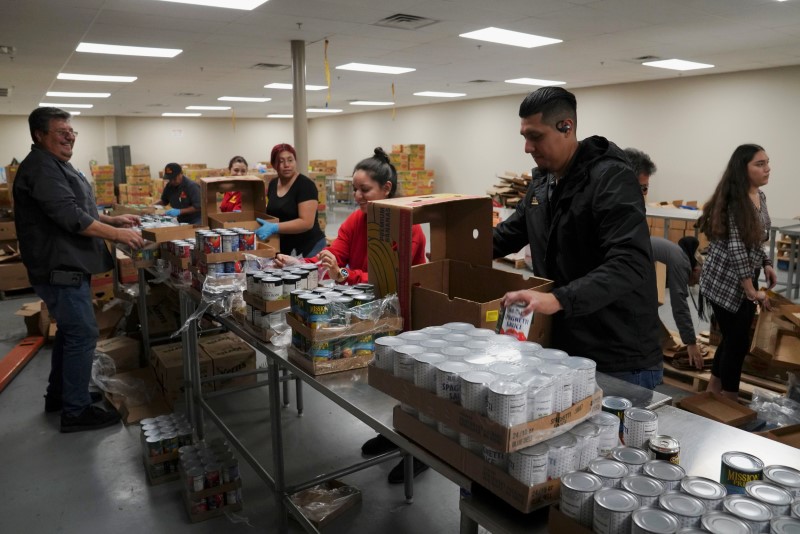
Other families are already in the food line. One day last week, more than 800 people showed up at the South Texas Regional Food Bank for boxes of pasta, rice and other supplies. On a typical day before the pandemic, just 25 or 30 people might have stopped by the organization’s warehouse to get food to sustain their families through a rough patch.

Now, instead of coming inside to ask for help, they sat at laptop computers under an awning outside, no more than 10 at a time, using video chat to talk with workers who didn’t want to run the risk of becoming infected.

“You have to feel for these people,” said Alma Boubel, the food bank’s director.

The severity of the U.S. economic crisis will soon become more clear with releases of new data. Federal Reserve Bank of St. Louis President James Bullard recently predicted the U.S. unemployment rate may hit 30% in the second quarter – higher than during the Great Depression of the 1930s. Goldman Sachs analysts estimated that more than 2 million people applied for unemployment benefits last week alone, more than triple the previous record.

The unemployment rate in Webb County, estimated at 4.1% in January, was above the national average before the virus hit. Many of the region’s jobs are tied to the transportation industry that moves goods back and forth across the border with Mexico – traffic that U.S. President Donald Trump and the Mexican government have sharply curtailed in an effort to contain the disease.

Officials in Laredo and Webb County did not respond to questions about how they planned to handle the public health or economic shocks.

The realities of lower-wage work also often mean that people can’t shift their livelihoods to a home office, as professionals in higher-end jobs often can. That dynamic also complicates government efforts to stop the spread of disease through social isolation.

“Social distancing is hard, and of course many low-income people work at jobs that are physical, in-person, manual, and you have to show up,” said Sara Rosenbaum, a professor at George Washington University’s Milken Institute School of Public Health.

Studies after an outbreak of the H1N1 flu virus in the United States a decade ago found that minorities and lower-income families had a harder time separating themselves from other people in the way health authorities recommend. “They were less likely to be able to avoid public transportation, lived in larger households,” and had jobs that couldn’t be done remotely, Quinn said.

Ricarda Rios, 65, worked as a substitute teacher in Laredo before the schools closed. The system’s employees are still on the payroll, but not the subs. He said he is already “completely out of resources.”

That’s made it harder to steer clear of other people, especially when stores run short of basic supplies. “I have to go to different places until I get lucky and buy a dozen of eggs or a gallon of milk,” he said.

Carmen Garcia, the executive director of the Laredo Regional Food Bank, said she grasped the enormity of the crisis when she exhausted the supplies she bought for all of March just ten days into the month. Many of the people who come to her for help live in large families and work low-wage jobs that are now threatened. Many regularly seek cheaper medical care on the opposite side of the border with Mexico, which has been closed to non-essential travel.

“There’s a lot of worry now,” Garcia said. “Our clients, what they’re saying is they don’t know where else they can get assistance. They’re willing to risk their health. They can’t work right now, so they don’t have a paycheck. They need whatever food they can get.”

(Reporting by Brad Heath and Veronica G. Cardenas; Additional reporting by Ned Parker; Editing by Brian Thevenot)